Affiliate Marketing — A Simple Step by Step Guide Everything you need to know about affiliate marketing, including how to get started, different methods, and things to watch out for are […]
The post Affiliate Marketing – A Simple Step by Step Guide appeared first on Smart Passive Income.
]]>
Affiliate Marketing — A Simple Step by Step Guide
Everything you need to know about affiliate marketing, including how to get started, different methods, and things to watch out for are all below. Let's get started!
Affiliate marketing is the easiest way to generate an income online. You don't need to create your own products (which takes a ton of time), and you don't even need to really sell anything.
All you need to know how to do is to recommend something, and if you've ever recommended anything to anyone before, then you already know how to do this.
I’ve been affiliate marketing since 2009 on my very first website, GreenExamAcademy.com. On this architecture-education website I promoted an exam software that has generated more than $200,000 in commissions over the years.
And that's just one product out of dozens of products I've recommended across multiple businesses. All together, I've generated over 3 million dollars since 2009. That's not total sales, that's total commission that I got to keep.
I know, this sounds kind of wild, and almost too good to be true. You're not going to make millions of dollars overnight – this stuff takes time to learn what works, and what doesn't. But, I'm here to help you speed up the process and finally get the momentum going your way.
In this guide, I'll teach you how to get started and find the right products for your audience, even if you're just starting out.
Instead of worrying about upsetting and annoying your audience with your promotions, I'll show you how to gracefully promote products in a way that people will thank you for the time and effort you put in to help them make a buying decision.
I'll also teach you about the amazing opportunities you can have related to the companies you help promote, and the special kinds of deals and offers you can get for yourself, and your audience, through those relationships.
It’s the guide I wish I’d had when I started my affiliate marketing journey way back in 2009.
Excited? Here’s what’s in store:
Contents
- What is affiliate marketing?
- How does affiliate marketing work?
- Benefits of affiliate marketing (and drawbacks)
- How much do affiliate marketers make?
- What affiliate marketing strategies do marketers use to promote their partners?
- How to start affiliate marketing for beginners
- Affiliate marketing examples
- Affiliate marketing case study: SPI + Kit
- 8 best affiliate programs and networks
- Affiliate marketing tips for beginners (and experts)
- Affiliate marketing mistakes to avoid
- My best resource for beginner affiliate marketers: The Affiliate Marketing Cheat Sheet

Get Unstuck in just 5 minutes, for free
Our weekly Unstuck newsletter helps online entrepreneurs break through mental blocks, blind spots, and skill gaps. It’s the best 5-minute read you’ll find in your inbox.
Free newsletter. Unsubscribe anytime.

Join 100k+
Subscribers
What is affiliate marketing in simple terms?
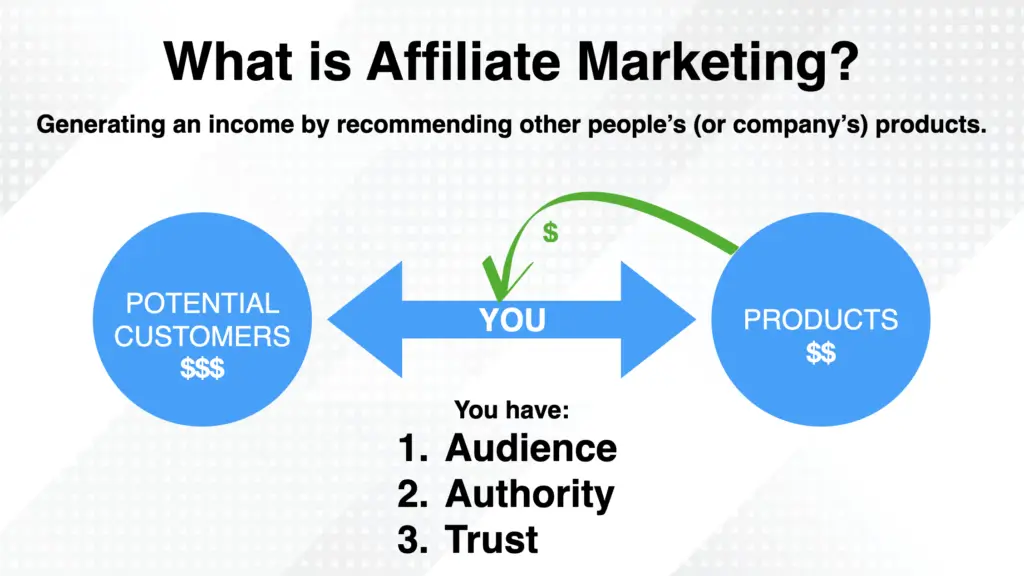
Affiliate marketing is the process of earning a commission by promoting another person’s (or company’s) product. You find a product you like, promote it to your audience, and earn a piece of the profit for each sale that you make.
It’s similar to a salesperson earning a commission, except you don’t work for the company. Instead, it’s like earning a reward for sending a new customer to the company.
In other words, when you help another company generate sales, you get a cut!
The best part is that you don’t have to spend the time and money to create your own products, because someone else has already done the hard work.
You can begin making money as an affiliate as soon as you have a place to recommend products, whether that's a website you have, a podcast you've started, or even on social media.
So, all you have to do is send traffic through a link to that product, and everything after that is out of your hands . . . right?
Wrong.
There's so much more involved to make this work well, which is why most people who attempt affiliate marketing fail, or just see a few dollars coming in from their efforts.
I want you to see amazing, life-changing results from affiliate marketing, which is why I'm thankful you're here.
There are two ways to be involved in affiliate marketing—either as a product owner/affiliate marketing program creator or an affiliate marketer.
In this post, we’re going to focus on how to do online affiliate marketing from the affiliate marketer side.
Affiliate marketing is quite simply one of the most powerful ways to generate an income online. Regardless of your niche, the upside with affiliate marketing is nearly limitless if you go about it the right way!
Part of the beauty of affiliate marketing, especially for beginners, is you don’t have to invest time in creating the products that will be serving your audience—because, guess what?
Those products likely already exist.
Because of that, affiliate marketing is an opportunity anyone can take advantage of, and it’s easy to get started.
Affiliate marketing examples are all around us—and you’ve probably been involved in affiliate marketing without realizing it!
If you’ve ever clicked on a link in a blog post to a product or service being offered on another website, there’s a good chance the owner of the website where you originally clicked the link received a commission from your purchase.
Yes, affiliate marketing is everywhere—but here’s the thing: few people understand how to take full advantage of it.
In fact, I believe affiliate marketing is the world’s most untapped source for generating passive income!
It’s a beautiful process that’s completely underutilized, and I’m excited to share with you exactly how it all works.
Who is a good fit for affiliate marketing?
Affiliate marketing can be a great choice for online entrepreneurs, bloggers, and really anyone who has a website and is willing to build an audience they can serve authentically.
If this describes you, products exist right now that people in your target market are probably already buying, and if you can become the resource that recommends those products, you can generate a commission as a result.
Affiliate marketing can be an especially good option if you’re not ready to create your own product or service, but you want to serve your audience by recommending products that may be helpful to them.
Online affiliate marketing can also be a good fit for a wide range of people because you can apply a bunch of different marketing methods to promote affiliate products and services.
These include the same marketing methods you may already be using—things like search engine optimization (SEO), paid search engine marketing (SEM), email marketing, content marketing, and display ads.
You can even take advantage of other nifty ways to market products, like product reviews and unboxings.
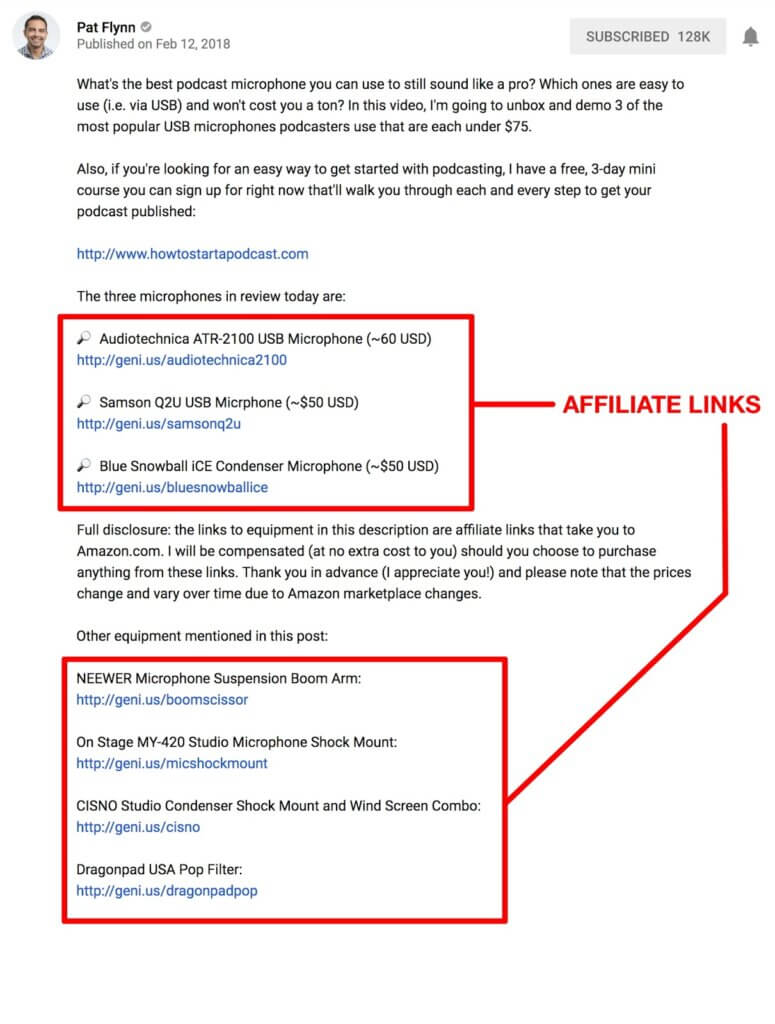
Take for instance this YouTube video I did, where I review and demonstrate three USB podcasting microphones and include Amazon affiliate program links to purchase each one in the description.
Finally, it’s important to remember that affiliate marketing works best when you’re sincere and confident about the product you’re promoting.
You’d only sell your own product if you knew it could help people, and it’s the same with affiliate marketing. If you go in with a get-rich-quick mentality, you’re not going to be impressed with your results.
How does affiliate marketing work?
Let’s get into the details of how affiliate marketing works. There are three main players in an affiliate marketing arrangement:
- You and your website—the “affiliate.”
- The affiliate company (or network). In the simplest affiliate arrangements, you work directly with a single company to promote one or more of their products. There are more complex affiliate networks that provide an opportunity to earn affiliate revenue on a range of products, such as Amazon, Impact, and ShareASale.
- The customer. This is a member of your audience who uses your affiliate link to purchase a product from the affiliate company or network.
A company that offers an affiliate marketing program may call it by a different name—these programs are also commonly called partner programs or referral programs.
Here’s how each party benefits from affiliate marketing:
- From your recommendation, your audience learns about a product, course, or tool that may be useful to them;
- From your recommendation, the company selling the product, course, or tool gets new customers they may not have found otherwise;
- As a result of the sales to your audience, the company gives you a commission.
When done the right way, affiliate marketing can be a win–win–win.
But at the center of this is one thing: your audience’s trust.
When your audience believes you have their best interests at heart and trusts your recommendations, then all three parties in the affiliate marketing relationship ultimately benefit.
A lot of people worry about getting involved with affiliate marketing because it might make them look slimy or too salesy.
That’s why I’ve made it part of my mission to teach people how to do affiliate marketing in a way that makes it a win for everyone.
The biggest element to success with affiliate marketing?
Trust.
Earn trust from your audience first, and only recommend affiliate products that you’ve used yourself and know your audience will benefit from.
And you know what?
A lot of people do it the wrong way by taking an income-first rather than a serve-first approach.
These folks push random products and over-promote them without providing true value to their audience.
This has given affiliate marketing a really bad rap in some quarters, causing many ethically minded entrepreneurs to be wary of affiliate marketing.
But thankfully, you CAN do it right, maintaining your audience’s trust and having them thank you for your recommendations.
Benefits of affiliate marketing (and drawbacks)
As with anything, affiliate marketing has its upsides and its downsides.
Later in this guide, I’ll give you the guidance you need to go about affiliate marketing smartly so you can make the most of the opportunities out there and avoid the potential downsides.
Here are the main pros and cons of affiliate marketing.
Affiliate marketing pros
- Low barrier to entry. Affiliate marketing is easy to get started with, and costs little. Most affiliate programs are free to join, and you don’t have to create, stock, or ship products, which also means less hassle/responsibility.
- Low risk. You’re not the product owner, so you don’t lose anything if a customer doesn’t buy.
- Passive income potential. Affiliate marketing provides the potential for passive income.
- More freedom. When you start earning passive income, you can work anytime and from anywhere, as long as you have internet access.
Affiliate marketing cons
- Not a quick fix. It can take time to generate the amount of traffic needed to result in substantial income.
- Less control. You don’t own or control the product/service you’re recommending, so you can’t control the quality or customer experience.
- Competition and audience fatigue. An attractive affiliate program means you might be competing with others for customers.
- Offer fatigue. Audiences can also get “offer fatigue” if they see too much ongoing promotion from you.
- Not all affiliate programs are created equal. While most companies that offer affiliate commissions are stable and ethical, there are shady companies out there too, some of which may not pay what they say they will. It’s important to do your homework.
- Risk of link hijacking. Unscrupulous individuals may hijack your affiliate links, known as “clickjacking,” potentially stealing your commission in the process.
How much do affiliate marketers make?
The beauty of affiliate marketing is that you don't have to invest the time and effort to create a product to sell.
You can begin selling something as an affiliate as soon as you have a platform to sell it on. In this way, affiliate marketing can be a great way to earn some extra income without a lot of hassle or upfront cost.
That said, it’s not a way to get rich quick.
Like all passive income ideas, it takes time and effort to create a decent revenue stream.
Although affiliate marketing has been my number one source of income for a while, it took me a while to get to where I am, including building close relationships with the companies I’m an affiliate for.
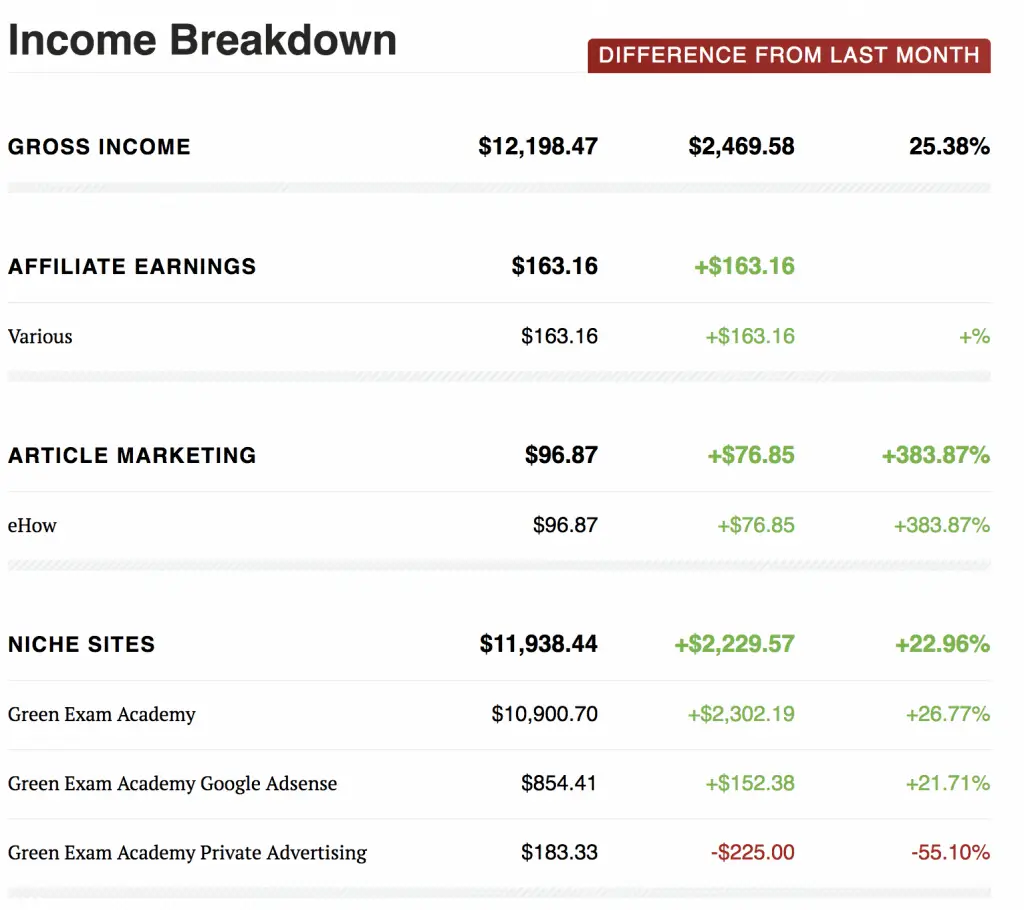
In my very first month doing affiliate marketing (December 2008), I earned a whopping $163.16:
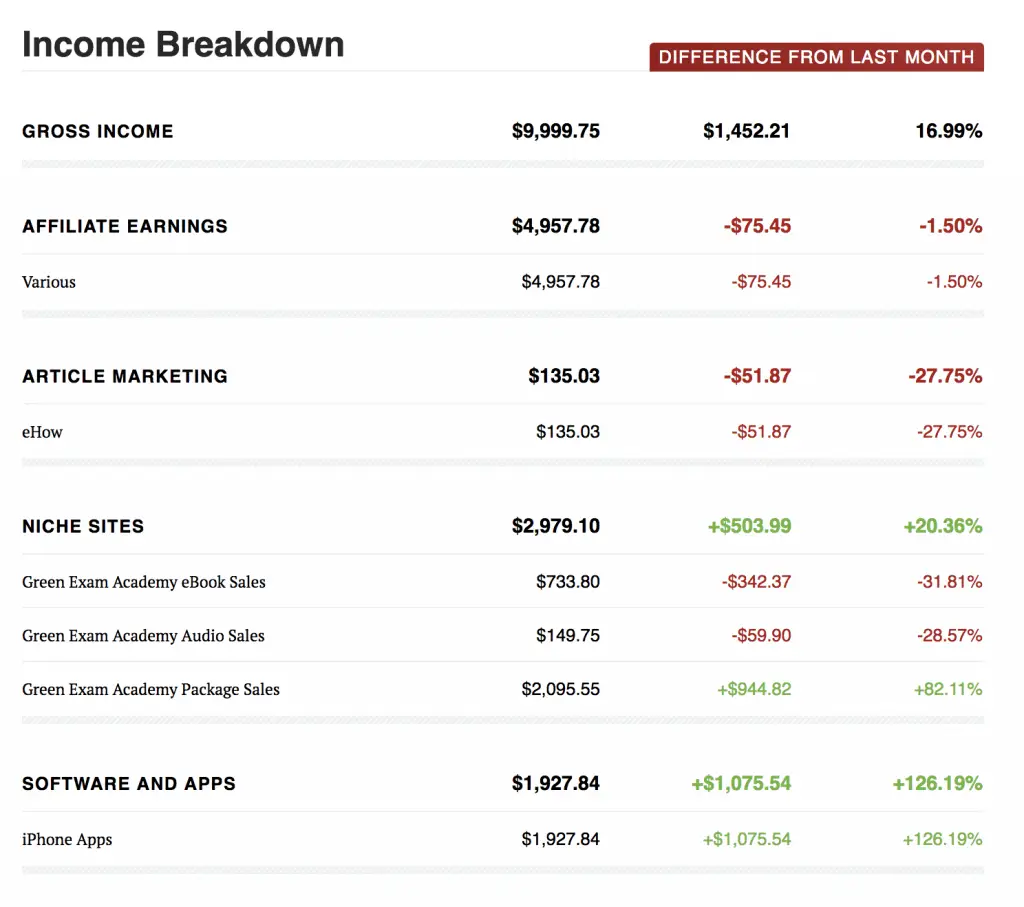
Here’s how I did in December 2009, the month that marked my first full year as an affiliate marketer:
And here’s what my affiliate income looked like in December 2017, the last month I published an income report:
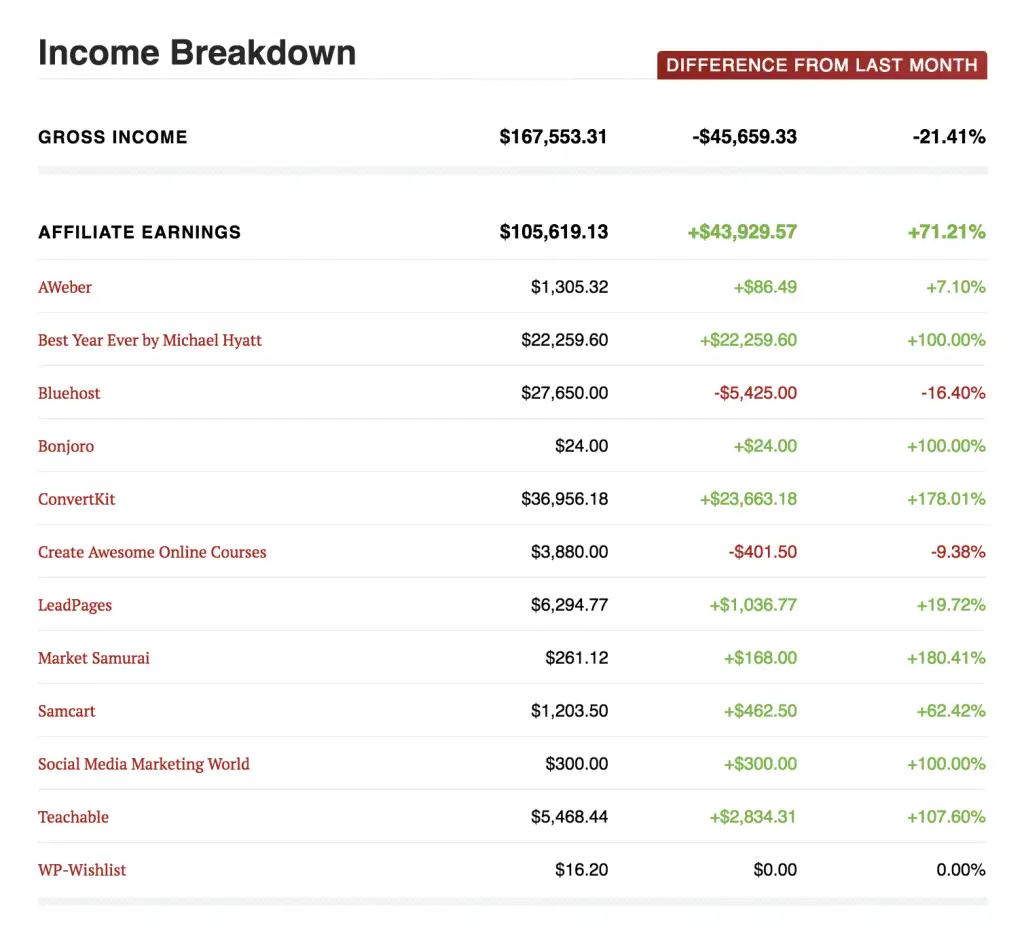
As you can see, I’ve done really well with affiliate marketing in the past 10 years—but it’s taken a lot of time and hard work to get to that point.
So, how much can you make once you’re up and running with affiliate marketing?
That depends primarily on how committed you are to making it work and how much time, energy, and focus you’re willing to put into it. It also hinges on a few other factors:
- The commission percentage you receive for each sale of an affiliate product or service.
- The size of your audience.
- How successful you are at promoting those products or services to your audience.
- Typical commission percentages vary depending on the affiliate company you partner with, and the types of products or services you’re promoting.
Digital products and services typically offer higher margins due to their lower costs of production and fulfillment—there are no raw materials, manufacturing, shelf space, shipping costs, etc.
These margins can be as high as 50 percent.
On the other hand, because of all the aforementioned costs, physical products tend to offer lower percentage margins, sometimes in the single digits.
Thankfully, there is no real limit on how much you can make as an affiliate marketer.
Affiliate marketing can be a great way to augment your existing income, or even become your main source of income if you’re willing to make the commitment.
But in either case, if you’re looking for long-term success with affiliate marketing, you have to be willing to do it the right way.
What affiliate marketing strategies do marketers use to promote their partners?
There are a ton of tactics you can use to promote your affiliate partner’s products online.
Here’s a starter list of 10 to get your affiliate marketer brain something to chew on and remix:
1. Create an epic post
One thing I like to do when promoting a product is create an Epic Post about it.
What’s an epic post?
Think of it as a potential one-stop-shop resource for this particular product—not just a review of it, but a full-fledged introduction, how-to, FAQ, best practices, and troubleshooting resource for anyone who purchases the product.
If you can show this much information to people before they make a purchase, they’ll be more likely to actually make a purchase.
At the same time, the epic post becomes an extremely shareable article, one with the potential to rank high for the particular product keyword in Google.
In this epic post, I’d go all out and . . .
2. Create multiple YouTube videos about the product
These videos should be embedded in the epic post.
This is an important affiliate marketing strategy because YouTube is the #2 search engine in the world. You can get a lot of traffic coming in through your affiliate link on YouTube, and the videos themselves can rank in Google too.
Plus, by shooting multiple videos about a particular product, you create even more SEO opportunities.
Make sure to include your affiliate link in the video description, ideally in the first part of the description, so people don’t have to click on “show more” or “read more” to see it.
What should you cover in these videos?
I recommend recording yourself from start to finish with it, then break it up into chunks. People like to watch shorter videos, so this works in your favor, and you get multiple opportunities to rank for various keywords related to that product.
If it’s a digital product, start at the moment of purchase and walk people through the entire process. And if you’re doing a physical product, consider an unboxing video.
3. Host a webinar
One way to take your affiliate product promotion to the next level is to host a webinar for it.
Webinars are an extremely powerful way to share a message with your audience. They’re personable, they’re live, and you can treat them like an actual event. That way, your promotion becomes a much bigger deal than just a regular affiliate link you dropped into a post.
Combine this with tip #15 in my list below, and have the owner of the product share high-value information, and even answer people’s questions directly on the webinar, and you’ve got yourself a winner.
4. Publish a webinar replay
Be sure to record your live webinar so that you can embed it on your website as a replay for those who didn’t watch it live, as well as those who did watch it live but want to review the information.
To be honest, more people will probably watch it as a replay than live, and that’s a good thing—you just have to give them the opportunity to do so.
I recommend recording using screen capture software like Camtasia Studio or Screenflow.
Here’s an example of a blog post on my site containing a webinar replay—one I recorded with Clay Collins of Leadpages, a company for which I’m an affiliate:
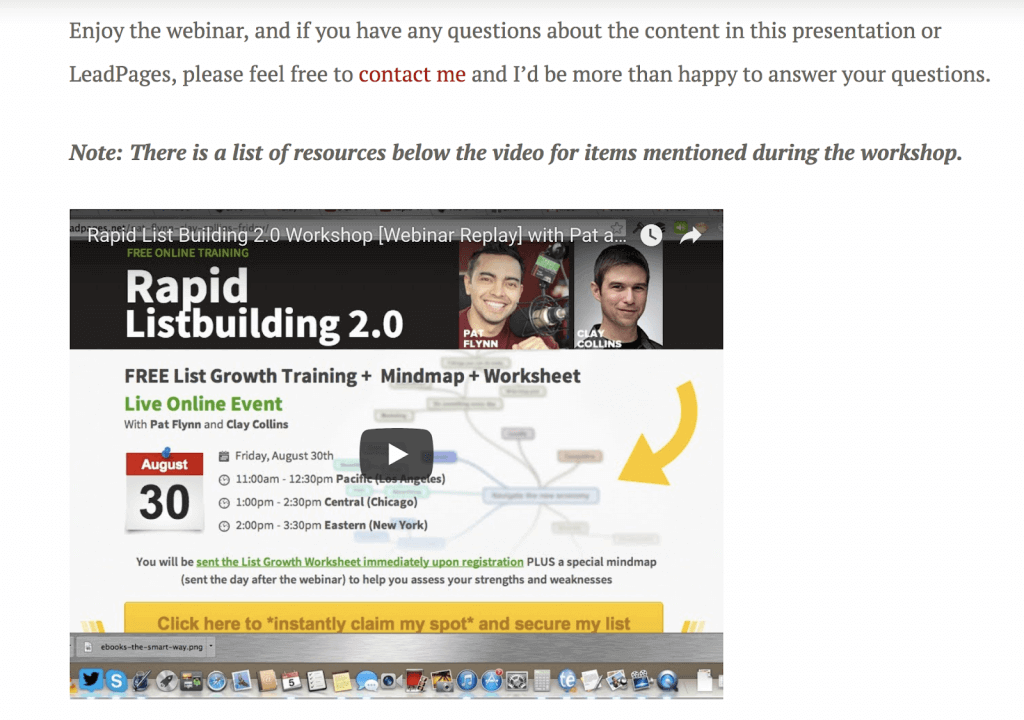
Finally, make sure that in the webinar and on the post where you embed the replay, you give people multiple opportunities to click on your affiliate link.
5. Give away a bonus
This is probably one of the more underutilized tips I have to share today—but probably one of the most powerful too.
In addition to promoting the affiliate product, give away a bonus to all of those who purchase the product through your link as a thank you.
Chances are, you’re not the only one promoting that product, so to get people to buy from you instead of the other guy, throw in a bonus that can only come with a purchase through your link.
Just have your audience members send you their receipt via email and then you can reply with the bonus, or information about how to access it.
So what could that bonus be?
Maybe it’s a special webinar that shows people how to use the product with a Q&A session at the end of it. Imagine being able to purchase a product, getting familiar with it, and then a couple of days later having access to a webinar that shows you exactly how to use the product, with an opportunity to ask questions about it. How awesome would that be?
Maybe the bonus is another product or piece of software that you have that complements the affiliate product.
Maybe it’s a discount you work out with the owner of the product, one that provides incentive to purchase from you.
Maybe it’s a coupon code or discount to another product you own or have ties to.
Maybe it’s a PDF quick-start guide with instructions and best practices for that product, or access to a website with videos with the same guidance.
You’re adding value to the purchase, making your buyers feel comfortable, and helping get those on the fence from “I’m not sure if this is right for me” to “This is exactly what I need, and more.”
6. Promote your products indirectly on social media
Although your website is the centerpiece of your affiliate marketing strategy, social media—Facebook, X, LinkedIn, Instagram, etc.—can play an important role in your affiliate marketing strategy too.
The thing about social media—at least in my experience and in the experience of many other people I know—is that if you directly promote on your social media platforms, you’re not going to get a good response.
People on social media are typically there to be social, not to be sold to.
But all is not lost in the affiliate marketing world, because you can do an indirect social media push, which means instead of directly linking to your affiliate links on Facebook or X or any other platform, you’re instead linking to something of value that includes the affiliate link, such as a video, an epic post on your blog, or a link to sign up for a webinar.
You’re not linking directly through your affiliate link, but a resource that will engage people beforehand, earn their trust, and show them what the product is about before clicking on your affiliate link.
Yes, one of the cardinal rules of online marketing has long been that the fewer gateways or clicks people have to go through before they get to the “buy” button, the better.
But I think that’s been changing, and now it’s closer to the less information you give away, the less you’re likely to make a sale.
The more trust you can earn beforehand, the greater the likelihood people will buy from you.
You don’t want someone to have to click 100 times before they get to where you want them to go, but a few clicks is okay, as long as you give them enough information beforehand to help them make their decision.
7. Run a giveaway to take advantage of “social proof”
Social proof is the idea that people will naturally gravitate toward what the masses are doing. As an example, say you’re at the mall, and you see a huge crowd gathering around one store.
You can’t help but want to know what’s going on—everyone else is there for some reason, and you want to know what that reason is.
Online, this translates to having other people do the marketing for you, except in this case it’s through metrics like numbers of subscribers, likes, comments, and things like that.
Here’s how this strategy can play out in the real world.
When you plan to promote a product as an affiliate, try to work with the owner to get a few copies to give away to your audience for free.
Maybe you can get a discounted price for a limited time only for your audience as well. This may not always be possible, but it never hurts to ask.
In a blog post, review this product—maybe it’s your epic post, or maybe you just mention it at the end of one of your regular posts.
Share that you have two or three copies of the product to give away for free, and that in order to be entered to win one of the copies, your audience members have to leave one comment about how they would use the product and why it would help them.
Have them go through an affiliate link of yours to see what the product is all about first, and then come back to your blog to leave their entry as a comment.
What happens here is that you get tons of people leaving comments that become social proof for the greatness of the product.
There’s nothing more powerful than someone else’s recommendation, and in this case, it’s other people’s recommendation for a product you’re promoting as an affiliate.
Plus, you can follow up with the people who leave a comment on the post but don’t win, to share a limited-time deal or an email saying thanks for the entry and giving them your affiliate link one more time.
I’ve used this strategy to great success promoting several products in the past, so I suggest you give it a shot.
8. Promote products indirectly via your email list
Your email list is an integral part of any affiliate marketing campaign—and if you don’t have one, you need to get started building one yesterday! Email is extremely powerful for marketing, which is why so many people say, “The money’s in the list.”
As with social media, I recommend indirectly promoting to your email list. I don’t directly promote anything on my email list. If there are any links in my emails they point back to other content, usually on my blog, such as epic posts, videos, webinars, and the like.
Email should be all about giving people as much high-value content as possible, not direct selling. In fact, certain affiliate programs such as Amazon’s don’t even allow you to include affiliate links in emails. For more on Amazon, check out my Amazon affiliate marketing guide here.
You need to take great care of your email list and not be too aggressive with it. Indirect promotion is a much better way to go about things, especially if you’re focused on building trust with your audience (and you should be!).
9. Promote products indirectly on other people’s sites
This is another instance in which indirect linking is your friend.
If you’re interviewed for another person’s blog, or asked to write a guest post, you can link back to a piece of content on your site that contains your affiliate link.
As with social media and email, you don’t want to hit people over the head with your links—and most of the time, if you try to link directly to an affiliate product through someone else’s site, they won’t allow it anyway.
10. Review and compare different products of the same type
Another strategy is to compare different products of the same type. Compare and contrast, and if you give them your recommendation, make sure that link is an affiliate link.
The reason this works is because people like to shop around, but they also like convenience. So instead of making them carry out their search all over the web, keep them on your site by reviewing each of the different products in one spot.
If you’ve done a good job building up audience trust, then a well-written comparison review of different products of the same type can be a great way to drive affiliate purchases.
This could potentially become an epic post as well, complete with videos and special deals just for your audience.
How to start: Affiliate marketing for beginners
Many how to start affiliate marketing posts suggest a series of steps similar to this:
- Find a company and product you want to promote.
- Sign up as an affiliate.
- Get your unique affiliate link and add it to your site.
- A visitor to your website clicks the link, which takes them to a third-party page.
- If the visitor makes a purchase, you receive a commission based on the value of the item purchased.
Now, these steps are definitely accurate—you can’t earn money with affiliate marketing without first finding a product to promote!
But more importantly, you shouldn’t be affiliate marketing without first establishing trust with your audience. Audience first, always.
That’s why my methodology for successful online affiliate marketing goes like this:
- First, build a relationship with your audience.
- Then, identify a product that might fit your audience’s needs.
- Next, use and test the product yourself, to ensure it’s truly something worth recommending to your audience, so you don’t risk taking advantage of their trust.
- Show your audience tangible proof that the product does what it promises via a blog post or case study on your website or YouTube channel.
- Then—and only then!—you can start to promote the product to your audience and hopefully start earning some affiliate revenue when they purchase it.
This approach puts your audience’s needs front and center, setting you up for success with affiliate marketing.
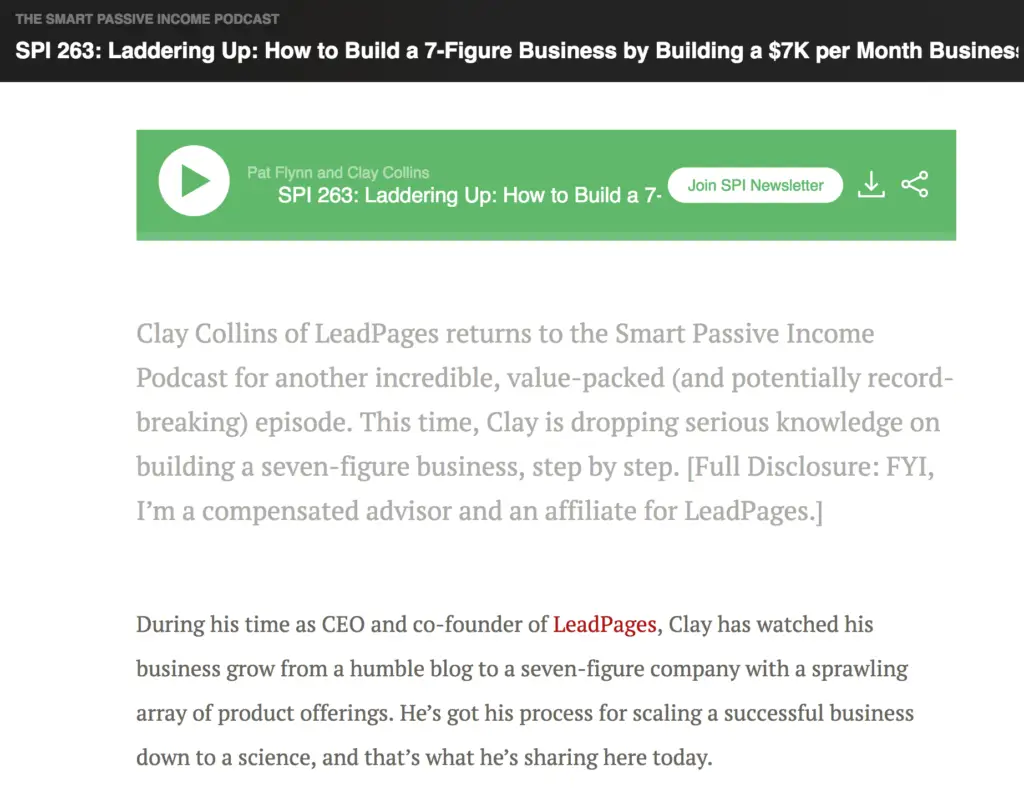
This YouTube video featured a panel discussion between me and several online course creators, hosted by Teachable, an online course creation platform for which I’m an affiliate.
Although I shared my Teachable affiliate link in the show notes, the primary purpose of the video was to deliver value to my audience, not promote the link.
Put your audience first (build trust)
Affiliate marketing helps me generate over $60,000 in affiliate commissions each month. My affiliate income has grown because I follow two major rules:
- I only recommend products that I’m very familiar with. Preferably, these are products I’ve used before and that have helped me achieve something. If I’m not confident in the product and I don’t feel it will help people, I will not promote it.
- I never directly tell anyone to buy a product. I always recommend products based on my experience and in the context of what I’ve done or what I’m doing with it.
What does following these two rules achieve?
Trust.
By doing these two things, my audience knows that I only want them to buy the tools that they need, at the time they need them. They know that I’ve used and believe in the products I recommend.
And they know there’s no pressure, because I’m only looking out for their best interests.
Many affiliate marketers choose not to follow these rules—and I think that’s why affiliate marketing has a bad reputation. We can do better, and so I hope you’ll join me in following these rules.
Every affiliate marketer needs to understand the importance of establishing and maintaining trust with their audience before they get started with affiliate marketing.
Thankfully, my system for getting started has trust baked into the entire process. Let’s dive into it now!
The Soft Pitch Pipeline
My approach to affiliate marketing is built around something I call the soft pitch pipeline.
This approach is designed to do two main things: build trust, and reduce the amount of “hard selling” needed to promote your affiliate products (hence the “soft pitch” part).
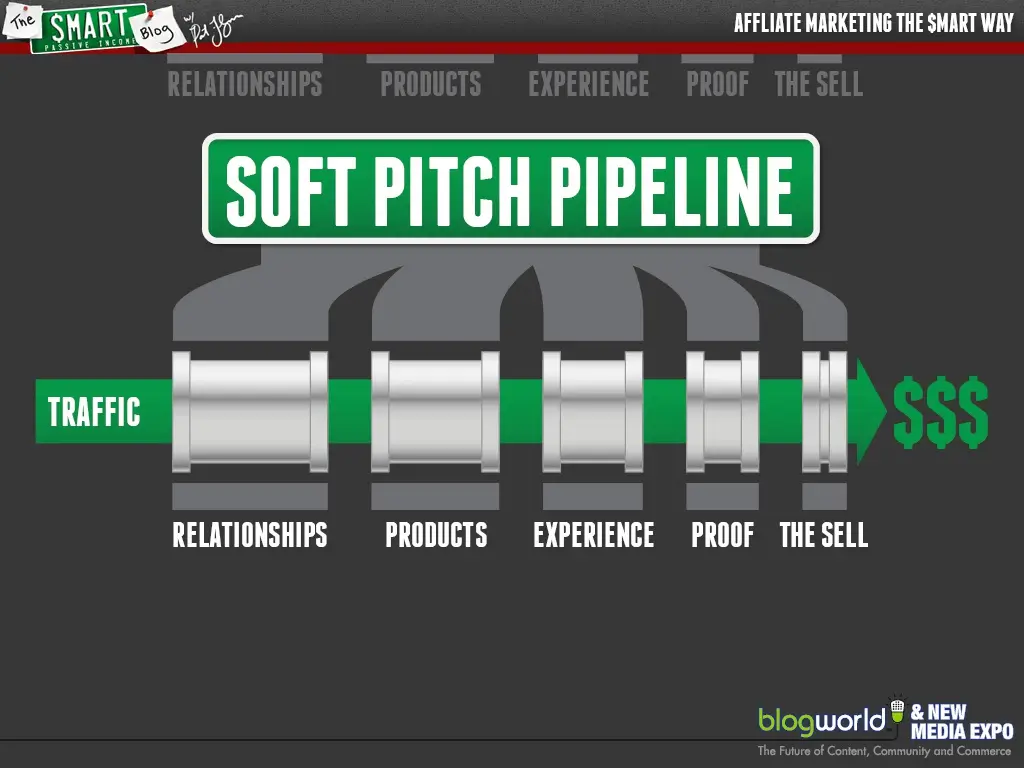
Imagine a series of pipes. These pipes represent the experience or “flow” people go through when they visit your site or are introduced to you and your brand.
On one end is traffic entering the pipeline, and on the other “exit” end of the pipeline is the sale or conversion.
Between these two points, there are five segments that combine to make up the total experience of your brand:
- The Relationships you cultivate with your audience
- The Products you decide to promote
- The Experience you have with those products
- The Proof you share that those products work
- The Pitch or “sell” of those products to your audience
These segments can vary in strength and size.
For example, if you have an amazing relationship with someone, it doesn’t take much to convince that person to do something for you.
In this case, the relationship segment is extremely long, so the pitch segment doesn’t have to be long at all.
For example, say your wife is pregnant. It’s two in the morning and she wants you to go to the store and buy a Little Debbie’s Fudge Brownie. Well, you’re probably off to the store to buy a Little Debbie’s Fudge Brownie—there’s not much pitch or convincing needed at all.
Now take the other extreme: a company you’ve never heard of before.
Since you hardly have any relationship with this company, they’re going to have to work a lot harder to pitch you—to convince you to try them out.
And many companies pitch really aggressively, which can backfire and make people uncomfortable or even annoyed.
That’s exactly what we try to avoid with the soft pitch pipeline.
By focusing on the first four segments of the pipeline—the relationships you cultivate with your audience, the products you promote, the experience you have with those products, and the proof you can share with your audience that the products work—you can make the pitch phase shorter and less aggressive.
If you set up the first four segments of the pipeline the right way, hardly any pitch will be needed to get your audience to click through your affiliate links and make a purchase.
Let’s go over each of those segments now!
Segment 1: Relationships
Relationships are everything.
Having a relationship with your audience is the foundation of trust. It also allows you to get to know your audience in depth, so you can understand their needs and pain points.
That way, you can identify potential products that can help meet those needs and pain points.
Not too long ago, a lot of people were trying to do affiliate marketing by finding a product that offered an attractive commission, then building a site around it and selling it by driving traffic using Facebook ads and Google Adwords.
That tactic used to work, but Google and Facebook have caught on and started clamping down on those ads, making it much harder to pull off.
But more importantly, on a strategic level, it’s just not the right way to do things if you’re interested in building a lasting business. Instead, you need to take a longer-term approach, one centered around relationship building.
What does that look like?
First, you need to identify a target audience that has a specific pain, issue, problem, or goal.
By homing in on that target market and understanding exactly what they’re going through, you can discover ways to help them achieve their goals and overcome their problems.
The key is to not go into it with the aim of finding an affiliate product, but to get to know your audience and find solutions they can use.
Start with the pain, not the product.
How do you learn what your audience needs?
You need to become friends with the people who visit your site and interact with you on social media. Without that relationship, it’s much less likely that meaningful transactions will ever occur.
By meaningful transactions, I’m not just talking sales transactions—I’m talking about email list subscriptions, comments, clicks, likes, follows, shares, and retweets.
The hard part is, a relationship takes time to build.
Thankfully, there are ways to speed up the process of building a relationship with your audience without compromising the quality of that relationship.
So how can you connect with your audience more quickly? Here are three ways:
1. Be Personable
What would make YOU buy something from someone you didn’t know, especially if they were selling a product they didn’t even make themselves?
In a lot of my content, be it blog posts, podcast episodes, and even in-person presentations at large conferences, I try to share aspects of my personality and my personal life.
As a result, most of my audience knows a lot about me—that I’m a family man, that I love Back to the Future, that I’m still working toward my goal to touch a regulation-height basketball rim…
The point is, they know me as a real person, someone just like them.
They can relate to me. And as a result, they’re much more connected to me than if I were to spend all my time telling them about the strategies and tactics that will help them build a successful online business.
What do my kids or my favorite movies have to do with affiliate marketing? Nothing, at least directly.
But what do those things have to do with my brand? Everything, because building a brand is the equivalent of building relationships.
People connect with people, and the more you can become a person in the eyes of your audience, the easier it is for them to connect with you—it’s as simple as that.

2. Tell Stories
People are programmed to love stories.
Think about the last time you were engrossed by someone’s tale around the dinner table, or just watched a movie or read a book.
When you tell a story, it’s easy for your audience to put themselves into that story; stories put things in context and make them relatable. Stories are an easy and personable way to relate to your audience.
Now, you don’t have to dedicate entire posts to stories about random things to create a meaningful connection.
Instead, be creative and share little anecdotes and examples here and there to illustrate concepts, honest stories that relate to the message you’re trying to get across.
Doing this helps you convey information and build those important relationships with your audience at the same time.
3. Practice ROAK
RAOK is short for “random acts of kindness,” and it’s one of my all-time favorite things to do.
Why?
Because when you do something unexpected and generous for someone, it leaves an amazing impression.
It can be as simple as replying to comments on your blog and social media. I do this, and it helps people see I’m a real person.
If someone has a question, I answer it. It saves them time, and helps them remember who I am.
Sometimes I even take it a step further and leave comments on the blogs of people who’ve left comments on my posts.
It’s small things like these that can help you quickly form a deeper relationship with your audience.
And you can do the same thing!
So ask yourself, what kinds of RAOK can I do for my audience? What unexpected favors can I perform that will help me build a positive, lasting relationship with them?
Segment 2: Products
Once you’ve started to build your audience and develop a relationship with them, you’ll start to learn what that audience needs.
The next step is to identify products you can recommend to meet your audience’s needs and help them in their journey.
First, keep in mind that sometimes the products will be ones that allow you to generate an affiliate income—and sometimes they won’t.
You never want to start with a product or commission in mind. You want to start with the problem, then find solutions for it.
And if the best solution for a particular problem is not an affiliate product, well, that’s what you should promote to your audience. Remember, trust and relationships come first, always.
With that in mind, once you’ve gotten to know your audience and its needs and pain points, how do you select a specific product?
To help you get in the right frame of mind here, think about a brand new visitor who comes to your site for the first time—what is it you want that person to ultimately achieve?
This might be a tough question to answer, but you need to know what you want your visitors to do, because if you don’t, then everything you recommend is going to seem random.
You need your recommendations to be precise and targeted, so your audience can get what they need from you to reach their goals.
Once you’ve identified what you want to help your new visitor to achieve, think about how they’re going to get there.
What’s their roadmap or path to success? Defining the steps on this path will help you determine exactly what kinds of products will help your audience at different points along the path.
Next, you need to think about the products that will help your audience along this path.
One of the best places to start identifying these products is through ones you’ve used yourself. Whatever niche you’re in, spend a little time making a list of the tools and services you use.
Those things that you used to help you achieve your goals can help your audience achieve their goals too. Just about any product or service can work, including:
- Courses
- Books
- Physical products
- Software
- Coaching services
Often, you’ll need to look beyond the products and services you already know and use to find things that will be a good fit for your audience—which means doing some research!
Thankfully, there are plenty of great places and resources to find new affiliate products, including:
- Word of mouth—your professional network, including masterminds, Facebook groups, etc.
- Amazon, to find books and products
Remember: don’t start with the products; start with your audience’s goals and pain points. Then find the products to help them get where they want to be.
It’s also important to realize that by not promoting products and services that will help your audience along their “success path,” you’ll actually be holding them back.
Remember, your knowledge and your relationship with your audience can help them filter through all the noise and find the right solutions, because you’ve put in the work to understand what’s best for them.
Finally, it should go without saying, but if a product doesn’t make sense to promote—if it’s not a part of the audience’s success path—then you shouldn’t promote it, no matter how generous the affiliate commissions may be.
Segment 3: Experience
Okay. You’ve found a product that will help your audience achieve their goals. Now what? Do you immediately start promoting it to them with your affiliate link?
Not yet. The next important element in decreasing how much you need to pitch is the experience YOU have with those products.
I have two words for you: Experience sells.
On Amazon, we read other people’s reviews—people we’ve never met!—to help us make a purchase decision.
That’s powerful stuff, so imagine how much more powerful your real-life experience with a particular product can be, combined with the relationship you have with someone in your audience already.
So, before you start promoting your product to your audience, you need to get to know it yourself, inside and out.
Affiliate marketing works best when you treat the products you’re promoting as your own. You need to know firsthand the experience your audience will have using this product.
Obviously, if you learn that the product is a dud, it’s not going to make sense to promote it to your audience!
And if it’s great, then you’ll be reassured that your audience is going to find it useful.
As a result, I really encourage you to use and test a product thoroughly before you promote it, for three main reasons:
1. For your protection
You have to understand what it’s like to use any product you promote, because your audience’s trust is the most important thing in the world.
Anything you promote directly reflects on you and your brand, whether it’s your product or somebody else’s. If you’re promoting it, your reputation is on the line.
2. To become a resource
By using and experiencing a product, you’ll be able to answer specific questions about it much better, and become a helpful resource for an interested person in your audience who could become a buyer.
3. (Most importantly) To get rid of the mystery
By showing your audience exactly how a product is used, they’ll be able to imagine themselves using it.
You make that product a known quantity, and make it easier for your audience to imagine buying it and benefiting from it.
So, how exactly do you show your audience how a product is used?
The key is to show the product in action—to show yourself physically using it.
Why is this important?
Science, and little things in our brains called mirror neurons.
Mirror neurons are a special set of brain cells that respond when we see other people do stuff; they let us understand what it feels like to do something by watching other people do it.
As an example, take all the “unboxing videos” on YouTube—the ones where someone buys something like an iPad and records themselves unwrapping the plastic and taking out all the parts and firing it up—those videos are extremely popular!
Check out this example, where I unbox three podcasting mic options for under $75:
People like to see exactly what they’re going to buy, so do yourself and your audience a favor and “unbox” the products you’re promoting as an affiliate.
Write extensive blog posts about products and everything there is to know about them. Record videos and podcast sessions with the products’ owners with questions to popular questions about the product.
You can even host live webinars with real questions from the audience about the product.
So, show them what it looks like, how to use it, and how not to use it. Share the good, the bad, the tips, the tricks, everything. Make it easy for them to picture themselves using it.
In every case, be honest and thorough. Give your audience enough accurate information to make a qualified decision about whether the product will work for them.
Segment 4: Proof
Next in the pipeline is proof.
People want to see how a product can help them be successful at achieving their goals. I’m talking about real, tangible proof—undeniable results you can feel, taste, smell, and touch.
You can’t just say something will help your audience—you have to show them.
Proof is similar to experience, but it’s about focusing on the positive outcomes of using a product. If experience is about seeing the product in action, proof is about seeing it work.
A few years ago, I watched a documentary called Fat, Sick & Nearly Dead. It’s about a man named Joe Cross who was going through a tough time: he was really overweight and had a lot of skin problems, things he attributed to the food he was eating.
The documentary covered his ninety-day juicing journey. That’s right—all he consumed for ninety days straight was juice.

His transformation was remarkable, and you saw it happen over the course of the documentary. By the end of the ninety days, he was completely healthy—off his medication, no more skin rashes, happy and healthy and thin.
Only thirty minutes after watching that documentary, I had a receipt from Amazon in my inbox for my new Breville Juicer.
All thanks to Joe Cross, whose documentary showed his remarkable transformation in a bold, personal way.
This documentary is almost the perfect example of proof—showing your audience the remarkable outcomes that are possible for them.
After watching Fat, Sick & Nearly Dead, I didn’t need to hear a pitch. The proof of Joe Cross’s transformation did it all for me.
If there had been an affiliate link mentioned at the end of that documentary, I would have been more than happy to use it. I was on the fence initially, but showing that proof sealed the deal and moved me firmly into the “buyer” camp.
If you can show the success you’ve had with a product, your audience will be excited about the possibility of achieving the same success.
Joe’s platform for showing his proof was a documentary—maybe yours is your blog, or a podcast you're starting, or video, or all of the above.
Whatever it is, give your audience tangible proof—data and demonstration—that the products you’re promoting can change their lives for the better.
Segment 5: Pitch
The last part of the pipeline, before you get to a conversion or sale, is the actual pitch or sell.
There’s a reason this comes last—because, as I mention throughout this guide, trust is key. You shouldn’t start directly promoting a product until you’ve earned your audience’s trust and know the product is something they will benefit from.
Here’s the great part: If you’ve done things correctly to this point, the pitch phase should be the shortest and least aggressive part of the pipeline.
The more you focus on building a relationship with your audience, recommending products that align with their success path, sharing your experience using that product, and providing tangible proof of that product’s benefits, the less important it becomes to actually pitch the product directly.
So yes, you can reduce the amount of pitching you have to do by focusing on the first four stages of the pipeline.
But at a minimum, you’ll still need to enable the sale. You need to make sure people have a way to click on your affiliate link to buy the product!
This means creating a point of sale where you insert one or more calls to action (CTAs) to click on the affiliate link and purchase the product. You have lots of options in terms of where to put these links and CTAs:
- Emails
- Blog posts
- Landing pages
- Podcast show notes
- Webinars
- Social media messages
So is it as simple as just adding your link to an email or blog post and watching the commissions roll in?
Not so fast!
There are a few crucial tips to keep in mind when it comes to adding your affiliate links at the point of sale.
1. Be honest
When you provide a link, always be clear that it’s an affiliate link that will earn you a commission for each sale.
In fact, if you do everything in the pipeline leading up to this point, this will actually help you, because people will want to pay you back for everything you’re doing for them.
Some people may not know about affiliate links and commissions, and will sometimes open a new window to buy a product.
By being honest and upfront that you’re using affiliate links, you’ll help ensure you’re getting all the affiliate commissions you deserve.
2. Offer support
In addition to telling them it’s an affiliate link, offer to answer questions and provide support if needed.
This is a great way to show your audience, right at the point of sale, that there’s someone there to help them if they need it.
Yes, this also means someone to blame if things don’t go well—but since you’ve already vetted the product and learned how to use it, you shouldn’t have any problem taking on that responsibility.
3. Provide multiple opportunities
Give people more than one chance to click through your affiliate link.
Take blog posts, for instance, since they’re probably the most popular way to share affiliate links. A lot of times, business owners will just link the first mention of an affiliate product in a post.
If their reader misses it—or keeps scrolling, intends to return, then forgets to scroll back up—well, you’ve lost your potential commission.
Instead, add a link near the beginning, middle and end of a post.
Also remember that, beyond just blog posts, there are lots of ways and places to share your affiliate links, including:
- YouTube videos
- Emails
- Podcasts
- A “resources” or “tools” page—in fact, my tools page here on smartpassiveincome.com is my most profitable page.
4. Offer a bonus
Offering a bonus with an affiliate product is a great way to make sure your audience goes through your link and not someone else’s.
Lots of people use the bonus technique, but many don’t use it to its greatest potential.
They’ll throw in random things that aren’t something the potential buyer needs. If you really want to knock bonuses out of the park, create a bonus that truly complements the product you’re promoting.
This could be something like:
- A quick-start PDF guide on how to use the product
- Access to something you have that complements the product—if you’re selling a juicer, you can provide a recipe guide to go along with it
- A coupon code or discount on a related product or service
Get creative!
5. Remember why
Finally, remember why you got into affiliate marketing.
It’s not for the commissions. It’s for your audience—to help them achieve something.
It’s your responsibility, as someone with a platform and an audience that trusts you, to give them the products they need to achieve success.
Your commissions are ultimately a byproduct of how helpful you are to your audience. So aim to be incredibly helpful, and you will earn more in the long run.
When you approach affiliate marketing in a way that keeps people around and doesn’t rely on the pitch, but rather everything that happens before that—the relationship, the product, the experience, and the proof—you’ll set yourself up for maximum success.
Remember: Use affiliate marketing as a tool to help your audience, and the commissions will come!
Affiliate marketing examples
What does affiliate marketing look like? If you’ve visited my website, you may have come across my Tools page.
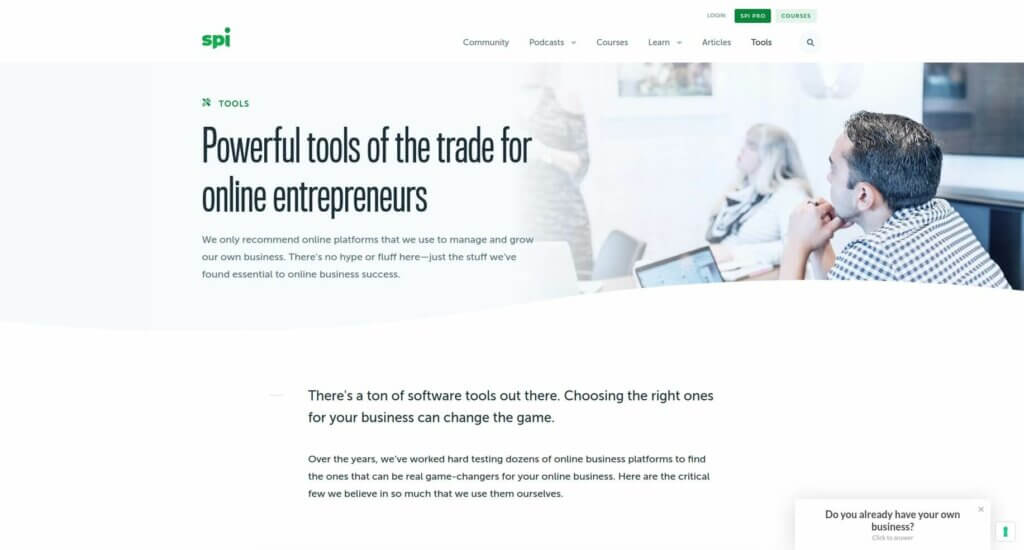
This page contains a list of recommended resources—products, services, apps, and more—to help my audience build their own online businesses.
Many of the links on this page are affiliate links, meaning I receive a commission if someone clicks on the link and purchases the product or service it links to.
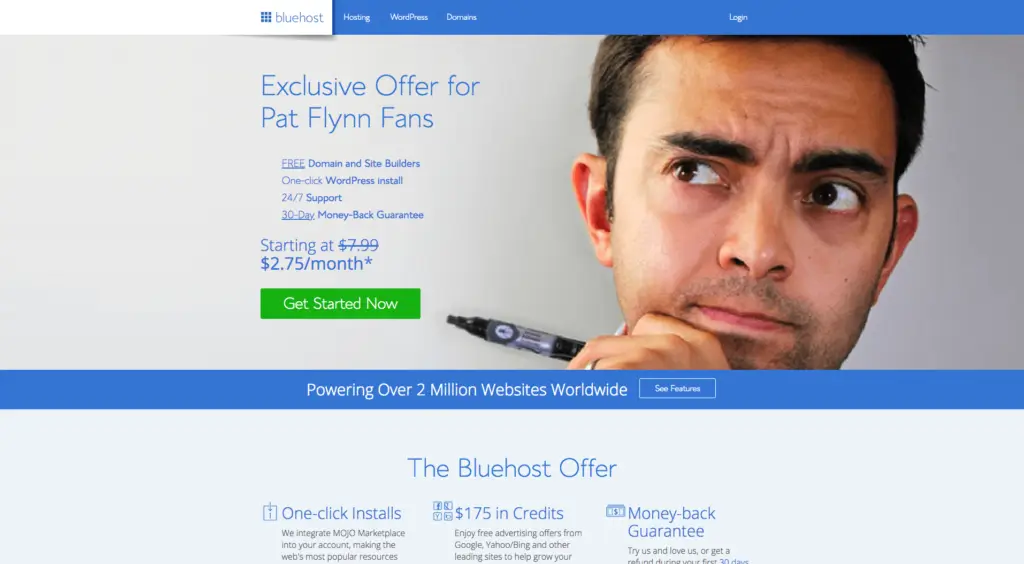
Here’s what someone sees if they click on my affiliate link for Bluehost, the web hosting company I use and recommend:
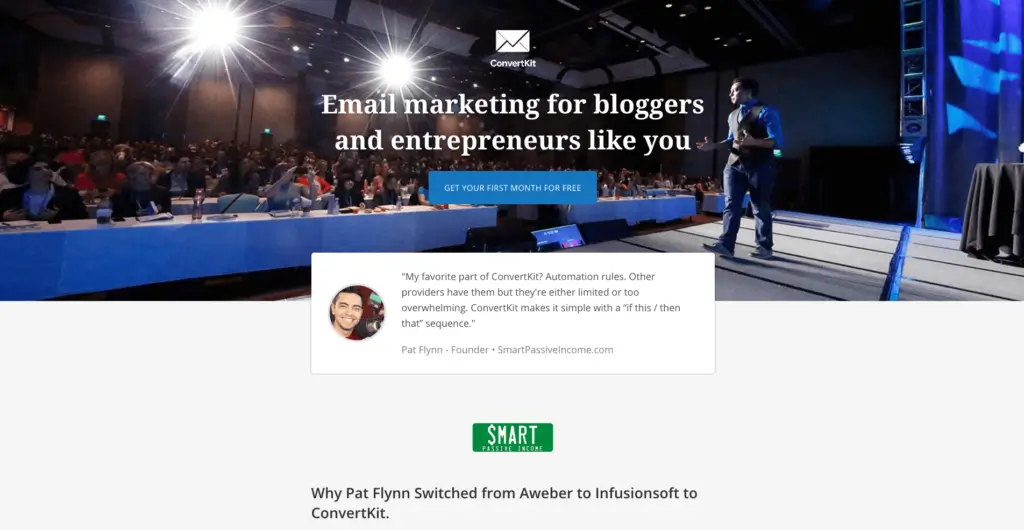
And here’s what they’ll see when they click on my affiliate link for Kit, the email service provider I’m happy to recommend:
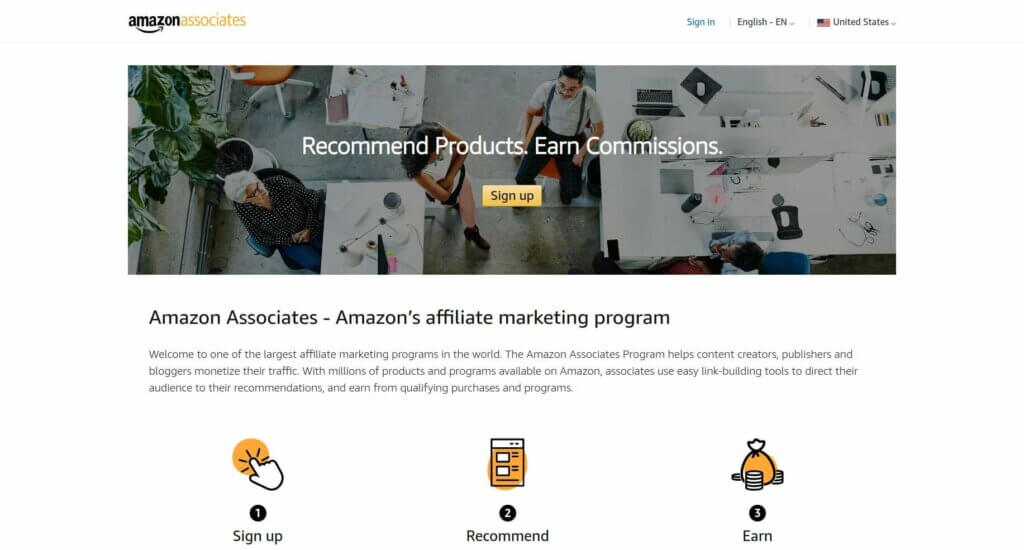
As we’ll further discuss below, you can also earn affiliate commissions by signing up with an affiliate network. One of the most popular is the Amazon Associates program which you can read more about here.
You can easily find tons of other examples of affiliate marketing “in the wild.”
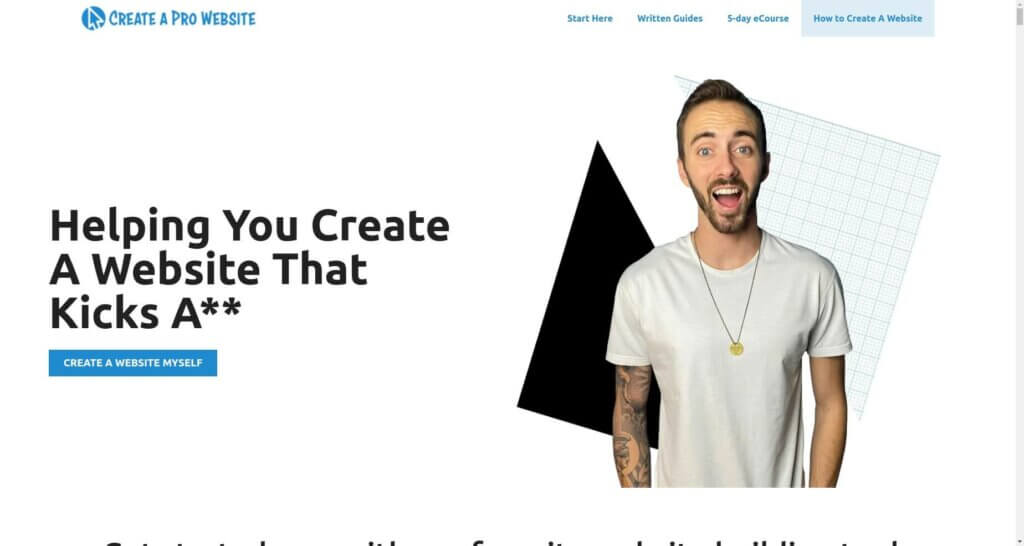
For example, Create a Pro Website is an affiliate marketing website and YouTube channel that creates tutorials on anything and everything related to “how to create a website.”
They do a good job of offering value through demoing products (which we’ll see in the case study below is a great affiliate marketing strategy), while working in their affiliate links where it makes sense.
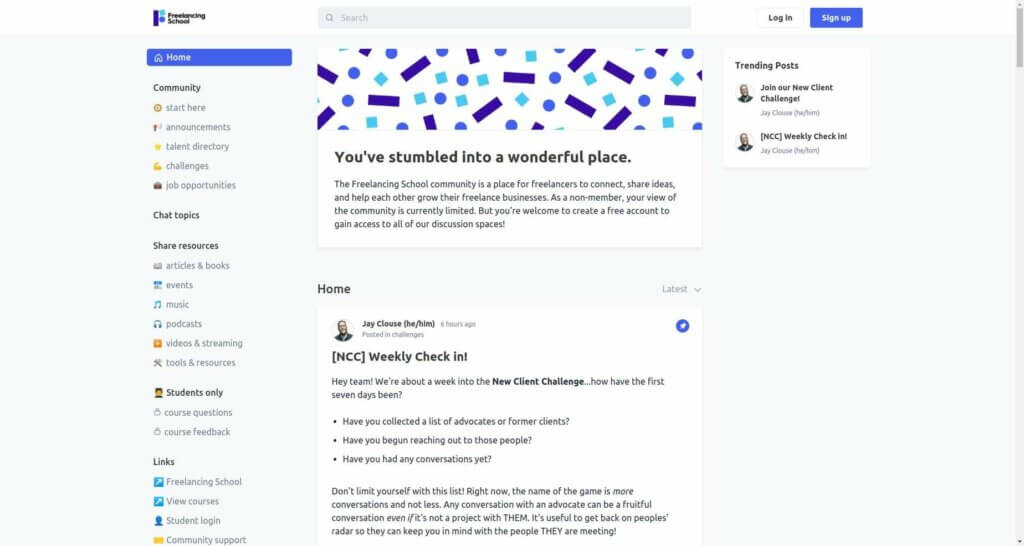
Freelancing.school is a particularly good example of focusing on building relationships with an audience first by offering extras like a community of like-minded individuals and a free course to help people find success with their freelancing careers.
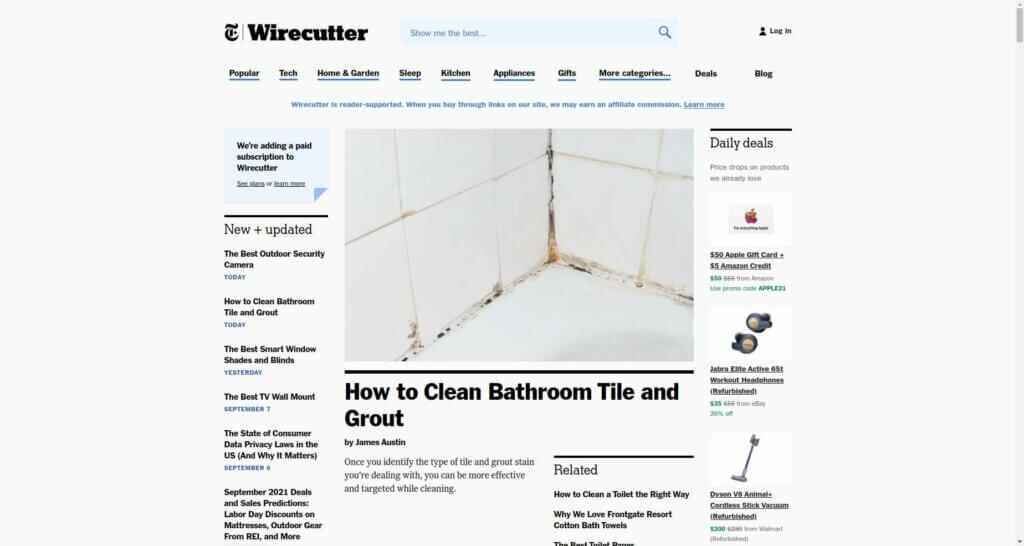
These days, even well-established news outlets like the New York Times are becoming affiliate marketing websites!
The example here is NYT’s Wirecutter section, which reviews products and offers tutorials on everything from How to Clean a Toilet the Right Way to Everything You Need to Make Hot Pot at Home.
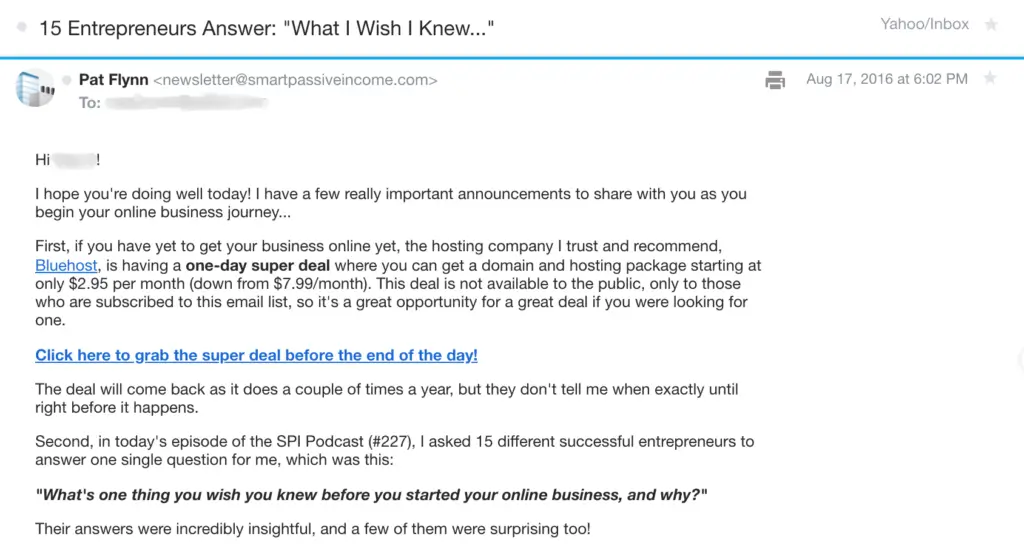
Affiliate marketing is essentially about sharing your affiliate links, so however you choose to share those links—whether on your website, on social media like X, Facebook, or YouTube, or via emails to your list—well, that’s affiliate marketing in action!
Affiliate marketing case study: SPI + Kit
Next up, I’m going to share a case study to show you what effective affiliate marketing looks like “on the ground.”
This case study is based on a product I’ve recommended for a long time that’s also become one of my biggest drivers of affiliate income.
From 2015 to 2017, it brought in a whopping $315,000 in affiliate revenue.
Kit (formerly known as ConvertKit) is an example of a product I promote as part of a long-term strategy.
It’s a great example of an affiliate resource I promote to my audience that can benefit and serve them over the long term and hopefully I earn a healthy affiliate income at the same time.
Although I love and use Kit myself (and the founder, Nathan Barry, is a good friend of mine), the point of this section is not to promote the product.
Instead, I’m here to show you how I’ve promoted Kit.
And I’ve done so in a very specific way: by D-O-I-N-G. This strategy has helped me be very successful in promoting Kit as an affiliate.
Those letters stand for:
- Demo the product
- Offer answers to your audience about the product
- Interview the founder of the product
- Never recommend more than one of the same kind of product
- Get the product in front of your people
Before we get into the details of the D-O-I-N-G approach, here’s a little background on how I got started promoting Kit as an affiliate.
ConvertKit (now Kit) wasn’t my first email service provider.
My first one, back in 2010, was AWeber.
AWeber was great as an entry-level email tool, and I also promoted it as an affiliate, making up to $2,000 a month at one point.
And that income still comes in each month, because I get paid a recurring commission for every month a person I refer stays on, even though I’m not actively promoting the product anymore.
Eventually, though, I needed an email service that was easier to use with more advanced features.
For a while, I turned to another tool called InfusionSoft, which was good, but still not exactly what I needed.
Shortly after I started using InfusionSoft, a friend of mine, Nathan Barry, reached out to me to ask how I was doing with the new tool.
Nathan had recently started a new email service provider, ConvertKit.
We met for coffee in downtown San Diego a couple weeks later.
After catching up about personal stuff, the conversation turned to business.
Nathan asked me a lot of questions about my needs, experiences, and desires as a blogger, podcaster, and digital marketer.
He didn’t try too hard to plug his new tool, except toward the end of our conversation when he said, “Hey, if Infusionsoft doesn’t work out for you, let me know, and we can see how you might be able to use ConvertKit.”
I didn’t think much of his offer for a little while.
But over time, I started growing more and more frustrated with Infusionsoft.
So I reached back out to Nathan to see how ConvertKit was doing.
I wasn’t surprised to hear that they were experiencing constant growth month after month.
New features were being added on a regular basis, and after a couple of side conversations with other users, I was happy to hear extremely positive reviews.
That’s when I asked Nathan to demo the current software for me over Skype—and I was blown away.
I loved the intuitive user interface, along with the tool’s segmentation and automation capabilities.
Seeing what the tool could do, it wasn’t long before I decided to switch from InfusionSoft, and Nathan’s team even helped me migrate my email list.
I’ve been using Kit very happily ever since.
That positive experience has shown up in terms of my affiliate revenue from Kit, too.
Although I was happy with my AWeber affiliate income, since shifting to Kit, I’ve broken into a new level of affiliate income and success.
Part of that is because Kit is an amazing tool—but a lot of it has to do with how I leveled up my promotional efforts with the D-O-I-N-G approach.
Let’s learn all about it now!
D: Demo the product
Affiliate marketing is technically easy to do.
All you have to do is get your affiliate link and start sharing it with your audience. It’s easy to stop there and think you’ve done enough.
But if you’ve been with us since the beginning of this post, you know that a crucial practice in affiliate marketing is to take products that are not your own and treat them as if they were your own.
If you were selling your own product, you’d show people what they were going to get before they got it, right?
But most people who do affiliate marketing just share a link and a couple of sentences and call it good.
Instead, as we talked about above, you need to show the product in action. That’s where the demo comes in.
People are more likely to buy when they know what they’re getting and exactly how it will help them.
The best way to do this is with a video demo that shows people two main things: 1) how they can benefit from the tool and 2) how to use it.
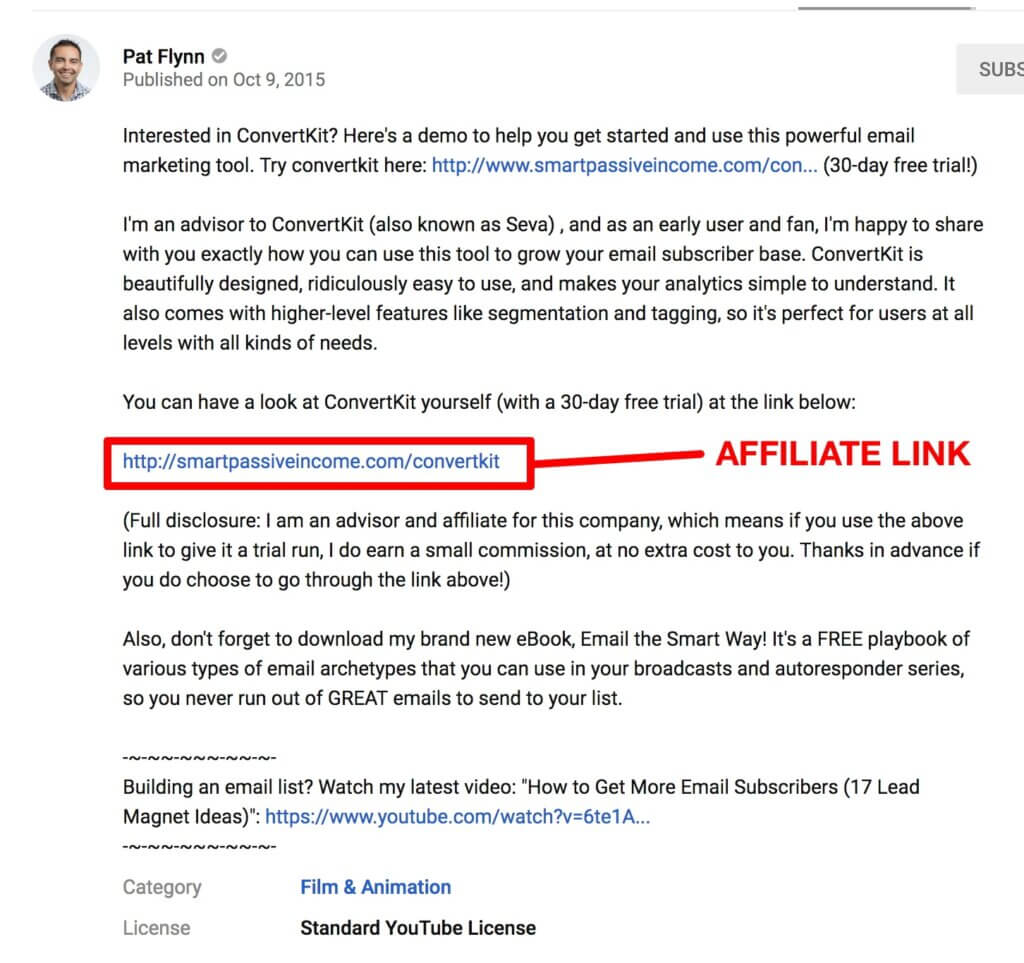
In 2015, I created a YouTube demo of ConvertKit.
In the video, I talk about the benefits and features that made me fall in love with ConvertKit: ease of use and setup, beautiful design, powerful statistical analysis, segmentation and tagging, and a lot more.
Along the way, I show screenshots of ConvertKit in action, so viewers can see exactly how to accomplish different things using the tool.
When you search “ConvertKit demo” or “ConvertKit tutorial” on YouTube or Google, my demo is typically one of the top results.
It’s been viewed 30,000+ times, and it’s driven a ton of traffic both back to my website and through the affiliate link mentioned in the video description.
When you’re thinking about creating your own demos, you want to show not just the features and benefits of the tool, but also make it fun and show your personality.
In the ConvertKit demo video, although you don’t get to see much of me (it’s just my voice with a Screenflow video), I’m just being myself.
I could have made a stiff, mechanical demo that was all about just conveying the relevant information—and it would have been shorter too—but who wants to sit through that?
Instead, I’m relaxed and sharing my honest opinions, using words like “cool” and “powerful” (and yes, “nice”!) to convey my excitement about ConvertKit’s capabilities, in the hopes that excitement will be shared by my audience too.
You want to create a thoughtful demo that shows you care about creating informative content while also keeping your audience engaged and excited to try the tool.
And of course, make sure you include calls to action (CTAs) to go through your affiliate link, as well as disclosing your affiliate relationship with the company.
You don’t want to bombard your audience with these CTAs, though, and if you’ve provided enough valuable, engaging content in the demo, you shouldn’t have to include more than one or two CTAs.
In my ConvertKit demo video, I only mention my affiliate link and status twice very briefly, at the very end:
“Go ahead and check it out: smartpassiveincome.com/kit. And I look forward to seeing how you are able to use it. As I said, Kit is constantly releasing new features to make our lives even easier. Hopefully, this is helpful. Cheers. I appreciate you. That affiliate link one more time, which I do get a commission from if you do go through that link, is smartpassiveincome.com/kit. Thank you so much, and I’ll see you in the next video.” [Full Disclosure: I’m a compensated advisor and affiliate for Kit.]
In other types of content, such as blog posts, I might share my affiliate link a little more often, for instance at the beginning, middle, and end of a post.
But in either instance—whether a video demo or a blog post—the content itself does the “heavy lifting” of sparking someone’s interest in trying out the product, so I don’t have to hit my audience over the head with my affiliate link.
O: Offer answers
The next step is to offer answers to people’s questions.
This is huge, because if a person asks you a question about a product, they’re likely already interested in it.
They may just be on the fence, and if you can be the one to answer their questions, that may give them the final piece of the puzzle to go ahead and make a purchase, knowing there’s someone there to provide product support if they need it.
That’s why I always offer support for Kit and the other affiliate products I promote.
When questions come in, I’m quick to answer them because I want to make people feel comfortable with the idea of spending money on this thing I’m promoting.
The combination of the demo and offering answers is powerful.
If you put together a thorough and helpful demo, you’ll likely answer a lot of people’s questions in the demo itself.
But even if your demo covers all the bases you can think of, you should still offer to answer people’s questions.
Why?
Even if they don’t have any, just the fact that you’re offering this assistance will make people feel more comfortable and inclined to buy the product through your link. Remember, you want people to trust you and feel secure in their investment.
Want an example of how you could offer support in this way? Here’s what I say toward the end of the ConvertKit demo video I mentioned in the previous section:
“I’m here to answer your questions too. If you’re watching this on YouTube, ask your question below; I’ll do my best to answer it. If you’re watching this on the SPI blog, go ahead and leave your question in the comments section. Or, if you want to send me an email, that’s totally fine too. Happy to help, because I really believe in this product.”
I also offer to answer people’s questions about my affiliate products via other channels, including email and social media.
People often reach out to me on X, because X makes it easy for me to reply quickly.
It helps that there’s a character limit, too, because it forces both parties to get to the point.
Offering to answer questions also makes people feel secure about the fact that if they were to have questions later on, once they’re up and running with the product, you’ll be able to answer them.
This is especially important if the product you’re promoting is of a highly technical nature.
So, offer support and people will be more at ease about buying through your affiliate link.
I: Interview
When you’re promoting an affiliate product, having other people talk about the product, and the story behind it, can be a powerful way to get people excited about it.
A great way to do this is to start a podcast and interview the founder of the product on one of your episodes.
ConvertKit (Kit) founder Nathan Barry joined me on episode 244 of the Smart Passive Income podcast, titled “Bootstrapping a Business.”
But here’s the thing: we didn’t actually talk about the product itself much at all!
We talked about his story, and how he bootstrapped the company and grew it successfully.
We talked about how I met him and built a relationship with him and his company, eventually becoming an advisor to ConvertKit (Kit).
Because the product itself—as well as my affiliate relationship with Kit—was not the focus of the interview, listeners were able to focus on how much care and quality Nathan put into creating the product and cultivating the company’s culture.
As a result, in a way, they were able to start building a relationship with him too.
I only mentioned my affiliate link at the very end in a casual way, as almost a natural conclusion to the episode.
The ability to augment your affiliate marketing efforts by interviewing the founder of a product you’re promoting is a great reason—among many—to have a podcast.
Even though Nathan and I recorded the episode in 2016, people are still downloading and listening to it today.
I also reference the episode a lot when I mention ConvertKit (Kit), which helps make it an active resource in promoting my affiliate relationship.
So, if you’re planning to promote a new affiliate product, see if you can get the founder of that product on your podcast.
If you can’t get access to the founder for a podcast interview, consider an email interview or maybe a video interview over Skype or Zoom.
And if you can’t get the founder, try for somebody who represents that company at a high level.
If that’s not possible either, aim for somebody who’s used the product and knows it well, hopefully somebody your audience is already aware of and respects.
In the How to Start Affiliate Marketing above, we talked about the importance of promoting a product yourself, showing how much you know and love it and the great results you’ve gotten from using it—i.e., showing proof.
When you’re the only one doing the showing, there’s always the risk, however small, that your efforts may come off as too promotional.
On the other hand, as the Nathan Barry podcast episode showed, interviews are powerful because most of the selling that’s done is indirect—and often, you won’t have to talk about the product much at all.
N: Never recommend more than one of the same kind of product
Next up, you should never recommend more than one solution for a specific type of problem.
This is a really important rule, and one that generates a lot of debate.
And there are exceptions, which we’ll talk about in a second.
But first, what exactly do I mean by never recommending more than one of the same kind of product?
Well, if I were to recommend Kit, but also recommend other email solutions like AWeber or MailChimp, it would dilute the strength of my primary recommendation.
You need to pick one, because otherwise people are going to be confused.
I went the route of recommending multiple similar products once, and it didn’t go well.
People said, “Wait, I thought you were recommending this one. But now you’re talking about this one? What’s the difference? How is it better?”
You don’t want people asking themselves even more questions about which product makes sense for them.
That’s why they came to you in the first place!
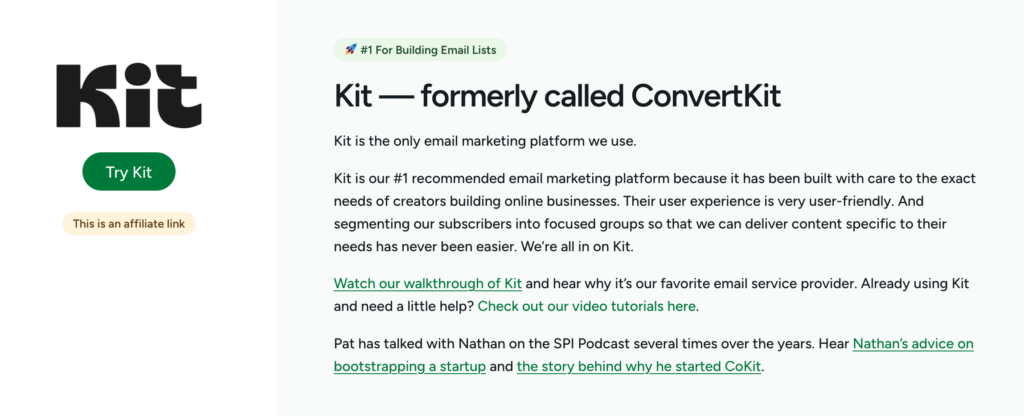
So, yes, I’ve made my decision, and the only email service provider I recommend to people is Kit.
Are you recommending more than one product right now that’s essentially the same type of solution?
If so, you’re diluting your affiliate marketing efforts and reducing the amount of income you can make. Yes, sometimes it’s great to give people options, but it can also work against you.
Now, if someone were to say, “Hey, Pat. I know you recommend Kit, but what other solutions are out there?” then of course I’m going to be honest with them and tell them what other options they have.
I’m not going to say, “Sorry, Dave. There are no other great options out there.”
That would be lying. There are other great email service providers out there.
But the one I use, recommend, and trust will be there to help my audience is Kit.
Plus, as with everything, there are exceptions to the rule.
In this case, only having one recommendation doesn’t make sense for some types of sites.
For example, if you run a vacuum review site, you can’t get away with promoting just one product, as that would go against the entire aim of the site.
You can certainly highlight featured products and recommendations in different categories. But when people are searching for helpful comparisons of similar products, the N rule likely won’t apply.
Here’s another example from one of my own affiliate promotional materials that you might remember from above.
In one of my YouTube videos, I review three different podcasting microphones.
Here’s the key: Even though each of these products is very similar (they’re all microphones), I use the review as an opportunity to differentiate them according to their best uses, then make specific recommendations about which microphone should be used for different scenarios.
For instance, in the video, I end up recommending that you not use one of the microphones for podcasting at all—instead, I recommend another use case that makes more sense for this particular microphone. I’m comfortable including my affiliate link to each of the microphones because I’ve made the effort of differentiating them for my audience.
G: Get the product in front of your people
This final one is a big one, and it represents a mindset shift I’ve undergone over the past few years.
Often, people become timid when it comes time to put products in front of their audience.
If that describes you, whether it’s your own product or an affiliate product, then I want you to shift your mindset—to one of excitement about sharing something you know will help your audience.
In fact, it’s your obligation and your role to do that, and you should embrace it. Because if you don’t, you’re not serving your audience in the best way possible.
It’s not about being pushy or aggressive; it’s about being motivated to get the product in front of people.
You’ve done the research, you’ve used the product, you’re offering answers, you’ve created the video demo, you’ve recorded the interviews.
You know the product can help your audience, so get it in front of them!
Talk about it on your podcast, and on other people’s podcasts.
Share it in blog posts.
Create more videos about the benefits and capabilities of the product.
That’s exactly what I’ve done and continue to do with Kit.
I believe in the product, and the company, so it’s my responsibility to get it in front of my audience so they can benefit from it like I have.
I’ve used lots of methods and channels to get Kit in front of my audience, including:
- Blog posts
- Videos (like the product demo)
- Social media messages
- My Resources page
- Podcast episodes (like the interview with Nathan Barry)
When it comes to getting the product in front of your audience, it pays to be creative!
On that note, I wanted to share one more pretty novel way I’ve gotten Kit in front of my audience.
In a March 2018 video, I congratulated ConvertKit (Kit) for a huge milestone—hitting $1 million in monthly recurring revenue (MRR).
In the video, I also shared 8 important lessons for people looking to start and grow a business, ones that came directly from ConvertKit’s (Kit) example in becoming a $1 million MRR business.
The video was a response to a single tweet by ConvertKit’s (Kit) founder, Nathan Barry, about the company’s $1 million milestone.
But I built on that tweet to tell a much richer story about the company and how they were able to accomplish something so remarkable. You can see the whole thing below.
The key in this video is that I didn’t focus that much on the product itself—and especially not on my affiliate relationship with them—but on ConvertKit (Kit) the company, and how they used 8 powerful and ethically-minded principles to grow their business rapidly.
These are principles anyone who’s trying to grow their own business the right way can learn from and implement.
And you can do the same thing I did with this video.
Ask yourself, what can I learn from the success of a company I have an affiliate relationship with?
How can I use that company’s example, and the principles behind its success, to help my audience and deliver them value?
When you do that, you’re getting the product in front of people—but you’re also giving them so much more.
8 best affiliate programs and networks
Reminder: always start your affiliate marketing journey by building a relationship with your audience and never recommend products you haven’t used or don’t love.
That being said, I want to give you a starting point for finding affiliate marketing programs that might be a great fit for you and your business, and give you some insight into what you should consider when evaluating affiliate marketing websites and opportunities.
Note: I’ve used many but not all of the below networks and programs myself, but am familiar with the others from my research and recommendations from friends and colleagues.
So while I’m comfortable sharing them with you there isn’t any direct financial benefit to me for doing so.
For more useful affiliate marketing tools, check out this guide!

Affiliate Marketing
Monetization
12 Affiliate Marketing Tools to Take Your Business to the Next Level
Want to upgrade the affiliate income potential of your business? This list of 12 affiliate marketing tools features software to help you do just that!
Top affiliate marketing networks
Affiliate marketing networks are platforms you can join to get access to hundreds, sometimes thousands of affiliate marketing products and programs.
Let’s explore a few of the most popular:
Impact
Formerly Impact Radius, their Marketplace was built to offer content creators a seamless way to monetize their work and offer their audiences a lot of value through a huge list of brands looking to advertise and a suite of tracking and automation tools.
With direct access to global brands like Airbnb, Adidas, and Allstate, flexible payment processing, and robust reporting and alerts, there’s a good chance you’ll find them a great fit for your audience and business.
CJ
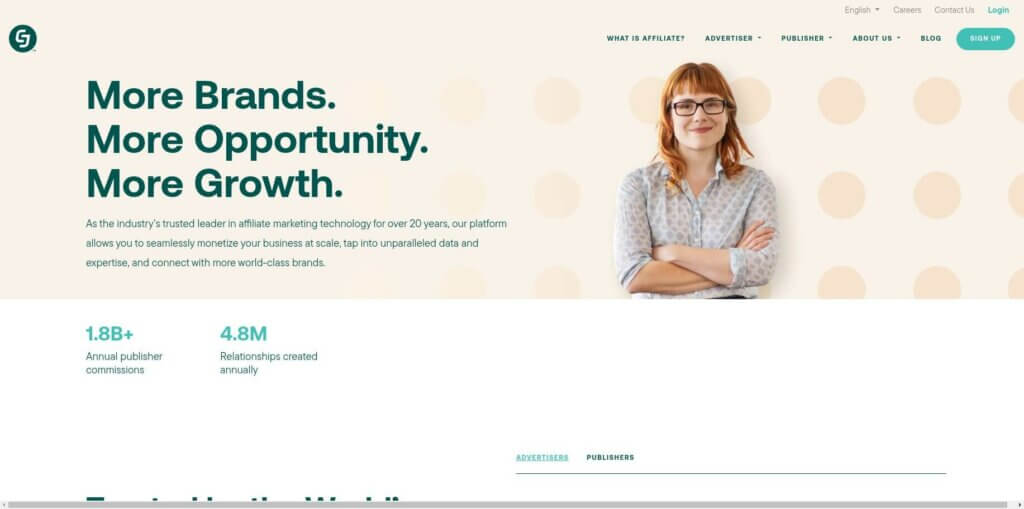
Formerly Commission Junction, CJ has spent the last 2 decades building relationships with brands and publishers to create an affiliate marketing platform worth exploring.
Advertisers you’ll find here include Priceline.com, Overstock.com, and J. Crew.
CJ also includes some one-click join affiliate programs to make it easy for beginner affiliate marketers to start their journey, while also offering omnichannel tracking (across browsers, devices, etc) and strategic recommendations based on business size, vertical, and region for when you’re more established.
ShareASale
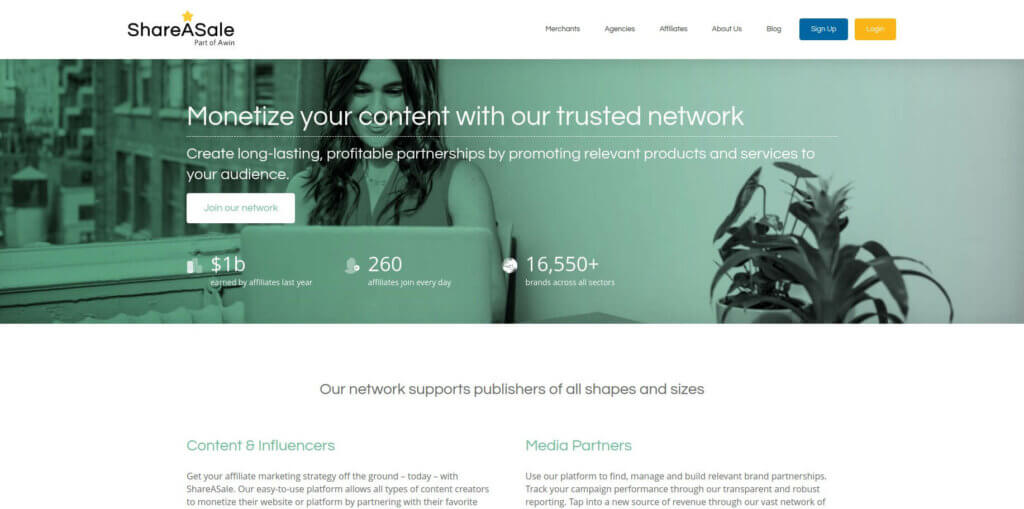
ShareASale helps beginner and expert affiliate marketers alike create profitable long-term partnerships with brands their audience will love.
With 260+ affiliate programs launched every month (businesses like Etsy and Rebook are already on board), a product discovery bookmarklet for quickly generating affiliate links, and a slew of analytics and reporting tools, if you find a product worth promoting to your audience here you won’t be going astray.
ClickBank
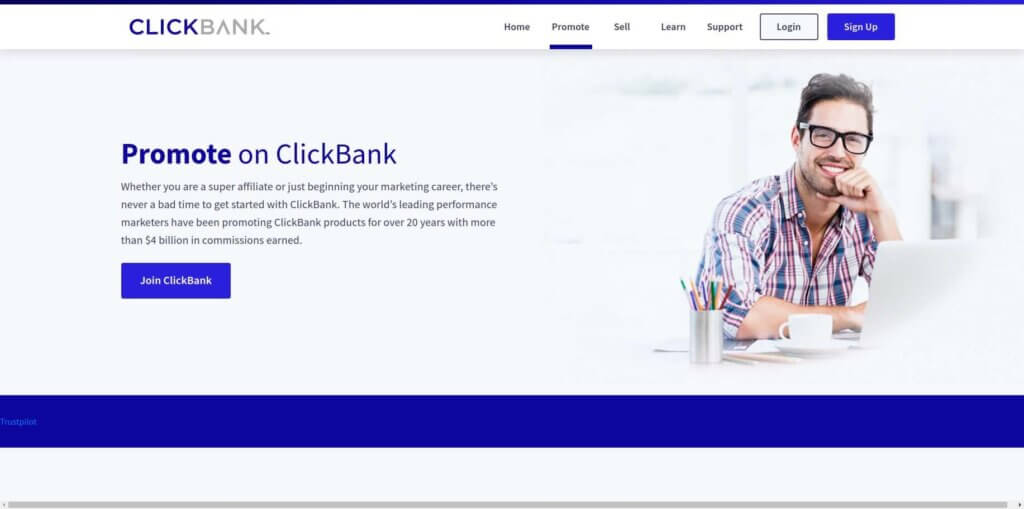
ClickBank has done a good job of owning the information product affiliate program space, offering products like online courses and ebooks that you won’t find as readily on other affiliate marketing platforms.
A word of caution: I’ve seen a lot of shoddy products that were created with an earn-a-dollar first approach on offer so be sure to do your due diligence before recommending what you find here.
If the affiliate product checks out, though, this is an affiliate marketing network you can rely on for ease-of-use and on-time payments.
Best affiliate marketing programs
What is an affiliate marketing program?
Beyond the products you can promote, affiliate programs include the commission rates, payment terms, marketing materials, and promotion rules a business with an affiliate product offers affiliate marketers like you.
Again, please do not start by seeing the financial opportunity in these programs and working backward from there to fit your business around them.
These affiliate marketing programs are great examples of what’s available to you as an affiliate marketer so use them, but only if they’re truly going to benefit the audience you’ve built a relationship with.
Amazon Associates
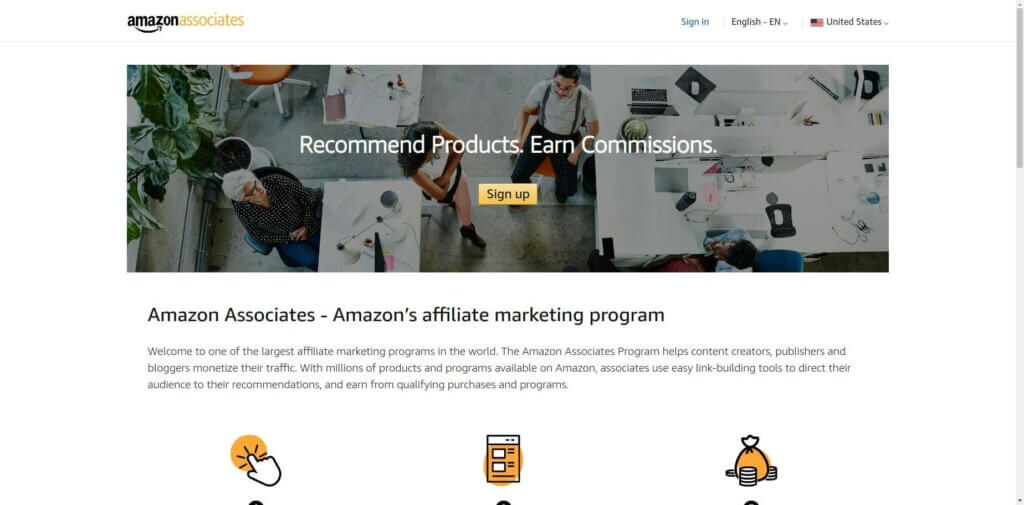
You know Amazon, now you know about their Amazon Associates affiliate program!
They’re the world’s largest retailer so if your business is related to any sort of physical product, you’ll find a quality option to offer here.
Worth noting, Amazon recently caused quite a stir by drastically lowering their commission rates (from 8% to 4% in many categories), which is a good example of why building relationships with your audience and eventually creating your own offerings is so important.
That being said, on top of having the world’s largest catalog, Amazon has poured billions into optimizing their site for conversions and you earn a commission for any product purchased visitors purchase within 48 hours of clicking your links, so they’re still a top recommendation for physical affiliate products.
Learn more about making Amazon Associates work for your audience and business in my Amazon Affiliate Marketing Program guide here.
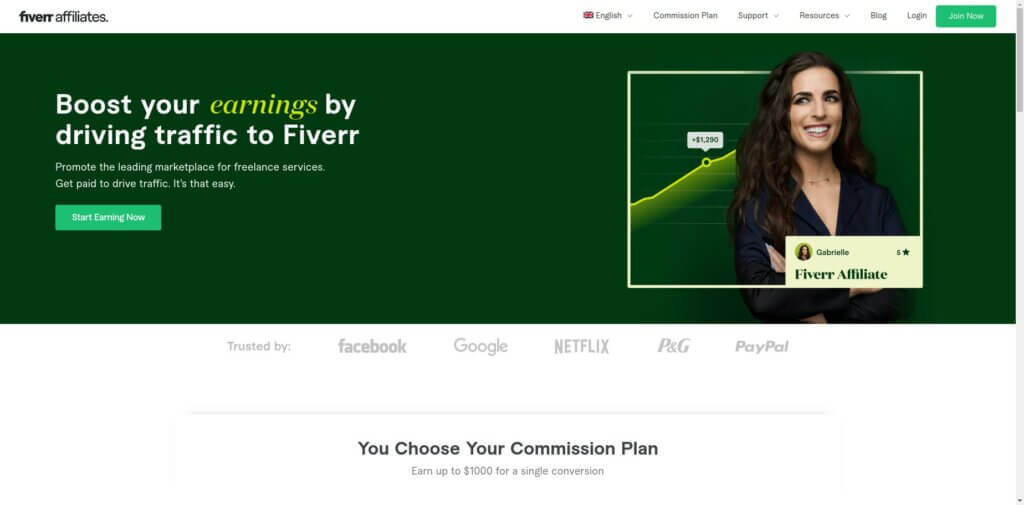
Fiverr Affiliates
Fiverr, the popular marketplace for freelance services, offers a few different affiliate products and services that might be a good fit for promoting to your audience.
These include:
- Fiverr, the freelance marketplace offering services for everything from graphics and copywriting to complete websites and custom apps.
- Fiverr Business, their suite of premium tools and vetted talent for business owners.
- Fiverr Learn, their online courses platform.
- Fiverr affiliates, their affiliate program (links to Fiverr on this page are NOT my affiliate links)
If you work with clients who might need support from freelancers available on Fiverr’s platform or have an audience of entrepreneurs, a partnership with Fiverr is worth considering.
In addition to being a good fit for a broad set of businesses, I decided to add Fiverr to my list of affiliate marketing programs because they introduce some interesting commission structures you can find in some other programs.
Many affiliate programs will offer flat commissions per sale.
In Fiverr’s case, this includes a $15-150 Cost Per Action (CPA), depending on the service the person you refer buys.
They also offer percentages of the sale price, 30% for Fiverr Learn courses as an example.
Something you don’t see as often but is very valuable as an affiliate marketer is a revenue share option.
In this case, Fiverr’s “Hybrid” payment structure lets you earn $10 for a first-time purchase and 10% of all further purchases made by someone you refer for 12 months.
The beauty of revenue share commission structures is twofold:
- You have the potential to earn a lot more than flat-rate plans
- Revenue share smooths out your earnings curves
For example, as people get outside during the summer months, you’ll sometimes see a natural dip in traffic and sales for software-based products as people are spending less time on their computers.
But, if you earn a piece of the monthly fees a person you refer pays for their software, you’re less likely to see a dip in your monthly revenues.
HostGator Affiliate Program
HostGator is a popular web hosting and domain registration company you’ve likely heard of because their affiliate program is so popular.
And because so many different audiences from entrepreneurs to crochet enthusiasts can benefit from having a website, chances are your audience may be interested in a web hosting service.
While I use and prefer Bluehost because I know them, trust them, and have a great relationship with their team, I mention HostGator here because it shows us another element of affiliate marketing commission structures: pay for performance.
What does this mean exactly?
HostGator offers a tiered payments structure based on how many monthly signups they receive from you:
- 1-5 signups per month: $65/signup
- 6-10 signups per month: $75/signup
- 11-20 signups per month: $100/signup
- 21+ signups per month: $125/signup
Again, please think about your audience’s needs and the quality of the product/service first, and commission rates and structures second.
But if all else is equal between two tools, it’s worth investing your time and effort in creating helpful content and building a partnership relationship with the company that helps you grow your commissions as you grow their sales.
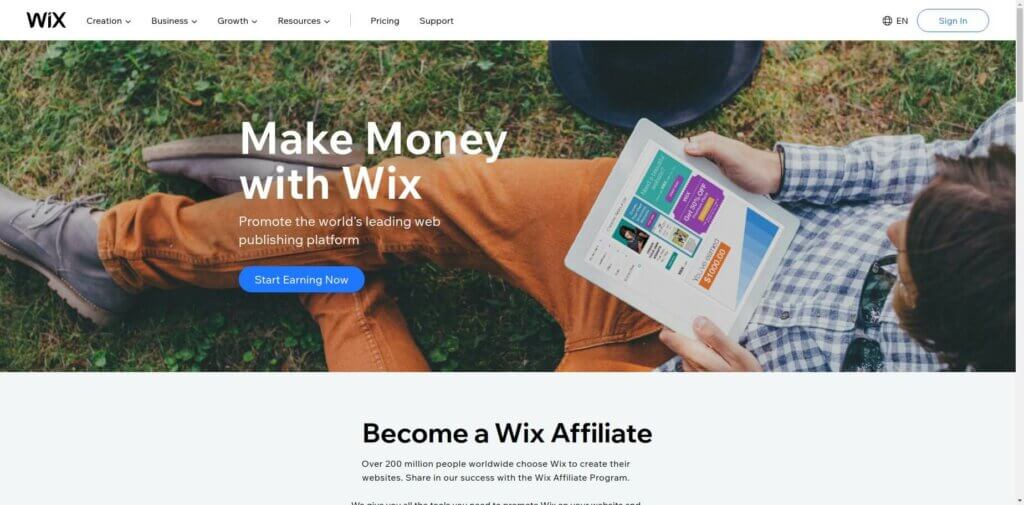
Wix Affiliate Program
Our last affiliate marketing program example is Wix, the popular website-building software.
I mention them here for two reasons:
- Again, website-related products and services are useful for a lot of audiences, so chances are Wix might be a good fit for you and yours.
- They’re an example of one other element of affiliate marketing program commission structures – minimum payouts.
To point 2, many affiliate programs have minimum earnings targets you have to hit to get paid. In Wix’s case, you have to generate at least $300 in commissions before they’ll send your earnings to your bank account.
This is a fairly common practice and thus a nice example of why I say affiliate marketing is not a get-rich-quick scheme.
Affiliate marketing tips for beginners (and experts)
Affiliate marketing is not a “push-button” solution. It takes focus and commitment, and a certain choreography to make it happen the way you want it to.
Thankfully, there are things you can do to increase the number of people clicking on your affiliate links and buying the affiliate products you’re promoting.
So below, let’s go over my 22 tips to help you succeed with affiliate marketing.
Some of these are things we’ve covered already but they’re definitely worth repeating!
Others will be new to you. But all of them are potentially important keys as you build your affiliate marketing business.
22 affiliate marketing tips for beginners
- Build trust first
- Know the product
- Ask yourself: Can I trust the product will be good for my audience?
- Show your own results (Proof)
- Help your audience learn as much as possible about the product (Evidence)
- Become a source of information and support for a product
- Use your website (or build one!)
- Give people multiple opportunities to click on your affiliate links
- Disclose that your links are affiliate links
- Keep track of your click-throughs
- Use your own language to promote your affiliate links
- Thank people in advance for going through your affiliate links
- Thank people afterward for going through your affiliate links
- Establish a relationship with the owner of the product
- Offer special deals just for your audience
- Ask for a landing page on the owner’s site
- Focus on how it will help your audience (not features, but benefits)
- Believe in your recommendation
- If it doesn’t work out, try another offer
- Test, test, test
- Make your own product instead
- Be patient
Laying the groundwork
A great affiliate marketing strategy starts with a solid foundation. Here are the fundamentals you need to keep in mind as you’re getting started.
1. Build trust first
Surprise, surprise! My number one tip is to build trust!
Trust takes time to build, and energy to maintain. This is why I wanted to give you this tip first because I want you to expect things to take a while, and to focus on building your community and the trust within that community first.
The recommendations for products and the affiliate love you’ll get from your community comes almost naturally after you EARN that trust from them.
Trust is earned through 2 things:
- Giving—and giving away as much as possible. Content, information, freebies, high-value stuff, and sometimes even your own time.
Online karma does exist, and the more you give away, the more you get back in return—and maybe not from the very same people you gave to, which is why the second piece of earning trust is . . .
- Recommendations from others. Get on other people’s radar and have them do the marketing for you. Not for the affiliate products that you’re promoting, but you, or your brand.
YOU.
Trust is earned faster through the friends and relationships people already have with each other.
That’s why it’s important to give to everyone, no matter how big or how small they may seem to your brand.
Because you never know—they may know somebody who knows somebody who will become your biggest client, or a multi-product customer, or maybe the window to an opportunity that would have never happened otherwise.
Relationships with other people are extremely important to your success, and you won’t have sustainable success with your affiliate marketing until you earn your audience’s trust.
2. Know the product
One of the biggest mistakes I see people make when attempting to sell a product as an affiliate is not knowing much about the product.
This usually stems from a desire to push a product for the primary purpose of earning money from it, which is a no-no.
Don’t get me wrong—it’s smart as a marketer to take into account what the commission is and how much money you might make per sale, but the commission shouldn’t drive the decision to promote a product.
It should be just one part of the entire decision to promote a product.
So, know the product.
Why?
Because if you really know the product, it will shape how you promote it, what you say to promote it, and the overall feeling people will get when you offer or recommend it.
So what’s the best way to get to know a product? Use it. Get to know it.
If you’re not extremely familiar with a product, don’t promote it.
It may not be a rule most affiliate marketers follow, but it’s one I’ve followed for years with great success, because it helps with tip #1, building that trust factor with my audience.
All of the products I promote on my Tools page, such as Kit for email marketing, Leadpages for landing pages, and Bluehost for web hosting, are ones I’ve used myself extensively.
I know all about them, and I’m very comfortable with how they work, so I’m happy to recommend them to my audience.
This goes along with tip #3, which is . . .
3. Ask yourself: Can I trust the product will be good for my audience?
This is crucial. It’s the idea that you should be sharing or recommending something that will actually help your audience.
Do you trust that after you send people through your link that the sales page for that product, the product itself, and the customer service for that product, if any, will be good to them?
This is important, because the dictionary definition of affiliate is:
Officially attach or connect to an organization.
The moment you decide to promote something as an affiliate, you attach yourself, your brand, and your business to that company and that product, and if that product isn’t going to be good for your audience, then it’s going to reflect ultimately on YOU.
If it’s an awesome product that totally helps them out?
Awesome! You’re going to look that much better and be thanked for it, and it’ll be a win–win–win for everyone.
If it’s bad? It’s a lose–lose–lose for everybody.
I was once approached to promote a product I knew would sell well and make me a lot of money.
But I didn’t end up promoting it, because I didn’t like the way the company managed the upsell process—it was very aggressive, and even ended with an automatic 30-day trial.
That didn’t sit right with me, so I didn’t promote it. I may have lost some money up front because of that decision, but in the long run, it was the right thing to do.
4. Show your own results (proof)
One of the biggest ways I’ve been able to take my affiliate income to the next level is by showing people what I’ve gained as a result of using those products.
For example, I use a tool called Kit to help me run my email campaigns to build an even bigger following. I then use these results as proof when I’m promoting Kit as an affiliate product to my audience.
By showing that I’ve actually used and succeeded with a product like Kit, it helps to build that trust and lessen the “I don’t know exactly what this product is about so I’m not going to buy it” mentality among my audience.
You want to show them as much as possible, which leads us to our next tip . . .
5. Help your audience learn as much as possible about the product (evidence)
So a person sees an affiliate link for a product you recommend on one of your sites. Big whoop!
Instead of just a paragraph or two explaining the product and what it can do for them, show them how it works.
Tell them what it’s like to sign up for the product, share some tips to make the experience of using that product even better, give answers to the most frequently asked questions about that product . . . show them everything.
The more you can show, the more comfortable people are going to be actually making a purchase.
Giving your audience thorough information about a product like this will help you to . . .
6. Become a source of information and support for a product
The next level is to make yourself available to your audience as a source of information and support for that product. To treat the product as your own.
This can help in the pre-purchase phase. If someone has any questions about a product before making a purchase, tell them to go through you (or maybe someone on your staff or a VA).
If a person is on the fence, it may just take an answer to a simple question to get that person to click through your link and make a purchase. Plus, they’ll feel more secure with their purchase, again, since they know if they have any questions they can come to you.
The next thing you can do is provide support for it too.
You don’t necessarily have to be available 24/7 for customer service questions.
But when you promote these products, you want to say, “Hey, if you have any questions about this, let me know. Because I know this product, and I want to show you how it can help you achieve your goals or address your pains and problems.”
And when you do that, your audience will automatically think, “This guy knows what he’s talking about, and if I ever have any questions, he’ll be there.”
Now, if you’re worried this means you’ll be deluged with support emails, don’t fear!
You’re not going to be buried with questions.
In all my years of offering support for my affiliate products, I’ve never had an issue with receiving too many questions.
But the value of offering this support is huge, and will help your audience trust your recommendations.
A lot of people think, “Oh, I don’t want emails from people about my affiliate products.”
You should!
Because the people who email you are the ones who are most interested in being successful with a product.
Must-Dos
These next 7 tips are things many affiliate marketers don’t realize when they get started—to their detriment.
7. Use your website (or build one!)
There are many ways to build an audience today: on social media like Facebook, X, or Instagram, or via your own website.
But when it comes to affiliate marketing, one of those is a must-have: a website.
I know a lot of people who are generating an income via Facebook, X, LinkedIn, and YouTube, without even having a website. Power to them—but if you want to set yourself up for success with affiliate marketing, you absolutely need a website.
What if Facebook or X were to shut down tomorrow?
That probably won’t happen, but these sites can still make changes that can greatly affect your business.
We’ve seen this time and time again, especially with Facebook. Facebook loves to make changes, especially since they went public and are trying to make money for their investors.
Affiliate marketing is your business, and so you need to take control of it, and if you put your business in the hands of something like Facebook, X, or even Google, you’re risking everything.
The smart approach is to create a website where you have full control over the experience of your audience and customers.
Platforms like Facebook are limited when it comes to delivering a custom experience to your audience.
X is extremely limited.
LinkedIn and YouTube are limited in customer experience, and you want those places to be the start of a conversation and always drive people back to your website.
The website is where all the action happens.
It’s where people buy stuff.
It’s where people click and share things mostly, and it’s where you can get the most leverage.
It’s where you can most easily build an email list.
Yes, there are affiliate marketing tools available that allow you to do everything without a website, but if you’re in it for the long haul and want to do affiliate marketing right, you need to have a website.
Why would you ever put your business in the hands of somebody else?
8. Give people multiple opportunities to click on your affiliate links
This next one is a pretty obvious tip that, sadly, many people fail to implement.
I say “sadly” because a lot of people are missing out on potential income as a result.
When you only give your audience one opportunity to click on your affiliate link—by adding a single link near the top of a blog post, for example—you’re losing out on potential income that could come with not much more work.
Of course, you should avoid the other extreme too.
You can definitely go overboard with stuffing affiliate links into your posts. The best thing to do is just naturally place links where it seems like they work.
For a blog post, this could be the first time you mention the product, somewhere in the middle of the post, and then again at the end.
You can catch the “low-hanging fruit” with that first link (since lots of people will click it just because it’s there).
But the people who continue to read the post are likely to be more engaged and take action.
That’s where adding links in the middle and at the end can come in handy, so these engaged readers don’t have to scroll all the way back up the page.
Another quick and easy tip is to link product images with your affiliate link.
Also consider adding affiliate links to other content, including YouTube videos, podcast show notes, and your Tools page.
Bottom line: make it as easy as possible for all of your visitors to use your affiliate links, without overdoing it.
9. Disclose that your links are affiliate links
Most of you know I’m all about transparency and authenticity—and it’s no different with affiliate links. So, I do my best to always reveal when links are affiliate links.
Why?
Well, for one, at least in the US, Federal Trade Commission (FTC) regulations require that if you’re receiving any compensation for promoting any other product or company, you have to disclose that relationship.
There’s a lot more to it than that, but the best thing you can do is just be honest and upfront with your links.
But more than that, people appreciate honesty.
Along with that, if you give away enough information and really help people out, some of those people will likely want to pay you back for your generosity.
If you disclose that you have an affiliate link they can click on, that right there is a good call to action for people to give back to you.
When you mention that you’re using affiliate links, you should also say you’re getting a commission, but at no extra cost to them, so if they are going to buy the product anyway they might as well buy it from you and help you make some cash too.
10. Keep track of your click-throughs
One thing you should always do with your affiliate links is keep track of them—where they’re located in your content, how many clicks are going through each one, and what your conversion rates are.
This takes time to set up, but you have to know what’s happening to each of your links in order to understand what works and what doesn’t.
If you have just one affiliate link for every location—your videos, podcasts, blog posts, webinars, etc.—then how do you know where you’re getting most of your sales from?
How do you know what campaigns aren’t working and which ones are?
You don’t, unless you track.
You can use a tool like Pretty Links, a WordPress plugin, to shorten your affiliate links into custom links that are trackable.
There is more on this in my affiliate marketing tools post, where I cover Pretty Links and other tools I recommend to augment your affiliate marketing efforts.
11. Use your own language to promote your affiliate links
When you sign up as an affiliate with a company, they’ll often send you marketing language to use in your emails, blog posts, and social media messages to help sell the product.
While this language can be helpful, I absolutely recommend not using it 100 percent verbatim. Instead, use it as inspiration to craft personalized language to sell the products.
Why?
Because of trust.
Your audience wants to hear from you in your voice. It’ll be obvious to them if you’re just copying and pasting from somewhere else.
12. Thank people in advance for going through your affiliate links
When I disclose affiliate links on my blog posts or videos, I will sometimes thank people in advance for going through them.
Is this a small thing that probably doesn’t make a drastic difference in sales?
Yes.
Is it something that’s easy to do and people will appreciate it?
Definitely.
With that in mind, here’s the next tip, which is . . .
13. Thank people afterward for going through your affiliate links
If the company you’re an affiliate with is able to provide you with the name and/or email of people who purchase through your link, you should definitely follow up with those people and thank them.
Maybe give them a surprise bonus if you want to, something you didn’t mention they’d get in the first place.
This will help make them want to make a purchase through one of your affiliate links again in the future.
Advanced tips
Here are 3 tips to consider once you’re up and running with affiliate marketing, to take your promotions to the next level.
14. Establish a relationship with the owner of the product
Imagine this: you’re promoting a product and you get the owner of the product to answer some questions about the product, which you post in a blog post, or a podcast episode, or maybe a video interview.
Or maybe you have that person on as a guest and he or she offers some really high-value content, with a small promo for the product at the end.
This does a couple of things.
One, it starts to foster the necessary relationship and trust between your audience and the owner of the product, if your audience is ever going to purchase that product.
Second, it helps the audience trust you even more, by showing them that you’ve established a relationship with the owner of the product— you’re not just messing around when it comes to recommending this product.
You’re familiar with the product and the people behind it, which will help your audience feel even more comfortable with their purchase.
I’ve done this a few times here on SPI, and it’s worked really well.
I have a great relationship with the team at Bluehost, even having gone to their offices to meet the team.
Not just to get to know them, but to ensure they’re A) on top of things and helping out my audience, B) learn about new product plans that might be coming up that I can help promote that could be a win for all, and C) see if there’s anything else they can do to help make my life easier, such as creating customized landing pages (as in tip #16 below).
I have a great relationship with the team at Kit as well.
Because I’ve cultivated this relationship, I’ve had the chance to speak at their event, and they’ve let me offer a longer free trial period that my audience seems to really appreciate.
One other advantage of developing a relationship with the product owners is you might even be able to negotiate higher commission rates.
It’s always worth making a connection!
15. Offer special deals just for your audience
This is the next step in building a relationship with the owner of a product you’re promoting.
If you can negotiate a special deal from the product owner just for your audience, that will give your audience an even better value and more of a reason to purchase from you.
Try to work out a deal with the owner before you have them as a guest on your podcast.
What’s the worst that could happen?
They’ll say no, and that’s it.
I’ve done special deals on several products here on SPI.com, and each time it has driven the affiliate sales through the roof.
You can do a limited-time deal, or one that is evergreen.
16. Ask for a landing page on the owner’s site
Most of the time, the actual sale of an affiliate item takes place on the website of the company that owns the product.
Unfortunately, it’s complicated to keep the entire sales process on your own site, so you’ll need to be willing to send people to the company’s site to complete their purchase.
By vetting the product and the company beforehand, you can help ensure that your audience will have a positive purchase experience.
But you’re still sending your audience into another company’s “territory” where you usually don’t have any control over their experience.
In some cases, you may be able to handle the purchase process on your own site, but that requires the company to agree to it, along with a lot of technical know-how.
But there’s another, easier option that can help increase your audience’s trust and comfort in purchasing: having your own branded landing page on the company’s site.
When people click on your affiliate link, they’re taken to a custom landing page on the company’s site that has some elements from your brand on it.
For an example of such a personalized landing page, see askpat.com/bluehost. [Full Disclosure: I’m a compensated advisor and affiliate for Bluehost.]
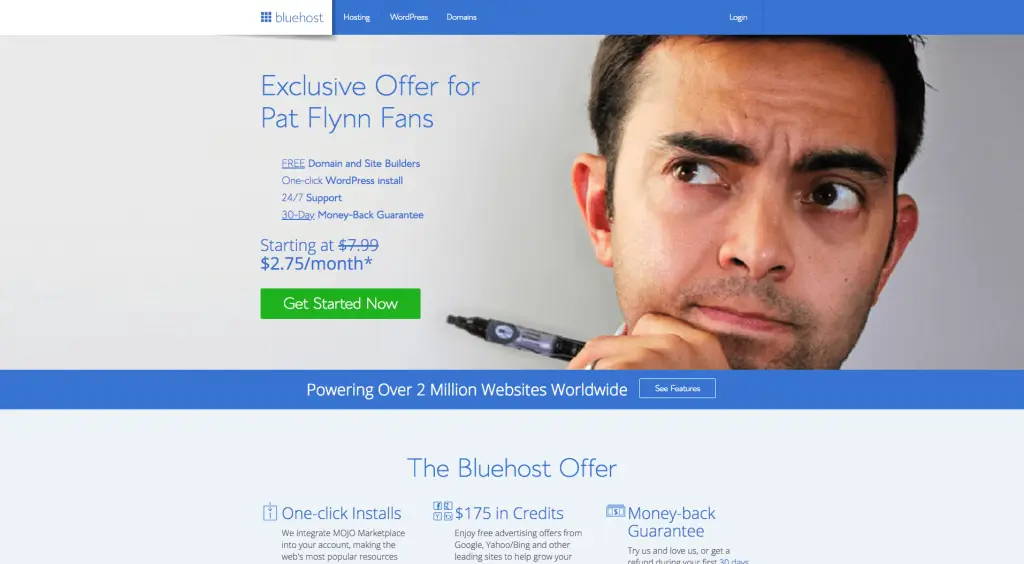
like you’re still there with them as they go through the purchase process.
The big caveat here is this will not always be possible, which is why it’s an advanced tip.
Some companies may not be open to creating a custom landing page for you, and even if they are, you may need to already be a successful affiliate with them before they’ll agree to it.
When the Going Gets Tough
As with anything in online business, affiliate marketing will throw up roadblocks along the way.
Here are 6 ideas to help you keep your head up when things get rough.
17. Focus on how it will help your audience (not features, but benefits)
When talking about the product to your audience, no matter what platform you’re using or methods you choose to deliver your content, always focus more on the benefits for your audience.
In other words, what’s in it for them?
In each section of your blog posts, in your videos, in podcast episodes, don’t forget to remind your audience exactly how the product will help them.
Features are good, but benefits are what people want.
“Sure, it’s cool that this link building tool helps you get links from high Page Ranked sites, but the benefit is that your site will have more authority, so you’ll rank higher in Google and get more traffic.”
“Sure, it’s cool that this in-ear headphone comes with a flat, tangle-free wire, but the benefit is so that you don’t get frustrated trying to untangle the darn thing every time you take it out of your backpack or pocket.”
If you’re having trouble with the whole feature vs. benefit thing, it’s okay—a lot of people get confused, but the simplest way to understand it is to think of a feature, then add the words “so that.”
“We have this feature, so that you can blah blah blah.”
It works every time.
18. Believe in your recommendation
If you really believe in the product, in your recommendation, then so will your audience. If you have motives other than trying to help people out or give them something they need—if it’s for the commission, or you’re just doing a favor for a friend who owns a product—then you’re not going to perform as well with your sales.
Believe in it, and your audience will believe in you.
19. If it doesn’t work out, try another offer
Let’s say you have an affiliate product you’d like to promote.
You’ve used the product, it’s great, and you know it will help your audience.
You set up a promotion with links in your posts, create an epic post with videos, the whole nine yards . . . and it doesn’t work out.
It’s not the end of the world.
Sometimes you think your audience will respond one way, but they surprise you and go the opposite way.
The campaign you thought was going to be a home run turns out to be a bust.
Why? Figure out why and evaluate the circumstances, and try again knowing what you now know from what you learned.
Then use what you learned and try another offer!
It’s all a learning process, one that happens through taking action, and trial and error.
That’s what affiliate marketing is all about.
In fact, the more things don’t work out, the better, because the more likely you’ll be to eventually get to something that does work.
And the more you’ll learn along the way.
Related to that . . .
20. Test, test, test
As in the previous tip, test your offers, yes, but more than that—test everything.
Test how you promote, to see what your audience responds best to.
Test the placements of your links, the number of links within posts, whether they’re bolded or italicized, whether images work better, whether interviewing the owner helps, whether Thursdays convert better than Tuesdays for webinars . . . test everything you can possibly think of.
Test, test, test.
21. Make your own product instead
If all else fails, but you know there’s a market out there for a particular product that’s perfect for your audience, and it doesn’t exist—create it yourself.
Yes, this isn’t affiliate marketing.
And when you create your own product, you waive the benefits of affiliate marketing, such as not having to create the product, dealing with customer service, and other aspects of being a product owner.
But affiliate marketing doesn’t always work out, and there are advantages to creating your own product.
You get to keep people in your own brand.
You get to keep all the profits.
You can even set up your own affiliate program for other people to sign up and promote your product.
And lastly . . .
22. Be patient
No matter how quickly people say you can make money online, realize that it’s going to take time.
Relatively speaking, yes, things can happen pretty fast—that’s the beauty of online business.
You can have a site up today and start sharing content with the world, but in order to make an impact and really make money online, you’re going to need to get your message out there, and build relationships with people.
In time, this will drive traffic to your site, and eventually clicks, sales, and affiliate commissions.
Learn, but take action and keep learning as you go.
Things take time, but by following these tips, and everything else you learn in this post, you’ll give yourself the best chance to make things happen as fast as possible for you with affiliate marketing.
Learn to choose the right affiliate products and services
Your affiliate marketing success depends on choosing the right product mix for your audience. The Affiliate Marketing Cheat Sheet will teach you how to find the products best aligned with the needs of your audience.
Affiliate marketing mistakes to avoid
Affiliate marketing: it’s easy to do—and easy to do wrong.
Anyone can grab a link and promote it from behind the scenes. But successful affiliate marketing that delivers value for you and your audience in the long term?
That takes work.
It also means knowing what not to do.
We’ve covered how affiliate marketing works, how to start affiliate marketing, my top tips for succeeding as an affiliate marketer, and a whole lot more.
Now, I’d like to give you some insight into what to avoid when it comes to affiliate marketing.
I’ll start by sharing with you what happened to me the first time I ever tried affiliate marketing—and what I learned when I fell flat on my face.
Then, I’ll give you the four main affiliate marketing mistakes and traps you need to look out for as you’re getting started on your journey.
My $300 affiliate marketing mistake
First, let me tell you the story of my $300 affiliate marketing mistake.
It was 2008. I had just been laid off from my job in the architecture industry. In the months leading up to my layoff, I had been experimenting in online business with my very first effort, GreenExamAcademy.com.
As I was building Green Exam Academy to help others in the architecture industry pass the LEED Exam, I discovered affiliate marketing and learned how others were making money with it.
So I signed up for an affiliate network and I picked a product I felt would be okay for my audience and got an affiliate link (I didn’t really know if it would be okay—unfortunately, that wouldn’t become clear until later).
I set up a Google AdWords account to start advertising it, and created my first ad. In the ad, I drove people to click on the affiliate link for the product I was advertising.
A couple hours after publishing the ad, I saw that it already had a few hundred impressions—i.e., views by a visitor.
Not bad! After a few more hours, it was over a thousand impressions.
But how many clicks had the ad gotten?
Zilch, nada, none.
I waited and waited until I finally got my first click, but that person didn’t end up buying the product.
I had spent $300 on a couple dozen clicks, and those clicks had amounted to zero sales.
I began thinking about those clicks, and the people on the other end of them.
Who were they? What compelled them to click?
At that time, I was a terrible marketer and copywriter—but that wasn’t the biggest issue. What I realized after a short while was that there was really no way for me to know the answer to those questions about who was clicking on my ad or why.
I had created an ad based on a product I didn’t understand inside and out.
I hadn’t spent the time getting to know the product and understanding how it could serve my audience.
And by failing to do that, I was failing myself and my audience (small, at the time) who counted on me.
I had left them behind while I panned for gold in the wrong place.
A wake-up call for doing affiliate marketing the right way
My $300 mistake was a wake-up call.
I decided right then and there I wasn’t going to do that ever again. I learned how integral relationship building is to effective affiliate marketing.
My learning process would continue from there, of course, but the building blocks were set.
Affiliate marketing isn’t a quick, impersonal thing.
It’s the exact opposite. You need to start from an authentic place.
Affiliate marketing is about fostering genuine long-term relationships with people you trust, products you love, and companies that align with you and your philosophies.
And unless you truly know the product, have used it successfully for yourself, and can prove that to your audience, you can’t expect others to just take your word for it.
Any healthy relationship takes time to build and a great deal of trust.
And that’s what we need to focus on in our affiliate marketing relationships.
Too often, I see people wasting time and energy promoting products under the guise of affiliate marketing while ignoring the relationship aspect of things.
But affiliate marketing should be a natural extension of your authentic efforts to build and serve an audience—not a tack-on just to make a little extra money.
The four biggest affiliate marketing mistakes
On the spectrum of affiliate marketing mistakes, my $300 mistake wasn’t too serious. You can chalk that one up to a beginner’s lack of good judgment or experience.
But there’s a bigger picture here we need to talk about too.
Like everything, affiliate marketing has its positive and negative sides. And in fact, for a long time—and especially when I first started out in online business back in 2008—affiliate marketing has had a negative connotation.
I’ve made it part of my mission to show that affiliate marketing can be done in a legit way, one where everybody can be a winner.
But at the same time, because affiliate marketing is technically easy to do, it’s easy to fall into an aggressive, income-first approach rather than one centered around serving your audience.
I want you to be aware of how affiliate marketing can be abused, or how your efforts can be derailed.
My intent isn’t to worry or scare you from going down the affiliate marketing route, because it can be a fantastic opportunity if done the right way—but I do want to arm you with knowledge about the traps to look out for as you build your affiliate marketing business.
I feel it’s my responsibility to show you how to do affiliate marketing right—and that includes knowing how not to do it.
Whether you’ve just started learning about affiliate marketing, or you’re already promoting other people’s products via affiliate links and want to make sure you’re going about it the right way, I’m going to share with you four rules to keep in mind in avoiding the dark side of affiliate marketing.
These are the four biggest traps to look out for, so that you have an even greater chance to succeed with this powerful tool that can help you better serve your audience, generate an income, and build relationships with the owners of the products you’re promoting.
The four biggest affiliate marketing mistakes:
- Promoting a product that doesn’t make sense for your audience
- Not keeping an eye on the quality of your audience’s experience
- Not being honest about a product or promotion
- Earning all of your income from affiliate marketing
Okay. Let’s talk about these four dangers you need to look out for on your affiliate marketing journey.
1. Promoting a product that doesn’t make sense for your audience
Perhaps the biggest affiliate marketing mistake people make is not promoting a product that actually makes sense for their audience.
This often happens when someone takes an income-first approach rather than a serving-first one.
You should look for solutions that can help your audience—whether there’s an affiliate opportunity there or not.
If there happens to be one, great. That’s a bonus.
If there isn’t, but you know the product could still be helpful to your audience, it’s your responsibility to share it with them.
Since my brand is focused on helping people build successful online businesses ethically, the products and services I promote are all things that support this focus: I recommend services that help people host their website (Bluehost), start an email list (Kit), plan their editorial calendar (CoSchedule); audio and video gear to create great content; and books and courses, both mine and others, to help people learn and improve their skills.
Most of these are things I recommend as an affiliate—but a good number of them are not.
Even if I can’t form an affiliate relationship with a company, if their product is the best one for my audience, I’m going to recommend it.
As your brand grows and you start to build an audience, you’re going to get noticed. The affiliate marketing opportunities will start to trickle in, as companies see the traffic you’re getting and the trust people are putting in your brand.
These companies will also know you’re a human being who can potentially be swayed by a commission.
Sometimes, they’ll offer you payments for simply sending them leads, because it’s basically easy advertising for them.
They know how much money they need to spend, and how many leads they need to collect, to convert a certain percentage of them to customers.
Either way, as you grow, you’re going to notice an increased number of those kinds of inquiries—many from companies you’ve never even heard of before.
At the start of my online business journey, every couple months I’d get an offer from a different company saying, “Hey, we have this new product. We think your audience would really like it. Promote it to your audience and we’ll give you $75 for every person you send our way.”
I implore you, please: do not be persuaded by the dollar value of the commissions you’ll be offered.
Sometimes when a new company reaches out to me with an affiliate offer, I’ll look at the product and realize it’s obviously not a fit for my audience.
In those cases, it’s easy to say, “No, thanks.”
But when you’re just starting out, the promise of a commission can make it hard to see things clearly.
You might think, “Wow, this opportunity is in front of me right now. Maybe I should say yes. What damage could it do?”
The damage it could do is potentially huge: the destruction of the trust you’ve worked hard to build with your audience.
That’s why my recommendation is to stay on the safe side by always offering and recommending products you’ve used before and understand, so you know exactly the kind of experience people will have with them.
You should also get to know the company itself, and ideally have a personal relationship with someone in a leadership role there.
That way, you can be certain that the company behind the product you’re promoting is one that will take care of your people.
Again, be careful.
Often companies will reach out to you based on a simple algorithm—if you’ve reached a certain threshold of social media followers, for instance, they’ll send you a message asking if they can pay to get in front of your audience.
You may have even heard of these products, and know they have a good reputation. Sometimes those products may actually be a great fit.
Still, don’t immediately say yes to the opportunity.
You need to be aware of this, because the vultures start to come out at a certain point once you start to gain some notoriety in a space.
In the early days, I’d get affiliate inquiries from companies every couple months.
Now, almost every day, I get emails from companies I’ve never heard of that want to get in front of my audience.
The nature of these offers also ranges more broadly now, probably because my audience is much larger.
For instance, I sometimes get offers from financial planning companies to get in front of my audience for tens of thousands of dollars.
But it’s not in my best interest to say yes, because even though those services might help my audience, financial planning isn’t what my brand is about.
Bombarding my audience and saturating my brand with stuff that doesn’t fit would dilute the brand and confuse people’s perception of what I stand for.
I don’t need to give my audience financial planning assistance to help them the best way I possibly can.
There are plenty of great brands out there that focus on financial planning, but it’s not my realm.
So, realize you have a choice, and that it’s okay to say no. Opportunities will come your way, but your priority should be to protect your brand and your reputation.
Choose wisely.
2. Not keeping your eye on the quality of your audience’s experience
This next one is similar to #1, but it has more to do with how things can change after you start promoting what seems to be a great product that you know is a good fit for your audience.
Let’s say you recently started promoting a new product, and it’s working out well. Everybody’s happy—you, your audience, and the company.
But then the company gets bought out, and new management takes over.
This creates a ripple through the entire company, affecting your audience’s customer support experience with the product.
Sound unlikely? It’s happened to me before, with the web hosting company Bluehost.
I still recommend Bluehost, and in fact, they’ve been one of my top affiliates over the years. But it hasn’t always been a smooth road.
I began recommending Bluehost in 2009, and was soon making a few thousand dollars a month from affiliate promotions. Even better, the company was taking great care of my audience.
Everyone was happy.
The next year, my monthly income continued to grow into the five-digit range. Things were looking good.
But then in 2013, I started getting a few emails from people who weren’t too happy with Bluehost’s customer support, especially when they had issues with the service.
The following year, things got a little better—the negative emails dropped off—but then they got worse again.
At that point, I started to really pay attention.
I decided to fly out to Utah to meet with the company and share my concerns with them directly. I met with the founders and told them, “Hey, this is not okay. This can’t happen.”
The Bluehost team told me they were aware of the issues, and that they were making changes to address them.
I said, “Okay, but these changes need to happen now.” Of course, with a big company like that, I understood changes can take time, but I wanted to do as much as I could to move them along.
Thankfully, the Bluehost team took my words to heart and put together an action plan to address the issues.
They also agreed to let me offer my audience a special connection to a customer support person who could take care of them more quickly than the company’s traditional support channel.
During my visit to Bluehost headquarters, I also kept in touch with my audience about how my meeting was going, and what the Bluehost team was doing to improve things.
I sent an email to my list about what was happening during my visit, and wrote about the experience in my May 2016 Income Report.
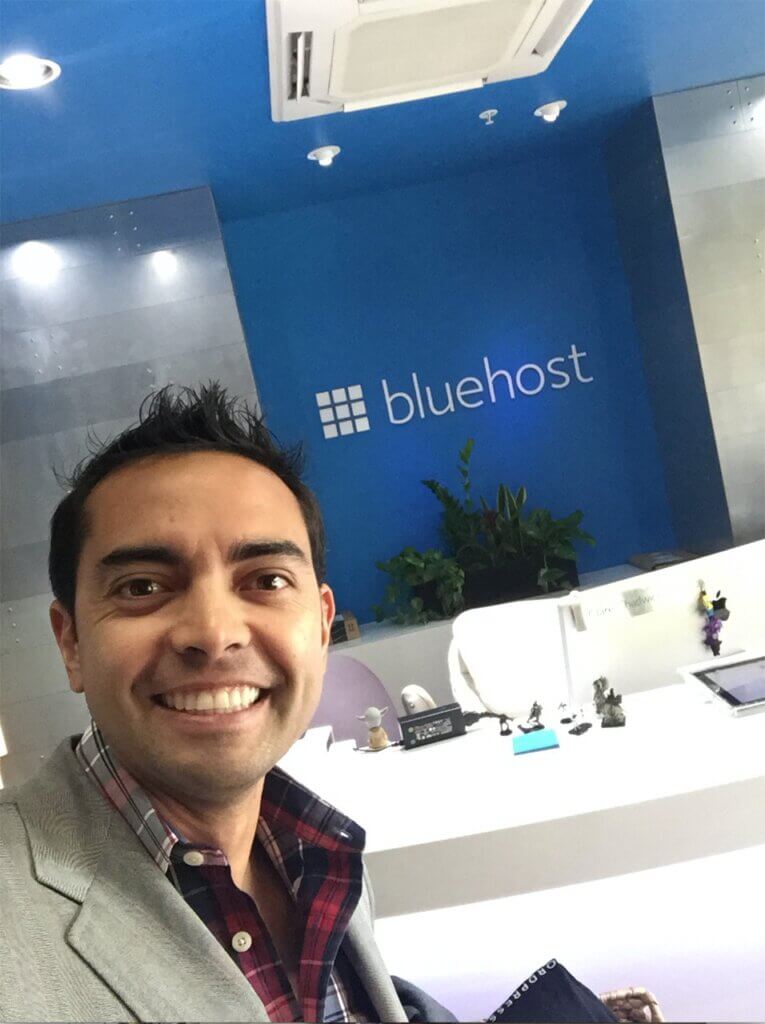
Although this kind of situation may not occur with every company you partner with as an affiliate, you have to be open to it.
Companies grow and evolve, and people come and go. You can’t assume that if things are going well, they always will.
The lesson here, especially for affiliate relationships you’d like to maintain for the long term, is to keep close tabs on your audience’s experience with the product.
In addition, you should cultivate relationships with the product owners, so they know how important your audience’s experience with the product is to everyone involved.
In an ideal world, your audience’s experience with a product should only improve over time—but if it’s going in the opposite direction, you’ll have to act to make things right, and having a direct line to the company leadership makes it easier to do that.
You also need to have a backup plan.
Right now, I’m really comfortable promoting Bluehost, especially knowing they have a customer support person I can send people to when things go wrong.
But there’s a point at which, if things were to go badly again, I’d consider promoting a different hosting provider.
Most of my audience is still having an amazing experience with Bluehost, but it’s important to stay aware and be prepared if things need to change.
3. Not being honest about a product or promotion
When I recommend products, I’m always very honest about what the product can and can’t do.
But I’ve been on the other end of this before—and not in a good way. I won’t name names or products, but let’s just say I’ve been recommended products that came with certain promises, promises that didn’t come to fruition.
These were products that, shortly after I started using them, I realized they weren’t at all what I‘d expected.
When you’re promoting your affiliate products, you need to make sure you set the right expectations for your audience.
Otherwise, what happens? You lose the trust of the person to whom you recommended that product.
In one case, someone I knew and looked up to recommended a software tool to me.
His recommendation also came with some lofty claims of how the tool could help me. I ended up buying the software based on his recommendation.
But what I quickly found was that in order to take advantage of the capabilities I was promised, I would have had to pay more—more than five times the price I was paying already.
Needless to say, I wasn’t happy about this.
I shared my frustration with the person who’d recommended the tool to me, and he apologized. It was an oversight on his part, and we’re still on good terms today.
Our story turned out okay—but this won’t always be the case if you’re not totally honest and upfront with your audience about the affiliate products you promote.
You have to be careful, because if you make a mistake that skews your audience’s expectations, you might lose them for good.
You need to be totally honest about what a product can and can’t do, and make sure you’re not recommending it to someone who’s not a good fit for it.
What if you find yourself in a tricky situation where you’ve promoted a product to your audience, then realized later that it wasn’t what you thought it was?
Thankfully, I have a special “rule” that comes in handy here. I call it the 8 Mile Rule.
[SPOILER ALERT] If you’ve never seen the movie 8 Mile, Marshall Mathers (aka Eminem), plays the main character, a rapper named B-Rabbit. In the finale, B-Rabbit faces off against another rapper in a huge rap battle.
B-Rabbit decides to rap about all the weird things about himself, things his opponent would likely call him out for in his rap.
Why does he do this?
By calling himself out first, he leaves his opponent without any ammunition to use against him.
Do you see where I’m going with this?
When you’re promoting an affiliate product, take the 8 Mile approach.
If something goes wrong, be the first one to say something.
If you make a mistake, own up to it.
Perhaps you recommended a product you realized wasn’t a good fit for your audience.
The quicker you can say, “I’m sorry.
That product wasn’t the right fit for you.
I hope you’ll give me the benefit of the doubt and stick around,” the more likely your audience will be to do that.

This rule is handy for a lot of other areas of your business, too. It’s all about taking ownership and being honest and forthright.
This is not always easy to do, but always the right thing to do.
Being honest fosters trust, even if the circumstances aren’t totally favorable.
And if you’re being honest and serving your audience in a way that’s valuable to them, they’ll often jump at the chance to help you back.
This is where the law of reciprocity comes in—when you do something helpful for someone, they often feel compelled to do something for you in return—and affiliate marketing can be an amazing way to give your audience a way to pay you back.
So when you tell people upfront, “Hey, you know what? This is a product I’m promoting as an affiliate, so I get a commission if you go through that link,” I guarantee some of those people will be excited by the opportunity to click on that link.
There are people out there you’ve served who are looking for ways to pay you back.
So make it easy for them.
4. Earning all of your income from affiliate marketing or treating it like a get-rich-quick scheme
This leads me to my final point related to the dark side of affiliate marketing.
That is, you don’t want all of your income to come from affiliate marketing.
Back when I started out—and this is still true today in some spaces—a lot of people were doing affiliate marketing by running promotions, not through a brand they’d created or trust they’d earned from an audience, but by using copywriting, targeting, and advertising techniques to get people to click on affiliate links.
Remember my $300 mistake?
Before I ran that fated ad, I signed up with an affiliate marketing network.
This is essentially a site that allows you to sign up and choose from a huge number of products you can promote.
Once you pick a product, you get a link you can share with as many people as possible.
Because most people who go this route don’t already have a brand established, they have to resort to advertising—things like Google Adwords—to get their link in front of people.
Unfortunately, there are several things wrong with this model.
As you learned from my $300 mistake, if you just throw a link up there hoping it’ll do all the work for you—well, it won’t.
That’s not to say that you can’t make money with this kind of affiliate marketing. You can, if you go about it smartly.
But there are still two main ways you can go wrong with this model.
First, as soon as you stop putting effort into it, the income stops flowing. It’s not passive.
Second, because it doesn’t require you to build a brand, it means it’s not unique to you. Just about anyone could leapfrog you if they master the copywriting and targeting required to be successful with it.
As a result, this kind of affiliate marketing can become a very scary game to play.
That’s why I recommend instead that you take the time to build your own brand and grow an audience you can serve.
Build that audience’s trust in you as the go-to resource in your area of expertise, not just someone they don’t know who’s only serving them ads.
This is at the heart of how I teach online business: to help people become recognized for their efforts in serving an audience, whether that’s through creating their own products, blogging, podcasting, building physical products, or affiliate marketing.
Focus on building your brand and serving an audience.
When you make this your primary aim, you’ll find you have plenty of options to make money—with affiliate marketing being just one of those options.
Think about it this way: With whatever path you choose to generate an income, make sure you give the people you serve a way to thank you.
If you’re not thanked for the products you’re promoting, you’re doing affiliate marketing wrong.
In episode 9 of the Smart Passive Income Podcast, author and online business consultant Nicole Dean shared one of the most memorable quotes from the hundreds of interviews I’ve done.
She told me the motto of her business was “to make the web and the world a better place.”
And when you approach your business like that, it trickles down to everything you do.
It affects how you advertise and promote.
It affects how you interact with people.
It helps you look beyond strategies and tactics, like affiliate marketing, and stay focused on the most important thing: making things better for others.
So give your audience a reason to thank you, and the (affiliate) income will flow in.
Serve first to succeed with affiliate marketing
As we’ve seen, there is a darker side to affiliate marketing.
But if you know what to look out for, you can avoid falling into the common traps and mistakes that befall so many aspiring affiliate marketers.
As a reminder, here are the four keys to staying in the “plus” column with your affiliate marketing:
- Being careful to promote only products that make sense for your audience
- Keeping tabs on your audience’s experience with your affiliate products
- Being honest and forthright about the products you promote
- Not relying solely on affiliate marketing or using it as an impersonal, get-rich-quick scheme
Use these four keys as your guiding light, and you’ll be able to make the most of this powerful tool that allows you to tap into the incredible array of products, services, and tools out there that can help your audience succeed.
My best resource for beginner affiliate marketers: The Affiliate Marketing Cheat Sheet
This guide was my first ebook on the topic of affiliate marketing.
I wrote it after lots of trial and error with affiliate marketing—starting, failing, and eventually succeeding.
I learned a lot, and I came to believe that there’s a “right” way to approach affiliate marketing.
That’s why I created my free ebook guide to doing affiliate marketing right, the Affiliate Marketing Cheat Sheet.
Sadly, there are a lot of misconceptions about affiliate marketing out there, which is what this guide specifically focuses on.
In the Affiliate Marketing Cheat Sheet, I address these misconceptions by tackling some of the most common questions about affiliate marketing rules and strategies, including:
- What specific mediums work well for affiliate product promotion?
- How do I find my number one affiliate product or service?
- How do I make my affiliate product stand out in a crowd?
- How can I improve the relationship I have with the product owner?
At just 11 jam-packed pages, the Affiliate Marketing Cheat Sheet is full of insights I’ve learned through years of real-world experience in affiliate marketing—insights I’m excited to pass on to you.
Here’s what a couple readers have to say about how the Affiliate Marketing Cheat Sheet (formerly called Affiliate Marketing the Smart Way) has helped them:
“Pat’s guide, Affiliate Marketing the Smart Way, really lives up to its name. Soon after implementing his tips, I saw a sudden $500/mo rise in my income. Reading it was enlightening!”
—Mike Martyns
“I gained a lot in the 30 minutes it took to absorb such valuable information. It was precise and to the point—a tool that is ready and available for any newcomer to GET STARTED.”
—Louisa Barzey
The Affiliate Marketing Cheat Sheet is filled with all of my best advice on the topic, and makes a fantastic free “pocket” companion to this article.
Make affiliate marketing part of your success.
Learn how to:
- Find products to promote
- Stand out from the crowd
- Find tools to help you with the setup and execution
The sky’s the limit with affiliate marketing
If you’ve stuck with me for this whole post, then you’ve taken an exciting journey into the heart of affiliate marketing!
And you’ve hopefully emerged from that journey armed with some serious knowledge, tools, strategies, and possibilities to take with you as you strike out into the wide, exciting world of affiliate marketing.
As with anything, what you get out of affiliate marketing is about how you approach it and what you put into it.
If you treat it as just another tactic, then you’re not going to be very successful with it.
But if you treat it as a way to build more trust with your audience and serve them better, then the sky’s the limit.
So now that you’ve made it this far, what’s next?
Hopefully this article has given you a great starting point, along with a wealth of resources to support you as you strive to become a pro at affiliate marketing.
It will always be here for you as a free affiliate marketing resource, along with the Affiliate Marketing Cheat Sheet.
And beyond those resources, I’d love for us to stay connected as you go down this exciting path.
I cover affiliate marketing-related topics often on my blog and in my podcast episodes, so stay tuned there. And if you ever want to send me a note, whether it’s a question about affiliate marketing, a success story you’d like to share, or anything else related to online business and entrepreneurship, you can reach me at [email protected]. I’m here to support you on your journey, so let me know how I can best do that!
Cheers,

The post Affiliate Marketing – A Simple Step by Step Guide appeared first on Smart Passive Income.
]]>Starting a podcast and looking for ideas and topics? You're in the right spot.
The post Podcast Topics: 101 Ideas for Things to Talk About appeared first on Smart Passive Income.
]]>Have trouble coming up with podcast episode ideas? Whether you release a new podcast episode every week or once a month, coming up with consistently high-quality episode ideas can feel like a lot of pressure.
This demand for consistent content is one of the major players in the “podfade” phenomenon and a challenging aspect of being an independent podcaster.
In this article, we'll…
- share 101+ examples of podcast topics,
- lay the foundation for great content,
- provide practical methods for coming up with new podcast episode ideas,
- and outline ways to cultivate creativity throughout your podcasting journey.
And real quick before we dive in — if you're starting out and want to kick off your podcasting journey with aplomb, check out the SPI Community.
Contents
- Podcast Topics: 101 Ideas for Things to Talk About
- How to Find Topics for a Podcast
- Keep the Podcast Episode Ideas Coming

101 Podcast Topic Ideas
Starting your process to think up podcast ideas can feel intimidating, but don’t worry; you have a lot of options. Get your ideas flowing with these 101 topics to talk about on a podcast.
(And, if you're just starting out, don't miss out how to start a podcast guide seen by over 100,000 people!)
1. Learning a new skill
When brainstorming what to talk about on a podcast, why not record yourself learning a new skill you’ve been wanting to pick up?
Start a podcast about your journey learning to play the piano, paint, or sew—the list goes on.
2. Events/groups
Consider making a podcast about specific events or groups, such as:
- Local or national political groups
- Sporting events or festivals
- Marathoners, bikers
Good podcast topic ideas will often align with your own interests, allowing your enthusiasm to keep you motivated. So, pick an event or group that speaks to you.
3. Book reviews and summaries
Are you an avid reader? Let people know what you think of your latest picks with full reviews.
Or, for the people who don’t have time to read the books themselves, put your storytelling skills to the test with engaging summaries.
4. Book recommendations
Similarly, if you like books, you probably have a lot of recommendations.
You could focus the podcast on a specific genre, do different genres for different segments, or take calls from your listeners and give recommendations based on their interests.
5. Sports
If sports are more your thing, make a podcast recapping last night’s game, discussing industry news, talking about your favorite players, and more.
Don’t be afraid to find an angle; you could discuss odd or underrated sports only or go the sports business route.
6. People who know nothing about sports
For another creative twist on a sports podcast, you could invite people who know nothing about a sport to try to explain it, narrate the big game, or bring little kids on to commentate.
Learn how to start a thriving podcast
A replay of our most popular webinar
7. Location-based
People spend a lot of time in locations like the gym, coffee shops, etc., so why not go super niche and target them directly? Create a podcast dedicated to a specific place that people frequent to help them pass their time there.
8. Time-based
Use your podcast to accompany people through the seasons, holidays, bedtimes, morning hours before work, etc.
You could create a spooky-themed podcast during the month of October or a New Years’ self-help/resolutions-themed podcast. Or, if you want to go at a more regular pace, you could do a nightly bedtime story podcast.
9. How-to
A how-to podcast can be as general or focused as you’d like it to be. You could focus the entire podcast teaching your listeners how to do something from start to finish, make each episode a new topic entirely, or take a broader focused topic, like getting a job, with relevant episodes like “how to make a killer cover letter.”
10. Preparation
A preparation podcast is like a how-to podcast but with a preparatory focus. Discuss things like preparing for college applications, preparing for a big race, or even just how to prepare for social gatherings.
11. Movie and TV review
If you’re someone who always catches new movie releases, give people the thumbs up or down on whether they should check them out too.
Or, give TV show recaps and reviews after each episode airs, offering your opinions and speculating what will happen next.
12. All things cinema
For the cinephiles, start a podcast on all things movies. You could do your podcast on the history of cinema, on a specific film movement, or humorously cover all the worst movies you can find.
13. POV
What better way to give your podcast a unique flair than by showcasing a popular story from a new perspective?
Take a show’s season, a movie, a novel, etc., and go through the story from each character’s (or an unexpected favorite’s) point of view.
14. Comedy
If you’ve always been praised for your sense of humor, give a comedy podcast a go. Tell funny stories, perform comedy sketches, or talk about current events with a dash of your winning humor.
15. Travel tips and recommendations
Tons of people love to travel, making it one of the best topics for a podcast.
Give great traveling tips and recommendations, talk about travel gear, and more.
Don’t be afraid to pick a niche; you could do a luxury or budget theme, an outdoor excursion theme, or some combination of themes.
16. Travel storytelling
Allow listeners to travel along with you through your storytelling. Narrate your experiences, give funny anecdotes, and provide vivid descriptions of the places you go and the people you meet.
17. Travel interviews
Make a podcast where you interview the people you meet on your travels; ask their opinions on the city they live in, recommendations, and any interesting information they might have.
Or, invite travelers to come and document their travel experiences on your podcast without even leaving your home.
18. Expats
If you’re an expat, you’re familiar with how daunting it can be for those just getting started. Share your expat story, the steps others can follow, and provide advice.
You can create a community in your new home country by inviting other expats to share their stories and inspire others too.
19. Fashion
If you’re known for your taste in fashion, share your opinions or advice through a podcast.
Topics for podcasts in the fashion niche are extensive, too; you can talk about styling tips, where to shop, models, designers, funny red carpet mishaps, or runway reviews.
20. Beauty
Likewise, podcast ideas in the beauty industry are endless.
Make a podcast about beauty brand news, holy grail products, products to avoid, curly hair tips, or how to manage common skin problems.
21. Politics
There’s always something to talk about with politics; share your thoughts on current events, invite interesting speakers, and discuss the latest news from a political standpoint.
22. Pets
If you’re an animal lover, consider starting a podcast on pets. Pet-lovers will surely tune in if you provide them valuable pet care information, facts, and interviews from experts.
23. Wild animals
Similarly, if you’re passionate about animals, make a podcast giving facts about wild animals and where to find them. Interview people who have worked with wildlife and have them tell their stories.
24. History
You’ve got thousands of years of known human history to pick from, making history one of the most expansive topics for podcasts.
And if you’re already a history buff, you’re (at least) one step ahead. Choose an era you love to research and talk about, and do just that.
25. Street interviews with strangers
Love talking to anyone about anything? Interview strangers on the street on various topics. Here are a couple of podcast topic ideas you could try:
- Ask strangers their take on current events.
- Have your show’s listeners submit topics to interview strangers about.
- Interview people at mundane places, like outside the DMV.
26. Tech
The beauty of a tech podcast is that the tech industry is one of the fastest moving around—you’ll never run out of podcast episode ideas.
Keep people up-to-date on new products and advancements, security issues, or tech how-tos.
27. True crime
It’s no secret that true crime is one of the most popular podcast ideas. People love to speculate and search for the truth behind an interesting topic.
Find a mystery and do some digging; interview people of interest, research facts, and make speculations from there.
28. Law
Want to put your law degree to another use? Start a legal podcast. Talk about odd or interesting laws, inform people on laws they should know, or discuss legal ethics.
29. Celebrity news and gossip
There’s no shortage of celebrities, and they’re always up to something. Give people the gossip.
Report the latest celebrity news, speculate the behind-the-scenes context, and snag some interviews.
30. The top 10
People love to rank and see things ranked. Give them something to talk about with top ten lists for anything and everything. You can rank musicians from Canada, TV ads, animes, and much, much more.
31. Facing fears
Ever wanted to put your fears behind you? Make a podcast to share your journey.
Take things a step at a time; give your story, delve into the psychology behind the fear, invite specialists, and inspire others as you work to overcome it once and for all.
32. Nature
For the people who live in the city or don’t often find themselves outside, you could start a podcast that describes everything you see out in nature, amplifying the natural outdoor sounds for a serene effect.
33. Time-crunch
For those who just don’t have the time or attention span to sit through a long podcast, give them some quick facts, short stories, or extremely condensed how-tos.
34. You
So, you’re trying to figure out what to talk about on a podcast… why not talk about you? If you feel you have something to share, your unique experiences and perspectives, you might find that many people will relate.
35. Educational
Are you an expert on a topic or want to learn it yourself? Do a load of research or round up the information you already know into bite-size pieces to teach others.
36. Language learning
Give people a hand learning your native language, or another language you know fluently, with a language learning podcast! Share vocab and grammar tips, mistakes to avoid, and cultural tidbits.
37. Perspectives by the generation
Each generation tends to view things a little differently than the one before them; start a podcast comparing and contrasting views from all different generations.
38. Acting
If you’re an experienced actor, younger actors could benefit from hearing about your insights, the challenges you’ve faced, auditioning stories, etc.
Or, you might turn to interview other actors on their experiences and start a discussion from there.
39. Local foodie
Are you really into your local food scene (or wanting an excuse to be)? Start a podcast taking listeners to restaurants, cafes, and food trucks around your city.
Conduct some interviews, talk about the places, and review the food itself to create a full experience.
40. Household chores
Everybody has to do chores—now and then, anyway. Consider making a podcast where you talk about household chores and hacks.
You could talk about all things chores, record yourself doing your chores and have people guess what you’re doing, or simply give tips and hacks.
41. Marketing
No doubt, the marketing industry is incredibly popular; if you have some insight or expertise from working in the industry, or find marketing data and trends fascinating, make an informative podcast about it.
42. HR
Start a podcast about what it takes to be in HR: the skills people need, the recruitment process, and difficulties they might face.
43. Live events
Go to live events solo or with a friend and chat about it—provide interesting, in-depth coverage with a full review. Interview people at the event and get their thoughts too.
44. Business
Know a thing or two about running a business? More and more people are curious to start their own and could use some insight and actionable advice, so start a podcast with all the business know-how.
45. Medical
If you’re a health professional, why not start a podcast in your field? Answer questions, talk about fascinating medical conditions or discuss medical policies.
46. Music
Does your life revolve around music? Make a podcast that dives into the lives of your favorite bands, discusses the industry, or gives your local indie bands a spotlight.
47. Self-Help
Make a podcast to help others on their self-improvement journey. Discuss topics like focus, stress, depression, and more. Provide tools and information to help overcome personal struggles and share inspirational stories.
48. ASMR
ASMR stands for Autonomous Sensory Meridian Response, and many people find it relaxing to listen to. Whisper to your listeners on a variety of topics, providing them a calming experience or sleep aid.
49. Freelance
Whether you’re a freelancing newbie or pro, invite people along on your freelance journey with a podcast. Share your experiences, advice on how to get clients, business and organization tips, and more.
50. Investing
If investing is your thing, make a podcast discussing strategy, market news, and giving your best “this is not financial advice” speculations.
Go for a penny stock, REIT, tech, or another niche to make your podcast a go-to place for specific topics.
51. Ads
Ads—love ‘em or hate ‘em, they often give us something to talk about. Rank the worst of the worst or the best ads out there, or provide some analysis and industry insight.
52. Casual advice
Everybody needs a little advice sometimes. Let listeners call in, share what they need advice on, and give the advice yourself or bring someone else in to help.
53. Quote of the day
Share a quote each day; this could be business, motivational, or literary quotes for people to start their mornings with. Analyze and dive into the quotes, and let people know where they can read more.
54. Blogs and blogging
Blogging is still prevalent across the internet. However, it can be surprisingly difficult to find good ones. Make a podcast that covers the best blogs in one or more niches.
Alternatively, create a podcast that helps bloggers get started with tips and other helpful information.
55. Cooking/baking
There are a lot of different options for a culinary or baking podcast; you can give recipes, focus on the culture behind dishes, talk about food science, create peaceful ASMR baking sounds, and the list goes on.
56. Wedding
If you love weddings or are a wedding expert, share what you know for all the newlyweds-to-be.
Or, share your best funny, dramatic, or sweet stories—basically, the podcast version of a 00’s romcom.
57. Day trip
Take listeners with you through your steps to plan and go on day trips. Invite some friends or family and let the conversations flow.
You could also let viewers pick or guess where you go to add extra engagement.
58. Philosophy
If sitting under apple trees or questioning the absurdity of life sounds more like you, start a philosophy podcast. Discuss one or multiple philosophical schools, interview leading thinkers, and have healthy debates.
59. A hiking/camping
Make a podcast about all things hiking and camping; talk gear, stories, and advice. Take listeners along with you for a peaceful or exciting experience.
60. Astrology
If you’re an astrologer or simply into astrology, consider doing a podcast all about it. Analyze the birth charts of famous people, your listeners, or go deeper into the philosophy of astrology.
61. DIY
Everybody wants to know how to do things themselves, so teach them how with a DIY podcast. You can focus on themes like organization, repairing clothes, or DIY crafts.
62. Social media
Everyone and their mom is on social media, so consider taking advantage with a social media-themed podcast. You could discuss social media companies, hashtag trends, influencers, marketing, and more.
63. Musical instruments
Invite listeners to learn new instruments with you, share your knowledge on an instrument(s), or teach people how to play.
64. Weather
Who says talking about the weather has to be boring. Make a podcast going in-depth about the weather. Discuss extreme or pleasant weather, science, forecasting, and how to prepare for certain weather conditions.
65. Adrenaline junkies
Take listeners along on courageous outdoor activities like skydiving, bungee jumping, paragliding, and more.
66. Sailing
Make a podcast taking listeners out to sea with you, detail your sightings and experiences, or give educational how-tos.
67. On the road
Always on the road? Start a podcast narrating your experiences on the road, whether you’re just driving around for fun, for work, or you live on the go.
68. Paranormal
Raise some hairs discussing paranormal phenomena. Invite people to share their close encounters, narrate ghost stories, and share your own spooky sightings.
69. Nutrition and weight loss
Make a podcast helping others with all things nutrition and weight loss. Share the science, helpful tools and information, meal ideas, foods to avoid, and more.
70. Home improvement
With some home improvement knowledge in your tool belt, start a podcast about all things home renovation and repair, home design, and general home DIYs.
71. Gameshow
Get people involved with your very own gameshow podcast with tons of fun segments.
For some gameshow podcast segment ideas, do one segment with a classic game (e.g., trivia), another where you take that classic but add an extreme twist, or try making your own whacky game for a segment.
72. Improv
What are some things to talk about on a podcast for improv? The beauty of this one is that you don’t have to plan much ahead. Start with any random topic and put your improv skills to the test from there. Consider inviting your listeners to join in the fun.
73. Art
There’s no shortage of good podcast topics for an art-themed podcast. Talk art theory, art history, the modern industry, or place a spotlight on underrated or minority artists.
74 Feminism
Make a podcast discussing current events and topics from a feminist perspective, talk about theory, and invite activists and authors on to your show.
75. Taxi/Uber driver interview
Many of us are familiar with the chit-chat you make with Uber and cab drivers—but what if you took the conversation a little deeper. Make a podcast interviewing drivers about their story and their experiences.
76. Mystery
Keep people guessing; create a podcast with a secret theme and hide clues within stories that seemingly have no rhyme or reason. Wait until the final episode of the season to reveal the theme and award listeners that got it right.
77. Human rights
Take a more serious tone with your podcast and discuss human rights. Cover parts of the world in violation of these rights—in need of help—and create awareness with options to help out.
78. Gaming
To appeal to all the gamers out there, you could make a podcast about a specific game you love, review multiple games, cover new releases, talk trends, and so much more.
79. Short story/poetry
If you’re a writer or just a lover of short stories and poetry, create a podcast where you immerse your listeners through readings of short literature and poems.
80. Children’s stories
Similarly, if you have strong spoken narrative skills, make a podcast dedicated to reading out children’s stories to keep kids entertained on the bus, in the car, or as a bedtime story.
81. Dating
Make a podcast all about dating; share date night advice, activities, and invite listeners to share their funny, bad, or sweet dating stories.
82. Relationships
If you’re somewhat of a cupid or just like to play one, offer relationship advice to listeners and guests, or invite a professional to share their expertise.
Another option: create a podcast with couples games and let people share their experiences and funny anecdotes.
83. Wine
Turn your love of wine into a full podcasting gig.
Wondering what to talk about on a podcast for wine? You could discuss wine varieties and pairings, rank and review wines, or even interview sommeliers.
84. Coffee
If you’re a coffee enthusiast, share your passion and teach people about the world of coffee. Cover brewing techniques, bean fermentation, and all other coffee-related knowledge.
85. Boozy
Give people a place to turn to when they have a glass at the end of the day. Talk about what you’re sipping, have a casual or lively chat with a guest or listener, and review the drink at the end.
86. Documentary
Wanting to deep dive into an interesting topic? Start researching and conducting interviews for the inside scoop, and make an enthralling documentary podcast.
87. A look into an industry
Take listeners behind the scenes of an industry, from publishing to farming, showcasing its inner workings.
88. All things geeky
Start a podcast to geek out with your listeners about a topic(s) of your choice. Create a community of discussion around The Lord of the Rings lore, Doctor Who, programming, or grammar.
89. Retirement
If you’ve retired yourself or know a lot about retirement, share wisdom on how people can set themselves up for a successful retirement.
90. Meditation
Provide peaceful meditations to help your listeners relax. Your meditation podcast could be as short as 5 minutes or as long as a full night’s sleep. Pick a focused topic like stress, sadness, motivation, etc.
91. Psychology
Create a space to discuss the human mind and behavior; focus on mental health, psychoanalyze fictional characters, or take a look at certain psychological phenomena.
92. AMA
Take a page from Reddit’s book and create an “Ask Me Anything” podcast. You can answer questions as an industry professional, an author, or simply anything about you—or anything you’ve done—that people might want to know about.
You could also add this to your list of good podcast segment ideas.
93. Habits
Want to form better habits? As it turns out, so do a lot of people. Start a podcast where you can take your listeners on the journey of forming better habits together.
94. Alternative living
There are several different kinds of alternative living out there. You could do your podcast on what it means to be a minimalist, a van-life person, or a WWOOFer.
95. Bad bosses
A lot of us have had bad bosses, but at least they make for good stories, right? Yep, bad bosses are a podcast topic idea many can relate to, so you won’t have any shortage of listeners to tune in or share their stories.
96. A day in the life of the successful
We’re used to hearing the broad, vague answers on how successful people found their great success, but wouldn’t it be nice to know what they actually do on a daily basis?
Interview the people who have it all figured out, following their day from breakfast to their nighttime routine to give listeners up-close inspiration.
97. Spotlight
Want to put a movie, event, destination, artist, or anything else in the spotlight? Pick something amazing that’s underrated or trending to feature and go in-depth with all facts. The podcast episode ideas here are endless.
98. E-commerce shop owners
More and more people are getting into E-commerce. Get the inside scoop from shop owners to find out how they got their start, their favorite tools, tips, and more, and share it on your podcast.
99. Mythbusting
There are a lot of widely-believed myths floating around; explore these myths on topics like history, science, nutrition, etc., and reveal the truth to your listeners.
100. News
Sure, there’s not much new about a news podcast, but there are several ways you can switch things up. For example, only discuss only good news or focus solely on environmental news.
Or, try out some podcast segment ideas to switch things up, like a rapid-fire Q&A or a round of Mario Kart with your guest to keep things interesting or lighten things up.
101. Podcasting
Why not start a podcast on podcasting? The sky is really the limit for podcast topic ideas here.
You can take people along on your own podcast journey, provide advice (tech tips, how-tos, etc.), talk about podcasting industry news, discuss other podcasts, and interview other podcasters.
Ready to learn podcasting the smart way?
The SPI Community has the courses, resources, support, and accountability you need.
How to Find Topics for a Podcast
1. Lay the groundwork: Know your audience
Ultimately, your content ideas won't get far without a solid understanding of your target audience and what they want to hear. And how well your ideas land once you choose them is heavily dependent on getting this step right.
So if you aren't already clear on the audience you want to reach, this is an essential place to start.
Knowing your audience doesn't only help you develop more ideas for episodes but also keeps you from experiencing creative burnout. If you're trying to create content for an audience whose needs you aren't familiar with, you'll run dry pretty quickly.
So if you don't already have a good read on your audience, start by asking yourself who you want to reach with your content, being as specific as you can. What's your target audience's age and geographic location? What are their struggles, goals, and interests?
Some podcasters find it helpful to create an avatar to visualize who you want to reach.
A well-defined listener demographic narrows your focus, gives you invaluable insight, and goes a long way toward connecting you with a wealth of podcast topic ideas.
2. Find out what's already been done
Before you try to develop ideas for episodes, it's best to survey the land to see what's already been done with your podcast topic. From there, you have a strong foundation for coming up with your own unique angle on the issue.
If you don't yet have any ideas, researching the competition can help get your gears turning. And if you have a vague idea for a possible episode, you can use this research to see what other creators have done with the topic. Here are a couple of ways you can start.
Research competitors & fill in the gaps
Researching episodes in your podcast's genre is a powerful tool for seeing what ground is already covered and what gaps still exist. The only way you can fill in said gaps is to consistently keep an eye on other podcasters' content and do something different from the rest.
Search out other shows and find ways to answer questions better than they've been before. You can also spin a topic that's been done a thousand times before with your own unique take.
You can go to Apple Podcasts > Browse > Categories to find your podcast's genre and search the top shows within its category, or just search a topic in the search bar. Browsing other podcast episodes is a great way to quickly survey your genre and see what kind of content is out there.
You can also run more specific searches using tools like Listen Notes for a deeper, more advanced search. This tool lets you tailor searches to quickly get an idea of the shows within your podcast's niche.
Search the topic on YouTube
Similar to researching the competition on Apple Podcasts (formerly iTunes) or Spotify, YouTube is a great way to see what people are already doing with your topic so that you can veer from it with your own take on the subject.
This method works best as a way to see what's already been done with your topic idea, vs. finding new ones—although you might end up finding some along the way.
Once you get an idea of what content exists around a topic, you'll have a sense of what you can do to stand out. From here, you can get more creative using tools to help generate specific ideas.
3. Use idea-generating tools and techniques
Creativity isn't just about waiting for inspiration to strike; there are many tools and tactics you can employ to help get your gears turning. Here are ten methods you can use when you need some assistance brainstorming episode ideas.
Answer the Public
Answer the Public takes the data from over 3 billion daily Google searches and puts them into one big well of data—and it's a treasure trove of episode ideas for podcasters.
The tool works by taking data from search engines like Google and collecting every phrase and question the public asks about virtually any topic you can imagine. Let's say you have a podcast on entrepreneurship and are considering doing a podcast episode on getting started. Just enter “entrepreneurship” in the search bar (it's usually best to keep your search to one or two words vs. a phrase or question).
The site breaks down your topic into questions related to the topic, comparisons to help you bring in other related issues, and even a list of common searches for each letter of the alphabet (i.e., “entrepreneurship books,” “entrepreneurship courses,” etc.).
“Google searches are the most important dataset ever collected on the human psyche.” — US data scientist Seth Stephens-Davidowitz
Answer the Public gives non-paying customers one free search per day, and the good news is that's more than enough for podcasters. One search gives you hundreds of ideas per topic the first time around and enough to chew on for quite a while.
If you want unlimited searches and a deeper dive into other pro features, you can upgrade to the Pro plan for $99/month (and cancel anytime). Again, this isn't necessary for the vast majority of podcasters, and the free version should do just fine.
Google the alphabet
In our opinion, Answer the Public is the best way to get an alphabetized list of searches on your topic. But what if you don't like the platform, feel stifled by the once-a-day search limit, or just want to do the research yourself? You can use the “Google the alphabet” technique to access some of the same information—with a little more footwork on your end.
Here’s how to do it. Open Google and enter your podcast’s topic. For example, you could enter “entrepreneurship for” or simply “entrepreneurship.”
Then, enter the first letter of the alphabet after your search phrase to let Autocomplete work its magic. Other ideas automatically generate when you type in “a,” letting you see what people search for related to your entry.
Next, enter “b” and continue going through the alphabet until you get enough ideas jotted down. You can go back and alter your phrase or question to get more ideas or a slightly different slant on the topic, and this can usually get you pretty far.
Again, Answer the Public does this for you automatically, but it can be helpful to know how to do it yourself, too.
Ask your social media followers
Social media platforms like Instagram and Facebook have made it simple to run polls, take Q&As, and stay connected with your audience's struggles and questions.
If you aren't already familiar with this feature, just take a picture or video in your stories, select the “poll” icon and place it in your post. You can ask questions like “What content do you want more of?” or “What's something you wonder about but are afraid to ask?”
You can also turn the tables and run a Q&A to let your audience ask you the questions. Running social media Q&As is a great way to get content ideas with little effort.
Ask your podcast audience
If you don't have a big social media presence yet, you can directly poll your podcast audience instead.
Asking questions via the podcast is an excellent way to reach your core audience and most loyal listeners—the people who care most about the content you create.
One of the most direct ways to get feedback from your audience is by posting a survey in your show notes using a tool like Survey Monkey. You can announce the survey in your episode and even provide an incentive for completing it, like a free ebook, guide, or cheat sheet.
Researching your topic is great, but nothing beats getting feedback directly from your audience to use as inspiration for future content.
Search Reddit & Quora
Reddit and Quora are network communities featuring forums based around people's interests and exist for nearly every topic imaginable.
These platforms are an excellent way for podcasters to get inside the heads of the public to get you brainstorming and help connect you with specific, niche questions you wouldn't find elsewhere.
Continuing with the entrepreneurship example, you can search these communities for related subreddits and see what kinds of questions the public has about it.
Forums attract people passionate about the topic, making them great resources for finding those nitty-gritty questions and untapped topics.
As a bonus, if you have an episode that answers a question, you can freely promote your own podcast (in the form of an answer). So you might attract some new listeners in the process!
Make a list of all your ideas (good and bad)
Some of the best podcast ideas come from writing down all your ideas—without judgment or holding back. Just list out your thoughts until you hit a designated number, let's say 50. If you write 50 ideas, you'll not only get your creativity flowing, but you'll likely come up with several unique ideas you wouldn't have thought of otherwise.
If you prefer, you can set aside a designated time, say 20 minutes, to write as many ideas as you can on a sheet of paper or in your Notes app.
The main takeaway here is to not second guess your thoughts, overthink, or hesitate to write them down. And when you find a good idea, you can flesh it out using a similar technique called freewriting.
Take the idea you want to explore, and write out your stream-of-consciousness thoughts. Set a timer and write everything that pops in your head. You'll surprise yourself with the ideas you can generate when you relax, lower the stakes, and get your thinking brain out of the way.
Advanced searches on Google & Twitter
Twitter can be an excellent tool for seeing what people are saying about a given topic, and a simple search on your subject matter can yield a lot of helpful results. For even more tailored results, you can use the advanced search filters to narrow your search by date, hashtags, accounts, and mentions.
You can use Twitter's search option as a time capsule to view past conversations or stay current with what's trending.
Google also has an advanced search tool that lets you tailor your search results with more exact parameters. Most people using Google results stop after the first one or two pages, and in podcasting, using the same sources can lead to a lot of repeated content.
Narrowing your focus using advanced search tools is key to finding highly relevant, relatively untapped podcast ideas.
Join Facebook groups
Like Quora and Reddit, Facebook groups serve as a helpful forum where people gather and discuss a given topic in more depth.
You can join a handful of Facebook groups related to your topic and occasionally browse the page to see what people are saying. You'll likely find a lot of questions, recognize some common themes, and get great podcast ideas from threads.
Consider the opposite viewpoint
Also called asymmetrical thinking, studying the opposite viewpoint of a given topic is a mind-expanding practice that opens you up to a bigger picture and can prompt more ideas for your episodes.
You can also study different ways people approach the same topic, question, or problem. Taking in conflicting or paradoxical ideas can clarify your own thoughts on the issue and keep your content well-rounded and dynamic.
4. Cultivate the habit of creativity
The ideas listed above work best as part of a consistent habit versus a last-minute effort to develop podcast content. Here are a couple of tips to help you cultivate the habit of creativity and integrate it into your workflow.
Schedule time to brainstorm
Coming up with quality content ideas is probably the most critical aspect of creating a successful podcast, so it's a good idea to schedule time specifically dedicated to content idea generation and brainstorming.
Scheduling blocks of time, or even an entire day, solely for coming up with content helps you stay one step ahead of the game and gets you in the habit of being creative instead of waiting for inspiration to strike.
Remember, as a podcast host, it's entirely up to you how often you publish new podcast episodes. You can build in scheduled gaps between episodes if you feel overwhelmed at the idea of posting new content every week.
Use a spreadsheet to stay organized
Once you start coming up with podcast topic ideas, you'll need an organized way to keep track of them all. Using a spreadsheet really pays off here, and a little organization can free up valuable mental space you can use to focus on your content.

Keep the Podcast Episode Ideas Coming
Now you have a ton of podcast ideas to get you started and the steps you need to keep the good ideas flowing.
To recap, coming up with podcast episode ideas takes a four-pronged approach:
- Know your audience
- Survey the competition
- Use the right research tools and methods
- Be persistent about cultivating the mental habit of creativity
Content generation is a big part of podcasting; whether you produce content about tech or the arts, it requires persistence and commitment.
We hope these tips can help you integrate the practice into your workflow in a way that feels feasible for the long term!Haven't nailed down your podcast's overall concept yet? Check out SPI Media’s complete podcasting tutorial and our blog post on untapped podcast ideas for more content inspiration and podcasting tips.
Ready to learn podcasting the smart way?
The SPI Community has the resources you need.
The post Podcast Topics: 101 Ideas for Things to Talk About appeared first on Smart Passive Income.
]]>How to Start a Podcast in 2026: A Step-by-Step Guide You're about to learn how to start a podcast, step-by-step, even if you've never done anything technical like this before. […]
The post How to Start a Podcast in 2026: A Step-by-Step Guide appeared first on Smart Passive Income.
]]>
How to Start a Podcast in 2026: A Step-by-Step Guide
You're about to learn how to start a podcast, step-by-step, even if you've never done anything technical like this before. I've been podcasting since 2010, but I can still remember how confusing and intimidating it was in the beginning. You're about to learn how to start your show, the easy way. The SMART way.
Let's get into it…
Table of Contents
How to Start a Podcast in 2025 (10 Steps & FAQ):
- Choose a podcast topic you can commit to
- Pick your podcast name
- Write a compelling podcast description
- Decide on your podcast format
- Get your podcast artwork and music created
- Purchase your podcast equipment and test your podcasting software
- Choose your podcast hosting service
- Record your podcast episodes
- Review my top tips for creating and growing your podcast
- Let the world know about your new podcast!
- How to make money podcasting
- How to start a podcast FAQ
[Full Disclosure: This article contains affiliate links. As an affiliate, I receive compensation if you purchase through these links, at no extra cost to you. You can read my complete disclosure statement here.]
Want to start your podcast faster?
The SPI Community has the courses, resources, support, and accountability you need to launch your podcast now.
The #1 reason why you need to start a podcast
On the Internet today, it's all about earning trust, and there's no better way to earn trust from people than with your voice—the real you.
As a podcaster, you're going to broadcast your message to thousands, maybe even millions of people. But to the listener, it's just you and them. As I once heard from a fellow podcast veteran, “Podcasting is the best way to scale intimacy.”
And it's so true. When I meet my listeners in person, they say things like:
- “Thanks for keeping me company while I was . . .”
- “I was scrambling, taking notes while you were talking about . . .”
- “Pat, I feel like I know you.”
When I learned about the kind of connection you can make with your listeners, I became obsessed with podcasting. I created several more shows, including AskPat, FoodTruckr School, and The 1-Day Business Breakthrough Podcast, and even one with my ten-year-old son called All Of Your Beeswax.
Here's my second most popular show with over 1,200 episodes!
AskPat 2.0
A series of weekly coaching calls with entrepreneurs and business owners just like you!
What do I need to start a podcast? Myths and blockers
Before you can begin recording, we first have to dispel a few myths. Once the “what is a podcast?” question is answered, these are the most common blockers I find many of my podcasting students have when trying to get started:
Myth #1: You have to be a natural-born communicator or speaker
Back in 2008, I wrote a blog post announcing that I was going to start a brand new podcast. I even published a little audio file to make the announcement to test my new equipment. I cringe when I think about it. Personally, it's hard for me to listen to, but I'm going to let you listen to it now:
What's with that music? And did you hear how timid I sounded? I was NOT great behind the microphone, and every time I tried to record my first actual episode, I'd get scared and go back to blogging. I didn't think I was good enough.
It took me a year and a half to finally publish my first episode, and of course, I'm so glad I did. Over time, my communication skills improved, and as you already know, the results are more than I could have dreamed.
I hope sharing this with you helps you realize that you don't have to be great to get started. I wasn't, that's for sure. Now, on to the next myth …
Myth #2: You have to podcast in a large niche to succeed
Not true. Need proof? Let me introduce you to one of my students, Phil Lichtenberger, host of Scanner School.
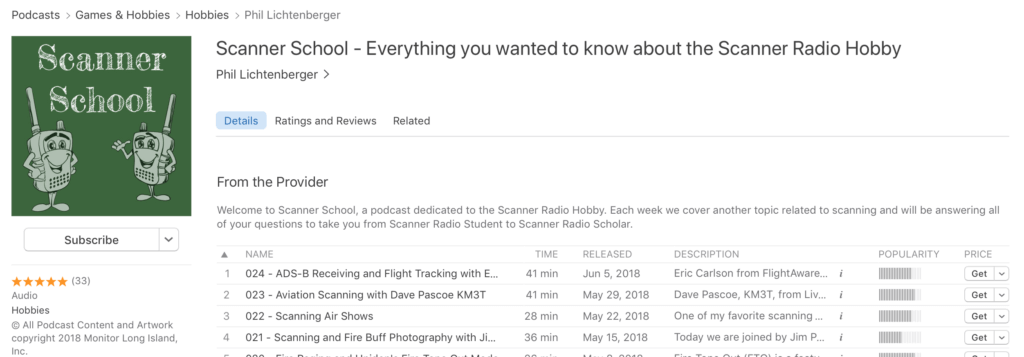
Phil's podcast is in the scanner niche, the handheld kind that you can use to listen to police lines and emergency frequencies and nerdy things like that.
Yeah, not too large in terms of a listening audience compared to things like entrepreneurship, personal development, fitness, and other large niches. This was a hobby of his, and he wanted to use a podcast to just talk more about it and connect with others.
Well, within six months, he became a micro-celebrity in the space. Check out this Facebook Message he posted in our Podcast Student Center:
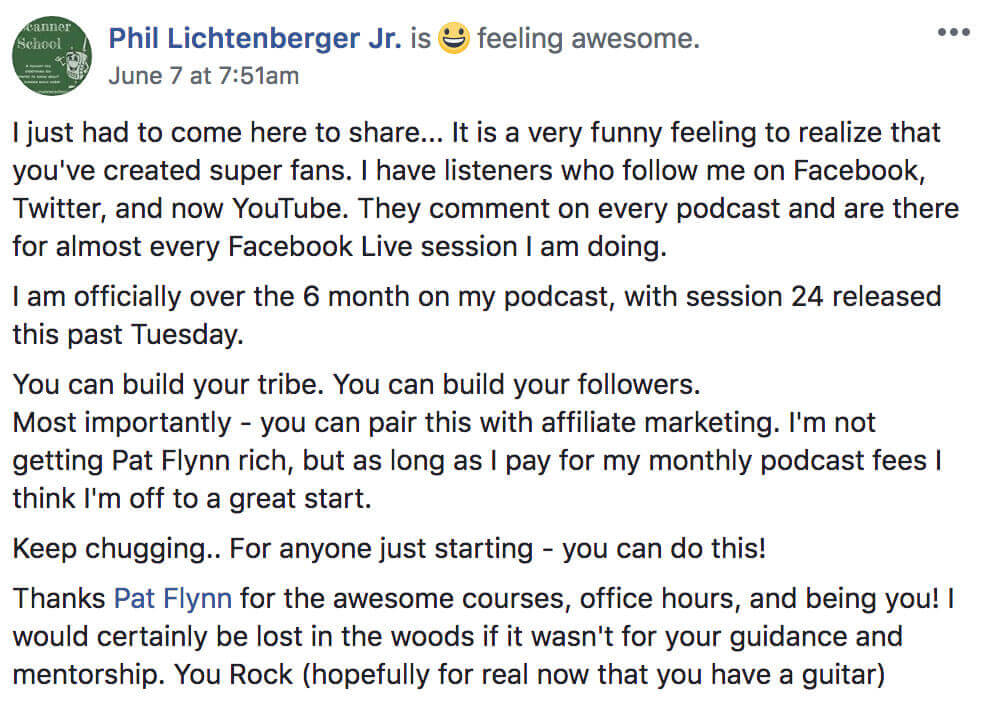
Phil's podcast, in the small niche of scanners, was a hit. Now he has fans, repeat listeners, and even companies reaching out to work with him.
No matter the size of your niche, you can bring your audience together. Also know that many times the riches are in the niches, and there's an advantage to narrowing down your focus and staying small.
Myth #3: You have to have a following to get started
Nope. Not true.
In fact, a lot of people are starting their podcasts SO THAT they can finally start building their audience, even from scratch.
Take Sophie Walker, for example, another one of my students who literally started with zero. No email list. No audience. No following.
Here's what happened with her new podcast, Australian Birth Stories:
Yes, she did it. She became the #1 Kids & Family podcast on Apple Podcasts in Australia. Her podcast has recently been accredited by the Australian College of Midwives as Certified Professional Development to all Australian Midwives.
How amazing is that?! And all of it, from scratch.
If you're starting from the beginning with zero audience, then I think you've made a wise choice to start a podcast to get going.
The easiest way to learn how to start a podcast
I've outlined the entire process from start to finish for you below. Recently, I also published an updated video to take you step-by-step. If you prefer learning visually, and with voice behind it, click play on the video below.
Looking to start an audio podcast? Watch this.
Looking to start a video podcast? Watch this.
Whether you watch the video above or not, here's a list of things you'll need ahead of recording and publishing your first podcast episode, explained:
What to prepare before you start recording
Before you start recording, and even before you dive into the tutorial videos below, there are five things you need to prepare. Have all of this stuff handy for later—you'll thank me for it.
1. Choose a podcast topic you can commit to
It's easy to get hyped up about an opportunity like podcasting, however I've seen it many times before: If you don't plan ahead, you're going to be doomed.
Podcasting takes some work, so you're going to want to make sure you spend adequate time upfront to make sure you choose a topic that excites you. Something that has more than three episodes worth in your head. Something that'll keep you going for the long run.
I can't tell you what topic to choose, but I can give you a couple exercises that I teach my students that will help you frame whether or not a topic you're thinking about is worth pursuing.
Check out my full guide on choosing podcast topics, complete with tons of ideas for podcast episodes!
Exercise #1: Create a list of 25 episodes
Write down a list of twenty-five potential episode ideas for the podcast topic(s) you have in mind. You can include potential guest names, too, as if you already have those people booked.
You don't need to worry about the exact title of the episodes — just come up with the ideas.
If you can't get past ten, then what happens when you record ten episodes and you're left scrambling to figure out what's next?
The Smart Passive Income Podcast has published over 850 episodes, and AskPat over 1200, because business topics are a passion of mine. I could write down 1000 more right now if I needed to.
If you showed me at least twenty-five right now, I'd feel comfortable about that topic for you.
Exercise #2: One year from now
It's one year from now, and you're going full-steam with your podcast. You're fifty-two episodes in, and you're even beginning to get a number of emails from companies and your fans about your podcast.
You wake up each morning and connect with people on social media who just recently listened to your show.
Are you bored? Are you stoked? Are you happy?
When I run this exercise with my students, some realize that a year from now, even if their podcast was successful, it's not a topic they'd really be happy about.
Instead of just choosing something that's obviously right in front of you, spend some time thinking about what would make you happy to wake up and podcast about a year from now and beyond.
2. Pick your podcast name
The title of your podcast is one of the first things people see, even before they listen to a single word of your show. So naturally, this is a really important decision.
All this info goes into your podcast host when you setup your show there, and you can always change anything related to your show (people change their title, description and artwork all of the time).
I understand if you're feeling a little hesitant about nailing down a show title and moving forward. It defines your branding, your artwork, what you say, how you share it, and many, many more things.
For several podcasters who already have a brand elsewhere (where the podcast is an extension of that brand) then naming the show is usually relatively simple. It includes the brand name, and sometimes some version of the word “podcast,” “radio,” “show,” or another modifier to differentiate it a bit:
For personal brands, you'll almost always see the name of the person in the show itself, which makes sense because they are the brand:

Then you have the titles of podcasts that describe exactly what you're going to get when you listen to it. The title itself is descriptive of the content. And yes, this does help with search engine optimization:
And then, of course, you have the podcast names that at first glance don't make any sense at all. These can be successful, too! The podcast name takes meaning based on what the host does with it. So even if you can't nail the perfect descriptive show title, know that whatever title you pick eventually becomes what you make of it:

Remember, Apple and other directories are also search engines — don't forget that.
However, I do have an important warning: Don't go overboard with the keywords in the title of your podcast. Don't keyword stuff by adding a billion keywords after the actual name of your show. Try to keep your title as natural as possible, and select your keywords carefully.
Apple has been known to remove accounts due to obvious keyword stuffing in titles.
Don't do that.
Oh, and for your host name, don't do this, either:
John Smith | Fitness Expert | Nutritionist | Weightlifting Coach | Likes Long Walks on the Beach
Spend some time coming up with ideas for your podcast title. Share it with people around you and get a gut reaction to see what they think. And if you have an audience, ask them. It's a great excuse to seed that you're coming out with a podcast soon (and it'll hold you accountable, too).
3. Write a compelling podcast description
You'll need to write a description paragraph about your show for your audience. After they make their way to your show page, this will be the description they read to decide whether or not they want to stick around.
This is where you'll have a little more freedom to play with keywords. Whatever keywords and keyphrases your target audience may use to find content like yours, include those words in your description.
But, just simply listing them out isn't going to work because people will read these descriptions — you want these people to feel compelled to click and listen to your podcast.
My best advice: write for the humans in your target audience and know who your podcast is for. Understand their wants, needs, questions, curiosities, and more, and you'll be more likely to create a description to feed people into your show much, much easier.
With that in mind, here is a list of tips I have for you related to your podcast description:
- Start with something that matters to them. There's a small part of the description they'll see first before they have to click to see the rest, so if the benefits or connection is buried, then they won't even know it's for them.
- It's okay to talk about yourself. You need to prove that you're someone worth listening to and spending time with. But similar to the above, don't start with you. Feel free to add any credentials and other proof that support this person's decision to listen to you.
- Imagine your listeners sharing your show with their friends. What would they say? When they say, “Oh you have to listen to this new podcast, it's great because it's the only one I've found that…”, how would you imagine they finish that sentence?
You have 4000 characters to work with, so you have a lot of room. Have fun with it, but make sure it all makes sense, and if something is not important, leave it out.
4. Decide on your podcast format
- Should I do interviews or a solo show?
- How long should my podcast episodes be?
- How often should I publish my podcast?
Let me answer these common questions for you:
Show Style: Interview show or solo show?
There's no wrong answer here, but it's good to think about, ahead of time, whether or not you'd like to invite guests onto your podcast.
Don't worry yet about how you're going to interview other people, or even how you're going to convince them to say yes (more on that later in the tutorial), but the earlier you decide, the earlier you can plan and begin reaching out to others.
Interviews are fantastic because you can get information and collect amazing stories that you yourself couldn't provide to your audience — at least not from the source. That being said, scheduling interviews and coordinating all of that can get difficult at times. I use a tool like SavvyCal [affiliate link] to help me schedule my interviews.
The biggest benefit, however, is the relationship that you can build with your guest during the call. You're going to have a conversation for several minutes, sometimes even over an hour, and sometimes you can't help but get to know the person and become friends.
Many of my best friends in the online and business space have come as a result of the people who I've connected with on my podcast, or on their podcast.
Solo shows (where it's just you recording) are awesome, too. They show off authority, you can build trust with your audience (especially if you help them) more directly, but imagine sitting in a room talking by yourself to a microphone. It feels weird at first, but you get used to it. Like anything, it just takes some practice.
“How long should my podcast episodes be?”
The most common question I get when it comes to how to start a podcast is about the length of episodes.
Number one, know that you don't have to have the same length episode every single time. In general, you want to stay within an expected range, but if you happen to journey outside of that time, it's not the end of the world.
The best answer to how long an episode should be is this:
However long the episode needs to be to serve its purpose for your audience.
If an interview was going well but you haven't gotten to the main story yet, would you cut it off just because of time? On the other hand, if you said everything you needed to say, would you add 20 minutes of fluff just to hit a certain time?
Long episodes are okay, and short episodes are okay. Try to remain within a range consistently over time, but the random outlier is okay, too.
“How often should I publish my podcast?”
You should publish your podcast consistently.
That's the answer.
It doesn't matter if your podcast comes out each week, every other week, or once a day. As long as you can get into a rhythm and groove so that your audience knows what to expect, then it's okay.
Obviously, the more frequently you publish, the more opportunities there are for your audience to download and share more episodes, plus there would be more content for you to be discovered with via search.
But at the same time, the more episodes you publish, the more work there is for you to do.
You can change your frequency (you're not “locked in”) and publish whenever you want, but try your best to stick to a schedule for a while until making changes, or else you might confuse and frustrate your audience.
When I started the Smart Passive Income Podcast, I only had the capacity for episodes once every other week. I was blogging and publishing three times a week. Then, once I saw how amazing the results were for my show, I switched it to weekly, and then got obsessed and created even more podcasts.
The most important advice related to all of this format stuff is, you have to pick something and go. Stop questioning what the right answer is, because really you won't know until you get started and publish your podcast. Stop holding yourself back, make decisions, and keep moving forward!
5. Get your podcast artwork and music created
Your podcast is definitely going to need cover artwork and could probably benefit from having a piece or two of music.
How do you get those?

Creating podcast artwork
Your podcast is also going to need some artwork — a square image that represents your show. As much as podcasting is an auditory medium, the graphic, visual element that represents your podcast plays an extremely important role.
For one, it's what people will see in podcasting directories before listening to a single spoken word and before reading any written words about your show in the description or summary. Your artwork is your podcast's first impression, and it's also what competes for attention with every other podcast that's out there.
For Apple Podcasts specifically, a visually appealing podcast image gives your show a better chance of being featured in highly visible sections of iTunes, such as their “New & Noteworthy” and “What's Hot” sections for your show's category.
And lastly, your artwork is what people will see on their media players — their computers and mobile devices — when they listen to your show. It's an important element for reinforcing your brand identity to your followers.
Podcast artwork specifications
The Apple Podcast image specifications change periodically. This is from the most recent update:
“Size: Square; 3000 x 3000 pixels. If you’re submitting your show via RSS feed, Apple Podcasts accepts show cover artwork ranging from 1400 x 1400 to 3000 x 3000 pixels. The largest size is preferred.File type: JPEG or PNG”
Here are some more tips related to your artwork to help you even further:
- Head to Apple Podcasts (or any other directory) and find podcasts in categories that you might potentially place your podcast in. What kinds of artwork do you see there? What stands out to you? What inspires you?
- Although you're designing for a big size (3000 x 3000 pixels), most people find podcasts on their smaller devices. Make sure you design for the small size, too. As a test, export your artwork at 55 x 55px and make sure all the things that you want to see are still there.
- Again, if you have an audience, design a few different versions and get their opinion. This will seed your podcast once again, get them involved, and make them more interested in this project of yours, and ultimately more likely to support you when it goes live.
Where might you get great artwork created? Out of everything else here, this is definitely worth investing in because it's literally the first thing people see related to your podcast. If you don't have a designer of your own, try 99designs.com or Fiverr.com, or potentially try designing your own artwork using a tool like Canva.com.
Finding podcast music
There’s certainly not an official book of rules for starting a podcast, and even if there was, “you must have music” wouldn’t be included.
That being said, I’m a big fan of having some bumper music at the beginning and end of my podcasts for an added layer of branding and professionalism.
You can follow my lead and also include a voice-over, though don’t let that hold you back from just getting started.
A 10-second piece of music on its own is fine, if you include a voice-over try to keep your intros and outros to about 30 seconds to avoid annoying your soon-to-be-long-time listeners.
Where can I find podcast music?
There are a ton of websites where you can find podcast music that’s completely safe to use (meaning you won’t be getting any copyright infringement letters from the music's creator).
This music will typically be called “royalty-free,” “library,” or “stock” music, and can be sold piece by piece or through subscriptions that give you ongoing access to huge volumes of sounds and tracks.
There’s also an avenue for finding free music under Creative Commons licensing, though keep in mind you’ll have to pay attention to the rules of the license for each particular piece of music as some don’t allow commercial use.
You also might consider commissioning custom music via Fiverr or another freelancing platform, but again, don’t let the time or dollar costs of doing this hold you back from starting your pod!
A few places I like to look for podcast music:
I hope you're enjoying learning how to start a podcast so far. Now is where it starts to get real. It's time to get podcasting equipment so we can finally make this happen.
6. Purchase your podcast equipment and test your podcasting software
There's a lot of equipment you could purchase to start your show — the prices range from cheap $5 microphones (that sound really bad) to entire broadcasting studio setups (that sound like you're about to drop an album) that get into the five and six-figure ranges.
I promise you, you do not need to spend as much money as you might think to get your show up and running.
The most important piece of podcasting equipment is a microphone that makes you sound good. There's a certain standard of audio quality now in the podcasting space. If you're not up to that standard, you could have the best content in the world but still have people leave and find something that sounds better.
So what should you get? Something easy to use. Something that won't require a lot of additional extras (like mixers, amplifiers, etc.), and something that's not going to break the bank.
The answer: The Samson Q2U USB/XLR Dynamic Microphone [Amazon affiliate link]. Here's what I love about it:
- Great value ($70-$90 on Amazon with accessories)
- It plugs in to your computer via USB (no extras needed)
- It sounds just like my pro $400 microphone
Here is my basic beginner podcasting gear recommendations. You'll find two microphones on this list to accommodate for availability issues in different countries, but you only need one (they are very similar).
The Basic Podcasting Kit
Consisting of only three items: a simple, high-quality USB microphone, pop filter, and a basic microphone stand, this kit will get you started as inexpensively as possible without sacrificing quality.
We have two microphones recommended here; the AudioTechnica microphone is easier to get in the USA and Samson microphone is easier to source outside the USA.
This is an Amazon affiliate link
Also, in case you're interested, here's a review video where you can see it in action below, along with the Audio-Technica ATR-2100, which was previously my favorite podcasting mic but has since been discontinued:
As far as software to record into, I recommend going simple with what you might already have access to. Again, you don't need to spend money on anything fancy right now. I'd rather you save that for marketing your show.
I recommend Garageband if you're on a Mac, or if you're not a fan of Garageband and/or you're a Windows person, then I'd recommend Audacity instead. Both are free.
For interviews, I recommend Zoom.us, or Skype on the low-end, but if you want the best quality, I highly recommend going with SquadCast, an amazing web-based interview platform that makes it SUPER simple to record the highest quality audio over the Internet.
For editing your show using the software mentioned above, I have a couple of tutorials on YouTube that have been seen over half a million times that you can watch here:
- How to Record & Edit a Podcast in Garageband (Complete Tutorial)
- How to Record and Edit a Podcast in Audacity (Complete Tutorial)
If you need help with reducing echo in your recordings (which can happen with hardwood floors and rooms with lots of windows), here are some easy (and cheap) ways to use things around the house to reduce the echo in your recordings:
7. Choose a podcast hosting service
A common mistake when starting a podcast is thinking that you can simply open the podcast app on your phone or computer, hit record, and voilà — your podcast is ready.
While we all wish it would be that easy to publish an episode, you must first pick a podcast host. A host that will publish your recordings to popular podcast directories with ease and give you the ability to share your episodes on your website in style.
For those reasons, SPI recommends Fusebox as both your podcast host and podcast player of choice, and here's why:
While there are quite literally dozens of platforms out there to choose from, it's rare to find one that offers …
- Intuitive podcast hosting and analytics
- A sleek web player experience
- A price that won't break the bank
- And no messy add-ons or extra fees
Sure. There are hosts that check one or two of those — but why settle for just a few?
Fusebox doesn't charge extra for podcast hosting. They offer the best-looking players in the industry. And their “go-anywhere” HTML code allows you to put podcast players almost anywhere you need them to be.
Fusebox
Fusebox began its journey as a tool of necessity. Back in the early days of podcasting, the podcast players available weren't great. So, they set out to build a highly-customizable player that can seamlessly blend into a website.
Over the years, Fusebox built a following of podcasters who realized that providing their website visitors with a top-tier, elegant player was sometimes more important than who hosted their podcast.
Fast forward to today, and Fusebox has continued to grow its presence in the podcasting industry by introducing its own podcast hosting service, Easy Hosting, all while remaining agile enough to quickly roll out new features and respond to customer feedback.
Here are some of my favorite features:
- Podcast hosting is INCLUDED with all paid subscriptions!
- Three different player modes to meet the needs of your website.
- Highly-customizable players. Hide all the buttons, show all the buttons — it's up to you!
- An intuitive dashboard design, built to make podcasting easy.
- Included podcast analytics to learn more about your listeners and how they listen.
- Go-anywhere player HTML! Embed a player in your Circle community, Shopify website, and more!
- An episode transcript plugin with email capture.
- Simple pricing with no extra add-ons, overage fees, or bandwidth throttling.
The team at Fusebox is so passionate about helping podcasters achieve their podcasting goals, we've worked out an amazing offer for our How to Start a Podcast Step-By-Step Guide!
This is an affiliate link
Fusebox
The official podcast player used by SPI! Fusebox provides your website visitors with a superior listening experience. From its powerful podcast hosting and analytics to the industry's most elegant and responsive web players, Fusebox is a must-have tool for starting a podcast.
Get three months free when you join using our affiliate link. After creating your account, email [email protected] with the subject line “Three month credit for SPI readers” to receive your free three months.
All new subscriptions to their Starter plan pay nothing for three months. After you create your free trial, email [email protected] with the subject line “Three month credit for SPI readers” to receive your free three months. [Full Disclosure: As an affiliate, SPI Media receives compensation, at no additional cost to you, if you purchase through this link.]
8. Record your podcast episodes
So you're finally ready to record. Great! If you're like me when I first started, then it's very likely that you're going to open up your recording software, stare at the screen, and hesitate to hit record. Or, you're going to hit record, struggle like mad, and doubt this entire process.
I use Riverside for recording remote interviews because they record high quality audio with each guest onto a separate track, and are able to compensate if a guest's internet drops during recording. This is a tool I use — and they've agreed to give my readers a special deal.
This is a sponsored link
Sponsored Recommendation
Riverside
Record, edit, and repurpose all in one place.
Riverside is a recording and editing platform built for creators, podcasters, and entrepreneurs. You can capture remote interviews in up to 4K video and crystal-clear audio, then edit and repurpose everything in your browser. It’s trusted by thousands of creators who want to publish faster and skip the tool-juggling.
As an SPI listener, you’ll get 30 days of our Pro Plan for free. That means full access to everything you need to create faster and free up hours in your week.
Use code SMART at checkout to access all Pro features.
Please don't wait a year and a half like I did. You can do this.
I know it's scary, but here are some tips I have to help you get started:
1. Editing is how the magic happens.
Don't think you have to hit record and get it all perfect in one seamless take. We call that a one-take Jake, and he does not exist.
You're going to mess up. You're going to have to re-say lots of things. You're going to have awkward pauses.
And no one has to know. That's the power of editing! You have two options here:
- Hit record, let it run, even through all of your mistakes, and then go back and edit those mistakes, long pauses, and awkward moments out after.
- Hit record and go until you mess up. Stop, cut out the mistake, and then hit record and pick up where you left off.
You do not…I REPEAT…you do not need to start over from the beginning if you mess up in the middle. You do not need to take perfectionism to that extent. And yes, I've driven myself crazy before thinking that's how it had to be done.
2. The Secret: Reverse engineer the episode outline
When writing a book, the worst thing in the world is staring at a blank page and asking yourself “What am I going to write about?”
The same goes for your podcast. Don't go into your recording software without a plan — at least a high-level one — for the talking points of the episode you're creating.
Here's my process for “reverse engineering” an episode structure:
- Start with the end in mind. What's the purpose of this episode? What's the takeaway I want people to have?
- What stories, points, case studies, or bodies of work do I need to reference in order to support #1? I just do a brain dump of these. No particular order.
- What order should all of #2 be in?
I often use Post-It notes (my favorite thing in the world) to outline my show so I can more easily move bits and pieces around. Watch this video if you'd like to see that Post-It note process in full effect.
If you're doing an interview episode, then it's a little different, but not by much. I want to know what I want the audience to take away from my time with my guest, and I also want to have an idea of what questions I might ask to help the audience get there.
I rarely stick to the entire list of questions when I conduct an interview. It takes practice, but eventually you'll get to the point where you can follow-up with great questions and dig even deeper to get better information from your guest for your audience.
3. Think of your listener persona while you talk
A lot of beginner podcasters get themselves in a tangle by imagining talking to themselves or just talking to a microphone when they start recording.
This can lead to feeling overly self-conscious or like there’s not much of a point to making a podcast. It’s not only uncomfortable for you, this can also leave your podcast feeling flat, disjointed, and unenjoyable for your listeners.
When you imagine yourself speaking to your podcast listener avatar, that one person who absolutely loves and raves about everything you create for them, you’ll help yourself stay connected to the why behind the podcast you’re making. That will shine through in your voice and words, just like you can tell a person is smiling and happy or angry and upset when you talk with them on the phone.
4. It's going to be bad at the start
You have to get through a good number of episodes first before you start to get into a rhythm and feel the groove. If you wait until you feel good about your show before you hit publish on episode one, I guarantee you will never have a podcast.
Just get it out there, let the world find it, and use that experience to continually improve your podcast over time.
5. Upload your episodes, even if they aren't perfect
Perfectionism will ruin any chances of your show taking off, or even getting published in the first place. Remember, it was the perfectionist mindset that got in my own way and kept me from publishing my first episode over a year after I purchased my microphone. I don't want that to be you! You will regret it, like I did.
Export your edited podcast episodes as a .mp3 file and upload it to your host, such as Fusebox. Finally, don't forget to submit your podcast to any podcast directories you want your show to be visible on. Fusebox's dashboard and support page point you in the right direction.
9. Review my top tips for creating and growing your podcast
I've updated one of my most popular videos for the current podcasting landscape. Here are 50 tips for making your podcast the best that it can be.
Then it's time to let the world know about it.
10. Let the world know about your new podcast!
Getting your podcast up and running is just half the battle. Once it's up, how do we get people to find it?
Well, that's my specialty. There's a lot involved with podcast marketing and findability (too much to share here or in a single post), — I offer a ton of detailed tips and strategies in my premium course, Power-Up Podcasting. But from a high-level, here's what you could focus on:
- Launch like it's an event. You want to make a big deal out of your new podcast to get as many eyeballs (and ears) as possible on your show as soon as it launches.
- Utilize your network. Now is the time to ask your friends, family, community, audience, colleagues — anyone in your network — to help support you and your show. Don't be afraid to ask (this is a big deal!) and hopefully you'll get lots of support.
- Anywhere you might have access to larger groups of people — for example your social channels, your email list, any groups you're involved with — let them know ahead of time that something is coming, and when your podcast goes live, you'll be able to announce it without feeling like it came out of nowhere.
- On social media, you could utilize tools such as Repurpose.io and Wavve.co to create little snippets of your audio in video format so it's more viewable and more interesting on your channels.
- During launch week, thank every single person who comments on your podcast. Ask them to leave a review and share it with anyone who they know who might find it valuable. Interact. Even if your audience is small to start, the direct interaction can feed your energy level and offer valuable feedback for your future podcast episodes.
And of course, I have a video with some more helpful info that you may find useful:

11. How to make money podcasting
Whether you want to become a full-time podcaster and have your show replace your income, or you just want to do it on the side, I think it's really important to consider how to make money with your podcast, even if the goal is to simply cover your time and costs with some passive income.
You should be rewarded for your hard work, for sure!
The most common way podcasts make money is through advertising or sponsorships. Companies may pay you money to have you read off a script or talk about their company in different parts of your podcast episodes.
This can be very rewarding, but at the same time it's hard to find sponsors when your show is just starting out. They want to know people are going to listen before they pay you.
I'd recommend starting with affiliate marketing. That means you can generate an income by talking about and recommending various products that you use, similar to how I've provided helpful content here while mentioning various microphones and podcast hosting platforms. You can start with this kind of income generation from day one. Even if you don't have many listeners, you'll see the clicks coming in a year from now when you do.
You could potentially promote software you use, programs you've joined, services you use, or even physical products by joining Amazon's associates program.
For more info about generating income from your podcast, check out this popular video below:
What's Next?
Download the free Podcast Cheat Sheet
Sign up for my free Podcast Cheat Sheet! This checklist was made as a companion to the How to Start a Podcast Guide, and will help you stay on track as you go through the steps I've outlined above so you can learn how to start a podcast the smart way. It has all the steps (and more) to help you launch and grow your podcast.
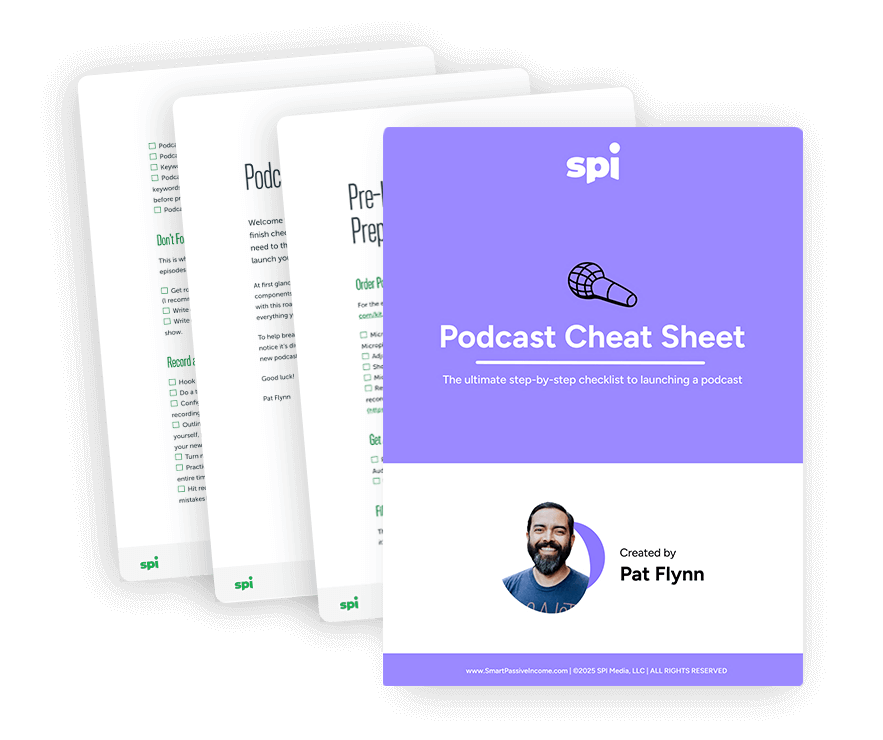
A free checklist for starting your podcast
Make sure you don't miss a step! The Podcast Cheat Sheet gives you all the steps you need to start your show.
Join 20,000+ other creators.



200+ Reviews
Thank You!
How to start a podcast FAQ
- How Long Should My Podcast Episodes Be?
- How Often Should I Release My Podcast Episodes?
- What Equipment Do You Need to Start a Podcast?
- How Much Money Does It Take to Start a Podcast?
- Can You Start a Podcast for Free?
- How Much Money do Podcasters Make?
How long should my podcast episodes be?
The answer here is tricky as the most successful podcasts in the world range in episode length from 10 minutes (like NPR’s Up First) to 3 hours (like The Joe Rogan Experience).
When you’re getting started podcasting, your episode length is really a matter of what you think is best for your format as well as your recording and editing stamina (it’s going to take a lot of energy to record and produce 3 hour long episodes multiple times a week when you have so much to learn and practice).
That being said, the 15 minute to 1 hour mark is a great place to start for most beginner podcasters.
Eventually you can layer in different series that could be different lengths (bite-sized 5 minute “did you knows” mixed with hour-long interviews), and get feedback from audience surveys about what they feel is best.
How often should I release my podcast episodes?
This is definitely one of the most common “how to start a podcast questions” I’m asked and my answer, as with so many things, is that consistency is key.
If you can only manage one episode a month to start, great. Publish your one episode a month and hold yourself to it.
One every two weeks? That’s awesome, get it done!
Podcasters and podcast networks that have a lot of experience (and hands to help) sometimes publish multiple episodes a day. That can certainly help you grow a large audience fast, but if you publish five episodes for one week, then completely lose steam and stop podcasting due to burnout, you’re not doing yourself or your audience any favors.
Some podcast producers create their shows in “seasons,” launching a series of podcasts all at once or in a regular stream, then taking breaks just like your favorite TV shows growing up.
Season-based podcasting can be a great strategy if you want to cover particular subjects or themes that are a subset of your overall vision, or feel that’s a better way for you to personally manage your attention or energy.
Just keep in mind that you will have listeners drop off as people incorporate other podcasts into their routines once they run out of new content from you. So unless you already have a large audience you can reach out to jump-start your listenership each season, I’d recommend you first find a consistent schedule without intermittent breaks.
Whatever schedule you choose — seasonal, weekly, or monthly — exercising the discipline of consistency is key.
What equipment do you need to start a podcast?
To start your podcast, at a minimum you’ll need:
- A computer
- A good podcast microphone
- Podcast recording and editing software
- Podcast artwork
- Podcast hosting
- Call recording software
A few things you might want but aren’t absolutely necessary:
- A podcast camera
- Noise-canceling headphones
- Podcast music
- A soundproof recording room
- Podcast music
How much money does it take to start a podcast?
Definitely an “it depends” question, but assuming the computer you already own is good enough to start a podcast with (8GB RAM, 2.5Ghz Quad-Core Processor should be fine), you can get a good podcast mic like the Samson Q2U for about $60, use free podcast recording and editing software like Audacity, and get podcast hosting free for 6 months from Fusebox — bringing the total to about $60 to get started podcasting!
Can you start a podcast for free?
It is possible to start a podcast for free using free podcast recording and editing software, a computer and microphone you already own, as well as free podcast hosting from companies like Spreaker or Podbean. The caveat with some of the do-it-for-free platforms is that you’ll likely spend more time working with tools that aren’t as easy to use as paid options, and in the case of podcasts you might end up with lower-quality audio using a less-than-the-best podcast microphone.
How much money do podcasters make?
This is yet another “it depends” answer that considers your particular sponsorship deals, audience, and size — but AdvertiseCast reports the average podcast advertising rates are currently $18 CPM (cost per mil, aka 1,000 listeners) for a 30-second ad and $25 CPM for a 60-second ad. And if you use affiliate marketing to promote products with your own custom ads and get paid when your listeners buy the products you recommend, you may be able to earn more than that by leveraging your audience trust-building and sales skills.
I appreciate you!
I truly hope you enjoyed this tutorial about how to start a podcast. I spent over 50 hours putting this tutorial together, and several more keeping it updated for you over time.
Feel free to share this guide (click here for an easy X share), especially with your friends and colleagues who you think could benefit from it.
Cheers, and I'll see you and your podcast on Apple (and other directories) very soon!
Lastly, if you still feel like you need more help and guidance to help you launch and market your podcast, check out my course, Power-Up Podcasting, for more help!
The post How to Start a Podcast in 2026: A Step-by-Step Guide appeared first on Smart Passive Income.
]]>Freelancing is the number one way to get started with online business. Here's why, plus how you can make more money doing it and transform your side hustle into a full-time, scalable business.
The post How to Start Freelancing (And Get Your FIRST Client!) appeared first on Smart Passive Income.
]]>The SPI community has been asking about the world of freelancing a lot lately, so I thought I’d share some recent thoughts on freelancing to guide you in how to get started freelancing (and get your first client).
But first, I want to take you back to a post I shared in November 2017:
The 2 Quickest Ways to Generate an Online Income
In that post, I explain that freelancing is one of the two quickest ways to generate online income (the other is affiliate marketing). Freelancing allows you to quickly get paid for a task that can actually help solve problems for people.
And when you’re first starting out, freelancing is the number one way to get started online. It’s not passive income, which is an important thing to understand. Freelancing is definitely not passive; it’s super active. If you don’t do the work, you’re not going to get paid. But if you are dedicated and put in the effort, freelancing is a great way to get your foot in the door of an industry or niche you’re interested in. It’s, quite simply, a great way to get started in business.
After all, think about this: You just need one client. One client to make a little money. One client to get the ball rolling. One client to make a difference. And then, as you’ll hear me talk more about later in this post, you can take what you learn working with clients, and turn it into something more passive—with tools, or even a team! But first, let’s figure out how to get that first client.
Let’s get started!
What is freelancing, and why there’s huge opportunity in freelancing
I think it’s important first to define what freelancing is. Freelancing is, at its core, offering a skill you have in exchange for payment. If you have a skill a particular client or brand or business needs to help them solve their problems, they will want to hire you to solve it. And you do so with your specialized skill.
The cool part about freelancing is that there are so many different types of freelancers out there, offering up a huge range of skills. Even if you don’t have that skill right this moment, who says you can’t learn it and eventually offer up that skill too?
Here’s just a sampling of some of the types of freelance skills out there:
- Graphic design
- Photo editing
- UI design
- UX design
- Video editing
- Video production
- Voice acting
- Web design
- 2D animation
- 3D animation
- Ajax development
- Java development
- API development
- HTML development
- WordPress development
- Administrative support
- Email tech support
- Virtual assistance
- Transcription
- Data entry
- Academic writing
- Copywriting
- Copy editing
- Proofreading
- Editing
- Creative writing
- Ghostwriting
- Translation
- Accounting
- Bookkeeping
- Business analysis
- Quickbooks
- Excel
- Advertising consulting
- Google AdWords
- Marketing strategy
- SEO
- PPC
- Lead generation
And that’s just a small portion of the types of freelance skills available on the market. That’s a huge benefit when it comes to starting out in freelancing. You probably have a few of those skills already. And even if you don’t, you know that there’s a big opportunity for you to build your base of skills for your future clients.
Another benefit of freelancing is that it empowers you to enter a particular business space, get to know the people in there, and learn the ins and outs of that specific business type or industry. You may be hired for a specific skill, but you (or them or both) soon realize that there are other opportunities that you see, other areas where you can benefit the business.
In SPI Podcast session 460, Jay Clouse joins me to talk through an easy way anyone can get starting freelancing. Listen to it here:
Will my business idea work?
Enroll in our free course, Smart From Scratch®, and you'll get:

A clear understanding of your target audience
Ideas on how to serve your audience
Your roadmap forward
Smart From Scratch® is a part of the SPI Community. Access the free course and start your entrepreneurial journey today! Learn more about Smart From Scratch®.
How to get your first client (and why you just need one client!)
Once you have your own client, the road ahead gets a little easier. Don’t get caught up in thinking you need ten clients out of the gate. You just need an audience of one to start.
To help guide you through what that’s like, I had a chat with Charli Marie of CharliMarieTV.
In the video (embedded below), Charli, a successful freelance designer, shares essential tips for how to get your first freelance client, best practices for working with that client to make sure that it’s a great experience, and advice for making sure you get paid on time.
Once you have your first freelance client, how do you start making more money? In the second video in my freelance series, I continue my conversation with Charli Marie on the topic of:
5 ways to make more money (as a freelancer & entrepreneur)
So, you have your first freelance client. Now what? How do you start making your freelance life fruitful? There are many ways you can start making more money as a freelancer and entrepreneur, but we’re going to focus on just five ways for now.
1. Start building a reputation
As Charli says, building up your brand and getting your voice out there allows you to be “known for your craft.” A few great mediums to make yourself known is a blog, YouTube channel, and podcast—all platforms I use to build and grow my brand and reputation. The more you put out there, the more useful and relevant content and information you share with people online, the more you’re going to look like an expert in your particular craft or skill.
2. Have a good process in place
Know your process, and know it well. A good process means that you have an organized system and way to work with your clients from the start, the middle, and the end. If your process is non-existent, it’s just a disorganized mess, the less likely your clients are going to want to continue working with you, and probably won’t recommend you to their friends.
3. Serve the clients you already have
It can be tempting to want to always go after new clients, or to land the next great client. But when you’re too focused on new clients, you’re often forgetting about the clients you are already serving. Focus on your existing clients and the ways you can improve your service to them.
4. Upsell in an authentic way
Upselling can be tricky, and in some cases has a bad reputation. But here’s how Charli does it for her freelance clients: a tier-based approach:
- Tier 1: You do the basic work to meet the client’s stated need
- Tier 2: You meet the basic needs of the client, but also provide additional value
- Tier 3: You have a solution for the stated needs of the client, but then you also offer an additional service based on your review of the client’s situation and your experience
5. Increase your prices
Most freelancers undervalue or underprice themselves when they’re first starting out. It’s an easy thing to do because you’re just doing everything you can to get your foot in the door. But it doesn’t have to be that way—especially if you have your one client. Focus on what you do and your value.
For an extended look at more ways you can make money as a freelancer, check out my video with Charli Marie below!
Now that you’ve started freelancing, what’s next?
Freelancing, THEN WHAT? Career & biz options for freelancers
As a freelancer, you’ve probably felt the pull to do more in your career. It’s totally natural. And so in this final section of this post, I am going to share a few ways you can expand on your freelance career and business. (And don’t forget to watch the video below for the full deep dive into your many options—with Charli Marie and Caleb, my videographer!)
1. Freelancing can transform into a full-time job
In the video, Charli shares how she got her first full-time design job after doing some design work for a company. If you do good work for your clients, and you have a good relationship with them, that’s a potential opportunity if the client is looking for a more long-term, stable solution.
2. Your side hustle can transform into a full hustle
Caleb, my videographer, used to work at Fizzle doing video work. He loved that part of his full-time job so much that he set out doing videography as a side hustle. And that side hustle is now a full-time hustle! In the video below, Caleb shares how he prepared for that transition, and how he masterfully worked his way to a successful videography business owner.
3. If you want to scale, you have to hire people
I know this very well, as I tried to do everything myself for a while before realizing that I needed to bring in a team to free me up to do bigger and brighter things for Smart Passive Income. The same is true for Caleb’s business. He wanted to grow and push the limits, and he realized he couldn’t take that journey alone.
And if you want to hear the story of my very own first hire—and why I tried really hard to avoid it—then give SPI 474 a listen.
Make sure to check out the full video below for an extended conversation about career and business options for freelancers!
Before I go, make sure to also check out SPI Podcast Session 158 with my guest Brian Casel, who shares how to productize your service-based business—a great lesson for freelancers like yourself.
Brian returned in episode 314 to share how to turn your service-based business into a product, or into something that can be scaled and automated, so check that out, too. (Don't forget to subscribe to the SPI Podcast!)
And don’t forget to subscribe to my YouTube channel for instant access to my weekly videos!
Again, you can check out the full Freelance Video Series below:
Happy freelancing!
Enroll now — access to the course is completely FREE
Smart From Scratch® is a part of the SPI Community. Access the free course and start your entrepreneurial journey today!
The post How to Start Freelancing (And Get Your FIRST Client!) appeared first on Smart Passive Income.
]]>I just had an amazing interview with Brenda Petrella of Outdoor Photography School on Wednesday, and it was one of my favorite recent episodes to record. It got me to […]
The post SPI 534: These Are the Best Episodes of 2021 appeared first on Smart Passive Income.
]]>I just had an amazing interview with Brenda Petrella of Outdoor Photography School on Wednesday, and it was one of my favorite recent episodes to record. It got me to dig back into the archives, where I realized just how many incredible episodes we've put out this year. That's why in today's follow-up Friday, I wanted to go back into time and call out some of my favorite episodes of the SPI Podcast in 2021.
I'll be sharing some of the most memorable moments from the show this year, and expressing my gratitude for the year that was in podcast land here at SPI. We've got a ton of great podcast content coming at you in 2022, and I can't wait for all of it. But for now, thanks for being here for the ride that was 2021. I appreciate you!
Resources
- SPI 455: How to Build a Trustworthy Brand in a Crowded Space with Rob Maurer from Tesla Daily
- SPI 456: From Side Hustle to a Life-Changing Business – How Josh Hall and His Courses Made It Happen
- SPI 459: The Right Formula to Win on YouTube with Derral Eves
- SPI 460: The Easy Way to Start Freelancing Now to Make Money and Change Your Life with Jay Clouse
- SPI 466: The Moment I Took the Entrepreneurial Leap
- SPI 468: When I’ve Failed at Work & Life Balance
- SPI 473: Assistants, Admins, and Appreciation (with Jess, My Assistant of 7+ Years)
- SPI 477: How to Launch and Manage a Successful Membership Community with Stu McLaren
- SPI 499: How to Get Your Ideas to Actually Spread with Jeff Goins
- SPI 500: Session 500! A Mystery Host Flips the Script!
- SPI 509: How to Play the Long Game in Business and Win in Life with Dorie Clark
- SPI 511: Why Thursday Is the New Friday with Joe Sanok
- SPI 517: The Best Way to Start a Successful Business Today with Arvid Kahl
- SPI 519: Great Storytelling 101: How to Be Remembered & Get Shared with Mike Pacchione
SPI 534: These Are the Best Episodes of 2021
Announcer: Welcome to the Smart Passive Income Podcast, where it's all about working hard now so you can sit back and reap the benefits later. Now, your host. He's lean, he's green, he's a podcasting machine, Pat Flynn.
Pat Flynn: Happy Friday, or follow-up Friday. This episode's going to be a little bit different because, well, we just had this amazing interview with Brenda last Wednesday and she told her story about how she started her online photography business and it was one of my favorite episodes to record. But then I go back and I'm like, "Wow, all the episodes this year were absolutely incredible," so what I wanted to do was go back into time to our first episode in January of 2021 and just call out some of my favorites, some memorable moments and some updates for some of those people who we brought on the show. Maybe you can remember those, or if you haven't listened to those yet, perhaps you were a new subscriber, you can go back and listen to those, but these are some of the standouts and favorites from 2021.
Pat Flynn: I want to start with the very first episode, 455. We're currently, at what is this, 534? 455 in January of [2021]. This was with Rob Maurer from Tesla Daily. Now, Tesla Daily is one of the only podcasts I listened to literally every single day, and I catch him on YouTube, in fact, and that conversation was great because Rob, an incredible human being who quit his job to just follow Tesla and provide news and updates in an unbiased manner about Tesla, and I'm a Tesla shareholder, I'm a Tesla user, and Tesla's obviously become very, very important in the media, and the media has been in a way skewing a lot of things one way or another. Rob always takes this amazing stance and just factual-based approach to it, and he's grown his audience quite big and he does both YouTube podcasting and audio podcasting and his YouTube channel has grown quite a bit.
Pat Flynn: I'm looking at a tool called SocialBlade just to remember where he was at and where he is now. He was getting maybe 200 to 350,000 video views on his YouTube channel Tesla Daily per month, so a quarter million per month. He's at a point now where he's getting 2.5 million views per month. Obviously, the news of Tesla and Elon Musk and all that stuff has contributed to this, but just the fact that Rob has remained consistent, and that episode was absolutely fantastic because we talk about balance, we talk about his story, and I think that's absolutely key.
Pat Flynn: We started off the year with a bang. The next episode, 456, was with SPI community member and SPI Pro member Josh Hall. How he created courses, he's in the web development space, and he created some niche courses to help people, and it's absolutely changed his business and his life. He's been so incredible inside of SPI Pro in helping and serving others, too. This episode, I remember getting a lot of feedback on. When I have people direct messaging me saying, "Wow, that episode was incredible," that's how you know it was really, really good. I mean, that happened with Rob as well, and Rob has this incredible fan base on YouTube who reached out to me to thank me for providing this side of the story for Rob. But Josh, I mean that episode was so tangible, very, very specific strategies that you can pull away from, and again, that's 456 with Josh Hall.
Pat Flynn: All right, moving up the list here, 459 was great, Derral Eves, who's a good friend of mine. He runs a conference called VidSummit. Unfortunately, I wasn't able to attend VidSummit like I wanted to in August of this year in LA, but that still happened, and he threw it down. It was an amazing event, I heard. One of my favorite events to attend, but I wasn't able to go, but I was glad to bring him on the show in 459 because his book The YouTube Formula breaks down really what the formula is for winning on YouTube, and obviously, I've gone pretty hard on YouTube on both the Pat Flynn side of things, as well as the Pokémon channel, which a lot of the episodes that I talked about midyear were about, and starting that channel, what has happened since. I'll give you a quick update on that in just a minute. But really, really exciting stuff. Derral, thank you so much for all the help you've provided.
Pat Flynn: We've actually started a YouTube channel for Smart Passive Income specifically, which features one of our very own, more than me, Mindy. Mindy has been our solutions manager, so if you think of her as sort of the IT person, right, solutions director, really, helping connect a lot of the technologies together and getting everything from landing pages to emails to sequences, campaigns up and running, and sales pages. She's been providing a wealth of knowledge on that YouTube channel. We have over 3,000 subscribers there now, which is really cool. You can check it out, Smart Passive Income, on YouTube. You'll find me there as well as the SPI channel featuring Mindy with a lot of technical help on how to connect a lot of your technologies together, so a big shout-out to Mindy there.
Pat Flynn: Now, soon after Derral came on the show, we started talking a lot about community. We launched SPI Pro mid 2020 to amazing success and it still continues to thrive and be the one of the most fulfilling things we've ever done, but we knew that we were going to step into this world and be an example for people, so in February of 2021, we brought Circle on, Circle.so. Circle and Matt and myself came on to talk about online communities and how to start them. Sid and Andrew over at Circle just created this amazing platform.
Pat Flynn: Full disclosure: I am not just an affiliate now, but I am an advisor to the company. If you want to check out Circle, smartpassiveincome.com/circle. We had predicted that community would be even more important moving forward in business and it definitely has become that since and we've done these things now called "Open Circle," where we invite anybody who's interested live to come in our team questions, and that's going to be happening again on and on into 2022, for sure. It's just been incredible to see more and more people creating their own niche communities with a tool like Circle, so again, smartpassiveincome.com/circle. That was a bonus episode in-between 459 and 460. It was not an emergency, but we just saw this emergence of community, and we wanted to step up and bring the team on over at Circle to talk about that together.
Pat Flynn: Then we have Jay Clouse, who came in in February. Jay has been our community director, really leading the charge with building an incredible team and community experience, really, community experience director. Jay, I highly recommend you check out his podcast. Creative Elements is the name of it. It is one of the most well-produced and fun episodes of any podcast to listen to, or fun shows to listen to, and again, Jay Clouse from creativeelements.fm, he came on to talk about freelancing, but I encourage you to check him out because he's got some amazing things going on, for sure.
Pat Flynn: Actually, March, I created a solo episode that had a lot of great feedback, 466, The Moment I Took the Entrepreneurial Leap, The Moment I Took the Entrepreneurial Leap. This talks about a lot of the psychology of what it was like to actually make that jump and leap into entrepreneurship. Actually, that was, I think, a Friday follow-up episode based on a chat with Gino Wickman, who has a book called The Leap. That was a book. Gino Wickman, you might remember him from one of the books that I recommend all the time, which is called Rocket Fuel. We had him on the show to talk about his new book, but most of all, just what's it like to take that leap and the things you have to look out for and how do you plan for it? I followed it up with 466, talking about my own entrepreneurial leap and such.
Pat Flynn: I think at this time I had a lot of solo things to share, right? In 468 in March, I talked about when I fail that work and life balance, because it hasn't always been rainbows and unicorns and roses. It's been a lot of trial and error and some stuff that definitely led to some really important conversations that my wife April and I had together that balancing kids, balancing more opportunities, learning to say no, all of that stuff, very, very important, in episode 468.
Pat Flynn: Now, moving into April, a fun episode, April 7th, number 473, we had Jess, my wonderful executive assistant, on to talk about assistants, admins, and appreciation. That marked Administrative Appreciation Day. We brought Jess on. She's been a recurring guest on the show. First time, I think her episode was 115 where we talked about how she came on to help me solve my email problems, which was really great, and she's come on a couple times since, so 473, if you want to listen to Jess chat about working with an assistant, or anybody on a team, really, and how to make them feel appreciated. That's so, so important because a lot of times these people who might do some amazing work for us, they don't need much. They don't need gifts. They don't need things like that often. I think it's important to do and to offer. However, sometimes just words of appreciation go a very long way, so we talk about that in episode 473.
Pat Flynn: Moving into the tail end of April, we bring on Stu McLaren to talk about how to launch and manage a successful membership community. Stu is just one of the most amazing human beings in the world. Stu coming on, always telling some incredible stories, he's really inspired us on Team SPI to dive deeper into learning about your users and their success stories and cross-checking them with the specific objections that they had and how that can be useful for sharing information and even selling and promoting the things that you have. I highly recommend checking out 477 because Stu is just absolutely just epic with all that stuff.
Pat Flynn: Okay, now, let's move forward. I'm going to skip over the summer and go into 499 with Jeff Goins. Jeff Goins is somebody who's helped me out with my book. Recently, you might have heard me talk about my book The Lean Learner, which is coming out sometime, at the time that I'm recording this. The proposal is in the hands of my agent, who is now determining what changes we need to make, if any, before we shop it around. Again, I don't know if it's going to be traditional or self-published. We'll see, but Jeff was really helpful with that.
Pat Flynn: But we didn't talk about that in episode 499. What we talked about specifically was the big idea and how to get your ideas to spread. What makes an idea spreadable, we talk about this idea between the just sort of outlandish and the obvious, right? You want that spot in the middle, right? Things that are obvious, people already know, they're going to breeze over, but things that are completely outlandish and just unreal are just going to be skipped over as well because it's like, "Oh, I don't believe that at all," or, "That gets way out there. I'm not even going to waste my time."
Pat Flynn: It's when you get something in-between that is sort of like, "Here's everybody's idea about this and here's how you flip it on its head and make people go, 'Whoa. Wait, what? Okay, I guess that could be true, but okay, I got to find that out. I got to click on that thumbnail. I got to read that book. I take that course, or at least read the next section of the sales page.'" If there's any one episode I would recommend you listen to, it would be that one. I mean, I wish I could say that about every episode. Every episode's great, but 499 with Jeff was absolutely incredible, and I would imagine life-changing for some people, episode 499 with Jeff Goins.
Pat Flynn: That leads us into our huge milestone episode, episode 500, which was super fun. I'm just even remembering that conversation right now with Shane Sams, who was previously a guest on the show, a fan favorite, in fact, who I invited on to interview me about my story, so when you go to that episode, episode 500, you'll see it's about a mystery host flipping the script. Well, the mystery host, I just revealed, was Shane Sams flipping the script. He owns with his wife Flipped Lifestyles. He and his wife Jocelyn are just so amazing and have been incredibly supportive and always credit me with their success. Honestly, it's a back and forth, right? It's a pass forward, a pass amongst each other, and I highly recommend you listen to that, because if you haven't heard about my story, and really, the details of it and how I got started in this space, I highly recommend you check it out. It's just awesome.
Pat Flynn: Cool. Now, we move forward into now the fall where we go into places like Dorie Clark talking about playing the long game. That's in episode 509. Dorie, another amazing human being who, she's been on the show before to talk about some of her other books, but this book in particular, how to play and win the long game, right, her book called The Long Game, doing business in a way that's going to get you to have success for a longer period of time, a lot of us perhaps have experienced the short-term game or the short-term win, but then we go through these droughts, right? Or taking an approach that we hope to cash in on really fast, and then we don't have this long-term success, so definitely recommend 509 with Dorie Clark about how to play the long game in your business.
Pat Flynn: Next, we go into episode 511, and this is with Joe Sanok, with the idea of Thursday being the new Friday, right? The idea of the four-day workweek. Actually, this is a great time to announce this. When we were in Denver as a team, Matt and I made the announcement to our team that in 2022, we were going to be implementing this and actually moving our way toward a four-day workweek, a Monday through Thursday, and if you want to learn more about the science behind that and some of the studies that been done, episode 511 is really great, and it's something that actually, even though you are having your team work less days, or hopefully you can do the same thing, you can also get much happier people and less stress. It also forces you to really prioritize and do the right things as opposed to doing just more things simply because you have more days of the week.
Pat Flynn: All right, and then we move into October here. We talked with Arvid Kahl about just some really immersive business tactics, right? You might remember that episode where Arvid had this idea to, well, when you wanted to learn about his audience and what it felt like to be in debt, he got into debt himself, right, which is pretty admirable, pretty scary, but also, it makes sense when you're trying to really empathize with your audience and understand, "Well, who are they?" Right? That was episode 517.
Pat Flynn: Then at the time of this recording, 519, again, another favorite episode of the year, not just because it was with an amazing friend of mine and a person I've previously worked with, Mike Pacchione, who was my speaking coach back in 2013, 2014, we talk about storytelling. Storytelling is one of the most important things in business, in my opinion. It's a skill that anybody can learn how to do, and once you learn the frameworks you practice, and of course, having a podcast like this definitely helps with that, it allows you to better connect with your audience, to resonate with them, to have them share those stories and pass it along, which is important for word of mouth. We get into storytelling tactics in episode 519. That's another episode that I've had a lot of feedback from, people personally reaching to me to say, "Thank you for this episode," and that it was game-changing.
Pat Flynn: That takes us to where we're at now. I know we're in the 530s, so there's a little bit of a black hole between 520 and 530, because this is just the way production works, right? I'm recording this episode for December at the beginning of November, but those are some episodes that I highly recommend you listen to, if you haven't already. That was just a fun recap for myself, personally.
Pat Flynn: As we continue to hone in on our strategies, as we continue to get more and more efficient, we sometimes forget, as things become more machine-like, to step back, to reflect, to look back, and just appreciate. I appreciate all the guests that have been on this show this year. I appreciate all of you for listening to, whether it's one or multiple episodes this year, and I'm so, so thankful for my team, and I'm really excited for the future because we have a lot of incredible episodes coming your way and more success stories, more featuring members of the SPI community. Yeah, thank you so much for being a part of this. I'm so looking forward to more episodes with you. Make sure to subscribe if you haven't already and check out those episodes that I just mentioned because any one of them could be life-changing for you. Cheers, peace out. Thanks so much, and I look forward to serving you next week. Team Flynn for the win.
Pat Flynn: Thanks for listening to the Smart Passive Income Podcast at smartpassiveincome.com. I'm your host, Pat Flynn. Our senior producer is Sara Jane Hess, our series producer is David Grabowski, and our executive producer is Matt Gartland. Sound editing by Duncan Brown. The Smart Passive Income Podcast is a production of SPI Media. We'll catch you in the next session.
The post SPI 534: These Are the Best Episodes of 2021 appeared first on Smart Passive Income.
]]>So look, I usually don't try to “sell” anyone too hard when it comes to these episodes, but this one might just change your life. Seriously, there is so much […]
The post SPI 460: The Easy Way to Start Freelancing Now to Make Money and Change Your Life with Jay Clouse appeared first on Smart Passive Income.
]]>So look, I usually don't try to “sell” anyone too hard when it comes to these episodes, but this one might just change your life. Seriously, there is so much value for you here. Let me tell you why.
A lot of us start out with passive income being our goal, right? Well, that's pretty much never how it starts. There's a lot to learn, and a lot of us have a hard time even getting started. But if I had to suggest ways to get started tomorrow, this would be one of my top recommendations: start freelancing now.
Freelancing is one of the best ways to learn how to make money online — you can start generating income sooner than you think.
With us today is Jay Clouse, Community Experience Director for Smart Passive Income. He's also the creator of Freelancing School, an incredible resource for anyone who wants to learn how to make money with freelancing. He's going to break down some of the in and outs of freelancing for us: from where to focus early on to landing your first clients and asking for referrals or testimonials. Like I said at the top, this episode could change your life so don't hesitate to give it a listen!
If you want to go deeper with Jay, you can save 25 percent on a bundle of his three courses: Business for Freelancers, Marketing for Freelancers, and Selling for Freelancers. Just visit Freelancing.school/spi and enter the code SPI25 — offer valid for the next seven days only! [Full Disclosure: As an affiliate, I receive compensation if you purchase through this link.]
Today's Guest
Jay Clouse
Jay is the Community Experience Director for Smart Passive Income. Previously, Jay was the founder of Unreal Collective, a community for creators. The Unreal community grew from a 5-person mastermind group into a tight-knit group of more than 100 business owners. SPI acquired Unreal Collective in January 2021.
Jay is also the creator of Freelancing School, which provides the training and community to help people make a living freelancing. And on the side, he hosts Creative Elements, a podcast about how high-profile creators broke through.
SmartPassiveIncome.com/pro
Freelancing.school
JayClouse.com
You'll Learn
- Why Jay left his full-time job within 48 hours and started his first mastermind group
- Why you don't need a blockbuster hit, viral video, or millions of followers to start freelancing
- Where to start if you want to start freelancing but have no idea what to do first
- Where to focus in the early stages of your freelance career
- Three ways to get freelance clients, and where to look first
- How to create advocates for your freelancing business
- Why freelancers don't hear back from potential clients
- How to set and manage expectations while creating deliverables
- Why it's critical to lead yourself as a freelancer
- How to ask a client for a referral or testimonial
SPI 460: The Easy Way to Start Freelancing Now to Make Money and Change Your Life with Jay Clouse
Pat Flynn:
All right, I got to tell you that this episode that you're about to listen to is probably one of the most valuable pieces of content you might ever hear. Especially if you are just starting out in your entrepreneurial journey, yes, passive income is the goal, but that's never the start. There's a lot of active things that need to happen up front. And one of the things that you can do to start to learn how to make money online sooner than later is to freelance. And today we have with us Jay Clouse, somebody who in fact has now joined Team SPI. This may be the first time you ever hear from him. The most brilliant answers to questions about how to get started online, especially as a freelancer, as somebody taking your skills helping clients, how to work with clients, how to have balance during that time and how to create a request for proposal. All these things.
You can begin to generate an income much sooner than you think. And I can guarantee that this episode will help you do that. I don't often go hard with the "baiting" upfront about an episode. But this isn't clickbait or anything like that, because this is value. And I am so looking forward to the day when you, the listener, the one who's listening right now can come up to me or Jay or anybody else on the team and say, "You know what? It was that episode with Jay that truly changed everything for me." That's going to happen. So here we go, episode 460. Let's do it.
Announcer:
Welcome to the Smart Passive Income Podcast, where it's all about working hard now so you can sit back and reap the benefits later. And now your host — he rediscovered his passion for collecting Pokémon cards during the 2020 quarantine — Pat Flynn!
Pat:
What's up everybody, Pat Flynn here and welcome to session 460 of the Smart Passive Income Podcast. My name is Pat Flynn, here to help you make more money, save more time, and help more people too. And today, speaking of help, we got some massive help coming in from Jay Clouse, who is now the Director of Customer Experience within SPI. You might see him if you're a member of SPI Pro, he's showing up every day going in there, making sure you're taken care of. And he also is a master at helping people start their freelancing careers. Whether you just want a little side gig and make a little extra money here on the side, or you want to go full-time with this or even potentially build an agency and have other people working under you to help serve more people, make more money. We're going to talk about all the ins and outs of freelancing today. Talking about strategy, tactics, mindset, the whole gamut. Here he is, Jay Clouse.
Jay, welcome to the Smart Passive Income Podcast. Thanks for being here, my man.
Jay:
So excited to be here with you, Pat. Thank you for having me.
Pat:
One of my favorite things to do is interview other podcasters because we all have good audio, we know what to do. We were just talking right before this you were like, "Hey, whatever I can do to help your audience." This is perfect. I'm really excited because we're going to be talking about freelancing specifically. You've helped loads of people be able to make money from their skills, from their talents and such. And we're going to dive into that, the nuts and bolts, how to get started, how to price, how to work with clients, all that stuff. But I do want to dive into you and many people who have listened to the show already might know or have heard of you, Jay, because you are now a part of Team SPI. And I want to lead up to that here in the beginning and your origin story. But before you came to work with us, who were you? What were you doing? Let's start there.
Jay:
Yeah, most recently before joining the SPI team I was a full-time independent creator for the most part. To go back a little bit further, I got into entrepreneurship because I bought into the whole tech startup hypergrowth idea. I grew up in a farm town. My parents were high school teachers and entrepreneurship just never really entered into my world, at least not nominally. So when I went to college, I went to Ohio State University, I found my way into an entrepreneurship organization and it just blew my mind. I could not believe that people my age were building apps in the app store and earning money, doing it and starting companies. I was like, I thought the path was you go to college, you get a degree, you get the job, you work the job for 35 years and that's it. And so once I realized that there was another path where you can build your own path, I was all for it.I was so excited about it.
But my view was still kind of limited. I thought that that was tech startups. So out of college, helped co-found a digital ticketing company, a little bit like StubHub. And we went through an accelerator. We raised some money and we were acquired in 2015 and it was rough. It was a hard, hard journey to build that company. And I didn't have a great experience with it, honestly. And so instead of going back out on my own to start some other tech company that I didn't know what problem I was going to solve, I took a product management role at another company here in Columbus, Ohio. But after about 11 months I felt like I wasn't learning much and I didn't care too much about the healthcare industry. It was really frustrating because it's really broken here in the United States. And I went back out on my own and I didn't know how I was going to get by. I just knew that I probably could, and started freelancing even though I didn't call it that because that was how I could earn enough money to pay rent.
Pat:
So did you just quit one day and go, well, I'll figure it out, or did you have at least a plan or a start before you made that decision?
Jay:
I was working on something. I had a kind of chance conversation with a friend of mine named Kwame. And I was telling him, "I think I'm going to leave my job soon, but I don't know what I'm going to do. Because I don't want to start another tech company myself, but I also just want to be out on my own." And he looked at me and he said, "Well, if I was you and I had the network that you do, I would consider facilitating mastermind groups because I think you could connect people and pull them together really well." And so while I was working that job, I started ideating on okay, how can I do that? And I'd never been in a mastermind group. I hadn't heard the term before, he had to explain what it was.
And I thought, "I think I can do that. I think I can pull together five of my friends who are working on their own independent projects and facilitate a weekly call with them so that everybody benefits." Now, the company was taking a hard right turn and trying to focus on a new product and my role was going to change a lot. And so about a month earlier than I was thinking, I decided it was the right time to leave. And I really left without a parachute, it happened really quickly. One day we had a leadership meeting and they said, "We're going all in this direction." And I just knew, I was like, "This is my time. There's no reason for me to start this new role, be there for a month, and then have to have them onboard somebody else. I should just go."
And I said, I'll give you two weeks, I'll give you six weeks, I'll give you whatever time you want, because I don't have a burning next step. And they said, "Well, because we're making this move you can just turn your equipment in and do your exit interview and you can leave." And so in a 48 hour period I was out on my own and figuring it out.
Pat:
Wow! And so you had this inkling of an idea from your friend to facilitate mastermind groups and likely doing a lot of research, figuring out what this is. And so what was your first attempt at actually doing this and where did it go from there?
Jay:
I reached out to five people in my network that I knew were working on something interesting on their own. And I basically said, "Hey, I want to test this. If you would humor me and agree to meet with me every week for 12 weeks and meet for an hour, I think I can help you make faster progress on that project than if you did it alone." And a lot of people said no, frankly. I didn't ask for any payment, I was just like, "Just let me see if I can make this work and make this worth your time." Because my idea was if they have a good experience, I'll document it, I'll tell the story, I'll have success stories, and I can parlay that into marketing it as a program and as a product if I even like it and if it goes well. And so I reached out to five people and five of them said yes and we started meeting every week for an hour.
Pat:
And then what?
Jay:
And then I started running out of money because this, as I said, was a unpaid pilot of this mastermind program, which I was calling an accelerator. And I didn't have much of a plan, as I said. I was starting to build WordPress sites for friends. I helped a friend mix his first podcast episode, I helped another friend name his company. These were freelance projects I was taking on before realizing they were freelance projects. And I got to a point where I was looking at the progress of the five people in the mastermind program, which I had called Unreal Collective. And I said, "these are interesting stories. I think I have enough here to talk about growth and I can wrap their stories into a marketing page, put it up and see if other people would pay to be a part of this program." And so I started marketing the program and pulled together the first 15 paying members of the Unreal Collective accelerator. And that got me through the next three to four months.
Pat:
That's incredible. And I've gotten to know the Unreal Collective very recently here as we've been talking about this acquisition of Unreal Collective and bringing the entire crew over to SPI and you coming in and working now as somebody who's really taking hold of the community that we have and bringing all those experiences of facilitating these group meetings and interactions and something that we have definitely wanted to do more of. So it just seemed like a perfect fit. So when it comes to - I just want to grab one question from you before we start hitting hard on freelancing kind of stuff, which I know you help a lot of people do, obviously you've done yourself. When it comes to the idea of mastermind groups and facilitating these interactions and such, how do people, whether they themselves are facilitating them or they're a part of them, because I know a lot of us listening are a part of mastermind groups and such, how do we get the most out of that? What creates an environment that allows us to grow best?
Jay:
I've learned so much on this point. This is actually the crux of the mastermind program we have within SPI Pro is what I've learned on this part. Which is, you need to have aligned expectations and you need to have a fit between what you're working on and also personalities. And it's so hard to pull all these ingredients together and make them meld really well if you're not an empathetic person who can kind of grasp onto people's personalities and how well they might gel together. Because you need to have people who are going to be willing to listen to others when it's not their turn on the hot seat and still be able to benefit from it. They need to be open-minded, they need to be generous in their own feedback, but also there needs to be an element of this is closely enough related to what I'm doing that it benefits me also just to be in this room.
And you need to have aligned expectations on when are we meeting? How long? How many times are we going to meet? Because if people don't show up, then it degrades very, very quickly. And so anyone could start a mastermind group. You can do it for free, you don't need to pay for a program. You don't need to join SPI Pro necessarily. But the thing is, when you actually invest into the experience and everyone else around you does too, they're more likely to show up, to take it seriously, and everybody has better results. So you need to have aligned expectations, you need to be at a similar stage in your business, and you need to have a group of people who are actually going to get along well interpersonally.
Pat:
How many people did you have at Unreal Collective before coming over to SPI?
Jay:
110. It started with that first five. And then it grew by 15 to 20 people every quarter for the last three plus years.
Pat:
So I want you all to hear that, 110. A lot of us want to start a business or freelance and we're like, "We need to have millions of people follow us. We need a blockbuster hit. We need a YouTube video that goes viral. Right? Can you speak to the point that that's absolutely not true, in fact, probably the wrong approach when it comes to freelancing or starting anything from scratch?
Jay:
Yeah. And the by-product of why this worked so well for me as a freelancer and creator myself, most people who are drawn to freelancing, they want control and they want time and space to work on their own creative projects. But the thing is, if you don't embrace the business of freelancing, if you don't learn how to market yourself or sell yourself to get enough projects to cover your living expenses, you're not going to have the time and space to do that. Literally so many freelancers are incredible, talented creatives who are just a little resistant to embracing the business side of things. And if you're resistant, it's not going to reward you with the time or financial upside that you want it to to put into your projects. It's kind of this tragedy that I see play out time and time again, because you end up spending more time than you've ever spent making less money than you've ever made, and you're not making any progress on your own stuff.
Pat:
Yeah. That makes complete sense. And we'll speak to the business side of this for sure, because that's often times the hardest part for people. But for those who are maybe - let's say for example that somebody just left their job or because of the pandemic or is no longer working with the job that they had and they're out on their own and they want to start freelancing, they want to start making money, but they just have no idea what to do. Where would they start? How do we even start to believe that we have the ability to charge for things?
Jay:
I think it's important to first take a realistic and honest inventory of your skills. And if you think about the job that maybe you left voluntarily or involuntarily, they were paying you to do something. So think about all those skills. But not even just the skills inherent in the job description that you might've been fulfilling, think about some of the other secondary or tertiary skills that you had to bring into that experience also. If you were a copywriter in your previous job, you might also have developed a lot of great marketing skills or even audio and video skills, depending on how much they asked you to flex into other roles that the company needed.
So really do an inventory of the skills that you've honed over the last couple of years. And especially mark down the ones that were things you really enjoyed. Because I guarantee you, there are people out there who are much further down the skill ladder on any of those skills that are much more willing to pay you to help them than to invest the time to learn those skills themselves. That's probably not their mode of creative genius, it's not where they want to play. They would much rather pay someone very competent to help them out with those things. And that can be you. And it doesn't need to be a lot of people to be meaningful enough income for you to have a good life and enjoy what you're doing and save time for your family or creative projects or whatever you want to prioritize.
Pat:
So we have a lot of students who I speak to who, when I asked them what they're going to do because they either just got laid off or what they're thinking about doing to begin something, they get an idea, it's based on some skills or talents they have . . . and then they start designing the logo for their business. And I mean, I know that that's not the right first step. And I think most of us, when we zoom out, we know that to be true. However, that's the fun part. We get to make letterhead, we get to get our social media handles and such. But what is actually the first step people should take once we have an idea and a thought that maybe we can turn this into something?
Jay:
If we boil it down to the simplest level, for you to stay in business you need to be able to financially afford to stay in business. What you need is customers, you need clients. And I know a lot of very successful consultants, coaches, freelancers, and they might not even have much of an online presence. It doesn't matter ultimately. If you're able to get clients through other means, you don't need all these fancy things. Now I get it, I've been there. I've been the guy who made the logo first, ordered a bunch of stickers and bought a teeshirt. It's easy to hide behind those things and it feels good. If that helps boost your confidence and you feel like this is legitimate, I feel more comfortable now going out and pitching myself as doing this thing, that's all great. Ultimately you need to be able to go out and market yourself.
Market yourself realistically, you need to advocate for yourself because until you are comfortable advocating for yourself, no one else is going to do it for you. So in the beginning you really need to be hyper-focused on how can I get clients? How can I get customers?
Pat:
How do we get clients? How do we get customers?
Jay:
There are a lot of ways. So for freelancers I think there are three main avenues that I would consider. The first being direct to client. It's the traditional I go to you, I learn about your problems, I say I can solve that for you. Here is the scope of work. Here's the timeframe and here's how much it would cost. That's kind of the most traditional. I also think that it has the highest upside potential and the most defensibility for you as a freelancer, because you're investing in your own reputation. You're investing in your own brand, investing in your own network.
Below that you have subcontracting avenues, which is basically to say other people are selling the contracts to clients and it's a large project where they need more help, and you can be an extra resource to another agency or freelancer to help fulfill that project. This is great because you don't have to do a lot of the sales yourself. It's difficult because it takes a lot of control out of your hands. It's hard for you to control when other people are signing clients where you can come in. Oftentimes you don't actually have direct interaction with the client. And if you do, you might have to be acting on behalf of the agency of note. So it's useful, it's a good way to help augment your streams of getting new client work or paid projects, but it's not long-term the best strategy in my opinion.
And then the third avenue is a freelance marketplace like Upwork or Fiverr. These have supply and demand, they have people that are looking for help. They have people that are actively looking for someone with your skills and abilities, and you can bid on projects and get hired for short term projects. And sometimes you can even parlay that into a relationship with those clients that becomes a direct relationship outside of the platform. But there are transaction fees involved. It's often a price competition. So it's sometimes a race to the bottom until you build your own reputation on the site.
And if you haven't started on Upwork yet, it does take a good amount of work to build reputation on that site and start to get people to trust you and want to hire you and pay the rates that you want to earn. So I don't think of these as you have to pick one of the three. I think, especially in the beginning, you can explore all three. But longterm I would be setting myself up to be in that first category where people are hiring me and me specifically because they know me and they trust me and they want me working on the project.
Pat:
How do they know you even exist? What is the first point of contact? And how do you phrase, how do you position yourself as somebody who could help somebody when you haven't helped anybody before?
Jay:
Totally. Great question. I look at it this way: Anybody who's going to hire you is going to hire you because they know you, they like you and they trust you. So you can start from zero and find people, introduce yourself so now they know you, have enough interactions that now they like you, and have enough experience with them that they also trust you. That's an uphill battle. But if you look around you, there are a ton of people in your life who are already in that camp. They already know, like, and trust you. And I'm not saying to go and just try and sell all your friends and family on whatever it is that you're selling, but they are the first place that I would start. When you start socializing that idea that, "Hey, I'm starting my own business. I'm going out there. I'm going to be a freelance graphic designer."
These people, I refer to them as your advocates because they are really this extra set of eyes and ears out there for your business all the time. They're essentially like a highly motivated unpaid Salesforce for you. This is word of mouth, this is referrals. This is what most service businesses live on. And it starts with your advocates. People who already know, like, and trust you. You can reach out to them just to say, "Hey, I'm starting a business. I would love to catch up with you, learn more about what's going on in your world." And when you have those conversations, spend the entire time talking about the other person. Ask a lot of questions, ask them how they're doing, ask them how the year has been treating them, how's their family. They will probably start to focus on problems they're facing right now because we're all self-interested to some degree and we're thinking about our problems all the time.
That's an invitation for you to see, can I help this person? Can I solve this problem for this person? They're going to want you to solve it if you can. And if you can't solve the problem, you might be able to connect them to somebody else who can. And now you've strengthened your relationship with both of those two parties. And that's a really positive impact too. So these conversations are about reconnecting with your advocates, making stronger relationships, socializing the idea that you are starting a business in freelancing, and hoping that down the line with enough of these conversations some of them will turn into clients, but a lot of them will turn into referrals.
And where people I think go wrong here, Pat, is they try to force each of these conversations into a client conversation, which becomes really uncomfortable and burns people out who are close to them. But statistically speaking, we've already mentioned that you don't need a lot of clients to have meaningful revenue to support yourself. Most of the people in your life will never be a client. So don't focus on trying to make any one conversation a client conversation, focus on making every conversation a relationship conversation. Because anybody can be a great advocate for you and your business. Your mom, your aunt, somebody in the community, anybody.
Pat:
Dude, absolute gold. It reminds me of a conversation we once had here on the show with the Jordan Harbinger, who talked about the importance of digging your well before you're thirsty.
Jay:
Yes.
Pat:
If you are going out there and you're selling something or you want to hire somebody or have somebody hire you, and that's the first point of contact, then you've already lost. You're digging your well when you're thirsty, it's too late. And this idea of going out there - and I love this thought of these are my advocates, meaning they aren't necessarily clients of mine, but they are people who can help me potentially find clients of mine. And they're going to go to bat for me because we've already developed the know, like, and trust factor like you said. And it reminds me of how Jess, my executive assistant, who has been on the show here a couple of times, most people who listen who have been a part of SPI know her. The way that she had gotten the job with me and SPI was in fact her just sending an email to everyone she knew. She's just like, "Hey, I'm not working at this place anymore. Just wanted to give you a life update. And if any of you happen to know anybody who would like some help I'm there for them. Let me know."
Eventually word got around and here we are. And she's been working with me for nearly a decade now. And it's because she had advocates and she built those relationships ahead of time. I absolutely love that. And there's obviously a lot of nuances to the contracts and the clients and payments and pricing and all that stuff. And I want to skip over that because that's the weeds and the details. And we'll talk a little bit here about some additional resources where people can go and get more information from you because those are the things that often can drag people down. But I think what I want to talk about now is what is it like to work with a client now? And how do we foster that relationship? What's the structure like of working with a client and what are the nuances of that? What's the etiquette, if you will, in the world of freelancing?
Jay:
When it comes to clients, actually I'd love to introduce us with a little bit of a story. Which is to say in Hollywood, this is something that we probably don't have a lot of experience with but we can visualize. You have casting directors and you have people who are auditioning. And the person going in to audition is often thinking, "Gosh, I hope they hire me for this role." And the casting director, believe it or not is actually saying, "Gosh, I hope this is the person that we hire because I'm tired of doing auditions." Everybody who's interviewing you for a freelance role or a project, they want you to be the answer to their problem. So you're actually starting off on a good foot in just about any one of these conversations. But you need to be confident and you need to lead the conversation because this person is hiring you for your expertise.
They want to put money towards this problem. They want to hire you and know that it's going to be taken care of. So from the first conversation, you need to be leading that conversation. And it starts with questions, it starts with saying, "Okay, so tell me about your goals here. Tell me about why we're talking about this project." Let them stream of consciousness tell you all the context that they want to. And then it's your job to say, "Okay, it sounds like we want X," where you identify the outcome. "It sounds like we want a logo that really speaks to your brand, it is aligned and feels really modern. Is that right?" And the client will say, "Yeah. Yeah, that's what we're looking for." And you can say, "Okay, what is the timeframe that you're working on here?" And they might have not have thought about that, but it's important for them to think about that.
And they probably have an intuitive answer. So say, "Well, we'd love to have this done by the end of the quarter." You say, "Okay, I can do that. I can absolutely do that. And we can have a great logo by the end of the quarter. For that to happen we're going to have to get started by this time." And you give them a new date now to say, "For me to hit the timeline that you've told me it's important to you, I can tell you based on my experience that it's important that we start by this date. How does that sound?" They'll say, "Okay. I think we can turn that around." "Okay, great. Let me go back, let me put together a proposal for you and crunch some numbers and I'll follow up with you tomorrow to give you that information."
Most freelancers won't ask these timeline questions, but they'll say, "Let me get a proposal to you." They'll send the proposal and they'll never hear from the client again. And it's because the client isn't entirely sure that you can solve the problem. You probably didn't lead the conversation enough to make them confident that you know their problem and you have solved it before. And second, unless you introduce some sort of urgency, they aren't incentivized to make decisions quickly. We love to kick the can on decisions until we have to make them because we're afraid of making the wrong decision. And then when a freelancer follows up and says, "Hey, I haven't heard from you. What do you think about this project?" It can feel pushy to both parties. But when you ask about the timeline, now when you follow up on the proposal, if you don't hear from them you can say, "Just want to check in. I know you wanted to have this project done by the end of the quarter and so for us to hit that we need to get started a week from now. So I'd love to hear what you think about this and if you're willing to get started."
Now it's not about your timeline. You're not pushing them on your timetable. You're saying, "Listen, I heard you and I know what you're looking for. And I can deliver that for you, but we need to get moving." And it removes some of the animosity or some of the - and a lot of times it's perceived pushiness on the freelancer's part - to just move the conversation along. So it's about confidence, it's about leadership, it's about making the client comfortable that you understand their problem and that you're confident that you can deliver the solution they need.
Pat:
I mean that is of service to them to help them reach their goals at the time that they want to reach them. I absolutely think that's brilliant, because now it's not about you at all like you said. It's to help that person. And that's the approach that I always take, serve first and that's of service and you can sell and serve at the same time. That's brilliant. That's absolutely brilliant. How about, okay we sign the contract, the proposal's good and it's a, I don't know, a month long project it's supposed to take, whatever it might be. Are we checking in every day? Are we sending reports? What is that working structure like after the proposal, pre-deliverable?
Jay:
I'll go macro and then I'll go a little bit more micro. Macro, the client wants it to feel like magic. As much as you can make it feel like magic that, "Oh, I signed this contract. And now on the timeline that I wanted I got the deliverable that's perfect." That's great, that's the goal you want. Now, for you to deliver that magic, depending on the client, depending on the project you might need certain types of information. So it's on you to be able to scope out, based on the project, the information you'll need so you can do your job, And try to collect that quickly in the beginning, make it as low stress and low input as possible on the client so you can deliver this magic. You'll have to read each client and how much they like to be involved or informed on the process.
I can say I don't know a single freelancer who loves to be micromanaged through a project. That's not why they get into freelancing in the first place. But clients have varying degrees of involvement they want or awareness that you want. So if you have a client that's pushing for a lot of check-ins constantly, "Hey, how's this going?" I would just recommend preempting that a little bit in the beginning. Again, it's about leading and it's about setting expectations. So say with my process, I want to make this as easy as possible for you. And so to keep you updated on how things are progressing, I'm going to send you an email every Monday to update you on the progress of the project since last week. That eliminates so much back and forth because the client knows I'm going to hear from this person on Monday.
What they don't want is to feel like I just gave this person a bunch of money, I don't have any real oversight. Are they proceeding on the project or not? That's really what most clients who are micromanagey are trying to identify as is progress being made? I'm a little afraid that I trusted this person I've never trusted before and already paid them. And I haven't heard anything from them. So be proactive with your conversation, but let them know that, "Hey, I'll reach out every Monday." If they push for more of that maybe you set up a standing meeting where you say, "I will bring an agenda, I'll let you know what information I need."
Again, it's all about leading the process. Continuing to reinforce I know our goals, our goals are the same, we're very clear on that. I'm confident that I can deliver it on the timeline that you want. And here's the process that I've seen works best. That's another thing that can work for you is to say, "This is what I've seen work best in the past." Because the client wants to be sure that you know what you're doing. And because you have experienced doing things like this in the past, they will defer to your leadership if you take it.
Pat:
That's brilliant. When it comes to work-life balance as a freelancer, I know that this is where often struggles can occur because there is no more nine to five. We don't leave work. We're often at home or in our office or wherever, doing the thing. And we just keep going until the thing is over and we deliver. How do you stay mentally healthy, physically healthy? How do you create that balance as a freelancer?
Jay:
You have to get comfortable leading yourself too. You need to be your own boss. If it helps you can make Google calendar or your calendar application your boss, which is kind of what I've aired on doing is basically saying I will do the work of breaking down everything I need to do into discrete tasks, simple tasks that are bite size. I understand what it means to complete them. And then I'll look at my calendar and I'll block out where those tasks will happen. Because if you look at your calendar and you can't tell when something is going to be done, it probably won't be. So you can avoid that by just plugging it in and time-blocking and saying, "Okay, for two hours in the morning I'm going to be working on client X. Then I'm going to take an hour break, maybe have breakfast, maybe have lunch, and then I'm going to work with client B for two hours. On Tuesdays I focus solely on business development. Tuesdays is all about sending emails to new clients, having conversations."
This is an idea of theming your days along with time blocking so you don't have context switching. It's really hard to have a deep work day where you're trying to do actual client project, and then also have four conversations with potential clients. It's hard to get in that mind space. So you need to think about your own - you mentioned time management. I think about energy management a lot, especially for creatives. I think they understand that. You know when you have your best creative energy and when you can really lean into it and probably do two hours worth of work in an hour if you're doing it at the right time of day.
So protect that and block that on your calendar. Say, "I work best in the mornings so mornings are totally dedicated to client work. All of my meetings, all of my business development activities, that happens in the afternoon when I don't have that creative energy anyway." You got to lead yourself and you got to set boundaries for yourself. If you don't have a lot of experience doing it intuitively, literally time block your calendar on where you're going to get things done.
Pat:
Perfect. You've obviously helped loads of people with freelancing. And this is one of your specialties. We're going to talk about a special offer here at the end of this podcast for something where you can get a special deal, especially if you want to get deep into freelancing and make more money, but also staying balanced as well. Jay, this has been amazing.
I do want to talk about one more topic related to freelancing. Something that I know even though I'm not a freelancer is something that is absolutely important, often can be the driver for more sales for you, and reduce the amount of work you need to do for marketing, which is a great equation. And that's this idea of referrals. When it comes to providing great work for your clients, your client can provide you more great clients.
What is your stance on referrals? How do we best manage that? Sometimes I've seen people ask for referrals in a very sort of just, I don't know, it's just a not very personal way. And sometimes it's very offputting. How would you recommend to best have the clients that you've served help bring new people in?
Jay:
I think this should be very, very natural and very, very relational. Because at the end of the day, if you do great work, it's likely going to result in a referral anyway. Because you're going to be the first person to mind when that client talks with someone, one of their friends, who's probably in a similar business having similar problems. And they say, "Who did you work with who did this? I can see that your brand is fantastic, your copywriting is amazing, your emails are so great. Who wrote them?" If you do great work, it's going to stand out and you're going to get referred anyway. So I don't think you have to be very pushy. I think it is worthwhile to follow up on successful projects and ask for testimonials. Say, "I really enjoyed this work we did together. Would you be willing to give me a written testimonial? And if you want, I can take some of the comments you've made for me throughout this project, put them together, and just get your approval on it."
If it seems like a heavy lift to ask someone to write a testimonial for you say, "A couple of weeks ago you mentioned this. Could I put that into a testimonial?" And they'll say, "Yeah, that's great." Testimonials are this amazing ... It's as close to a referral as you can get without it being an actual referral. Because putting that on your website, putting on your social media, it's social proof, it's a third party validation that your work is great. Of course it's going to mean more coming from somebody else because of course you think your work is great and you want people to think that your work is great. But testimonials go a really long way and then just simply tell people at the end of a project, be like, "This was so great. I would love to stay in touch, if any other needs like this come up in the future please let me know. I also love referrals. So if anyone comes to you looking for this type of help, please keep me in mind."
It can be that simple. You don't need to be more pushy than that. You don't need to throw on a bunch of affiliate agreements with them for it. You could if you're working with sub contracting agencies or things like that, you absolutely could say, "By the way, anyone you send my way I'd be happy to give you X dollars or X percent as a thank you." But you don't have to do that. Most of the time people are going to be very happy to recommend you if you did good work, because it looks good on them. If you are recommended to somebody else and you do great work for the person that they recommended you to, it looks good on the recommender that they made such a good suggestion. So you don't have to push too hard if you do great work.
Pat:
Absolutely brilliant. Jay, this has been absolutely incredible. And again, I'm just so grateful to have you on the team now to help support our community. And speaking of supporting the community, for anybody listening who is interested in diving into the world of freelancing, Jay, I know we have a special thing. One of your courses, actually several of them in fact, in a really special deal that I don't know if it's available anywhere else. So can you talk about that a little bit and where people can go and what they can expect?
Jay:
Yeah, absolutely. All of these lessons, much more than I could fit into a 30 minute conversation as much as I would love to, Pat. So I've wrapped these into three courses underneath the brand Freelancing School, where I teach people to make a living freelancing. Business for Freelancers, Marketing for freelancers, Selling for Freelancers are three separate courses. However, Pat, you and I were talking, I bundled these together and I wanted to make this available to the SPI listenership and community. And so for the next seven days, you can save 25 percent on that bundle which is already a discounted amount for each of the three courses together. You can save 25 percent using the code SPI25. The link will be in the show notes, but you can also go to Freelancing.school/spi. [Full Disclosure: As an affiliate, I receive compensation if you purchase through this link.]
Pat:
Cool. Well again, we'll have all the links and such in the show notes, but thank you for putting that together for us. And although Jay, of course you're on the SPI team now, you still have your own thing going on and your focus on freelancing is still continuing to help people. And this is a great opportunity for people to get in. And if you like Jay's style, you like what he has to say, I definitely recommend checking it out. That link one more time in case people are sort of on a run or on a walk and aren't in front of a computer right now?
Jay:
Freelancing.school/spi. [Full Disclosure: As an affiliate, I receive compensation if you purchase through this link.]
Pat:
Cool. Jay, thank you so much. We appreciate you. I'm sure people are going to hear more and more from you here now that you're with us and just really incredible to work with you. Thank you. It's been a pleasure so far and we have so many great things that we're going to accomplish together.
Jay:
Thanks so much, Pat.
Pat:
All right. I hope you enjoyed that interview with Jay. Didn't I tell you that was value all the way through? Wow. So if you want the links to everything we talked about and also the special deal that happens - and that, like Jay said, it's only available seven days from the day that this is published. So if you're listening to this afterwards, you can still go to the same link and check out Jay's course and such. But we wanted to provide a special deal for those who are very interested in starting right now, especially in February, 2021, we're moving on some stuff. We're trying things out for the first time. Definitely check it out and again, the links and all that great stuff and more info about Jay and how you can connect with him as well as other members of Team SPI, you can go to SmartPassiveIncome.com/session460.
Again, SmartPassiveIncome.com/session460. Awesome. Thank you so much. I appreciate you, take care and I'm looking forward to seeing you and serving you in the next episode. We got more heat coming your way, so make sure you hit subscribe if you haven't already and can't wait to chat with you then. Cheers, take care. Team Flynn for the win. Peace.
Announcer:
Thanks for listening to the Smart Passive Income Podcast at www.SmartPassiveIncome.com!
The post SPI 460: The Easy Way to Start Freelancing Now to Make Money and Change Your Life with Jay Clouse appeared first on Smart Passive Income.
]]>“Your blog is not your business.” If, like Pat and me, you started looking to the internet in the late 2000s as a possible avenue for new career opportunities, then […]
The post The SPI Beginner’s Guide to Business Fundamentals appeared first on Smart Passive Income.
]]>“Your blog is not your business.”
If, like Pat and me, you started looking to the internet in the late 2000s as a possible avenue for new career opportunities, then you’ve probably heard that phrase once or twice…or a hundred times. It became standard advice during the height of the blogosphere boom. New sites were bursting to the scene like wildfire. Blogging was the new it thing. Everyone wanted one. And thousands upon thousands of people started one because blogging had become intertwined with the dream many of us were chasing.
The dream? To escape the 9-to-5 job. To become your own boss. To pursue and perform work that is meaningful to you. To replace (or exceed) your current income level. To maybe, just maybe, build something that can grow bigger than you and become something more—a thing that creates a real, lasting impact upon others that is celebrated and remembered well into the future, perhaps even after you're gone.
I dare say that many of us entrepreneurs share that same dream—at least that broad outline of it. I also dare say that dreaming is the easy part. And that's the gritty truth at the heart of the notion that your blog is not in fact your business.
Many an entrepreneur have become misguided in their thinking that merely having a popular blog, or podcast, or YouTube channel, or similar platform with a large following is the dream personified. It's not—at least not completely, not by a long shot—though it's easy to understand why this mistake is made. On the surface popularity may look like success, but buying into the notion that popularity and success are synonymous risks the misconception that marketing drives success on its own. That's not true, though many are fooled into thinking so in part because it's human nature to ascribe success merely to the things we can see (the marketing) and then focus on those things—and only those things—with limited to no consideration of anything else that may be unseen (e.g. the business model, the operating budget, the team culture). The point: Marketing is a critical business function, yes, but it's not the whole picture and on its own cannot transform your entrepreneurial dream into reality.
The dream, really? To have a business—a real business that serves customers and generates profit—including but not limited to marketing.
Business dynamics differ. You may envision a solo endeavor performing a service-based craft to help others. Or you may want to partner up with one or two other founders in a venture that creates a product that solves a pesky problem in your industry. You may see the value in hiring and leading an in-house team. Or you may get queasy at the prospect of recruiting and managing employees. You may not want to take on any money to start because the notion of debt or having investors gives you the heebie jeebies. Or you may actually want to raise startup capital to give your new venture a fast and hot start.
Business outcomes also differ. You may never care about exiting—meaning selling in some form. Instead, a freelance business that's just you working from the comforts of anywhere you please may sound perfectly dreamy. Or, the promise of an exit may be wildly motivating and exactly what you want to build toward. Or maybe something in between sounds right—a business that isn't just you alone doing everything, that can achieve modest scale with a small team, and that generates a healthy and sustainable profit for the foreseeable future.
Despite such important differences, many fundamentals are the same. A set of documents that establish terms and boundaries with your business partner(s) (if you have them). A well-defined business model. An empowered set of culture principles. A sensible operating plan inclusive of anticipated costs. A method for planning, managing, executing, and delivering work. These assets are among the most important foundational pieces to any business venture.
As a composite, they are what's meant by the “business” part of the phrase, “Your blog is not your business.”
This guide exists to help you learn the ropes of these fundamentals as well as guide you through the big decisions related to them. These subjects aren't as sexy as the marketing. From someone who happens to love this stuff, I think that's just fine—thank you very much—because for what the business stuff lacks in terms of outward flashiness it more than makes up for in terms of inward intricacies that make a business a beautiful thing.
As a dream-big entrepreneur, if you’re up for the challenge to take these business matters seriously and embrace them fully, then you'll develop the mindsets, instincts, and abilities to actually run a business versus just being the face of one.
Vital skills, trailblazing resources, and a motivating community.
Your business growth starts now.
What to Expect in this Beginner's Guide to Business Fundamentals
This guide is for you if you self-identify as a digital entrepreneur of some variety. That's not to say that it can't help you if you're pursuing a brick-and-mortar business like a bakery or bicycle shop. It definitely can, and I encourage you to give it a go if that's you. However, the primary lenses used to structure and develop this guide come from the world of agencies, book publishing, content marketing, enterprise information technology (IT), e-commerce, software product development, MBA-caliber leadership programs, and freelancing.
It's definitely for you if you're someone who is pursuing any of the following venture types:
- A personality-driven brand and business that may incorporate self-publishing or related book deals, speaking gigs, coaching clients, and paid membership programs.
- A tech startup that may or may not be venture capital-backed and is operating in rabid pursuit of ever increasing monthly recurring revenue (MRR).
- A freelance company of one specializing in a particular craft within your industry that is likely focused on a niche client persona.
- An information product-based company that sells premium content (e.g. online courses) to students who want to learn from your experiences and skills.
- An agency that concentrates a fine-tuned collection of services toward a portfolio base of individuals and brands.
- A media company that may lean heavily on paid ads or sponsorships to monetize audiences that amass around quality podcasts, newsletters, video channels, etc.
This is not a comprehensive list by any means. I share it merely as a launching off point to help give context to the subject matter in this guide.
Here's a quick preview of what we'll encounter in this guide:
- How a Good Business Is Structured, From the Inside Out
- How to Start a Business Built to Endure
- 3 Ways to Raise Capital For Your Business
- Business Case Study: The Operating Dynamics of SPI
- 7 Business Mistakes That Risk Ruin
- 15 Essential Business Tools to Help You Operate and Grow
- The Lifecycle of a Business
- Our Recommended Business Platform for Darn Near Everything
Before we dig into all of that, here are some not-so-exciting but important disclaimers that govern all the material in this guide:
- I am not a legal or tax expert nor am I attempting to be here. Neither is Pat. Neither is anyone else who works at SPI. The information to come is based on my personal experiences as an entrepreneur and founder, which I’m excited and proud to share on the explicit grounds that it’s for your consideration only and not actual legal or tax advice.
- Should you have any questions, comments, or concerns at all about how to apply some of these concepts to your own business, whether it’s new or existing, please consult with an accredited professional who can properly advise you.
- Our legal counsel, whom you’ll meet later in this guide, have thoroughly reviewed this guide to make sure I didn’t say something that was outdated, inaccurate, or plain stupid. (See, I’m taking my own advice and involving the real pros on this stuff.)
- Finally, this information is based on experiences forming and running companies founded in the United States. If you happen to live outside the United States and intend to start a business in your home country, I’m afraid this guide will be of little service to you.
Now, with that pretext established, let's get down to business, starting with the blueprint that underpins it all: your business model.
How a Good Business Is Structured, From the Inside Out
A blueprint is to an architect what a business model is to an entrepreneur. They're foundational planning documents that force an ambitious and creative mind to distill, describe, prioritize, organize, and harmonize ideas from their nebulous origins into specifics that work together to support the big picture.
You'd be in your right mind to run out of any building that wasn't built using a meticulous blueprint. Oddly, many entrepreneurs run their businesses into a market without the equivalent thing there to support them and their teams. Such behavior is, quite frankly, not sound judgment because of the significant risks left unchecked by such a cavalier attitude. Granted, a total collapse is not guaranteed to occur if a business model is absent or rushed, but the chance of that outcome happening is significantly higher.
“I get it,” you say. “I'll organize my entrepreneurial dream into an actual business model, but what in the heck is that?”
First, it's not what you're probably dreading—namely, it's not some horribly complex thing-a-ma-jig that only scholars can understand. Second, it doesn't have to take you a month to create. Third, it isn't something that should be worked on just once and then collect dust on a shelf (or get lost in the ether of your cloud drive). And fourth, there isn't a right way of creating one, though there are some best practices to consider, as we'll soon see.
So what is a business model?
I like Joan Magretta's answer in her Harvard Business Review (HBR) article, “Why Business Models Matter.” In the piece, Margretta, a senior associate at the Harvard Business School, writes that business models are “at heart, stories—stories that explain how enterprises work. A good business model answers Peter Drucker’s age-old questions, ‘Who is the customer? And what does the customer value?’ It also answers the fundamental questions every manager must ask: How do we make money in this business? What is the underlying economic logic that explains how we can deliver value to customers at an appropriate cost?”
Magretta neatly summaries the practice of business modeling—the act of actually creating your business model—as “the managerial equivalent of the scientific method—you start with a hypothesis, which you then test in action and revise when necessary.” To her, it's as simple as “tying narrative to numbers,” and then testing both parameters: (a) for narrative, does the story make sense?, and (b) for numbers, does the profit & loss statement (P&L) hold up?
Don't worry about testing. That, naturally, comes later once you have a good model built that's gone to market and generated data to analyze. For our purposes here in this chapter, we'll stay focused on the business modeling part, which raises the next logical question likely buzzing in your head: “Now that I know what a business model is, how do I make one?”
Let's ask Alex Osterwalder.
Osterwalder is an entrepreneur, speaker, author, and—most notably—creator of the Business Model Canvas. While there are many methods and resources out there to help you develop your business model, his canvas is, according to HBR senior editor Andrea Ovans, “arguably the most comprehensive template on which to construct those hypotheses.”
The Business Model Canvas looks like this:
As you can see, Osterwalder's canvas comprises nine interconnected components, as follows:
- Value Proposition—(What do you do?) What core value do you deliver to your audience? Which needs are you satisfying?
- Customer Segment(s)—(Who do you help?) Which groups are you creating value for? Who is your most important audience?
- Customer Relationships—(How do you interact?) What relationship does the target audience expect you to establish? How can you integrate that into your work in terms of cost and format?
- Distribution Channels—(How do you reach them?) Through which channel does your audience want to be reached? Which channels work best? How much do they cost? How can they be integrated into your and your audience’s routines?
- Revenue Streams—(How much will you make?) For what value is your audience willing to pay? What and how do they recently pay? How would they prefer to pay? How much does every revenue stream contribute to the overall revenues?
- Key Resources—(What do you need?) What key resources does your value proposition require?
- Key Activities—(How do you do it?) What key activities does your value proposition require? What activities are most important for your distribution channels, customer relationships, revenue streams, etc?
- Key Partners—(Who will help you?) Who are your key partners/suppliers? What are the most important motivations for the partnerships?
- Cost Structure—(What will it cost?) What are the most important costs in your work? Which key resources/ activities are the most expensive?
These nine components partition off nicely into three important groups that represent distinct and valuable concepts for your business, as follows:
- Value Delivery (right three columns)—Your value proposition (the value itself) flows to-and-from through your customer relationships and distribution channels with your customer segments to create a virtuous loop.
- Value Creation (left two columns)—Value is created and prepared for delivery by integrating your key Resources, key Activities, and key partners together like well-fitting Legos.
- Value Capture (foundation)—Value is measured by you (as a business) in economic terms, namely the revenue generated by the revenue streams in association with the expenses incurred via your cost structure.
If you choose to model your business using Osterwalder's canvas—and I highly suggest that you do, at the very least as a first go—then you'll need to flesh out all nine of those elements.
Best practices suggest to first start with your value proposition (What do you do?), which sits central in the model's visual layout. Why start here? Because your value proposition—sometimes referred to as your unique selling proposition (USP)—is the soul of your narrative, your story, your reason for being. It guides a ton of your contemplation of and decision making for the other elements.
Second, develop the rest of your value delivery. You don’t need to worry over the order in which you develop the three included components. Some guidance suggests proceeding from customer segments to distribution channels and then to customer relationships. But really, the three of these ping-pong off each other to inform one another. So, if anything, go a couple of rounds on all three until you feel good about your value delivery as a whole.
Next, dive into your value creation. Tackle this section in the same manner as the value proposition—namely, without too rigid a path through the included components. Rather, circulate among them and hone them together to a point where you feel the whole is developed and integrated with your value proposition.
Finally, build out your value capture. Here's where numbers and math jump into the mix, which is always an area that tickles my nerdy heart. Roughing out your cost structure at a high level is the beginning of your business's operating budget. Doing the same for your revenue streams starts to give definition to your business plan. Combined, these two components are each distinct halves of the P&L coin.
Osterwalder's framework has become so popular that it's been replicated and spread far and wide. A simple Google search for the term “business model canvas” will yield many variants that you can use for your purposes as well as examples (such as the business model canvas for Netflix and Tesla) to use as comparable references. Definitely check out Osterwalder's own strategyzer.com site for the original creations.
I especially like DIYtoolkit.org’s variant of the business model canvas. The core canvas template is free to download (as it is in most cases elsewhere) and includes useful instructional content along with the canvas. And the purpose of the DIY organization—to provide “practical tools to trigger and support social innovation”—is top notch.
While entrepreneurs should fortify their thinking at the outset of their new venture using a framework such as this one, the startup moment is not the only time when it's applicable. So, in the event that your new thing has already taken flight but is lacking in a fully developed business model, it's absolutely not too late to develop one.
Additionally, when a business enters a new major phase of growth within its lifecycle, it's often advisable to revisit the underlying assumptions of its business model and adapt from there. Assumptions change over time. Marketplace conditions also change. As a consequence, your business model will need to adapt to new demands and opportunities in the future. Be ready for that, and look forward to it.
We are heeding our own advice here at SPI. Pat's original SPI model was almost entirely rooted in affiliate revenues fueled through content marketing. Those days are long gone. New offerings such as online courses entered the mix gradually over the years. Most new things begin as experiments, which is a healthy way to validate or invalidate the assumptions at the root of the thing. Today, we're revisiting our core business model assumptions again and making major new commitments to how we want to structure and grow our business into the future so that we fully live out our mission. We're excited to expand our capabilities as a means of increasing our value creation and value delivery to others.
Now that you have a better understanding of how a strong business model is structured, let’s turn to what it takes to properly form and launch a business. We'll delve into those important topics in the next chapter.
How to Start a Business Built to Endure
False starts are an everyday occurrence in the land of startups. To avoid tripping yourself out of the gate, pay attention to several critical founding decisions, which we'll review in this chapter.
Being in possession of a bright, promising, exciting, game-changing new business idea is a euphoric rush of emotions. The emoji sums it up for me. Initially, it’s all party, party, party!
If you’ve experienced that rush before, then you may be familiar with the nosedive those emotions can take when the dream leads to questions about the legal, tax, financing, and related matters you may know little to nothing about that are blocking you from bringing your dream to life. That mental state shift is best represented by the emoji.
Thankfully, setting up and incorporating your business doesn’t need to trigger a nuclear winter inside your head. As long as you learn the ropes and proceed in an organized manner, you can get your new business in gear without too much of a headache.
To set the stage, here are some of the valuable lessons you’ll learn in this chapter as we explore how to intelligently set up and incorporate your new business:
- Why you should never form a new business venture with a co-founder until you and your partner have reached alignment on the fundamentals.
- How to capitalize your new business venture with the cash it needs to get started and operate, and why you need to care about this during the formation process.
- What it takes to develop an operating agreement for your business that empowers its initial formation and successfully governs its ongoing operations.
- What the differences are among the various business entity types so that you can make the most informed decision about which one is best for your new venture.
- Why your state of incorporation matters, and why incorporating in the State of Delaware may be an advantage.
- What the heck an S-corp election is and how to harness it to potentially reap significant tax benefits.
- Where to actually register your business with federal, state, and local agencies so that it is fully recognized as legitimate and functioning.
- What online tools exist to ease your business formation burdens, including a special option from one of the world’s most respected financial technology companies.
- When to consider engaging professional advisors such as attorneys and accountants to help you set up and incorporate your business the right way the first time.
Now, with that stage set, let’s get on with the learning!
1. Reach Alignment With Your Co-Founders, If Any
It’s critical to align expectations with any co-founders you may have for your new venture before officially forming it. Without such alignment, troubles will almost certainly arise related to individual roles and responsibilities, how to make key decisions, how to resolve conflict, how to break ties when alignment cannot be found, and much more.
Specifically, here are some of the big risks that can be avoided when founders talk with humility, honesty, and intention upfront in the business formation process:
- Uncalibrated equity allocations based on what each person is bringing to the table for the company’s benefit, which is perhaps the most sensitive topic to get right up front before inking any documents to avoid major disagreements, trouble, and legal fees later.
- Ambiguity about what happens if the founders find themselves at a deadlock on essential matters such as whether or not to raise capital, hire (or fire) a team member, and what direction to take the company, especially once the company’s product or service has reached the market and there is data to consider in reflection of the company’s business model and business practices.
- Resentment toward one another on alleged grounds that one person is putting in more time and energy than the other, or that one person is held more accountable to producing results than the other (or both), which may not seem fair in connection with each person’s compensation, including their respective equity positions in the company.
- Difficulty to exit one of the founders from the company, for any reason whatsoever, because a proper “buy/sell” (or equivalent) provision wasn’t thought up and agreed to in advance of forming the company.
It may sound weird, but these talks with potential co-founders are very similar to “define the relationship” (a.k.a., the “DTR”) conversations with your potential life partner. When you’ve reached the stage in your relationship (and discussion of the business idea at hand) where this conversation needs to happen, that’s usually a good thing because it suggests that you both are serious about one another, share a common vision and set of values upon which to form the company, and may be committed to taking this crazy business idea seriously enough to turn into something special.
Of course, the talk may not go the way you hope. That’s okay. Before encumbering yourself (and your co-founder[s]) with the legal bonds that come with the actual formation of the company, evaluate whether or not you both are on the same page. Having a vivid business model on paper—that you worked on in chapter 1—will help with these conversations. Talk about your needs, wants, hopes, and fears as much as the business mechanics. If you don’t fully vet each other now with all cards on the table, there’s always the chance that some unspoken thing will come back to bite you later.
If you have a co-founder in mind, and if you do find strong alignment with him or her, make sure to spend some dedicated time discussing the startup capital needs of this beautiful business idea you both are contemplating. If you do not have a co-founder joining you on this venture, then figuring out the startup capital needs for your business is squarely on your shoulders.
2. Make Decisions Regarding Startup Capital
Capital (a fancy word for cash) is the energy source all businesses need to enter the world, operate, and (hopefully) grow and mature into strong, vibrant companies.
While you don’t need startup capital in your bank account to set up and incorporate your business, it’s advisable to have your funding strategy generally figured out before you actually form your company so that you don’t waste time and resources. And if you do have a co-founder(s) from the beginning, then aligning with them on funding is one of those make or break things you want to fully vet before inking formation documents so as to avoid straining the relationship to potentially disastrous consequences.
Fundamentally, there are three options for funding your startup business:
- You use your own savings or positive cash flow from other income sources (such as a day job, side hustle, or another business you’re running), which is the definition of bootstrapping your new venture. Once your new venture starts to generate its own revenue, this cash also counts as part of bootstrapping.
- You use credit, which can take many different forms: a business line of credit from a financial institution like a bank; debt financing from startup accelerators/incubators, state-run programs, or similar; even credit cards (which I’ll say right here and now that I do not advise).
- You raise capital from family, friends, or others. The others are almost always investors of some ilk: venture capitalists (VCs), angel investors, private equity firms. In recent years, crowdfunding via such platforms as Kickstarter.com and Indiegogo.com has become a popular option to raise capital directly from fans, supporters, and early adopters.
We'll dig into each of these three options in the next chapter, which is fully devoted to the startup capital needs for your new business. For now, merely recognize that the topic of money—with emphasis on startup money needs—is one of those important foundational pillars to get right from the get-go.
Oh, and take note now that, clearly, there’s no one-size-fits-all plan for funding your new business. Devise a plan that’s right for you (and your co-founders, if you have them) so that when you do set up and formalize your company it’s positioned to make gains out of the gate.
3. Develop an Operating Agreement
Whether you’re starting your business as a solo founder or forming it as part of a founder team, you almost always need an operating agreement. While it’s not a requirement to have one, it’s still wildly advisable to have one to avoid operational issues.
The purpose of an operating agreement, as defined by an article published on the United States Government’s Small Business Administration (SBA) blog, is “to govern the internal operations of the business in a way that suits the specific needs of the business owners. Once the document is signed by the members of the limited liability company, it acts as an official contract binding them to its terms.”
The US SBA blog article lists three reasons why an operating agreement is necessary:
- To protect the business’ limited liability status
- To clarify verbal agreements
- To protect your agreement in the eyes of your state
Developing an operating agreement may sound as pleasurable as walking over hot coals on bare feet. And it will be if you head into this experience with that mindset. Instead, think of an operating agreement as merely the output of how you (and your co-founder[s]) desire to operate the business, codified in proper terms, and it really isn’t that bad.
If you’re a solo founder, then establishing an operating agreement during the setup and incorporation phase of your business is remarkably easy. There’s no negotiation of terms to manage with others. Simple single-member operating agreement templates abound online that you can find via a simple Google search. Or, as we’ll get to later in this chapter, you can engage a legal firm that specializes in business formation, or even just use an online tool like doola to get an operating agreement (among other critical founding documents) in place.
A few critical elements of an operating agreement are necessary to call out now as they are required inputs when you register your business with federal, state, and (maybe) local agencies. Those elements are as follows:
- Ownership, management structure, or directors
- Number and value of shares (if you’ve chosen a corporation entity type, which we’ll explore in the next section)
Do not disrespect or take lightly the operating agreement development process, particularly with regard to the above elements. Get these right up front so that the registration process does not become difficult, and especially so that the actual operation of the company isn’t handicapped from the get go.
In light of this seriousness, I’ve heard some entrepreneurs refer to operating agreements as “business prenups.” That’s kinda true because good ones contain thoughtful exit provisions for their members. Far more importantly, a bona fide operating agreement is a bedrock legal instrument that validates the legitimacy of your business, protects it from subjective interpretation—whether by other persons or state agencies—and positions it for operational growth and success.
When you’re working on your operating agreement, a seminal question to ask and answer is: What kind of business should it be? Welcome to the world of different business entity types.
4. Choose a Business Entity Type
Selecting your business entity type is similar to selecting your character in a role-playing game like Dungeons and Dragons or World of Warcraft. Each option has its unique strengths and weaknesses, and it’s important to make an informed decision because it will directly impact very serious matters such as your taxes.
The US SBA describes the importance of your business entity type selection by stating, “The business structure you choose influences everything from day-to-day operations, to taxes, to how much of your personal assets are at risk. You should choose a business structure that gives you the right balance of legal protections and benefits.”
The most common forms of businesses are the following:
- Sole proprietorship
- Limited liability company (LLC)
- Partnership
- Corporation (C-corp, S-corp, or B-corp)
The US SBA’s “Choose a business structure” web page is a wonderful resource to read up on the specifics of each entity type. You may also want to reference the IRS business structures web page, which provides additional context as well as associated tax forms for each common entity type.
By default, if you generate income from work you do on your own without a properly formed business entity in place, then you’re operating a sole proprietorship. That may be okay for you, especially if you’re just doing side hustle work as an independent contractor in a low-risk industry. But as you research the other entity types, you’ll quickly learn that a sole proprietorship doesn’t provide nearly the caliber of protections and benefits as, say, an LLC.
If you are looking to incorporate your new business venture with more legal protections than a sole proprietorship can provide, then chances are good that an LLC is the most appropriate choice for you. It usually is for single-member founders who care to establish a business entity separate from themselves and who intend to provide professional services or information products. LLCs are quick, easy, and relatively inexpensive to set up. And LLCs can be bolstered by additional legal and tax provisions, as we’ll see when we crack into the opportunity for an S-corp election for an LLC.
If you’re raising capital from major league investors like venerable Angels or VCs, then a corporation may be the better choice. If this is your circumstance, I advise engaging an experienced attorney or law firm who can help you navigate the complicated waters of structuring and closing an investment round. I’ve been through this experience as a co-founder and board member of an e-commerce software-as-a-service (SaaS) company. It’s a trippy universe that can easily make your head explode. If you care to read up more on this subject, I highly recommend Brad Feld’s book, Venture Deals: Be Smarter Than Your Lawyer and Venture Capitalist.
5. Choose a State of Incorporation
Choosing the state to incorporate your business in is thankfully less involved than your business entity type selection. That said, it’s still a seminal decision.
Here are the two most common options:
- Your home state
- Delaware
If you’d prefer to not strategize this choice, then simply go with your home state. Done.
However, if you do want to consider some strategy, then investigate the tradeoffs between your home state’s laws (including tax regulations) and those of the State of Delaware. This option is particularly useful for those entrepreneurs forming corporations (C-corps, versus LLCs) involving investors that may demand that the company be incorporated in Delaware for investment-related advantages.
Why is Delaware so popular for business incorporation? There are two main reasons: (a) its business laws are very modern and up-to-date as compared to other states, which in part means that its laws are among the most business-friendly in the country; and (b) it has a high-quality and efficient judiciary process including its special court, the Court of Chancery, that specializes in business law.
Incorporating in Delaware does have its disadvantages. Some include extra incorporation fees, additional fees for a registered agent based in the State of Delaware, and an annual franchise tax, which may be extremely nominal in the grand scheme of things, but still.
If you care to read up more on the advantages and disadvantages of incorporating in the State of Delaware or any state in the US, here are two worthwhile reads:
Don’t overthink this choice. Pick a direction and go with it.
6. Decide if the IRS S-Corp Election Is Right for Your Business
Tax rules and regulations vary based on your business entity type. Normally, those rules and regulations are fixed to your base entity type selection. However, there is an option to have your company taxed as an S-corp even if it is, say, an LLC entity.
The article How a Corporation Elects S Corporation Status describes the key benefits of making the S-corp election as follows:
- An S-corp has the same liability protection as a corporation.
- S-corp status can reduce self-employment taxes.
- S-corp status can avoid double taxation.
- S-corp losses can reduce owner taxes.
- S-corp profits are taxed at individual rates.
The same article contains the steps you need to go through in order to properly file for the S-corp election with the IRS. It’s worth noting that the IRS does have qualifications—eight in fact—that you must satisfy in order to be eligible.
Mind you, there are some limitations on S-Corps, including: one class of stock, fewer than 50 shareholders, only US individuals as shareholders, etc. Unless you’re venturing to build a large and complex company with outside investors and potentially international partners, chances are good that your business satisfies those qualifications and, thus, is a candidate for this election.
That said, do what’s right for your circumstance and business.
7. Register Your Business with the Necessary Agencies
In most cases, you will need to register your business with federal, state, and local agencies. However, according to the US SBA, “If you conduct business as yourself using your legal name, you won’t need to register anywhere. But remember, if you don’t register your business, you could miss out on personal liability protection, legal benefits, and tax benefits.”
Based on my experience as an entrepreneur and founder, I would never *not* register my business. Doing it your first time can seem daunting. That’s just because it’s an unknown. Once you gain this experience, it’s a no-brainer decision should you ever have to go through the business formation process again.
Here are a few final considerations—some mandatory, others optional—before you proceed with registering your business:
- S-corp election (if you skipped this topic before, consider it now)
- Trademarks (for your business, brand, product, etc.)
- Articles of incorporation/organization (the key registration document for your state)
- Registered agent (the person or firm you designate to receive official papers and legal documents on behalf of your company)
- Foreign qualifications
Trademarks are purely optional. You do not need to register for them, certainly not as a requirement to form your business and get it up and running. Down the line, registering brand or product trademarks may make good sense for your business.
Articles of incorporation for corporations (or articles of organization for LLCs) are the birth certificates of companies. In either case, the applications for these documents are fairly short and straightforward. In every case, they need to be completed and registered with your chosen state of incorporation.
Registered agents (sometimes called statutory agents) are required to be named for all new businesses. You can act as your own agent, but I prefer having my legal team act on my behalf because they are the subject matter experts on most things that would likely be sent to the registered agent. To say it another way, it’s a big peace of mind for me *not* to serve as my own agent. There are dedicated registered agent services for exactly this purpose. Whomever you choose as your registered agent, they must be located within the same state as your incorporation.
Foreign qualifications sound weird, complex, and scary. They’re not, though their name is misleading. These qualifications have nothing to do with foreign countries. The use of the term “foreign” in this instance applies to states other than your declared state of incorporation, which in this context is considered the “domestic” state. If you have business activities occurring in states beyond your state of incorporation, then you may need to file a “foreign qualification” with those states.
Winning Edits, my creative agency that merged into SPI at the start of 2019, was registered in four additional states beyond its domestic state of Ohio. Why? Because most of my team was remote with respective home bases in Minnesota, Illinois, California, and Massachusetts. During Winning Edits’ integration into SPI, we had to also register SPI in those states for the exact same reason. Given the proliferation of remote workforces, your business may find itself in the same situation either out of the gate or in the future.
Once you have all your ducks in a row, it’s time to file your formation documents with the necessary agencies, which will result in a properly established business in the eyes of the government. It’s an important and exciting step toward becoming a legitimate business!
Here’s the short-list of what you need to do to register:
- Federal: Register for your federal employer identification number (EIN), also known as your federal tax ID. Click here to learn more about an EIN. And click here to cut straight to the IRS web page to submit your EIN application.
- State: Each state is different, so there is no single website to visit for registration. Instead, Google “how to register a business in [state]” to find the appropriate site for you. Look for your chosen state’s Secretary of State website.
- Local: If you intend to run an internet-based business that is relatively simple and small in scope (e.g. a professional services company), then chances are good that you do not need to register anything with your local city or county. That said, still check. Local governments set their own registration requirements.
For a more exhaustive review on what you need to do to actually register your new business with the various agencies, read the US SBA’s excellent register your business online guide, which links out to a number of useful forms and websites that you’ll need to use if you’re intent on the do-it-yourself approach.
However, if the DIY approach gives you a crippling case of night sweats, then consider engaging some professional advisors or using some trustworthy online tools to help you get across the registration finish line.
8. Consider Online Tools to Help, If You Wish
Business formation is one of those activities that entrepreneurs can and should engage with professionals or online services for assistance. Formation can be a complex process. It’s too important to risk getting wrong, and the costs of professional assistance are too nominal (in most cases) to worry about in the grand scheme of things.
There is also the ongoing recurring aspect of keeping your business compliant after it has been formed including but not limited to a registered agent, annual fees to the state and IRS filing requirements.
If you share that opinion, then online tools are a good first option to consider. That’s what I did way back in 2010 when I formed my very first company.
Doola (formerly called StartPack) is my recommended option.
Doola is a founder-friendly company that provides a one-stop-shop platform to help entrepreneurs like you:
- Form a US company
- A free tax consultation with a certified US Tax Professional
- Open a business bank account remotely from anywhere in the world
- Obtain your Employer Identification Number (EIN) (as a US or non-US resident)
- Accept payments with Stripe or PayPal
- Join the Doola Community to connect with other founders globally
- Access over $50,000 in exclusive startup perks and rewards such as credits from Amazon Web Services
- Handle your annual obligations: registered agent, annual reports to the state, taxes, and more
Suffice it to say, Doola offers more business setup components than merely legal registration, its principal point of differentiation from options like LegalZoom. Unlike LegalZoom and other one-time offerings out there, Doola is a long-term solution, sort of like having a business partner by your side (if you don’t have one). Instead of forming your company and feeling like you’ve been “thrown to the wolves”, Doola is a subscription that is there to scale with you and your business as it grows. And they offer business formation in any state in the US.
Pat and I are big fans of Doola and are proud to be partnering with them to support entrepreneurs and creators everywhere in launching, maintaining, and growing their US business. (Note: If you do not live in the US but need or desire to form your business in the US, Doola can help you do that.)
All that said, if your new business venture is complex, then you might want to consider engaging a tax/legal professional to help you navigate the business formation waters.
9. Consider Professional Advisors to Help, If You Wish
At this point in my career, my default choice is to engage my legal counsel, accounting firm, and financial advisory team to inform and shepherd along the formation of any new business, whether solo or as part of a founder team. This choice satisfies a few critical needs:
- Peace of mind that it’s going to get done right
- Expediency that it’s going to get done timely (faster than it would if I did it myself)
- Relief to focus on the high-value work that deserves my attention
If you have an established relationship with (a) an attorney or firm that practices business law, or (b) an accounting firm that may be doing your bookkeeping, then it’s worth asking either or both of them to help you set up and form your new business. At minimum, ask them for a quote on what it’d cost to perform these services.
Many firms offer business formation services as a fixed-fee package or similar service offering. Such offerings should be reasonably priced and ideally not based on billable hours, especially if your business venture isn’t that complex. In low-complexity situations, if the fee isn’t fixed nor reasonable, I’d say no thanks and look elsewhere.
In general, if you seek to work with professional advisors, find those that align with your core values, professional standards, and frameworks of working together. That’s true of SPI’s legal counsel, Stansbury Weaver, who advise and help us with a range of business, legal, and compliance needs. If we ever need to form a new business entity, we’ll go to them in large part because our vision at SPI is complemented and enabled by theirs, which is to “serve first and foremost as strategists. And in our vision great strategists must at all times understand and consider not only legal but also business, economic, cultural, and ethical rules, norms, and customs that impact our client’s entire situation.”
Phew, you’re ready to form your business. Now let’s ignite the operational and growth fires, and that means it's time to talk capital, the kindling of startup companies—which is precisely what we'll dig into in the next chapter.
3 Ways to Raise Capital For Your Business
Is your business a hungry monster or a little gremlin? In either case, how are you going to feed it?
Those are the key questions at the heart of the most important aspect of your business: cash.
Cash (formally called “capital” in business terms) is the energy source all businesses need to enter the world, operate, and (hopefully) grow and mature into strong, vibrant companies. Without initial cash, your business may likely never get off the ground. Without generating cash, your business will struggle to operate and grow. And without adequate cash for a long enough period of time, your business risks burning out and shutting down.
When it comes to discussing the cash needs for your business, let’s start at the beginning: the startup moment of your company.
In chapter 2, I emphasized that making decisions regarding startup capital is the second action all founders and entrepreneurs need to concentrate on when setting out to forge a new business from scratch. It’s too fundamental and sensitive a subject to avoid; address it early and head-on, whether you have a co-founder(s) or not.
Not all options for raising capital are appropriate for all founders and entrepreneurs. And pursuing more than one option at a time is often sensible in order to diversify risks and increase the odds that you’ll secure the amount of capital you need to begin operations.
Which capital raising options are most appropriate for your startup company situation? That’s up to you to decide. Let’s explore what’s available to you by diving deep into the three principal avenues to cash.
1. Bootstrapping from Savings and Freelance Cash Flow
Bootstrapping is defined as starting and growing your company using existing resources, such as savings and cash flow from other income sources. While the term can bean overused buzzword in the zeitgeist of modern entrepreneurialism, it’s still a viable funding strategy that is worth serious consideration.
For starters, you may have some personal savings that could be used to fund the early days of your new company. If that’s an option for you, great. However, if tapping into those funds puts severe and undue stress on you and your family, then it’s probably best to consider that cash off limits. If that’s the case, then you need to generate your upstart cash from different sources.
Side hustle cash flow is a great second option. Anything that involves you performing services for customers or clients that result in a new income stream can be earmarked to help launch your new company. You might think that freelancing is a temporary pursuit to raise just enough cash to get your new company off the ground. In many cases, that is likely true. For example, if your dream is to build the next boutique fashion brand for young professionals living in metro markets, and if your core competency is in design, then freelancing as a designer for other fashion brands could make great sense to raise cash for your own retail brand. In that scenario, freelancing isn’t directly linked to the business model you’re envisioning for your company, although the connections you may make with other fashion brands may help a lot with the launch and growth of your own.
That said, freelancing can be synonymous with starting your company even if yours isn’t envisioned to operate on a freelance model, at least not long term. In other words, it can be one and the same thing, which is a third option for starting your company through bootstrapping means. The origin story of RightMessage is a strong example of this option—and it's magic—in action.
RightMessage is an up-and-coming SaaS platform that helps brands (including SPI) personalize web experiences for their site visitors and customers. You might think that as a SaaS company, RightMessage got its startup funding through venture capital. Not entirely. While it did raise $500,000 from angel investors on a S.A.F.E. (the now famous financing model developed by the legendary startup incubator, Y Combinator), the larger and more important path it pursued was to validate (and fund) the SaaS idea through personalization consulting (e.g. freelancing), followed by selling personalization resources (e.g. online courses).
As Brennan Dunn, CEO of RightMessage, states in his origin story article, “Before creating RightMessage, a tremendous amount of experience and validation (in the form of $$$) occurred by selling personalization consulting (Done-For-You) and then, later, by selling personalization instruction (Do-It-Yourself).” Ultimately, once Dunn had a lot of consulting experience under his belt, he writes that he was able to sell his course more effectively and leverage the knowledge from selling consulting on his sales page. From those two forerunner experiences, Dunn and his team amassed “a tremendous amount of wind at [their] back” when the time came to consider whether to productize their knowhow into a SaaS platform.
The broad takeaways from this gamut of bootstrapping methods represent incredibly powerful questions to consider for your new venture:
- Can you leverage any existing cash reserves to get your business going?
- Can you augment that cash on hand with new income generated by freelancing, however temporary and unrelated to your new company’s intended market?
- Is it possible to begin in a less cash-heavy manner whereby you can validate the concept while generating direct revenues to further bootstrap its development?
Ponder these opportunities deeply before venturing into credit-based fundraising waters because those waters are almost always deeper and more turbulent.
2. Securing Credit or Loans From Financial Institutions
Most founders and entrepreneurs I know utilize various forms of credit to start and grow their companies. Few lean on credit alone due to the inherent risks involved with using credit, a course of action I agree with. So, as we delve into the credit-based opportunities that exist for founders and entrepreneurs like you, I advise caution: secure and use credit with great care.
Credit cards are likely the most obvious form of credit. Most folks have credit cards in their personal lives and know-how they generally operate.
NerdWallet is a phenomenal resource to investigate on all matters related to credit cards. The site is more geared toward personal credit card use cases as compared to small business ones. Still, since a lot of the terms and usage behaviors pertaining to small business credit cards are similar—if not identical—to personal credit cards, it’s a quality resource for founders and entrepreneurs. As a starting point for researching a possible small business credit card that may be best for your circumstances, read their How to Pick the Best Credit Card for You: 4 Easy Steps article as well as research specific card options using their business credit cards ratings and rankings tool.
It’s highly unlikely you will be able to secure a business credit card unless you have already properly incorporated your business. Why? Because financial institutions usually require that a business credit card (and checking account, for that matter) be linked to the company’s federal employer identification number (EIN). It is also likely that they will ask for the company’s Articles of Incorporation, operating agreement, or other seminal founding documents to prove the duly formed existence of the company.
That said, don’t think that you as the founder are off the hook personally for any debts that your company may incur with respect to your usage of a business credit card(s). For first-time founders and small business owners, financial institutions will almost certainly insist as part of their underwriting process that the individual opening the account personally guarantee it, meaning that if your business folds the financial lender can recoup its debts from the individual. That’s a serious decision for many entrepreneurs, especially those that may be pursuing high credit card limits because of the cash demands for their startup company.
A business line of credit is another common form of raising working capital either for immediate upstart needs or growth and development investments. All banks will offer different terms, so it’s important to sit down with a business banker at your local branch and talk through options and details should you have an interest in adding a line of credit to your startup fundraising strategy.
With a business line of credit, you don’t actually receive that cash like you would a loan. In other words, you do not receive that cash directly into your business checking account. Instead, the business line of credit sits outside your business checking account as a separate account. You can then draw cash from this line of credit account into your checking account when you need it. Applicable interest rates are only applied to the amount of cash you draw out and have not repaid to the line within a reporting period. During one of my former companies, we used a business line of credit regularly, and especially during growth periods, in part to build a good credit history in the name of the company, which helps with securing greater amounts of business credit in the future.
Specifically, we pulled on the line of credit to offset certain operating expenses (e.g. payroll, credit card balances), then repaid that draw to the line of credit as soon as possible to showcase that we were responsible with our use of working capital.
One final option here is a small business loan, which is similar to a business line of credit but functions differently. A seminal difference is that with a loan, you do receive the entirety of those funds directly into your checking account. Small Business Administration (SBA) loans are perhaps the most common and popular type of business loan for founders and entrepreneurs, which you can learn more about directly from the United States SBA program webpage.
If you’re struggling with the question “Should I get a loan or a line of credit?” you can use an online calculator like this one from Huntington Bank to evaluate the two options in terms of the cash amount you need, applicable interest rate, any other fees (like an annual fee), and other assumptions like tax rates that are applicable to your circumstances.
If you need a quick guide to further inform your thinking between these two, CreditKarma.com states that a line of credit may be best when (a) “you need ongoing access to cash, and (b) “you need payment flexibility,” versus a loan, which may be best when (a) “you know how much you need to borrow,” and (b) “you want set repayment costs.”
Credit and loan options may sound pretty dull. Don’t discount them, especially if you’re like one of my entrepreneurial friends who is the CEO of a founder team building their own microbrewery here in Columbus, Ohio. A microbrewery business has very different capital needs than, say, an internet-based retail brand, which itself will have very different capital needs from a professional services company like a digital agency.
Regardless of your business, the bottom-line calculus is the same: First, evaluate your company’s specific capital needs in correlation with your company’s business model. Then align specific capital raising strategies to hopefully achieve those funding goals.
To achieve those goals, you may need to venture into the third category of fundraising options: raising capital from investors.
3. Raising Capital from Others, Including Big League Investors
If you aren’t going to bootstrap your new startup company yourself, and if securing credit lines and debt financing don’t sound like a good fit for you—or won’t get you all the way to fulfilling your upstart capital needs—then the third arena to explore for financing your company is direct investments from others.
“Others” can take on a variety of forms. Here are the most notable:
- Friends and family
- Fans and supporters
- Private equity firms
- Angel investors
- Venture capitalists
Friends and Family
This group is precisely that—your family members or friends whom you have personal relationships with and who may be in a position to write checks to you as part of a “friends and family round” of fundraising. Now, although you may be tempted to think that fundraising from such personal contacts is an informal act, it’s not. Any investment dollars you raise for your company should be treated seriously and managed in writing.
Specifically, investment dollars from family and friends don’t always take the same form. As explained in this article from Entrepreneur.com, money raised from such contacts “could be a gift, a loan or an equity investment in the business. Each have pluses and minuses, and each should be recorded in writing, in many cases a legal document.” Different friends and family members will likely have different financial interests in mind, so consider these various forms and align the right one with the individual person. It’s okay to have some take the form of gifts while others take the form of equity investments, so long as those conditions are mutually understood and accepted by the respective parties involved.
If you need guidance figuring out how to approach the conversation (a.k.a. the pitch) with your family and friends, Forbes has a good article to get you started with the basics. Don’t ignore your prep work before you even start that conversation. As the Forbes article mentions, honestly answer questions for yourself such as, “Am I going to give every inch of my soul to making this the biggest and best business this can be?” and, “Am I ready to speak about my business all the time?” You want to think carefully on those points before pitching those close to you because often the personal relationship is put on the line if expectations aren’t abundantly clear up front.
Fans and Supporters
This category of people is very viable for those founders and entrepreneurs who have already developed an engaged following online. Crowdfunding is the hallmark method of activating that audience to participate in a round of fundraising for your new thing—which is often a flagship product for the new company. Pat and Caleb’s Kickstarter campaign for their SwitchPod product is a strong example of involving their fans and supporters in an early-stage capital raise to advance that particular business.
Kickstarter is arguably the largest and most popular crowdfunding platform used by founders and creators, but it’s far from the only one. Other credible options include Indiegogo.com, Gofundme.com, and Patreon.com. Each one has their own unique spin on how to raise funds from fans and supporters. In Patreon’s case, their model is rooted in ongoing contributions (a la, a subscription) from those willing to back a particular creator’s project. Our very own Non Wels, our solutions expert, has a Patreon funding page set up for his personal podcast, You, Me, Empathy.
Private Equity Firms
This category is a whole different—and more serious—can of worms.
Private equity (PE) firms raise their financial capital from their limited partners and invest almost exclusively in privately held, mature, and (usually) traditional companies in exchange for equity.
As you might already be able to tell, PE isn’t usually an appropriate option for younger companies chiefly due to misaligned financial incentives between such small, early-stage companies and the investors. That said, if you have a track record of success as a startup founder and are working on your next big business idea, then that pedigree may be enough to attract some PE interest, especially if your next company promises to be the sort of high-stakes, high-reward venture that PE investors covet.
To expand your knowledge on private equity, read Entrepreneur.com’s A Beginner’s Guide to Private Equity. Even if you do not intend to pursue a PE investment now for whatever reason, I encourage you to read up on the mechanics of PE financing because it’s a good idea to educate yourself as a promising startup founder and serious businessperson.
Angel Investors
If you’ve ever heard of an “angel” investing in a company, that’s an angel investor—an individual (usually with a high net worth) who makes a personal capital contribution into a company in exchange for an equity position. Angels can be one-and-the-same as a family member or friend.
Typically, angels invest in early-stage, high-risk companies such as tech startups. And in most cases, angels operate in stark contrast to venture capitalists because although angels care about the possible return on their investments like venture capitalists, they invest more in the individual entrepreneur (or founder team) and less in the potential viability of the business model.
If you’re considering approaching angels for investment into your company, read Investopedia’s angel investor definition as well as Forbes’ article about the twenty things all entrepreneurs should know about angel investors. And if you care to explore the mindset of a world-class angel, read up on Chris Sacca, who has made billions (yes, billions) from his investments as a super angel from investing early into companies such as Twitter, Uber, Instagram, and Kickstarter. Sacca was featured prominently in season one of Startup, Gimlet Media’s first podcast with founder Alex Blumberg that chronicled the start of their company, which—naturally—Sacca invested in.
Venture Capital
Venture capital (VC) is private equity. That said, VC firms are historically far more willing to take bets on young entrepreneurs and their unproven companies, especially in high-stakes, high-rewards market sectors like technology. And VC money has flowed rather freely over the years, particularly in hot beds like Silicon Valley. That’s why successful tech entrepreneurs like our friends at Kit, Teachable, and RightMessage are often presumed to have taken on VC money even if they actually haven’t. (For the record, Teachable is venture-backed while ConvertKit and RightMessage, as of this writing, are not.)
Venture capital—it’s a lot to get your head around. To begin to make sense of this universe, I highly recommended Brad Feld’s book, Venture Deals: Be Smarter Than Your Lawyer and Venture Capitalist.
The Road Forward
Road, well, given all of the variables and options we’ve covered, it’s more like roads. You don’t need to travel the super-fast highway of complicated term sheets from aggressive VCs or excessive loan amounts from financial institutions if your business concept is a little gremlin. And never, ever, accept money from anyone unless you know how to put it to good use in your business to achieve your intended business objectives.
If you do choose the route of big-league money, those professionals and firms will almost certainly require that you develop a use of funds model for the amount of money you’re seeking to raise. So, get ready for that work. In fact, it’s a good exercise to do even if you’re staying small and only looking to raise a little bit of startup capital from family and friends. Everyone will be happier and stand a far greater chance of experiencing a positive return on their respective investments when you’re smart about your use of money.
You’ve now made it through the thicket of capital fundraising. With your newfound wisdom, let's shift to talking about business operations. The best way to illustrate and teach these important concepts is through a transparent lens on our very own company. So, if you’re up for a look inside the machine that is the SPI business, let’s move on to the next chapter.
Ready to start your business the smart way?
The SPI Community has the courses, resources, support, and accountability you need.
Business Case Study: The Operating Dynamics of SPI
Tony Robbins. A primetime news broadcaster. The front-man for a popular band. What do they all have in common? One heck of a team behind the scenes that brings their respective magic to life.
Your favorite newscaster, for example, may be a star. But the folks in the control room are the ones running the show. Aaron Sorkin’s show Newsroom puts the chemistry between newsroom team and big personality broadcaster on captivating and insightful display as only Sorkin can. I love it so much not just because the writing is brilliant but more because of the truths it conveys:
- big personalities cannot do it alone;
- uncontrolled ego is a destructive force;
- mutual deference between authority figures (e.g. between the broadcaster and the EP [executive producer]) is central to trust, alignment, and performance; and
- cohesion of team (with the star included) bonded by a noble purpose bigger than any one person and empowered through principles, process, and standards is the engine that produces and delivers value to others.
This behind the scenes work is exciting and messy at the same time. When it’s done well, the outward projection appears effortless to readers, fans, audiences, and anyone else who may be observing what we do. However, anything that appears effortless is never actually so. Making magic happen is messier than most people think. And it takes an unimaginable amount of practice, individually and collectively, to get good at it.
I admit that I’m a romantic when it comes to this stuff. I live in the control room directing others to conform chaos into order to achieve our intentions much like Mackenzie McKale of Newsroom’s fictional News Night so that the show can go off without a hitch. It’s always a challenge. And it’s always worth it because that’s where the magic comes from.
Care to take a peek inside our control room? You won't find anyone wearing a headset. And we don’t work behind TV cameras. What we do have are a collection of things that give our work its form and function. We may not be movie stars but I like to think that this stuff equips us with our own form of magic.
As you explore our inner workings in this chapter, think hard about your own. Take notes. Write down questions. Scribble out rough workflow diagrams. Do whatever you need to do to begin forming workable models for your own business operations. Use us as a mirror. That's not to say that you can or should mimic everything we do. We are far from perfect and not an exemplar of all things for all business types. Rather, by studying us and comparing what you see to yourself and your vision for your own business, you'll begin to see in high-definition what you want to replicate, what you feel won't work for you, and which parts are missing for your model that need to be filled in.
Okay, let’s get started. First up, our operational Northstar: purpose.
[Note: Some of the resources below may be affiliate links, meaning SPI receives a commission (at no extra cost to you) if you use that link to make a purchase.]
Purpose
A company’s purpose gives definition to its intention. Purpose should manifest in a few different forms including a stated mission, vision, and core values for the team to rally behind. If these central artifacts don’t exist, then there is no good rally point.
This rally point is seminal to keeping team members in sync with each other so that everyone is rowing in the same direction. If they aren’t, then the team can spin and get nowhere fast even if the individual outputs from each person or department are adequate.
In this way, a common purpose unifies a team much like sheet music unifies a symphony of musicians. In both cases, the output quality of an individual (your copywriter, a clarinet player) or department (your marketing team, the winds section) matters less than how that output integrates with the output of others to achieve the endgame (hitting your goals, delivering a masterful symphonic performance). If the output is disjointed because there was no governing purpose, then you risk making not music but noise and wasting a lot of time, energy, and resources doing so.
We spent most of day one during our Q1 business meeting in January 2019 immersed in this subject matter. It was critical to give this stuff immediate attention after merging so that we didn’t leave the dock without a rudder. It was a powerful and inspiring experience as we worked through ideas and feedback together. What emerged couldn’t have been achieved alone. It was a team effort, which is the point.
We later reconvened as a team for our 2020 strategic planning summit. Once again, we allocated the majority of our day one agenda to this same subject matter. Why? Two important reasons: (1) During our first year of work together as an integrated in-house team, we learned a lot about ourselves, our fans, and our business that deserved to be reflected on and woven into our purpose. And (2) based on those learnings, we needed to fine-tune our mission and vision statements to supercharge our acute 2020 business plan as well as our emergent three-year multi-generational plan (MGP).
Here is what our purpose looks like now after this deep reflection:
Mission: To elevate entrepreneurs to within reach of their dreams.
Vision: SPI is a trusted learning and development ecosystem that serves a worldwide community of online entrepreneurs. The community is alive with individuals and teams from all walks of life and at all stages of their entrepreneurial journeys bonded by a common cause—to build purpose-driven and profitable businesses they can be proud of. SPI empowers its community members to take action toward achieving their goals by providing best-in-class educational content and training experiences. Beyond its own creations, SPI partners up with other industry experts to develop and champion useful resources that further enable its own mission.
Core Values:
- Work With Purpose—The best, most valuable work we can do comes from focusing on priorities, reducing waste of resources, providing helpful feedback, and collaborating with positive intentions.
- Take Care—We strive to care for our team and our community through being considerate of the needs, goals, and boundaries of all, weaving empathy and service into every action and intention.
- Embrace the Process—Be curious. Question assumptions and explore opportunities. Learn from failure and admit mistakes. Reduce chaos. Promote sustainability. And find as much joy in the work as in the success.
- Own Your Outcome—Embrace the privilege that responsibilities provide to do deep work that delivers meaningful results and makes a positive difference in the lives of others.
- Share Without Ego—We offer the complete picture of our experiences—to ourselves and to our audience—to enable authentic learning that promote our values without compromise.
- Choose Health—We embrace, without guilt, the flexibility of our work life that allows us to take care of ourselves first so that we can better serve others.
Mission is a declaration that ideally will waver very little (if at all) over time. It is elemental to your existence. By contrast, vision is an expression of the mission in more concrete terms that *can* be realized over time. Vision statements are usually crafted to represent a two- to three-year pursuit. Finally, core values exist to ensure that those enrolled to help realize the vision do so within a framework of behaviors and cultural norms that promote the caliber of action and accountabilities necessary for success.
Putting this stuff on paper isn’t enough. That’s why for us at SPI, we talk about these things at our quarterly business meetings as well as during routine 1:1 check-in meetings. It’s why we reference these things when we’re debating a big and bold new idea to potentially invest our resources in, such as a new online course or future event offering. In all, these things provide a leveling benchmark for us to use to frame our thoughts, orient our feedback, and govern our actions as a team.
Ensuring safe air exists within our culture is a vital enabler of our purpose. For instance, trading opposing ideas for how to organize and execute our next online course launch can be touchy but is necessary to arrive at the best plan. Additionally, delivering feedback to someone, including to Pat and me, when an important internal deadline is missed that adversely impacts a project is a sensitive moment, yes, but one that cannot be brushed under the rug so that we don’t allow that to become our norm.
The quality of our talks, as well as the efficacy of their outcomes, are inextricably linked to how candidly our purpose is channeled during those conversations. Charles Duhigg (the author of The Power of Habit) beautifully illustrates this theme in his New York Times article about Google's quest to build the “perfect team.” In it, Duhigg reports on Google's big discovery: that “psychological safety, more than anything else, was critical to making a team work.”
Nailing your company’s purpose is harder than it looks. And I believe that degree of difficulty increases exponentially as more people enter the picture. So hunker down with your co-founder, partner, or team. Workshop this stuff with safe air. I bet you'll be pleasantly surprised with what you come up with if you give this the attention it deserves.
People and Partnerships
People are the conduit of your purpose. Recruiting, hiring, on-boarding, training, supporting, and empowering the right people in the right roles is vital to any operation.
We have eight talented professionals on our in-house team, including Pat and me. We serve in roles spanning different functions: marketing, partnerships, education, operations, finance, solutions, product, and technology. Marketing and partnerships roll up into our Growth Team, whereas Education is a standalone team. Pat leads both of those. Solutions, product, and technology all roll up into our Innovation Team. I lead that team in addition to operations and finance. And Pat and I together share executive responsibilities.
If the prospect of hiring staff gives you goosebumps, don't worry. You don't need to hire anyone if that feels out of place for your business. Often, startup companies and lifestyle businesses can be effectively operated by you and your co-founders, at least in the beginning. Some can continue on in that manner perhaps indefinitely. However, at some point, you’ll need help. Be okay asking for it when that moment arrives.
We ask for help from others all the time because our in-house team cannot possibly do everything alone. For starters, we still collaborate with freelancers who have unique skills that we do not have in house. We also involve consultants from time to time to pressure-test our own thinking, train us on a new skill or competency area, or lend an alternative point of view even if we think we’re on the right track with a big decision or project. Such individuals include our designers, business coach, book launch consultant, and community manager among others. We cherish these folks as extended team members.
We’re also extremely grateful to work with individuals that we regard as creative partners in our work. Caleb Wojcik, SPI Ceo and owner of Caleb Wojcik Films, exemplifies this caliber of partner. He is our videographer for all video work that Pat doesn’t do himself. He’s a trusted advisor as we vet business plans. And he’s even Pat’s business partner in SwitchPod—which is wicked cool.
Our strategic partners are in a class by themselves. We’re so fortunate to have deep and meaningful relationships with the likes of Kit, Teachable, RightMessage, and other platform partners. Equally so, we’re excited to have deep relationships with our web design and development service partner, Authentik, as well as Pat’s literary agency for book deals, organizers of marquee events like Podcast Movement and Social Media Marketing World, and influencers like Michael Hyatt whom we admire, support, and do occasional joint promotions with. Our ability to live out our purpose is significantly enabled thanks to these folks.
Policy and Performance
Yikes, policy and performance. That sounds dry. I understand that sentiment. I also assure you that providing clear guidance to the team on what does and does not constitute good performance aligned with and enabling of our purpose is a linchpin in our operations, as it very well should be in the operations of any company with a magnanimous purpose.
First off, we embrace remote work and champion its ethos as a pillar of the future of work. That is our policy and preference. All of us work remotely, even if we reside in a city with a fellow team member. For instance, Sara Jane, our partnerships manager, and I both call Columbus, Ohio home. Similarly, both Pat and Jess, Pat's assistant, reside in San Diego. We make efforts to work from coworking facilities regularly because, still, there is no substitute for in-person collaboration. (We do have an HQ1 office in San Diego as well as an HQ2 office in Columbus for such occasions.) And we gather as a full team at least twice per year. But most of our team operations function wherever there is a good internet connection. (Let’s be real, we don’t always have quality wifi.)
Next, we have a formal employee handbook of policies and procedures that is a key part of our human resources management. Why are we so serious about this stuff? Because having a child is a serious moment in one’s life. Because getting called to jury duty is a serious event. Because harassment in any form is a serious offense. Because confidentiality is a serious aspect of business. Because travel is a serious business expense. Because time off, in its various forms, is a serious benefit extended to the team that they rightly expect to be honored.
Our employee handbook gets ahead on all of the above situations and many more by stating how we will handle such situations if and when they arise. Already this year, we’ve had a team member called to jury duty; folks using paid time off to travel the world including Hong Kong, Japan, Germany, and Greece; and someone who welcomed the arrival of their firstborn child (um, that’d be me) as well as someone else about to welcome theirs.
I’m a staunch advocate for formalizing such policies not just because it’s good business but more so because it’s being a good human. Certainly, at some point in a business’s growth, these things become legal requirements. Even then, I encourage you not to think about them as dry things you have to do. Rather, I hope you can lean into these expressions of your culture because you care about them. Here's an excerpt from our Parental Leave policy to give you a flavor of how we embrace these opportunities to care for our team:
“[SPI] believes unequivocally that what is good for its employees and their families is also good for business. Therefore, [SPI] proudly offers a progressive gender-neutral parental leave policy of up to six (6) weeks paid leave (“Parental Leave”) to all of its eligible employees. After six (6) weeks, a full-time employee has the option to come back in a part-time capacity, elect to take unpaid time off, or a combination of the two for up to a total of twelve (12) weeks. . . . The purpose of this policy is to afford parents the quality time and flexibility they need to bond with their new child, adjust to new family situations and schedules, and otherwise do what is necessary on the home front so that when the time comes to return to work the employee is rested, energized, focused, and prepared.”
The above has been inspired by and adopted from a host of companies that champion the same values through their parental leave policies, including such vanguards as Etsy.
Also, we require formal agreements with all of our team members whether they be in-house or not. Declaring the boundaries of any relationship is important for all involved. I know way too many companies that shirk their responsibilities on this front. We don’t.
Finally, we are big champions for the growth and development of our team. That devotion manifests as a combination of performance reviews and professional development plans. Performance feedback is given and discussed regularly in 1:1 check-in meetings. And it’s formalized in annual performance reviews. (Which we are likely to evolve into quarterly reviews.) While discussing performance can be awkward, it’s an essential leadership skill that must be developed and utilized with the right intentions—to support and enable the growth of the team member consistent with the business's purpose.
Process and Management
Let's be real: Process can be both a lifesaver and a straight jacket. Process for process-sake is indeed a joke. But disdain for process and the outright rejection of it are willful derelictions of duty for any entrepreneur and business leader motivated to achieve big things.
When deployed well, process is protective armor from the following threats:
- Distractions and interruptions that pull attention away from your priorities
- Wasteful ideation that stymies progress or undoes nearly completed work
- Quality and non-compliance issues in your experiences, services, or products
- Burnout of team members and partners due to disorganized collaboration
- Acrimony and infighting within your culture because expectations aren’t standardized
- Uncontrolled spending that isn’t conscious about its impacts on the bottom line
Furthermore, good process is rocket fuel that ignites the following capabilities:
- Delegation of work to others who are empowered to execute
- Healthy checks and balances between visionary and operational forces
- Effective dissemination of information to the team and other stakeholders
- Timely responsiveness to and recovery from unexpected adversities
- Sustainable resource management including assignments to team members
That said, too much process can immobilize your team by stifling creative thinking, requiring unnecessary busy work, causing disengagement from your business purpose and from each other, among other systemic issues.
The secret sauce of process lies in assembling together acute processes that each target a specific workflow pattern or need. Alone, any one process is small and manageable. Together, they work like linked armor that enables lightweight and nimble performance (versus plate metal armor that constricts performance because it's big, heavy, and rigid).
Here are some of our most important processes within SPI:
- Strategic business planning
- Month-end and quarter-end financial close
- Editorial management and publishing
- Online course production and launch
- Cross-functional governance
Each of these processes is a targeted workflow within a specific business function owned by the individual leading in that function. For example, our executive editor defined, implemented, and leads our editorial management and publishing process. Over years of refinement, it's become a gold standard for us that enables all of us involved in content creation to operate efficiently. The end result is that we’re months ahead on quality content for the blog and both podcasts, SPI and AskPat, at any given moment.
Cross-functional governance deserves special mention because it’s the one process to rule them all. Lord of the Rings quips aside, our governance process doesn’t rule in a harsh manner. We don’t require arduous paperwork to be completed for every project we do. We keep team meetings to a minimum. And we don’t micro-manage.
Instead, our governance process provides a stable and sustainable foundation upon which managers in the team are empowered with autonomy and authority to plan, organize, and execute their work in direct collaboration with others on the team.
Our model comprises the following components:
- A weekly one-on-one between individuals and their immediate supervisor to review performance expectations, exchange feedback, touch base on work assignments, and generally lend support.
- A two-week sprint schedule that serves as a common measuring stick to organize and integrate work across projects and departments.
- A weekly all-hands staff meeting on Mondays executed like a standup where everyone gets the mic to share their plan for the week ahead and any blockers they’re facing.
- A weekly retrospective and prospective on Fridays to connect with each other both professionally and personally to share our wins, acknowledge our struggles, and crowdsource any previously unacknowledged risks to upcoming plans.
- A bi-weekly (every other week) sprint meeting on Wednesdays that serves as a check-in on project milestones, a showcase of completed work that needs to be presented for feedback or a decision, and a forum for discussing and aligning on the next sprint.
Beyond the day-to-day stuff, we incorporate the following strategic components into our operating model:
- An annual business planning meeting (in person) where big-picture ideas and continuous improvement opportunities are discussed and synthesized into detail to inform financial projections and culminate in actionable strategic plans aligned to our declared objectives and goals.
- Quarterly business meetings (sometimes in person) to review progress against the annual business plan, review status on individual strategic plans, identify necessary adjustments to our plans, exchange feedback, celebrate wins, and more.
Our governance model doesn't come straight out of one book. Instead, as a process wonk, I've assimilated together different ideas and components from a variety of experiences I've had and sources I've encountered throughout my career. If you're interested in this stuff, I encourage you to read The Agile Manifesto, The Hard Thing About Hard Things by Ben Horowitz, Rework by Jason Fried and David Heinemeier Hansson, and The Five Dysfunctions of a Team by Patrick Lencioni. That list is not an exhaustive one but it's a great start. Those publications were among the most influential on my understanding of effective workflows and governance methods.
That’s a lot of ink on process and management. It may make you think that we’ve gotten all our process kinks ironed out. Far from it. While we’re pros at a lot of this stuff, we remain quite imperfect. In fact, this is perhaps the one area of our company that warrants the most attention and innovation as we further transform and grow as a merged team.
To close out here, breathe easy knowing that you shouldn't over-engineer your business operations out of the gate. As we'll hit on in a later chapter, all businesses go through different lifecycle stages. Each stage has unique characteristics and demands. Business dynamics should, therefore, remain somewhat organic so as to adapt and conform to the unique needs of a given phase.
That said, there are some perennial traps to avoid as you structure, operationalize, and grow your new venture. What are these common mistakes that risk ruin for your business? Find out in the next chapter!
7 Business Mistakes That Risk Ruin
When you run in business circles for long enough, you're bound to hear the term “SWOT”, which stands for Strengths, Weaknesses, Opportunities, and Threats. A SWOT. analysis is usually performed as an audit by or for internal leaders possibly with the aid of outside advisors. The objective is to critically examine the integrity of the business to inform strategy conversations and decision making that will impact its future.
While each dimension of a SWOT analysis deserves your attention, “threats” commands special attention for a few key reasons:
- Mismanaging threats can single-handedly break a business regardless of its strengths and opportunities.
- Threats almost always have more potential energy to impact your business as compared to weaknesses.
- In particular, internal threats to a business's leadership team, culture, and operations can emerge early, quickly, and suddenly and with severe consequences.
It's arguably overkill to perform a full SWOT audit before a business is up, running, and generating data worth examining. That's why this chapter zeros in on just threats as those are integral to the foundation of any business because they're attributes of your model, culture, leadership, staff, funding, among other things.
Specifically, this chapter explores seven common internal threats that can vex founders and entrepreneurs of all stripes. I have faced all of these myself, sometimes more than once and sometimes on an ongoing basis—which goes to show that threat management is never a one-time exercise. The identification, mitigation (at minimum), and eradication (at best) of threats is a perennial job function of entrepreneurs and leaders. Use this opportunity at the dawn of your business to develop this skill set if you haven't already.
You'll notice that all of these threats revolve around behaviors. That's not coincidental. Threats take shape and become real when people make mistakes. It's therefore useful to understand that behavior patterns are both the cause and solution to threats. If a threat exists, and especially if one is getting worse, then the underlying behaviors need to be identified, analyzed, and changed. Otherwise, the threat will persist, possibly metastasize, and risk ruinous effects.
With that grounding, let's begin our study of risky behaviors that threaten a business:
1. Ignoring the time, attention, and empathy that makes for healthy partnerships
Relationship integrity among partners is paramount to the performance of any business. When a founding team invests serious effort into its chemistry—a combination of values, intentions, incentives, responsibilities, and skills—then its prospects for a healthy, productive, and long-lasting partnership are high.
Those prospects are like the stock market—always ebbing and flowing based on conditions that change in real time. Business partnerships that ride those waves with casual awareness and attitudes risk careening out of control and sinking their prospects. And it doesn't take much for that destabilization to begin. Any number of behaviors can begin to tip the scales out of balance. Here are but a few:
- Disregard for partner check-in meetings.
- Lack of feedback and accountability reviews on individual responsibilities.
- Dependency upon another partner to perform one’s own responsibilities.
- Inability to hear, process, and respond to bad news either at all or in a mature manner.
- Reluctance to express vulnerability.
- Defensiveness when times get tough (e.g. a period of tight cash flow).
- Egotistical perspective on the importance of one partner's role versus another.
The above behaviors are, sadly, not uncommon when the pressures of a business begin to mount. Perhaps oddly, they're equally likely to surface when successes begin to accumulate. It's human nature to retreat into corners when times get hard as well as to desire individual recognition when times are good. If these instincts are left unchecked due to the disappearance or absence of purposeful investments (of time, attention, and empathy) into the relationship, then the relationship is primed for decay.
2. Believing that good marketing can make up for a bad business model and plan
As we touched on in the opening chapter, “your blog is not your business” is old internet wisdom that remains true. Whether it's a blog, podcast, or other audience-centric channel, the marketing piece alone—while dazzling—is merely window dressing for the business itself. Even a YouTube channel with one million subscribers is worthless as a business asset if there is a non-existent or non-functional model underneath it.
Don't construe this threat as hating on marketing. Marketing is a core business function and getting good at it is a worthy use of time and resources. The threat, instead, is more nuanced—namely, if you perfect your marketing without preparing your business to harness the attention that it generates in a manner that produces a viable profit, then your business is unbalanced with shaky-at-best prospects likely with a short life expectancy.
When revenues and profits aren't where they should be, many entrepreneurs double or triple down on marketing. (This includes paid advertising like Facebook campaigns.) That's almost always a mistake because if it works (by generating more brand awareness) it merely compounds your problem of being unable to profitably harness that attention. Instead, the better choice would be to streamline your already effective marketing operations to open up both time and capital that can then be reallocated to addressing the underlying business issues.
3. Disregarding the importance business agreements and contracts
Contracts—you may hate them, but you risk ruin if you rush them or run from them. So please, don't, even if you see all of your entrepreneurial friends doing it. The liabilities that can result from half-baked or non-existent contracts aren't anywhere close to offsetting the upside that you may think exists by choosing to defer your time and energy near-exclusively into the “fun” aspects of entrepreneurial life—such as ideation, networking, and marketing.
Frankly, being casual with contracts doesn't pay. And the threats are plain: loss of financial advantage, exposure to costly liabilities and damages, forfeiture or difficulty claiming ownership of valuable intellectual property and other forms of business assets. Behave in the opposite way—get serious with your contracts to protect your financial interests, minimize your exposure to liabilities, safeguard your proprietary assets, and more.
The exact contracts that you'll need to prioritize for your business will vary based on its type, model, and industry. Some common ones that may be candidates for you include your operating agreement, service partner contracts, master service agreements for clients and customers, terms of service, and employment agreements for your employees.
Do you need to become an expert in legalese? Heck no. Do you need to write contracts yourself? Absolutely not. Should you sign a contract that you haven't read or don't fully understand? Never. Get professionals to help you. Don't be bashful about asking questions you may think are silly. And don't cut corners. Serious entrepreneurs treat all manners of contracts with the utmost respect, which includes respecting the process it takes to create, negotiate, and finalize them.
4. Allowing friendships to cloud your judgment and decision-making
I dislike the phrase, “It's not personal; it's just business,” though it does speak to an important conundrum most entrepreneurs face: How do you balance friendships with performance in the workplace?
The key assumption here is that entrepreneurs lean on their personal networks to staff roles in their startup companies. Every entrepreneur I know does this to some degree. It's not unwise; in fact, tapping into personal networks is an advantage to move at the pace that a new business requires to get organized and running. Moreover, there is a lot of intangible value that comes along with involving friends including established trust, communication patterns, enthusiasm for the vision, willingness to put in extra effort when it's necessary, etc.
Challenges arise and risk becoming threats when friends are involved in low-performance situations, and there are plenty of hypotheticals:
- What if a friend drops the ball on producing a product, or some other thing, to your quality standards?
- What if a friend whom you entrusted with the company's big holiday marketing campaign delivers sub-par results?
- What if a client becomes extremely upset and chooses to terminate a project because the friend leading that project is mismanaging the work?
- What if the friend making sales doesn't fully vet the parameters involved with a new project resulting in an undersold contract with impossible expectations?
- What if the strategy development you've delegated to a friend comes back unfocused or inconsiderate of resourcing constraints?
It's never a good move to avoid confronting those challenges just because you have personal feelings for those involved. Those challenges require resolutions, and resolving them is your job. It's demanding work, and it's gutting when it involves a friend. But when someone within your business—partner, employee, or contractor—is underperforming or behaving in a manner that is detrimental to your company's ability to meet its commitments, deliver value, and operate successfully, then corrective actions are necessary. That should start with feedback. And it could end in dismissal or an exit of some kind. Never be heartless, just don't allow your heart to corrupt your mind.
Am I guilty of committing this mistake? You bet. Whenever I do, I re-learn the lesson that the hardships experienced confronting and resolving performance and behavior matters when they arise pale in comparison to the hardships that result when such problems fester.
5. Operating a growing business with an unstructured budget
Budgets are the first and, sometimes, last line of defense against unhealthy spending patterns in your business. The patterns usually develop from minor expenses like buying your whole team lunch for all the extra effort they've put in recently. Other examples include small upgrades on flights, upgrading to a more powerful software platform, the next tier of internet service, and higher quality business cards. All of these expense types are valid. And stand alone instances of them are not that risky. It's how much these expenses scale, and how fast, that matters. For instance: Buying your team lunch once a month is probably fine. Buying your team lunch daily is probably foolish.
There's also the threat of developing self-destructive spending habits on things like overly lavish dinners with clients or prospects, attendance at multiple high-end events per year, and constant hardware upgrades just to have the coolest tech possible. If your business has the revenue and cash flow to support such activities, then perhaps those high-end expenditures are justified. But in many cases, especially in the early days of a company that may be largely bootstrapped, they're not. And yet, entrepreneurs regularly overspend in these areas and put great financial strain on their businesses as a result. Why? One reason is pure vanity. Presenting a professional image for your business is important, but believing that you must spend money like it's no object to create that image is not a strategy, it's a trap to avoid.
Budgets alone cannot cure these habits, but they do provide guardrails that you can measure against. To start, work on budgets for your variable costs (e.g. discretionary spending)—such things as meals, entertainment, trips. These sorts of expenses are the ones in danger of getting out of control the fastest. Next, organize your fixed costs (e.g. mission-critical spending)—which may include such things as your payroll system, office space, utilities, and project management system. These costs are usually recurring in nature and should represent things that are vital to being able to operate your business.
I could write I whole guide on just budgeting (and maybe I will in the future). For now, beware of this threat and begin to mitigate it with some baseline structure around those variable and fixed costs. Hint: if you worked through the cost structure of your business model that we discussed in chapter 1, then you're ahead of the game on budgets and likely in a very solid spot already.
6. Surrounding yourself with “yes” people who do not challenge your thinking
US President Abraham Lincoln famously surrounded himself with a “team of rivals” in his Cabinet, the people closest to him in his administration who informed his thinking and decision making. To make the best decisions possible toward healing some of America's deepest divides and bloodiest wounds, Lincoln purposely created a context—the composition of his Cabinet—where he would be forced to listen to those who didn't always share his ideas or reasoning.
Most entrepreneurs and leaders I know are familiar with this story of Lincoln. And yet, the majority of them do not actively court ideas and reasoning contrary to their own. That's not a crime, though it does present a significant disadvantage when it comes to starting and growing a business. Companies operate on the basis of assumptions, early stage companies in particular. As we touched on in chapter 1, successful companies test those theories core to their business model to either validate or invalidate their ideas. Thus, without the willingness to invite and receive feedback that may invalidate a core idea, an entrepreneur risks creating a “false positive” in their head that their idea is genius when in fact it's not.
Consequences of false positives present notable threats to startups. Here are a few:
- Time and resources wasted on a new product, service, or experience that the market doesn't want.
- The inability to seize an opportunity within the market that could have become a positive differentiator and advantage.
- Disenfranchisement of team members or advisors who perceive a faulty course of action that appears detrimental to the business.
Remedies to such isolated thinking and decision making can take different forms. To start with, consider an informal board of advisors comprising professionals you know and trust enough to tell it straight. Find folks from diverse backgrounds with different specialties. Incentivize them in some manner to stay engaged on your business and not BS you when tough matters need to be discussed.
7. Being insensitive to your staff's innate selves and skill sets
Startup companies are often chaotic ventures at first. Many entrepreneurs love those free-wheeling times where nearly anything goes so long as it sorta-kinda-maybe moves the business forward. That level of chaos, however, isn't always perceived the same way by members of your team, especially those who are non-founders/partners.
Why the discrepancy between entrepreneurs and their staff? Two common reasons: (1) hardwiring, and (2) skill set.
First, whether you've hired someone on salary or on contract, those individuals likely aren't wired like you're wired. In other words, they probably aren’t entrepreneurs. That means that the excitement you feel from the chaos of rapid ideation and experimentation may come across as stressful madness to them. Generally speaking, people appreciate and prefer very clear parameters of what's expected of them. The whims of a startup company often run the risk of violating those innate needs and expectations—by a little or by a lot.
Second, the individuals you've enrolled in the vision for your startup likely gravitate toward one skill set area versus others. Jake may be a really great writer who you've employed to work on your company's content marketing. Sarah may excel at organization whom you've contracted to manage your projects. Keeping those staff members in their relative lanes of expertise is important to their sanity and productivity, even though you—the entrepreneur—may regularly fly in and out of different functional areas lending strategy, guidance, and production support to all.
Burning out your team is the cumulative threat you face as an entrepreneur employing or contracting others who may not operate as you do. It's a big threat because a functioning team is essential to establish traction, generate revenue, and reach a point of sustainability that you can then build upon to grow your business. If you behave ignorantly or insensitively to such forces, you risk sabotaging your business from the inside.
At large, remember that behavior patterns are both the cause and cure of many threats to your business. Do a full SWOT analysis when the time is right for your team and business. Before that moment arrives, lean on these seven common threats as a preliminary health check. Do add to them if other threats are known to you. And work diligently to mitigate and manage those that present themselves even if they feel small. The startup phase of companies is a wonderful honeymoon period, but it can be short and harsh realities can set in quickly if you let them.
Once you do get things in gear while hopefully avoiding some of these common threats, you should spend some time concentrating on your operating systems. The right tools can make a world of difference while the wrong ones can be frustrating handicaps. In the next chapter, we'll take a peek at the essential tools we use at SPI to run our business in the hopes that our experience can help inform your selection of empowering tools.
15 Essential Business Tools to Help You Operate and Grow
Tools can both help and hinder professionals in any industry.
[Note: Some of the resources below may be affiliate links, meaning SPI receives a commission (at no extra cost to you) if you use that link to make a purchase.]
When helping, tools are a means of organizing, planning, executing, sharing, and—possibly—automating some or all of your work. But when hindering, tools can easily become distractions from doing the hard work of growing your business. For instance, I've known many first-time entrepreneurs rush to sign up for a host of online systems (and begin paying for them!) without a coherent business model and go-to-market plan in place. I've also personally witnessed companies—including a few of my own—struggle with “tool switching,” which is when a person or team opts to change from one tool to a competitor for reasons that are usually of marginal, if any, value. The costs—direct costs as well as in-direct opportunity costs—can be severe and risk being crippling in the early days of upstart businesses when working capital is usually limited, everyone's time is stretched razor thin, and forward momentum is just beginning.
Don't get me wrong—I love tools as much as the next professional who nerds out about their craft and industry. That nerd-love is a big reason why it's so easy to rush into over tooling your business. To avoid a fools-rush-in situation, remember this: tools are tools, not solutions. It's which tools you use along with when and how you use them that ultimately generates value. For instance, just because a lot of folks are flocking to the latest project management software that, okay, looks better than the one you're using doesn't mean that taking time to re-platform all your projects over to a new system and start paying twice as much is a wise decision. In six months when your business is larger with greater and different forms of project demands? Maybe. Today, probably not.
So please—before we proceed—think judiciously about what tools are truly important for your business to function at this moment in its lifecycle. Those tools, and only those tools, are the ones you should be choosing to invest time, energy, and money into. It should go without saying, but I'll say it anyway: never—ever!—spend money on tools you do not need. Just because someone else loves and recommends a tool—including us here at SPI—doesn't mean it's right for your business at this moment, or ever.
Speaking of us, we have spent years experimenting with dozens upon dozens of different tools across a range of business functions. Our tooling experiments were—and remain—concentrated on online software tools that support a digital-first business model, because that's true for us. Most tools are okay. Some really stink. And a precious few are exceptional. The latter have become interwoven into our operations. Simply put, we could not operate SPI without these systems.
I offer up our experience with these tools in the hope that they will help inform your thinking and decision making about which tools may be most useful for your business. At the very least, I hope our tool categories help narrow and direct your focus into different functional areas that you might not have thought about before when it comes to tooling.
Okay, let’s delve into the 15 essential systems and tools we use to run SPI.
Operational Systems
1. Gusto—Gusto is a fantastic platform for payroll and extended capabilities like benefits management and paid time off (PTO) tracking. We use it for all of those services and for making certain vendor payments to take advantage of its automatic 1099 paperwork processing come end of year tax time.
2. Guideline—We’re proud to offer a 401(k) investment benefit to our team, managed via Guideline. It connects directly with Gusto so that appropriate deductions are withheld from the team’s respective paychecks per whatever selections they’ve made.
Financial Systems
3. Proprietary data models—We conduct our business planning forecasts, cash flow management, and related finance data modeling in a collection of proprietary Google Sheets. For forecasting explicitly, consider Dryrun.com, though we don’t use it.
4. Stripe—Stripe is a go-to payment processor that powers some of the best platforms on the planet, including our friends at Teachable. We use native Stripe to handle processing of payments for any of our subscription programs.
5. Harvest and FreshBooks—The internet is rife with systems for invoice processing. We’ve used many across our team’s collective experience online. Harvest and FreshBooks are two solid options to consider among the many.
6. PayPal—PayPal remains an element of our financial operations despite the many pesky quirks that drive online entrepreneurs like us batty. Mostly, we use PayPal as a vessel to receive funds and limit it heavily in terms of making outbound payments.
Management Systems
7. Monday.com—Monday.com has become our system of record for work. That’s a fancy way of saying it’s our go-to project management platform that all managers use. It’s a delight thanks to its intuitive user experience and comfortable views. Best of all, at least to me, there are roll-up views that allow me to see all projects visually mapped together.
8. CoSchedule—We use CoSchedule as our central content marketing calendar and production platform. In it, we’ve structured an automated workflow of tasks for the different pieces of content that we regularly produce and publish. Everything is tracked and easily malleable to our content needs. And it integrates directly with WordPress.
Communication Systems
9. Slack—I doubt that Slack needs any introduction. It’s the powerhouse platform adored by companies of all shapes and sizes for collaborative communications. We have our Slack workspace carefully architected with a variety of channels, each with a specific purpose. We’ve also developed helpful Slack guidelines to ensure that our affinity for using Slack doesn’t overtake our sensibilities for doing the actual work that matters.
10. G Suite—G Suite is Google’s business offering for its suite of collaboration tools including Gmail, Drive, and Calendar. Of the full G Suite, we primarily use just those three.
11. Dropbox—Dropbox remains our go-to cloud-based storage system. We completed a large digital asset migration from a legacy Dropbox account to a new one. Business Dropbox accounts come with Dropbox Paper, which I have to say is also a good document platform. We dabble with it but still rely heavily on Google Docs for documents.
Marketing Systems
12. Kit—Kit is the best email marketing system in existence today. The intention that was put into designing the database for easy and meaningful segmentation is masterful. The drag-and-drop sequence builder is a gem. The available integrations with other key platforms is seamless. There's so much to love.
13. RightMessage—One of our newer platforms of note, RightMessage is quickly becoming a permanent fixture in our marketing efforts thanks to its ability to personalize content and copy within an existing landing page based on known user data. RightMessage also has other products in its portfolio such as RightBar that we’re currently using.
Publishing Systems
14. Teachable—If you plan to create and publish online courses, then you need to consider Teachable. We have found it to be the best platform in its category thanks to its ease of use on the creator side, intuitive user experience on the student side, two-day payouts (Stripe only, not PayPal), and a host of other awesome capabilities.
15. Fusebox—Fusebox is where podcast hosting is included at no extra cost! A truly wonderful podcasting platform built for beginner and veteran podcasters alike. From an intuitive UX to a modern, fresh UI, Fusebox is a great platform to host your podcast and serve your audience with the industry's best-looking players.
Operating and growing a multifaceted online business is no slam dunk. Thankfully, these systems take a good amount of the pressure off. We streamline anywhere we can, and we automate whenever possible. For example, a fair amount of our planned email publications are configured in Kit. And many of our back office processes, like payroll, are fully automated thanks to Gusto. Additionally, we boost our productivity through our communication systems, which are pretty good out of the box but also require a fair amount of intentional custom structure within them (e.g. your Slack channel information architecture [iA]) as well as disciplined usage through our own norms and rules.
Truthfully, we don't use a single one of these tools in a plain vanilla form. We've worked hard to structure, integrate, and otherwise equip these tools to meet our company's unique needs as well as our team's unique dynamics. The same will be necessary for you, your team, and your business because, as I said, tools are not solutions.
It's also worth emphasizing that you should enjoy the experimentation process with tools. Looking under the hood of new tools is a great way to challenge your thinking about how you're running your business. You may discover ways of doing things that you would never have considered before if you hadn't looked. Such testing is relatively easy these days, especially with regard to software tools. In many cases, you can sign up for free to give those systems a solid test run. Need more time for your trial? Just contact those companies and ask. In our experience, we've found that most are very willing to extend free trials if you're expressing genuine interest in them.
Equipping yourself with tools is an empowering moment. Enjoy the process. Proceed with caution. Make good decisions. Be ruthless in your testing. And always put your business needs first. Do that and you'll be in a good spot to discover a set of tools that become essential for you.
The Lifecycle of a Business
Birth. Infancy. Adolescence. Adulthood. Death. These phases of life don't only pertain to living creatures. They are also the lifecycle phases of companies. And much like our mortal existence, the living experience of a company in each phase is characterized by different demands, needs, opportunities, skills, mindsets, etc.
Understanding the evolving lifecycle dynamics of companies has been a body of research for decades. Titans of industry such as Jim Collins have devoted their careers to such research to answer big, important questions like, “Why Some Companies Make the Leap and Others Don't”—which happens to be the subtitle of Collins' famous work, Good to Great.
This notion of lifecycle phases and the management consulting principles that underpin it may make you nauseous. I get that the average entrepreneur doesn't want to be burdened with these thoughts. Instead, the prevailing priority during the early days is to focus on building the product—whether that's a service-based or tangible product—as well as the launch and marketing of that product. During the birth and infancy phases of a company—a la the entrepreneurial days—that's very appropriate. Your company will die a premature death if it doesn't find genuine product-market fit quickly that can generate revenue.
But you don't want to be just another average entrepreneur, right?
Whether you're off to build the next great software product for your industry or establish the go-to agency for your space or achieve some other meaningful marketplace position, your company will find itself influenced by these inescapable lifecycle forces. As the research shows, those companies that perform best and last the longest are those that are led by individuals very aware and masters of these dynamics.
If you care to rise above average and angle your business toward living a better life, then let's explore the phases of life that your new business is about to encounter.
The Lifecycle Phases
Famed British economist Alfred Marshall is often credited as the first person to develop a lifecycle model for businesses based on a living thing. In the late 19th century, Marshall compared companies with trees in a forest to describe their development patterns. His 5-part model is as follows:
- Growth
- Competition
- Top position
- Stagnation
- Decline and (eventually) death
Marshall's model was the unrivaled standard for the better part of 60 years. Then, in 1950, another influential economist, Kenneth Boulding, declared that organizations grow through the “same” lifecycle as living organisms, which he described simply as: (1) birth, (2) growth, (3) decline, (4) death.
Nearly two decades later—starting in the late '60s and surging through the '70s into the '80s—the management consulting boom ushered in the golden era of organizational design principles and practices. That boom bore a range of revised lifecycle frameworks—all very similar to one another and more or less derivative of Marshall's and Boulding's original works.
I'm particularly fond of two models: one from Virginia Lewis and Neil Churchill, and one from Larry Greiner. Both provide context needed to apply the practical methods that we'll get to later in this chapter. Let's briefly touch on each of these models:
Lewis and Churchill's 5-stage model is arguably the modern gold standard. If you only examine one model, choose this one. It's rooted in an entrepreneurial mindset, which is helpful for those in the infancy phase of their companies. It provides for alternative growth pathways at each stage, a level of nuance other models lack. And it incorporates Greiner's model regarding each lifecycle phase's unique growth and crisis characteristics, the latter being critical to understanding how to successfully evolve from one stage to the next.
Greiner's 5-stage model concentrates on what he calls the “evolutionary” and “revolutionary” moments of a company's lifecycle. Evolutionary moments are periods of prolonged growth using established methods that work. Revolutionary moments are the turbulent times (e.g. crisis points) when growth is stalling because the established methods no longer work. The beauty of Greiner's model is that the thrust of an evolutionary growth stage is the cure to the preceding revolutionary crisis.
Must you adopt these two models? Absolutely not. Feel free to apply any lifecycle framework that most speaks to you. Just make sure to choose a model that helps you very clearly understand what it's going to take to get from your current stage to the next. The door to each subsequence stage is always represented by a crisis. As Gandalf might say, you shall not pass to the next stage of growth unless you take these organizational inflection points seriously. Let's explore just how to do that below.
Growth Phases & Crisis Points
Puberty. Heading off to college. Getting married. Having a child. These events mark some of life's most important, challenging, and memorable moments. Businesses experience similar lifecycle moments that hallmark entrance into a new phase of existence. And like big life moments, big business moments are always rooted in a fundamental change of being that is new and, therefore, uncomfortable and daunting.
Understanding your business’s lifecycle will illuminate these right-of-passage moments in a way that will help inform how you navigate them, from the exciting times of growth that require little operating change, to the challenging times of turbulence when the status quo no longer works and the resulting crisis becomes a transform-or-risk-dying decision point. It’s in these latter periods when companies that do not transform and evolve to accommodate new demands of the business will not survive.
Specifically, mastering the dynamic relationship between growth and turbulence is critical to successfully exercising your executive duties for your business. As the saying goes, what got you here won't get you there. Or, as Greiner puts it, “Smooth evolution is not inevitable or indefinitely sustainable; it cannot be assumed that organizational growth is linear.”
The non-linear nature of growth is a concept that should be self-evident to anyone based on their own natural life experience. However, unlike the natural world where non-linear growth is common sense, the business world is full of entrepreneurs and founders who struggle to understand, accept, and master the non-linear nature of their companies. That inability to mature as a businessperson leads many promising companies to crash and burn at its first real challenge—a crisis of leadership.
The crisis of leadership moment is, I believe, the riskiest post-launch moment for any startup. This is when you, as founder and entrepreneur, need to examine yourself—your headspace, your ego, your skills, your needs, your behaviors, your strengths and weaknesses—to answer a serious question: Are you equipped to handle, by yourself, the organizational challenges that are characteristic of and unavoidable during this revolutionary moment?
That question isn't likely to have a binary yes or no answer. More often, you are well equipped in some areas but not in others. The imperative at this moment, therefore, is to assess yourself and your organization's needs and use those insights to find new levels of harmony among three key variables—personality, skills, and role—that align with the leadership demands. Such self-examination can be daunting to be sure, though when it's taken seriously and performed honestly it can yield wonders that promote the caliber of maturity needed to successfully grow as a person and professional as well as navigate your business into the next major lifecycle phase. To prepare for this major right-of-passage moment, consider these practical actions. Moreover, if you happen to have a leadership team already, involve them in these actions too.
1. Read Rocket Fuel by Gino Wickman and take action on its recommendations.
It's rare that a single entrepreneur possesses all the characteristics necessary to make a business successful. Wickman's book delves into this subject by examining the relationship dynamics between a company's two key roles: a visionary and an integrator. According to Wickman, “Visionaries have groundbreaking ideas. Integrators make those ideas a reality. This explosive combination is the key to getting everything you want out of your business.”
The concept itself may not be all that revolutionary to you. A healthy yin-and-yang partnership where two entrepreneurs join forces to complement each other is old wisdom. What I enjoy most about this book is not the illustration of the core concept itself but rather it's deep, specific teachings about how to make such a dynamic relationship work. From personal experience, it's the behaviors, not merely the labels, between these two individuals that make-or-break a business.
If you have a founding partner now who already complements you, great! Still, read this book, discuss its teachings, and implement those that you aren't already doing. And if you don't have a partner and feel that someday finding one will help you eclipse the crisis of leadership, then absolutely dig into this material and use it as a guiding framework in your quest for a complementary partner with equal capabilities as your own.
2. Execute personality assessments for yourself, any partners, and team.
Personality assessments are tricky. On the one hand, they can provide tremendously valuable insights into behavior defaults, communication preferences, and stress responses. On the other hand, they can be used as combative weapons to excuse bad behaviors, justify poor performance, deflect feedback, and admonish others. Personally, I find the value to outweigh the risks because you, as the person in charge, get to decide how personality assessment data is used within your culture. Use it wisely.
Wise use of personality assessment data helps calibrate fit between an individual and their role. If you and your team are new to such assessments, you may uncover some real misalignments within your organization. Perhaps you've staffed Sally into a management role when her innate personality is more prone for leadership work. Maybe David is in a creative role when his hardwiring prefers organizational structures and methods.
First and foremost, subject yourself to an assessment. Be open-minded to the results and use them as part of your broader self-examination to gauge your fit for the leadership challenges ahead at the end of the infancy phase of your business. That data may reveal some gaps that you can work toward filling with a combination of leadership training for yourself, recruitment of a partner (if you don't have one), hiring of new staff, and more.
Which personality assessment is best? None, in my experience. Each one has pros and cons. Those that rise to the top include Myers-Briggs Type Indicator (the classic), StrengthsFinder 2.0, and the Enneagram. Lesser known ones include DISC, Personalysis, and the Birkman Method. The website 16personalities.com is a decent starting point if you're new to this material. It's based on the Myers-Briggs Type Indicator, presents the data in an engaging manner, and is free.
3. Develop a detailed RACI matrix for you and your business partner(s).
Who is responsible for what, both now and when the turbulent demands of a leadership crisis strike? Answering that question today may be difficult even if you do have a co-founder or partner with complementary abilities. And while investing time and energy into personality assessments can get you closer to an answer, they alone are unlikely to be enough.
This is where a RACI matrix can really help. The acronym—R=Responsible, A=Accountable, C=Consulted, I=Informed—is used to clarify important nuances of various work functions. For instance, you as the entrepreneur and founder, are Accountable for top-line revenue. That said, you may already have someone on staff in a sales or marketing role to whom you've delegated some revenue-generating responsibilities. That person is Responsible for that subset of work instead of you even though you remain Accountable for the results of that work. Additionally, if you have a business partner who leads operations, that person may still need to be involved in marketing strategies. In that scenario, the partner is Consulted on marketing, not Responsible for marketing.
I recommend that the practice of crafting and maintaining a RACI matrix becomes an organization-wide discipline. Jumping to that extent right off the bat, however, is probably over-engineering your business right now. So, to start, focus a RACI matrix specific to you and any partners you may have in aid of structuring your respective leadership duties. Getting those down on paper in detail now—and making sure that everyone is aligned to and accepting of them—is a mature move that will yield positive dividends down the road.
4. Evaluate leadership training options and experiences.
Getting outside your own bubble of thought is a good move, especially as the dynamics and demands of your business evolve. You may already have a counsel of friends whom you turn to with pressing questions. You may also already have a mastermind of contemporary entrepreneurs moving in a similar direction with their businesses. Both such group types can provide BS-busting feedback and wisdom to help you avoid missteps and overcome challenges.
For the big stuff, like the various lifecycle crisis moments, involving professional help may be the extra boost you need to succeed. Such help can come in various shapes. A business consultant. A leadership coach. An industry mentor. A professional association. An executive training program. One, many, or all of these learning environments may be desirable. Each one will look and feel differently, so choose with care. For instance, committing to a months- or years-long executive program will only be valuable if you truly have the time and focus to commit to it. Similarly, a leadership coach will only help you develop as a leader if that coach's character, experience, and methods resonate with you.
Mind you, all consultants and coaches aren't created equal. Neither are executive programs or professional associations. I've had mixed experiences and results with a few of these options. I've loved some and hated others. Before you head into any such relationship, with an individual or a program, really zero in on your personal needs as well as those of your business. The best advisors will never give you answers or force outcomes; they'll develop your mindsets, principles, and skills to guide you to making the best decisions yourself. If you're looking for a starting point, consider Seth Godin's altMBA program. I haven't experienced it myself but I know others who have and they've really enjoyed the curriculum, format, and community.
Becoming more self-aware, being receptive to challenging feedback, and working on your leadership and management abilities, you'll become better equipped to rise above the ranks of average entrepreneurs. Better still, you'll put your business in the best position possible to survive future trials of growth and flourish through more expansive phases of prosperity.
Once traction is found and growth begins, you may find yourself struggling to manage your operational growing pains. An expanding payroll. Heftier independent contractor payments. Tricker tax matters involving multiple states. Heightened seriousness with respect to all things human resources (HR). Extension of new benefits to entice new talent onto your team while retaining the talent you have. I'm familiar with the pressures of these growing pains. They can quickly sap your entrepreneurial energies. They can also, if mismanaged, put your business in real legal and compliance binds. Thankfully, there's a single solution that we recommend for many of these growth woes, which we'll geek out about in the next chapter.
Our Recommended Business Platform for Darn Near Everything
You may not need a digital HQ for your business on day one. But if your new thing has a special sauce to it that your market loves, then there's a real chance that it’s about to boom. Don't get caught off guard when growth strikes. And don't let unmanaged growth wreak havoc within your organization. Instead, get things under control in a manner that can scale along with you by implementing a digital HQ.
[Note: This chapter contains affiliate links, meaning SPI receives a commission (at no extra cost to you) if you use that link to make a purchase.]
At SPI, Gusto is our digital HQ of choice. Yes, it's a payroll platform. But, golly, it's so much more than just that.
Gusto positions itself with a simple idea: “Grow your business with a platform that supports your team.” Its team-centricity is a big reason why we love Gusto. From its empowering feature sets to its delightful customer service, Gusto has dramatically lowered our stress levels running SPI while boosting our confidence that important matters like tax filings, HR documentation, and even benefits are appropriately taken care of.
Here are some of the biggest specific benefits to a business like ours:
- Automated payroll for the team that never misses, handles all tax withholdings and related filings, and produces year-end tax documents for everyone.
- Easy configuration of payments to 1099 contractors via ACH-like direct deposits that cleanly, accurately, and automatically handles those pesky 1099-INT tax forms.
- A standardized on-boarding experience for all new employees complete with intake forms, payroll setup, I-9 (and similar documentation) capture, etc.
- Administration of important policies like PTO allowances.
- On-demand access to certified HR professionals when you need advice on something that is way too important to screw up.
- Anonymous employee feedback surveys automatically sent and tallied monthly to ensure that you're keeping a healthy pulse on your team's feelings and feedback.
- Secure documentation retention to remain in total compliance with data privacy laws.
- Simple—and free!—benefits administration for health insurance (medical, dental, and vision) that automatically syncs with payroll.
Health insurance is a major win for our business. While we're not required by law to provide health insurance benefits to our team given its size, we are proud to do so because of who we are as people as well as what we stand for as a company. Health care costs are real, and health care complexities can be overwhelming. Thankfully, Gusto makes searching for, offering, and administering benefits not only very manageable but—honestly—easy and almost fun.
Care to enrich your culture with even more benefits than just health insurance? We choose to do so and, as a result, lean on Gusto for expansive benefits for our team—namely a 401(k) plan. Our plan is actually administered via a separate platform called Guideline. Gusto and Guideline have a relationship with one another; the technical integration couldn't be easier, and once it's set up it runs beautifully in the background in sync with payroll.
Additional benefits that Gusto can help you provide include:
- Health savings account
- Flexible spending account
- Life and disability insurance
- 529 college savings account
And then there's workers' compensation (comp)—a sometimes maddening thorn in your side while trying to run and grow a business. In relative terms, workers' comp rates are very low. For instance, at SPI, we pay less than $100 per month in workers comp charges. For such a low-level expense, becoming non-compliant with your workers comp status is not a risk you want to fool around with. Thankfully, Gusto saves the day (again) by seamlessly integrating with AP Integro, a platform that streamlines and automates all workers comp payments in compliant fashion.
In the grand scheme of things, Gusto is a steal for all the value we receive from it. We pay for their Concierge plan, which gives us access to their certified HR pros and advanced features. That top-tier plan runs $149 (base) plus $12/person per month. That does add up a wee bit, but we still deem it a grand bargain for all the headaches Gusto solves for us plus the savings we enjoy by not needing a full-time HR manager on payroll to handle all of this stuff for us in-house with less compliant systems.
For all the love we have for Gusto, it's definitely not right for all entrepreneurs. If you're truly new to the game without any employees and/or benefits needs, then Gusto may be overkill.
However, in a later lifecycle stage or phase, you should give Gusto a serious look at solving a good many of your growing pains. And when you do, you're probably good to start off with their lowest level-tier, which runs just $39 (base) plus $6/person per month. We put our full weight behind recommending Gusto because we emphatically believe in them and the value they provide to entrepreneurs.
Experiencing growing pains now? Dreaming of a simpler way to manage contractor payments? Want to get compliant without the headaches? Then check out Gusto now. Even twenty minutes of research into their capabilities will prove to you that there’s an easier and wiser way of running your business. If you sign up through our Gusto link (yes, it’s an affiliate link), then you’re eligible to receive a $100 Amazon gift card. To qualify, all you’ll need to do is run payroll.
As we've explored throughout this business fundamentals guide, behind the scenes business dynamics are serious make-or-break subjects. Please do continue to be scrappy, creative, and malleable as an early-stage entrepreneur. Please also balance your enthusiasm for the outward aspects of your business with the inward ones. Platforms like Gusto are here to help with the latter if and when you need them. Overall, prepare to build not only a blog (or similar marketing channel) but rather a business—something that can operate wisely, empower others, scale through the good times and bad, become sustainable, and—through it all—achieve your dreams.
The post The SPI Beginner’s Guide to Business Fundamentals appeared first on Smart Passive Income.
]]>RightMessage Creator Brennan Dunn lays down strategies for understanding and serving your audience through segmentation and web personalization, driving more sales and saving you money at the same time. It's a next-level tool for online business!
The post SPI 361: Super Simple Segmentation & Web Personalization for Next Level Marketing—with Brennan Dunn appeared first on Smart Passive Income.
]]>Ever hear a customer say “I feel like you made this just for me”? It's an amazing feeling—RightMessage can be a major catalyst for personalizing your customer's journey. Today I have Brennan Dunn on the show—the Creator of RightMessage. Rarely do I get excited about a tool like this, but the possibilities are giving Team Flynn and I goosebumps. [Full Disclosure: As an affiliate, I receive compensation if you purchase through this link.]
If you've listened to this show before, you know that at the top of each episode I say that I'm here to help you make more money, save more time, and help more people too. Well, sometimes that happens because of inspiration. Sometimes it's because of strategies. Sometimes that happens because a new tool comes along.
If you like making more sales and providing a better customer experience—pay attention to this episode! RightMessage is one of the most mind-blowing tools I've used in the last year. Seriously, it's a total game changer. Today you'll learn strategies for onsite and email personalization, segmentation, and more, so that you can increase your earnings, save yourself some time, and yes, help more people too. Whether you have something going or not, this tool can totally change the way you approach business.
Brennan has an amazing story that ties into how and why he developed RightMessage. I remember making the switch from Aweber to Infusionsoft to ConvertKit and being super stoked about that tool—I feel similar about RightMessage. It's going to change your business big time. And speaking of ConvertKit . . . there's more to come between ConvertKit and RightMessage, so make sure you listen until the end to find out what that is.
Let me put this in no uncertain terms—if you have an email list (and you should), you should check out RightMessage as soon as possible. Brennan's making that very easy for you today—if you go to RightMessage.com/spi you can get an extended trial—more than double the typical trial length for RightMessage. Plus they're offering screen-shared onboarding via Zoom completely free! It's an insanely generous offer, and I highly encourage you to take up Brennan and the team on it. [Full Disclosure: As an affiliate, I receive compensation if you purchase through this link.]
Pat Flynn: Hey. If email marketing is important to you, if making more sales is important to you, if providing a better customer experience before they become a customer and after they become a customer is important to you, then I would make sure you really pay attention to this episode.
Pat Flynn: Today, I invited Brennan Dunn from RightMessage.com on the show. And RightMessage is probably one of the most mind-blowing tools that I've been able to use in my business over the last year. We've been experimenting with it and really playing with it over the past six to eight months. And it is about time to let you know about it, if you don't know about it already, because it a game changer. A game changer.
Pat Flynn: So what we're gonna talk about today is, onsite and email personalization, segmentation, learning more about the market that you are serving already, and how to actually better serve them through learning by their actions and their answers to questions. And we're gonna talk about how to segment your audience, all about the interaction, so that you don't just make more money but you can better serve your people, too. It is amazing.
Pat Flynn: Let's get to the intro.
Announcer: Welcome to the Smart Passive Income podcast, where it's all about working hard now, so you can sit back and reap the benefits later.
Announcer: And now your host, he's writing a new book as we speak. Pat Flynn.
Pat Flynn: Hey, Team Flynn. Welcome to Session 361 of the Smart Passive Income podcast. My name is Pat Flynn, here to help you make more money, save more time, and help more people, too. And sometimes that happens as a result of inspiration. Sometimes that happens as a result of just learning strategies. And sometimes, that happens because some tools give you the ability to do all of those things. And saving time, helping more people, a great byproduct is making money. All these things come as a result of this tool, and the principles that we're gonna talk about today with Brennan Dunn from RightMessage.com.
Pat Flynn: He has an amazing story that ties into exactly why he developed this product. It's very similar to the story that we heard with Nathan Berry, related to what he was doing before. And then how he just had this major pain and created a solution for email, which then became ConvertKit.
Pat Flynn: This is Brennan's story about how, where he came from, what he needed, what he built, and now, what he's offered for all of us. And again, like I said, this is a tool that we've been using, RightMessage, and it's been game changing.
Pat Flynn: So even if you're just starting out, learning these principles are gonna be really important. So don't think that because I'm gonna be talking about a tool here, that you already have to have something going. And especially if you have something going, then this could be the next big thing for you.
Pat Flynn: So, here we go. Brennan Dunn from RightMessage.com.
Pat Flynn: Hey, Brennan. Welcome to the Smart Passive Income podcast. Thanks for being here, man.
Brennan Dunn: Thanks so much, Pat. Good to be here.
Pat Flynn: Yeah. This is funny, you know. You and I have known each other for a while, and I knew you back when you were really focused on helping freelancers make more money, which was really cool. So, I kinda want to rewind and take us back there. And then connect the dots between that and this amazing tool that my team and I absolutely love. And then I wanna recommend to everybody, and we'll let you know more about that in just a second.
Pat Flynn: But take us back to your freelancing career, and kinda how thing kinda happened from there.
Brennan Dunn: Sure. So, I think I quit my day job back in 2006. So I've been working for myself for a while. In 2008, I built an agency, set aside, you know, I was getting more work than I could handle. So I dived off the deep end and got a lease on a brick-and-mortar office. Hired a team, did all that stuff. Got a [inaudible 00:03:41] employees, but really I had a lot of friends who were making really good money in software online.
Brennan Dunn: So I liked the idea of having a lot of people paying me a little bit of money, versus a few people paying a lot of money So I decided actually to shutter the agency. I started a project management saas called Planscope, which was meant for freelancers and agencies. It's still around, but I sold it a few years ago.
Brennan Dunn: And that kind of [inaudible 00:04:07] this wonderful world of online business. And the thing that happened with that was, I realized very quickly that it's very hard to get customers. So I thought, you know, I'd build a great product and people would flock to it, and everything would just be great. And didn't work that way.
Brennan Dunn: So I ended up writing a lot about all things freelancing and consulting, with the hope that that would bring in trials for Planscope. Well, that did well. And that turned soon into an E-book, which then turned into a course. And I've done now four or five different, four conferences, not five. Four conferences, two in Europe, two in the U.S. And got a podcast. And this is all now under this brand called Double Your Freelancing, which used to be really just a content marketing arm to grow my software company, Planscope.
Brennan Dunn: So got to the point where I couldn't handle both. I sold Planscope in 2016. And a big thing that has kind of been a mainstay with Double Your Freelancing, which again, it's kind of a, it's like your set. It's a blog, lot of content, there's a podcast. We sell courses. And one thing I realized pretty early on was that there are a lot of different types of freelancers. So some are designers, some are writers, coders, and so on. People have, are in different stages. So some are just starting out, others are more established.
Brennan Dunn: And my background is in software engineering. So I thought, what if I could make it so if they're on a sales page, a designer's looking at that sales page and they're gonna see testimonials from other designers. And then likewise, a copywriter is looking and they're gonna see copywriting testimonials.
Brennan Dunn: So I kind of wrote from scratch a lot of code that made that work. And got on the interest list of a lot of more established companies who were saying, well, can you do that for us? So dappled in consulting to do that for a few companies. It worked out really well for them. I ended up building a course on automation and personalization, that did it even better. And the biggest complaint in that course was, "I love the theory. I love what you're teaching. But you telling me to hire a coder is not what I want to do."
Brennan Dunn: So that's what led to what I'm doing now, which is RightMessage.
Pat Flynn: So essentially, what RightMessage does and what you had done for consulting before building it is, you are helping us understand how to personalize the experience that our audience has on our website.
Pat Flynn: I'd love to go a little bit more deeper into that. In talking about, maybe, like, why does this work so well? And what could we even do right now that we aren't doing, even before getting involved with anything, if anything is available for us?
Brennan Dunn: Yeah, so I think to answer that first question of why does it work, the thing that I like to tell people is, it's such an age-old thing. I mean, none of this is new. Back when I was selling consulting, if a CTO lead comes to me and I'm speaking with them over the phone or in person, I'm gonna be more technical. I'm gonna reference, like, if I know their industry they're in, I'll talk about other projects we've worked in in that industry.
Brennan Dunn: And that's just how we kind of naturally convince people offline, right? Offline, if I'm at a conference, so next week I'm gonna be at a BB conference in Europe. And I'm inevitably gonna be asked at the after-party, "So, what do you do?" Right? And my response at that conference is gonna be, you know, it's a [inaudible 00:07:26] sales conference. So I'll talk about the tools I use. I'll be a little more technical than I would if I were at a local kind of business mixer thing that was going on in my town.
Brennan Dunn: So we all kind of do this, right? We change the way that we talk about what we do or what we offer, based on who we're speaking with. So the idea is, well, what if we could do something, that same thing, but online? So basically, have all the benefits of niching, but without actually needing to have a fully niched website.
Brennan Dunn: So that's personalization in a nutshell. Where it gets harder, though, is how do you figure out well, who is this person? And what stage of business are they at? And how do they self-identify, and what do they need? And then, how do you go about changing that?
Brennan Dunn: So that was the challenge with us as a business, was making that more accessible, really, to everyone.
Pat Flynn: Right. And a lot of you know that a couple of years ago, or a few years ago, I got involved with ConvertKit, which I love. And it's a tool by Nathan Berry. He's been on the show before. Email service provider.
Pat Flynn: And what I loved about that is it gave me the ability to start thinking about personalization, because those tools allowed me to do that in my email sequence, specifically. And it was my job in the email sequence and the way that I structured those emails to track, you know, what people clicked on. And then, where to take them, and what bucket to put them into. What sequence to put them into, what campaign to put them into.
Pat Flynn: I started to see massive results inside of my email environment, because of that personalization. My open rates increased. My click through rates massively increased. And just the general feeling that I was getting from my audience, because I was giving them information that made sense for them.
Pat Flynn: But that was all after they came to my website, all that personalization stuff then happened. And what I love about what you're doing now, is you're allowing us to better understand how to deliver more specific, targeted messages to our audience even as soon as they get on that website. Or as soon as they, as soon as we start to learn even just a little bit about them, even before they come on our email list in some ways.
Pat Flynn: And then, what I love about what you've been able to build and what RightMessage and what RightAsk has enabled us to do is, now that we know where they are, we can serve them different things back on the website. And that's, it's blowing my mind, for one. Number two, it is making us make more money.
Pat Flynn: And a good example of that is recently, we had our Cyber Monday deal, which we called SPI-ver Monday, and thanks to RightMessage and its integration with ConvertKit, and it integrates with a bunch of different things, we were able to serve everybody the same Cyber Monday page. But it was different for them, depending on where they're at, and what questions they had answered, or if they were already a customer, they wouldn't see the promo for that particular product. They would see the other ones that they didn't have access to. If they were a beginner in the audience, they wouldn't see the more advanced courses. If they were an advanced person, they wouldn't need to see the stuff for beginners.
Pat Flynn: And it's just been really amazing to see, not just the numbers climb, but just the direct response and comments from people saying, "Thank you for showing me exactly what I needed." So there's a couple sides of this coin here of personalization. There's the idea that people can understand that you know where they're at, so then, that activates them to go, "Oh, well then you must have the solutions." But then, even after the solution is given, it is the idea of, "Thank you for putting me in my own path."
Pat Flynn: And I, again, I'm just so blown away by the tool. And so, for anybody doing email who wants to know how to better give messages to their audience, RightMessage right now is my top recommended tool for doing those kinds of things.
Pat Flynn: And so I'd love to ... have you speak on, really, who is this for? And how can one just get started with it? I think we'll mention a trial offer and stuff for this tool. But it is really the next phase for, I think, business right now. And everybody who has an email list should be paying attention to this tool, which is why I wanted to bring Brennan on.
Pat Flynn: So that's just a very long testimonial for you, I guess. But I-
Brennan Dunn: That's awesome to hear.
Pat Flynn: It's so true, how ... And we've just scratched the surface with what's possible, too. So I'd love for you to start by talking to the audience about just, how this works, how we can use it, and obviously, with the many ways that we can, what would be the most impactful ways to use it?
Brennan Dunn: Right. So I think the biggest thing ... So, I know a lot of your audience is familiar with Ryan Levesque and the Ask Method and everything like that. So we're very complementary to that, in the sense that we believe you can't personalize without segmentation. So you couldn't have done the SPI-ver Monday personalized offer pages, if you didn't have that backing data to ... If you knew Brennan is in this segment and that segment, and everything, without that data you couldn't have done that, right?
Brennan Dunn: So, we start with segmentation. That's something that we, cause we've realized that personalization as a concept is kind of overwhelming for people, cause you don't know where to start. It's kind of a new, new concept and everything like that. But the big thing that has really been resonating with people is, everyone has drank the Kool-aid now about email marketing. We know how effective automated messages over email are, right?
Brennan Dunn: And like you were saying, you've been using trigger links for a while within ConvertKit to be able to say, part of your onboarding is asking things like, have you not started a business yet? Are you still kind of getting off your, getting your feet wet? And are you scaling?
Brennan Dunn: And you would use those clicks on those links within your initial emails to segment people. So you were doing a lot more than what the average email marketer is doing. So we surveyed our list, which is about six thousand people, and we asked them, "How are you currently segmenting? How do you currently break up your audience?"
Brennan Dunn: And 75% of people only segment by purchases, meaning they only tag you if you're a customer. And they tag you if you bought this or that. But beyond that, very few people are asking things like, "Who are you? And what do you need from us?"
Brennan Dunn: So our big thing that we're trying to convince people to do, with or without our software, is to get better at being able to slice and dice up your audience, your list, by things, specifically things like, what do they need from you? So, how can you best serve them, along with how do they identify? So, are they in this industry? Are they this job role? You know, this and that.
Brennan Dunn: And you can do that through a number of ways, right? Like, you can use trigger links within a tool like ConvertKit, where really, most email marketing apps support this now. We have a tool built into RightMessage that lets you do that on your website, which you are using now to kind of, in a way, back up, if you think about it. Back up the trigger links, cause they can either segment themselves on your website by reading, say, your newest blog post, or by clicking that link in that onboarding email. Right? So they both kind of write to the same kind of record.
Brennan Dunn: So, we're really big on trying to get people to start there. Cause once you've done that, you're gonna start getting metrics about, well, 40, 50% of my audience is this. And I'm not doing anything to make it more clear how I can help them with that. So once you get the kind of overarching high-level data, then it's a matter of thinking, "Well, if somebody like this is reading the sales page, or looking at a call to action, how can we better position that product or that offer, based off this?" Right?
Brennan Dunn: So if they're starting out, they're not gonna want to see a bunch of testimonials from people who are, "You know, I was making a million dollars a year, and now I'm making 10 million." That might be a little overwhelming for them, right? So, we're typically encouraging people to start with getting that data right, so, segmenting your list. And using a tool like ConvertKit as your single source of truth, as where you keep all the data about, this is Pat. This is what we know about him, based on what he's told us or how he's behaved. And I can touch on behavior in a second.
Brennan Dunn: And then, you can start thinking, "Well, how does that affect the emails I send Pat? Or how does that affect when Pat gets an email promoting our newest course, and he clicks out of that email to go to our site to buy, how do we continue that theme, that positioning, that we first had in our email on the sales page?" Right? So that's, we're always telling people to start with segmentation. Start with finding out ways that you can better understand and kind of segment out your email list.
Pat Flynn: I 100% agree. Segmentation is so important, because although a lot of us are smart and niched down and have a focused market, within that market and within your audience, there are gonna be smaller buckets that you should be serving in different ways.
Pat Flynn: And so, I imagine somebody, and I, this just comes to mind cause I interviewed a person recently who is a person who has built a resource for backpackers. And he has these amazing recommendations for tools and backpacks and gear, and survival gear and shoes and all these things. But he's also noticed that his audiences are split, because he has people who are just learning how to backpack for the first time. And they have a certain set of sort of, tools that would be perfect for them. They have a perfect sort of, segment of articles on his website that are just for beginners.
Pat Flynn: He also has people who backpack and do day trips, or two-day trips. And they have a certain requirement, or parameters around what gear they need. And what kinds of strategies and information they should know. And then he has another subset of people in his audience who are taking those like, four- to five-month backpacking trips up the coast of California and into Oregon and Canada kind of thing. And that means there's a completely different, you can imagine, set of gear and information and tools and recommendations and maps, and all those kinds of things.
Pat Flynn: So he is starting to learn how to segment his audience. And he's gotten really excited about using something like RightMessage to do this, because you can understand this information upfront. So, RightAsk, which is built into RightMessage, and you might see this if you go to SmartPassiveIncome.com, there's a little, nice, sort of popup on the bottom, which acts like a very easy-to-use survey. So on my website, it says, "Hey, have you started a business yet? Have you just gotten your feet wet? Or are you scaling right now?" And then based on that click, it can ask further questions. But already, even if they only answer that one question alone, they are then, through the magic of integration with ConvertKit, tagged as somebody who has yet to start a business.
Pat Flynn: And now, they are already in that bucket on my list, without even having to self-segment being on that list. So it's really cool. And correct me if I'm wrong, even if a person answers that survey question, if they were to later join your email list, you would already have that information about them.
Brennan Dunn: That's correct. And that's what's actually really cool about this, is that, if they ... Let's say they get referred to some random blog post of yours today. And you ask them, you know, which stage is your business? And then they close the tab and come back later, say, a week later or a month later. Assuming they're on the same computer, and they haven't cleared their cookies or anything like that, if and when they opt in now to ConvertKit, all that info will be synced up.
Pat Flynn: That's crazy, dude.
Brennan Dunn: We'll remember that, which is really nice for a lot of people, especially if they're doing kind of this, multi-touch thing, where people don't opt in right away. Right?
Pat Flynn: Right. Right. And then, to go back to the backpacking example, the stay on something outside of my own website. You know, I can imagine that this person can, for example, after understanding based on those quick survey questions or however he might segment his audience, then, even if they aren't customers yet, when those people come back to the website, the homepage, for example, can say something to the beginners specifically, "Ready to start your first backpacking trip? Click here to learn all the resources for that." Or, "Planning your next two- to three-day trip? Click here," if they're in that segment. Or, "Gearing up for your six-month trip? Click here," or you know, even just the language on the website can change, based on who they are, which is just blowing my mind.
Pat Flynn: And you have specific applications for on a sales page, where if there were a product that would serve all of them, the testimonials would be different. I can, the imagery could perhaps even be different. And the headlines can be different, specifically to them. The call to action on the button can be different. And what's cool about what RightMessage does is, it's the same page. It's the same homepage. It's showing different messages. You're not creating three different homepages. It's not a software that is similar to like, visual website optimizer or any of those tools, where you actually have to create four different versions of the same page. And then it takes all that traffic, and then divides them evenly. No. This traffic all lands on the same page. They are just seeing the messages that are right for them.
Pat Flynn: Hence, RightMessage. And you can just imagine how powerful that would be. And then also, you removing the things that they don't need to see, either. So, it's like, yeah, so you're showing them the right message, and you're also not showing them the wrong message or the wrong product, or too many things. The application is just huge.
Pat Flynn: And so, my team and I, we are just getting goosebumps thinking about the possibilities of what we're doing. And we're already seeing a lot of results. I mean, I haven't checked the latest numbers, but we've had tens of thousands of people just quickly answer those questions at the bottom, which is already informing us a lot of information about them. About you, all the listening. And it allows us to, to be honest, just better serve you.
Pat Flynn: And it's just so cool, man. I'm just so stoked on this.
Brennan Dunn: If you don't mind me saying so, I'm looking your dashboard now, too.
Pat Flynn: Yeah.
Brennan Dunn: And in the last 11 hours, you've had 57 people who've answered questions. 34 of those answers have gone up to ConvertKit, across 17 total subscribers to ConvertKit. I mean, that's just in the last 11 hours. Yeah. You're averaging about a thousand answers a week, which is really good. But what's awesome is that all that data is being sucked up to ConvertKit, so without really you needing to think about anything, right?
Pat Flynn: Right.
Brennan Dunn: And you know what, I wanted to mention something really quickly about the sales page example. So a lot of people think this is crazy and probably borderline overboard, but one of my course sales pages, so for Double Your Freelancing, has 12 hundred variations. And that might seem-
Pat Flynn: Wait. There's 12 hundred different versions of the same page, depending on the data that you've collected?
Brennan Dunn: Right. Exactly. And what's interesting is, they only took about 40 minutes to set up. So it's not like I cloned the page 12 hundred times. What I did was, I have, I think it's eight different dimensions. Right? Everything from income range to what kind of work you do, to are you an agency or are you solo? To why did you join the email course? So, I have an email course that leads to that sales page.
Brennan Dunn: So if I, I ask them when they join, why are you joining this email course? What does this email course need to accomplish for you? And then at the end of the email course, I ask them another question. Now that you've gone through this free training, where are you still stuck? Right? So let' say that they join the email course, and one of the options that they choose for joining is, "I'm struggling to close proposals." So they choose that, they type in their email address, and they tell me they're a designer. At the end of the email course, I cycle back. And I say, "I know you were struggling to close proposals in joining this. Hopefully now, throughout this course, you have a better understanding of how to write really good proposals. Where are you still struggling?" And one of the options might be, "I need a framework. I need a system."
Brennan Dunn: So if they choose that, by the time they get pitched, and this is about a week later, on the paid course, the focus is on, "This is gonna help you deliver a turnkey system that will help you close more proposals for your design business," right? And that's, I mean, it seems like there's- I mean, if you think about it, there's what, six or seven different types of work. There's three stages. So, having it started, agency, or solo. You know, all these multiplied by each other, I forgot the exact number, but it's 12 hundred something possible variations, where what I'm doing, I'm just saying, you know, if they're, you know, depending on the kind of work they do, change out these testimonials.
Brennan Dunn: Depending on what they need right now, which is the end of that email course ask that I give them, change the way I describe that offer, right before the purchase button. And then the headline is changed, based on why they came in.
Brennan Dunn: So, it's different elements on that page, which is all done visually. So none of this is with code. Change based on these different data points that are all sitting- So I just switched to ConvertKit, so now all sitting in ConvertKit. And when they click from a ConvertKit email, that was pitching them on the course to the long form sales page, all that data from ConvertKit, all that tag and custom field data is being brought over. And they get a one-off page, that is specific to them. And the impact on that has been 66% more sales, through that email course, just by 40 minutes of one-time work.
Brennan Dunn: So I'm really happy with that. And that's kind of the thing, that's like the quintessential use case of the product we've built. But I mean, it makes sense, when you think about it. Cause if you were selling your course, let's say, to somebody over the phone, you know, I'm talking with you over the phone. I'm gonna, I know a lot about, kind of, what you do for a living. You're in San Diego. I know all these different things that would help me change the way that I position that course to fit you and your needs.
Pat Flynn: Yeah. Like, if you went, if instead, you were like, "Hey, Pat, how's living in the United States?" And I'm like, wait, what? "I know you're a business owner and you want to get more traffic, right?" Yes. "Okay, well, I have this tool for you."
Pat Flynn: Versus like, "Hey, I know you're a podcaster, and you wanna get more listeners, and you've tried these things before. But have you tried this?" That to me is like, wow. You know where I'm at. And I think it was Jay Abraham who said, if you can define the problem better than your target customer, I mean, they're gonna automatically assume you have the solution. So this is just a tool to help you do that.
Brennan Dunn: So what's interesting, too, we haven't really touched on this yet, is, we talked about surveys. So you're using surveys, both over trigger links in emails and on your website now. There's also a behavioral element to this. So, let's say, you can set up different segments like designer, developer, marketer, you know, and so forth. But it can also plug in rules that say, if somebody lands on the "How To Start a Business" blog post of mine from Google, well, we're gonna automatically put them in the beginner segment. We don't need to assume they're trying to scale a business, if they land there first.
Brennan Dunn: So you can look at things like, the website that sent them traffic. So, if ConvertKit.com sends you traffic, you can probably assume that the person coming over uses ConvertKit. So we do this. So we integrate with all these different tools, we're on these different integration directories. We have guest posts we've done on these different sites. When active campaign sends us somebody from their blog, we don't ask, "Are you active campaign, drip, ConvertKit, or any of that stuff?" We just assume they're active campaign, cause they came from active campaign.
Brennan Dunn: So when they come over, they're seeing the active campaign logo, big, prominently highlighted front and center. And you know, little things like that where you can kind of behaviorally segment people. Where, instead of just explicitly asking them. And explicit is a fallback, so if they came directly or something, you would need to ask them, "What do you use?" But sometimes you can kind of guess, based on where they came from or the- And this is another big one, is the ad they clicked on.
Brennan Dunn: So if you're doing these sort of paid ads, with, say, Facebook ads, you can target, this ad is going to men. This ad's going to women. This ad's going to this age range. This ad's going to people who like this. So, people who like [AppSumo 00:27:30] or something, you have a testimonial of Noah Kagan or something, right?
Brennan Dunn: There are so many interesting things you could do, based on looking at, you know, where is this person coming from? And what type of people engage with that kind of ad, or click on a URL from this blog? Like, what kind of people read this blog? And we've seen really, really good results from a lot of our customers, when they go through their analytics and look at who's sending me traffic consistently? And what type of people read these different websites?
Pat Flynn: I like that. So, if I had a fitness website, for example, and I talked about all things fitness, from nutrition to weight lifting, to weight loss to running, you know. All those things. If I had a very popular article that was about, sort of, running your first 5K, and I saw where it was coming from. Perhaps Google was sending me traffic, like, how to run your first 5K. As soon as people land on that page, we would then, so, it would be a rule that if people land on this page from Google, then, essentially, tag them as a sort of couch to 5K person. And have RightMessage show all future information on the website will be about, sort of, getting started and getting your first few steps.
Pat Flynn: And then, eventually, hopefully, show them a training program on how to just have a really good but easy running regimen, to train you for that.
Brennan Dunn: Exactly. And what's nice is it's not about just doing it at that point, at the landing page. So, if they go to the homepage, or they come back days later, you still remember that entry point. And you've segmented them that way, so they're looking at your homepage hero, and now it's all about getting started running a 5K. Whereas somebody who searched for joining an ultra-marathon, they're not gonna ... Running a 5K is not gonna be that appealing to them. Or, you know a triathlon or something like that. Right?
Brennan Dunn: You can change up, depending on how they behaved on your own website. And I'm even doing this now, where, on Double Your Freelancing, if, I have different blogs that send traffic consistently, one of which is a web design blog. And they link people to random article in my blog. And that's been there for the last few years. So, people come over from there. I assume they're a designer, if they're reading a design blog.
Brennan Dunn: And then, depending on the type of content they're reading the most of, I group them into what I think they need help with. So, if they're binging articles about proposals and they came from a design blog, when they go over to my homepage or they get hit with an exit popup, or a footer opt-in at the bottom of the blog post, it literally says, "Designers: Find out how to close more proposals."
Brennan Dunn: And it's based on what they're consuming, and how I've segmented them based on acquisition, in that case. But they could have also said, "I'm a designer," by clicking on the option in RightAsk and ended up seeing the same stuff.
Pat Flynn: That's crazy. And to some listening right now, it may seem a little complicated still. I would love to simplify this even more. Cause I remember when I first started segmentation, before I learned about RightMessage, it was ... I was like, "Okay, I'm gonna think of all the different people and buckets and kinds of people in my audience, so I have like, 40 different ways that I could sort of like ... Okay, what about millennial females? Millennial males. And people who are older, baby boomers who are just getting started. But then, baby boomers who already have a successful business."
Pat Flynn: And there was like 40 different things. And I was like, this is gonna be way too complicated to figure out. And if you were to recommend how to start easily segmenting beyond the obvious one, which is like, customer, not customer. How would you begin to have people understand, well, what are those buckets that they should be focusing on? Is there a specific question we can ask ourselves? Or how do we even know what questions to ask?
Brennan Dunn: Good question. So, in turn, I would actually start with the segments you just talked about. What we do know. Cause the big thing, I think, is, a lot of us have a model where we, say we're using ConvertKit. We grow a list. And then we nurture our list by sending them emails. And these emails will often point them to a new article or something on our blog.
Brennan Dunn: The best thing that I think everyone listening should do is, if I am on your list, never show me another opt-in. Right? So if you just emailed me a link to your latest blog post, and I go there, and you hit me with a popup immediately that says, "What's your email address, and I'll send you whatever," you literally just emailed me. Right?
Brennan Dunn: So, I tend to think that that's a really good starting place, is to say, if they're off my- And this is where I started out, to be honest. So the very first thing I ever did, doing this kind of stuff, was subscribers see a push to a product. I didn't go really refined with it. I just said, the entry level product. And then, non-subscribers, I wanna get them on my list.
Brennan Dunn: And that was my initial thing. That way, I could just email everyone on my list. And then new people, seeing that article, would be incentivized to opt in. And existing people who emailed that article would see a promo for a product or something.
Brennan Dunn: So I'd probably do that. And that's pretty straightforward and relatively quick to do. But to answer your, kind of, the over-arching question here, I think the biggest thing that we've seen the best results for, are things like, how can I best help you? So, you know, instead of ... People generally, if you asked, you know, "What kind of industry do you work in?" Or something like that, you're gonna get engagement, but it's not gonna be huge.
Brennan Dunn: But if you ask somebody, "How can I best help you today?" And, so for instance, on Double Your Freelancing, I'm asking people that. And the options are things like, "I want training on how I can start or grow a business." The other answer is, "I want to augment my skills with new technologies." The third is, "I want community." And the fourth is, "I want one-on-one mentorship."
Brennan Dunn: So if they choose mentorship, what's gonna happen is, if and when they opt in, they're gonna get emails from me that are about the coaching program we offer. Whereas, somebody who just says they want self-study business training, they're gonna be put more on that routing, right?
Brennan Dunn: So I tend to find, something, and this is huge, especially if you have a portfolio product. So let's say you have a self-study course, and then you have a group coaching platform. And then you have something else. Traditionally, I would say it's better to route people to the lower-priced course first, and then upsell coaching later. But I would also try to think through, well, if they want coaching right now, maybe you could kind of short circuit them to the coaching product.
Brennan Dunn: So I tend to find asking people, "What is it you need from, like, what is gonna make it worthwhile to stick around and to hear from me?" And one way that I've done that is, when somebody opts into my email list, have a little P.S. that says, "Hey, in two or three sentences, could you reply and tell me a bit about who you are, and what you're looking to get out of joining my list," let's say. And you just get a lot of, you'll start to get email replies to that. Some of these will be multi-page novels. Right? But some of them will be pretty quick.
Brennan Dunn: And over time, you can start to kind of read between the lines and see, well, a lot of people are struggling with this. So maybe I can kind of, I've seen these three or four different themes. And I can now go and replace that P.S. with trigger links, that say, "Which of these three or four are you?" Or with a survey of my site, that says, "Which of these three or four are you?"
Brennan Dunn: And that's typically where I would start, is by having something more open-ended. And then, once you get data back, to try to distill that down into a few core segments.
Pat Flynn: And then to add to that, really pay attention to the language that they use when they send you those replies. Because essentially, your messages on your website to that particular audience for anybody visits your website or sees your future emails, new or old, you would wanna use the same language. Because that's what they resonate with. That's how they're sharing that information back to you.
Brennan Dunn: Exactly. And that's gonna- You're exactly right in that, and that's gonna be ... So, say you find out, let me come up with ... Say there's the three options you come up with are A, B, or C. And the A people use the word cat, the B people use the word dog. Again, this is a crap example. But [crosstalk 00:36:10] illustrates the point. So the A people keep saying cat. The B people keep saying dog.
Brennan Dunn: So, when you start to segment people into A or B, when you start to think, how do I personalize the headline of the sales page for A people or B people, well, you, like you just said, you have, you kind of know. Right? You've been getting raw language that you can kind of effectively throw back at their face. So when they get to some sort of call to action or offer, you can show them that, I get what A's need, because you've told me. Right?
Brennan Dunn: And that's a skill in itself, I think, is to be able to kind of normalize that data into these different data sets. But once you start to do this, and it should be a regular thing, right? That you are constantly revisiting what are people saying. This is why I love an email course, is to have open-ended worksheets that you give people, that are a hosted form that asks them to apply what they just learned. Right? And then, they get a copy of that when they click submit. But you get a copy, too.
Brennan Dunn: And I've got about 16 thousand worksheets, filed away in a folder in my inbox, that sometimes I just like to kind of browse through, and see what are people saying. How are people responding to the, "Why did you join this email course?" And I have structured ways, too, of asking them, so I can properly segment them. But I do like that open-ended, raw text input, so you can get the actual language that people are using.
Pat Flynn: You know, I often teach, like, and my books are about removing the guesswork. And let's have our audience tell us, essentially, what they need. And let's better serve them. And I think I've done a good job of doing that without tools, but, and so this is possible to do without tools. It takes a lot more manual effort and work, and a lot more, just, conversations. But using tools like RightMessage can allow you to sort of automate this process, so you can get to the data faster, and better deliver and better serve your audience down the road.
Pat Flynn: So what I love about RightMessage and personalization and understanding, and asking these kinds of questions, is just, it just removes the guesswork for me. And stacks the odds, if you will, in my favor.
Brennan Dunn: Yeah. And you can ask, I mean, you can quickly ... You're at the point where you can ask a new question with RightAsk. And within probably a few days, you'll have an indication of how people are being segmented, right? So you could ask, "What would you like to see more of on SPI in 2019?" And you have three or four things that you could be kind of gut-level guesses about what you've heard from random people. But you could get statistically significant data about what people actually need from you, relatively quickly, by throwing up a survey like this and just letting your natural site traffic kind of provide that data to you.
Pat Flynn: That's awesome. So, hey, you know, a lot of people are likely very excited about using RightMessage and getting their hands on it. And just testing out how it works. Do we have a special kind of thing for everybody who's listening here on SPI, that they can get access to?
Brennan Dunn: We do. So if you go to RightMessage.com/spi, you're gonna get two things from that. One of which is, you're gonna get an extended trial. So we're more than doubling trial length.
Pat Flynn: Thank you.
Brennan Dunn: The second is we, you just reply to that first email you get. Say you came from Pat, and we, any, someone from the team will be happy to jump onto Zoom Screen Share with you, walk through your website, walk through kind of, and help you figure out your segmentation. And will help you get- Basically, it's, screen-shared onboarding, is what we're gonna be offering you guys.
Pat Flynn: That's huge.
Brennan Dunn: So, we typically don't do this. We typically charge for that. But we know that this is kind of new training for a lot of you, so we wanna make sure that ... We know how effective this is. This is better for you, but it's also better for your now and future customers. Cause people don't want to need to think through, how does this actually benefit me? You can directly tell them, this is how this product, or this offer, will benefit you. And people want that, I think. People don't want to need to, kind of, try to think, apply what you're saying, which is, if you think about it, most sales copies' common denominator, trying to speak to everyone. If you can be more direct, people are more confident that you can help them. Because you can show them how you can help them.
Brennan Dunn: So we'll jump on a call with you. We'll spend as little or as much time as we really need, to figure out that strategy with you and get you all fully set up.
Pat Flynn: That's insanely generous, Brennan. Thank you and to your entire team for stepping up to do that for Team Flynn here, and everybody who's listening.
Pat Flynn: And so, the URL one more time, please confirm, RightMessage.com/spi.
Brennan Dunn: Right. And you're gonna see personalization in action, when you go there. So what we're gonna do, is as you move around the site, you'll probably see little pictures of Pat around the site. And more of a focus toward Pat, pretty much, like the needs of your audience. The types of people who listen to you.
Brennan Dunn: So this is another example of that. So if you go on a podcast, let's say, you can set up these links that will make it so as you move around not just that landing page, but the whole site, the pricing page, the signup page, and everything, you will be able to kind of continue that theme.
Pat Flynn: Yeah. That's insane. That's insane. The application is just insane for a tool like this. So, RightMessage.com/spi. And to finish off, one of my favorite things that allows me understand I'm doing things the right way, is when I hear comments and responses to my content, that sounds like this. "I feel like you made this just for me."
Pat Flynn: And that, I get goosebumps when I hear people say that. And it happens after podcast episodes. It happens in responses to emails or when I meet people in person. It's just, it shows me that I'm resonating with them, right. And a lot of that is because the content is useful. But a lot of it is also just the understanding of knowing where that person is. And connecting the dots for them.
Pat Flynn: And so, what I love about this tool and what you're allowing us to do now with it, is we are now more easily able to receive messages like that. I feel like you wrote this just for me, with just a little bit of, almost, like, hacking the website, in a way, to make those connections that are sometimes not obvious. And when you can better personalize information on the web for people, I mean, people are looking for people who understand them. That's really the truth. And you can do that, and showcase how you understand them with RightMessage.
Pat Flynn: So, Brennan, thank you so much for coming on, man. I appreciate you and your team for doing what you do. I have the similar feelings to ... I remember when I first announced making the switch from A Webber to Infusion Soft to then ConvertKit, and just, the excitedness I had about that tool and its capabilities for my business and everybody else watching and listening, was ... I have the exact same feelings right now. And I know this is gonna be a big game changer for a lot of people and their businesses.
Pat Flynn: This could be the answer for a lot of people, too. So thank you.
Brennan Dunn: Yeah. And you know, to kind of give a little tease about the future. We've actually partnered with ConvertKit on, cause Nathan is one of our investors, on doing a full-blown course on advanced automation and personalization with ConvertKit and RightMessage. So something to keep in mind. That's gonna be a few months down the road, but it's something we're working on now.
Pat Flynn: That's awesome. Brennan, thank you so much. And looking forward to chatting with you again soon.
Brennan Dunn: Awesome. Thanks, Pat.
Pat Flynn: All right. I hope you enjoyed that interview with Brennan. The link to go to get your extended free trial plus some good stuff there is RightMessage.com/spi. One more time, RightMessage.com/spi.
Pat Flynn: And you know, I don't usually go hard on these episodes with telling you about tools. Yes, I tell you about tools all the time. And people behind them and all those sorts of things. But you could probably hear in my voice, rarely do I get this sort of excited about a tool. And it's because it is very exciting for us on my team, and it's very exciting to know that, by sharing this with you, and giving it a shot, you're gonna get some results. And it's gonna be extremely helpful for you and your business, in helping you better serve your audience.
Pat Flynn: That's my job here, is to help you learn how to better serve your audience. And sometimes, like I said earlier, sometimes that's strategies. Sometimes that's inspiration. And honestly, sometimes it's just tools. And this is an amazing tool. RightMessage. RightMessage.com/spi.
Pat Flynn: So I hope you'll at least check it out. Again, free trial, no obligation, that is an affiliate link. So just keep that in mind. I do get paid a little bit if you choose to stay with it after 30 days, but, wanted to be upfront with that. But it is a tool that I'm using. You can see it being used right now, if you haven't already answered the questions when you go to SmartPassiveIncome.com. And as you know, that tells me more about you, so that I can give you better things and help you out even more.
Pat Flynn: So hopefully this episode was helpful for you. Game changing for me, for sure. Hopefully game changing for you.
Pat Flynn: I appreciate you so much, Team Flynn. You're amazing. And if you haven't yet done so, please subscribe to the show, because we have a lot of great content coming your way. The next episode, I'm really excited because it's with a person who I got to know last year. An amazing woman with an incredibly large brand, and probably one of the biggest fan bases I've seen. And it'll be fun to chat with her about business, all things business.
Pat Flynn: So, hit subscribe. Check that out. Until then, Team Flynn, you're amazing. Thank you so much. I appreciate you. Team Flynn for the win.
Announcer: Thanks for listening to the Smart Passive Income podcast, at www.SmartPassiveIncome.com.
Thanks for Listening!
To share your thoughts:
- Leave a note in the comment section below.
- Ask a question over on AskPat.com.
- Share this show on Twitter, Facebook, or Pinterest.
To help out the show:
- Leave an honest review on iTunes. Your ratings and reviews really help and I read each one.
- Subscribe on iTunes.
Special thanks to Brennan Dunn for joining me this week. Until next time!
Today's Guest
Brennan Dunn
The creator of RightMessage lays down strategies for understanding and serving your audience through segmentation and web personalization, driving more sales and saving you money at the same time. It's a next-level tool for online business!
- Website: RightMessage.com
- Twitter: brennandunn
You'll Learn
- How Brennan went from a brick-and-mortar agency to an online business and created RightMessage.
- How RightMessage is doing online what people have naturally done offline for decades.
- Why RightMessage has been a game changer in my business, and why it can help anyone with an email list.
- How RightMessage powerfully integrates with tools like ConvertKit.
- How Brennan uses RightMessage in his own email course to drive 66 percent more sales.
- Why using RightMessage to change your website's hero image can make a massive difference in conversions.
- Strategies you should implement for understanding your audience and serving them better.
- How RightAsk (part of RightMessage) gives you significant data about what your audience needs, and more!
Resources
Note: Some of the resources below may be affiliate links, meaning I receive a commission (at no extra cost to you) if you use that link to make a purchase.
The post SPI 361: Super Simple Segmentation & Web Personalization for Next Level Marketing—with Brennan Dunn appeared first on Smart Passive Income.
]]>Have you ever considered transitioning your business into an agency? Learn strategies for growing, hiring your team, positioning and marketing your brand, and pacing yourself with special guest Jason Swenk.
The post SPI 332: How to Build and Scale an Agency Model Business—with Jason Swenk appeared first on Smart Passive Income.
]]>What do you do when you hit a ceiling? Sometimes that means it's time to grow, and sometimes that growth happens in the form of an agency. If you've ever considered starting one, then this is the episode for you because I've got Jason Swenk with me today, who has mastered the art of helping people build and scale their agencies. Even if you have a personal brand, there's a lot to learn today, so let's do this!
Jason defines an agency as a digital marketing agency: Anyone creating a website, pay-per-click ads, AdWords, or other marketing services for a business. On a broader scale, if you have skills that serve people through your own capabilities or the people you hire, you're going to want to listen up. There's a limit to how much you can do on your own, and Jason has a lot of helpful information for anyone who wants to grow their business through a team.
What happens for a lot of people in online business is that they start off freelancing, but later discover that there's a cap (Jason uses the metaphor of milking a cow). The only way to grow, at a certain point, is to hire, to bring on team members to do the things that you don't need to be doing. The goal is for you to only be doing the things that you're really good at, the things that not everyone can do.
If you're considering going the agency route, Jason has some guidance to offer on that decision. He's also got a ton of practical and straightforward advice for growing into an agency: how to take your first step toward agency life, who to hire first, how to manage your team and position your brand, plus the mindset you need to get past any fear you might have about taking those first steps. It's a packed episode today, so press play and let's get started!
You can hear more of Jason over at the Smart Agency Masterclass podcast, and the Swenk Today Show podcast. Plus, you can get a bunch of free resources from Jason by visiting Swenk.it. Jason's got a new book out as well: Accelerating Your Agency. Check it out!
I've been doing a bunch of live webinars and free trainings recently, and I'd love to see you at the next one! If you want to see when the next training is, and also where I'm speaking next, go to SmartPassiveIncome.com/connect/. If you're looking for help on starting a podcast, how to do affiliate marketing, or even if you're starting a business from scratch, that's where to go. See you there!
Jason Swenk: They tell me their gross revenue. I'm like, "I don't care about your gross revenue." I know a lot of 10 million, 100 million dollar industries that make zero, so that's not good. so what is your profitability margin? They say, "Oh, it's 15-20 percent."
I'm like, "Okay. Do you know all the service space companies in the US based on the Service Bureau—are around 32 percent? That's the average, so you're way below the average. So let's focus on profitability.”
Pat Flynn: That's Jason, our special guest today. Swenk is his last name, and Jason is a master at helping people build their agencies; an agency being a business where you are in the service-based business helping others do something, whether it's an SEO agency, a design agency, a copyrighting agency, what have you, it doesn't really matter. If you have the ability to serve others through your skills or the skills of those who you hire, then this is going to be a show that you're going to want to listen to, because Jason is an expert. He's helped people build their agencies and he can help build yours too, and even if you don't have an agency, you have more of a personal brand and you sell digital courses versus services, this is still going to be very helpful for you as well, so make sure you listen all the way through.
I appreciate you for sticking around. Let's get to the music.
Announcer: Welcome to the Smart Passive Income podcast, where it's all about working hard now so you can sit back and reap the benefits later. And now your host! He once lost his wedding ring, but found it hours later on the floor of a train station . . . Pat Flynn! What a lucky break!
Pat Flynn: Hey, what's up? This is Pat Flynn, and thank you so much for listening to Session 332 of the Smart Passive Income Podcast. I'm here to help you make more money, save more time, and help more people too. Today we’ve got Jason Swenk on the show. You can find him at JasonSwenk.com, but like I said earlier, he's a master at helping people build and scale and profit from their agencies. He sold one of his own, and he's doing great and he's helping a lot of people, so let's just dive right in. Here we go: Jason Swenk.
What's up, Jason? Welcome to the SPI Podcast. Thanks for being here, man.
Jason Swenk: Oh man, Pat, thanks for having me on the show. I've been listening since 2014, so it's an honor to come on.
Pat Flynn: That's crazy, man. It's funny, a lot of people, they set their goals too when they hear the podcast. Like, "One day I'm going to be on the show," and I never even knew you listened to the show, so that's awesome. With what we're going to be talking about today, hopefully one day somebody's listening, has listened to this, and goes, "Man, it was that episode with Jason that really changed everything," because I know you are able to do that and you are doing that for people.
Tell us what it is that you do, Jason.
Jason Swenk: Yeah, I help agency owners grow a little bit faster and just provide a resource I wish I had when I was growing my digital agency. I mean, I started in 1999, back when Al Gore invented the internet, if we can remember back that far enough, and really had no clue of what to do. I got my start because one of my friends looked like Justin Timberlake, and so I created a fake band, fake website, and I know you like the rap and all that kind of stuff. I could not sing, even though we put out some music, and if anybody finds it I'll deny it. It got popular, and then people offered me money to design websites, and that's how I got my start.
Pat Flynn: That's crazy. Can you define for us exactly what an agency is, for those of us who are like, "What does Jason mean?"
Jason Swenk: Yeah, so it's a digital marking or a marking agency, so think about admin, right? Anybody creating a website, doing pay-per-click ads, AdWords, doing any kind of marketing services for your business, that's what an agency is.
Pat Flynn: Okay, and then tell me about the first time you've dealt with agencies and why that model.
Jason Swenk: Well, I mean, I fell into it by accident, and I think all of us are accidental entrepreneurs or agency owners, right? I always joke with people; when I created that fake website, I knew how to do websites back then, and then that's when people started wanting websites, and so I just faked it till I maked it. Literally. I think they fall into it going, "Hey, I can get this freedom. I don't have to work for the man anymore, and I can do what I want to do," and so they just start jumping into this life, and it's an amazing life. It's a challenging one as well.
Everybody always thinks it's sunshine and rainbows, but you just have to work at it and create the right systems and really surround yourself with the right people and just try to help people out and pick a market, and you can be successful.
Pat Flynn: Yeah, you mentioned a couple key words: systems and people. We’ll get to those in just a moment, but an agency, correct me if I'm wrong, it's not you doing the ads. It's not you creating the materials and all that stuff. It's people that you hire to do this for you, correct?
Jason Swenk: That's correct. You first start off doing it by yourself, but really at the end of the day you're a freelancer with a lot of contractors. But then what you start realizing is there's a cap on what your time's actually worth and actually how much you can actually do, and then what we want to do is we want to scale that, right? I think that's with any business, and I heard a great analogy the other day. It's called milking the cow. I don't know if you've heard this.
We think about, you're a cow, you can only produce so much milk, and that milk will only get you so far, but then you start trying to spread that a little bit thinner and you try to make that milk into cheese, and then try to distribute that cheese, and you try to do all these things, but what got you to where you're at right now, and when you try to scale, is totally different of what you need to do to get to the next level, and it takes a while to realize that.
When they start realizing that, they realize that they have to surround themselves with people to do other things that you don't need to be doing, and you only need to be doing your milk: the things that you're really good at that no one else can do. So for your business it's doing the podcast, doing the videos, speaking. That's your milk. Everything else, people can slice and dice your podcast for you, distribute all your social media content, create your funnels, all that kind of stuff.
Pat Flynn: Okay, so let's take it back to a person who is a freelancer; they're doing some work for others, but they are getting at that point where they're feeling capped and tapped out, and they know they need to start growing and scaling. What might their first steps be to head down into the agency model?
Jason Swenk: To charge more. Look, I talk to so many freelancers and even agency owners all day long, and the biggest thing that they tell me is, "Look, Jason, I'm too busy and I can't afford to hire anybody," and the biggest thing that they're not doing is they need to charge more. They need to charge more so they can afford to bring in the right people to do the things that they don't need to do anymore. Then the other thing they need to really do is niche down and really pick a particular market, because we always struggle with knowing where we need to go and who do we need to contact, and we're always wishing, "Hey, that perfect client needs to come to me, but I don't know who that perfect client is," and those are the two things I always tell a freelancer to do.
Pat Flynn: So, raise your price, which in my experience will do a couple of things: It'll allow you to get better clients and it will reduce the number of clients that you have, so you can have a better experience. You had mentioned something I hadn't thought about, but now you have more money to start hiring people.
Jason Swenk: Exactly. It's the easiest thing that you can do, but you have to figure out, how much are you worth? We always undervalue ourselves; even me, and probably even you, Pat. We always think, "Wow, man, I'm charging this much? I don't know about that," and we know a lot more than everybody else, so we're always like, "Well, I think they'll pay this," but the funny thing is, when someone challenges you to charge more, you start to, like you were saying, you start to get better clients and then you're able to bring in other people to even deliver a better experience, a better process, and that's everything.
Pat Flynn: Why do you think we undercharge or undervalue ourselves, just in the first place?
Jason Swenk: I just think it's always self-doubt. I think we all lack the confidence because this is the first time going through this particular thing. Like when I created this particular business my whole goal was to create a resource I wish I had, because I remember how hard it was, and I would always second-guess my decisions and I would be like, "Is this the right decision?" Then I finally realized, the wrong decision was not making a decision. I just needed to go at it. It was just like, we just ponder back and forth, and even when we buy something or we buy a course or we start working with someone or hire or whatever, our first idea after that is, did we make the right decision?
We just need to be like, "Yes we did, let's move on. We'll either learn from it or we'll make money from it." That's it.
Pat Flynn: Okay, so we're hiring somebody now that we've started charging more, and we have some money to work with. We're hiring somebody: Who do we hire first? And I know that's kind of a loaded question, but you've had experience with this, so where might I start?
Jason Swenk: Well, it comes down to self-awareness and figuring out, what are you really good at? So what I was really good at was sales and getting in front of people and talking with people and walking them through a process in order to sell them. But I was really bad at attention to detail and really doing follow-ups. So my first hire would be the project manager, and I think it’s for everybody. My first first hire for everybody, I really think it comes down to a project manager, because too many of us try to manage our clients, and when we're managing our clients, who do we forget about? Ourselves. And then we are the cobbler’s kids, right?
How many times do you talk to an agency or you see an agency's website and be like, "Don't look at her website. It's horrible." We never have time to do it, right? All the time, and so we're the cobbler's kids, but if we can hire the people to actually manage the project, you are going to free up so much time so you can actually focus on growing the business.
Pat Flynn: Which is, I think, where we should be focused on as the agency CEO, if you will, but I know a big issue that a lot of people have when they start expanding their team—especially if it's sort of an agency model where now the hires are the ones that are doing the work, where before it was the CEO that was the one doing the work—they feel a little disconnected between them and the clients now. How do you help facilitate that and keep . . . Even from the client's side, somebody might hire you because they're hiring you but then you're not doing the work for them. How do you position that in a way that makes sense so they still feel like they're getting the right thing?
Jason Swenk: It's all about positioning in the very beginning. So I used to work for Arthur Andersen right out of school, and so they were famous. The paper-shredding company, the big consulting firm, and so they were famous for the partner selling the deal, and then the school bus dropping us kids off that knew nothing about what to do, right? Then the clients would be upset. Well, what you need to do is in the sales process, start introducing your team or the person that's going to be the project manager.
Once you get to a qualification process, you don't want to bring your team in for every prospect that ever comes to you because they may not be qualified, but once they're qualified, start positioning them as the experts. I would say, "Look, you don't want me managing your project. My attention to detail really stinks, but Beth here is amazing at follow-up. She's going to take care of you," and all of this, and just setting them up and positioning them as the expert, as their advisor going forward. Say, "Look, I will always be here to listen to you, but at the end of the day they know what's going on. I'm just the pretty face or the goofy guy on the video and wine and dining you. This person's going to take you where you need to go."
Pat Flynn: I really like that positioning. It reminds me of being in architecture, because the principals of the firms, they were the ones striking the deals, going out and building the relationships, but then, who was actually working on the projects? It was the project manager, who was in charge of the captains and the senior drafters and what not, and the principal was just there to make sure everything was cool every once in a while, but it was the project manager that was really the one working on it, and yeah, that's a perfect way to position it. I like that a lot. What are some of the challenges when a person starts to build the team that maybe I'm missing or we haven't talked about yet, that are pretty common and that we should avoid?
Jason Swenk: So, remember when I was saying that everybody's accidental when they create their agency or even their business? This applies to any business out there. You have to have clarity of where you're going. You have to be able to set that vision and communicate that to your team often so they can make decisions without you. When you start building a team at first, all of your employees, all your team members are always going to come to you for every single decision, and you're creating a huge bottleneck, and it's happening because you haven't given them the ammo in order to go make a decision. So let's say you all jump on a boat, and the boat starts going east. Well, they don't know how to course correct it because you never told them to make sure the boat's always going north, so giving them the clarity of where they're going.
Once you do this . . . Zappos follows this. All these great, amazing companies follow this way of going, "Look, this is our vision. This is our why. Now, I will always back you up on whatever decision you make if it's always leading towards this. You just need to help me out with this," and I'll use an example. This was a most recent example. We were developing a blog post of the top market conferences agency owners needed to go to, and my team listed three or four that I was like, "Dude, I don't like those people," and I said to them, "Look, we can't. Take these people out," and they asked me why. I said, "Well, I just don't like them," and they go, "Jason, that doesn't fit the vision. You want to be the number one resource in the world for agency owners and provide a resource you wish you had." And they called me out. I said, "You're exactly right. Put it back in. It's not about me. It's about them." Because I gave them the ammo and the clarity of where to go in order to make that decision.
Pat Flynn: Wow. That's a really powerful example. Thank you for sharing that. How do you communicate with your team effectively?
Jason Swenk: A lot of people are creating remote teams. Like with my company now, I didn't meet my right hand person for three years in person.
Pat Flynn: That's crazy.
Jason Swenk: I feel really bad about it, but in my agency I had we had over 100 people and we're all in one office, so it's a totally different caveat. The biggest thing is just give them the ammo that they need in order to be more successful, and give them . . . What I would do, I would always do daily check-ins with them, so I would say, "Look, I want you to do three things in the morning every morning for me, if you're remote or in the office. I want you to let me know, what did you do yesterday? What are you planning to do today based on the goals of the organization? And do you have any problems? Send this to your team distribution list," or put it on Slack nowadays, right?
Pat Flynn: Mm-hmm.
Jason Swenk: And what it would do is it would put everybody on the same page and so they would do it for their small team, and then that team manager would do it for his small group, and then it would just bubble up and it would all go to me by maybe 10:00 in the morning, so we'd always have a good snapshot of what everything was going on. So for example, if a client wasn't paying or they were having trouble in an account and the designer shouldn't be designing that website anymore because they haven't paid, we would know about it before he even started his day, or we would know when someone was having a problem so the other team could actually help them out. And it was just a very easy thing that we could do to make sure everybody was on the same page and support them.
Pat Flynn: I like that. I like that a lot. Okay, so your website, Swenk.it—which is an amazing domain name. You're helping people grow and scale their agencies which is fantastic. I imagine that as you start to build your team, okay, now you have all these resources. Now you need to get more clients, and so it kind of goes back and forth right, and then you get more clients, and now you need to hire a bigger team if you want. I'd love to talk about any strategies that you have for agencies that are growing, on how to get more exposure now that they are building this team and they have all these resources now. Any specific marketing strategies that agencies can focus on that work better?
Jason Swenk: Yeah, I really think before you even think about the strategies I think it's all about the positioning, and I think so many agencies out there are positioned as “me too” agencies. They all look the same. And they all look the same because they keep talking about themselves, and in someone else's story they're telling themselves as kind of the lead, right?
Where they really need to focus is on everybody else. So if you go to anybody's websites, they always say, "Hey, check out our portfolio. Check out our work, and this is how we can actually help you." Even if you go to the About page, all they do is talk about themselves, and I want you guys to think about, how can you switch that and how do you switch it to make everybody else, like your visitor, the person actually coming to you, how can you make them the focal point and make yourself as the trusted advisor? Like if you looked at my About page, if you would go to JasonSwenk.com/about, you won't find anything about me until the very bottom. I ask questions and I say, "Hey, are you struggling with lead generation? Are you struggling with scaling your agency? Are you wanting to sell your agency one day? Well you may be in the right place."
And I ask those right questions and I position myself as this trusted advisor rather than a “me too” business, and I think once you do that then you can get into the strategies. One of the strategies I tell everybody is, “hey, you should have a podcast,” and I actually direct them to your course. I used to direct them to your free course all the time but now I know you have a paid one so I always tell them go there. Because this is an amazing strategy, because you can reach out to your perfect client that you want to build a relationship with. You're doing a couple things. You're building the relationship with them, but also you're building amazing content for other people, so it just helps and most of the time when they reach out, they actually become clients. They're like, "Dude, I really like the podcast. You're an agency. Can you help me out a little bit more?" I'm like, "Yeah, sure. Come to Papa." Right? And you start helping.
Pat Flynn: I think a podcast is a great strategy, and I'm not just saying that because I do have a course and free resources and stuff, and we'll let you know at the end of the show where you can get more of that, so thanks for plugging that, Jason. I'll send you your check later, but honestly we should talk about that affiliate thing at some point in the future because I don't want you to have to just continue to send people over for free. But anyway, you're providing so much value here which is great. But the podcast, I'm curious. I'm an agency. I want to start a podcast. Do I just name it my agency? Or how do you position that podcast to best feed people into the agency?
Jason Swenk: It's all about the audience that you're serving, and what are their biggest problems, and what do they want to transform into? Then thinking about that name from that.
Pat Flynn: So this is where niching down, like you said earlier, really pays off.
Jason Swenk: It is. I don't think you can do it without niching down, I really don't, and I think a lot of agencies, we look at bigger agencies and we go, "Look, they're serving everybody and they're doing this." But what we need to look at is how did they get there? And if you actually start looking at how they actually got there, they started small.
Just like Facebook. Facebook didn't come out to compete with Myspace, for anybody that doesn't remember Myspace. They came out, they said, "Hey, we're going to do this for Harvard students, and then we're going to do this for Ivy League schools, and then colleges, and then ex-girlfriends and boyfriends stalking each other," and they just started getting bigger and bigger and bigger, and that's the same thing you need to do.
Stop looking at what the big guys are doing. Because look, I know all the big guys and I talk with the big guys, and they laugh at their websites. They laugh at their marketing, because they're doing it wrong. They've built a huge database and relationship with all these big brands and that's how they're getting the big brands. They're not winning them because they put the portfolio of Porsche on their website.
Pat Flynn: Yeah, that's great, and I think again, niching down, even though you're serving less you're actually serving more people better. That's great, and then I also love the podcast because it’s, to me, the most intimate form of a relationship building process here online through hearing a person's voice, and if it's anything it's like you're already getting a taste of what that service is going to be like and the kind of vibe that they have and that sort of thing, and it's just very simple to have a person lead into if they need some help, to get that help, and I also like the niching down thing, just to further that a little bit . . . Because the riches are in the niches, as I always say, and I think for this particular show and with the agency model it makes even more sense because you can now, even though across all different industries the pains and the problems are similar, you talk about it in a way and use the same language as that niche so that they really begin to understand that you are the solution for that, because if you can understand and show that you understand using the same language, it's just kind of an obvious end of that conversation, is "Oh, yeah, I want to work with you."
Jason Swenk: Yeah, and I always tell people too, don’t worry about the numbers, and I think you say this all the time. I always joke with people. I'm like, "Look, Sara Blakely of Spanx, all she needed was one. That one listener was Oprah." Right? And so we always look at people with these huge numbers, and I think people get a little discouraged when they do their podcast and they think that it's going to happen overnight. One of our mutual friends, like Jaime Tardy, or Jaime Masters now, I think she did her podcast for nine months and was about to quit and just hung in there, and then things just clicked for her and things changed and it built up her momentum. I mean, I've built this whole business off my podcast because of listening to your podcast. I was like, I didn't even know what a podcast was. Literally I was like, "What is this podcast thing?" Because I was watching your podcast on the website, not even on the phone, and then someone was like, "You know you can listen to it on your iPhone?" I'm like, "Really?" I was like, "That's cool."
Pat Flynn: Yeah, by the way guys, if you're listening to this on my website, you should subscribe so you can get it on your device. Yeah. Thank you for that one too, Jason.
Jason Swenk: You're welcome.
Pat Flynn: But moving on to something else. I think a lot of people who start to grow a business like an agency get into this sort of rhythm of hire and get more clients, and hire and get more clients. I've seen people fall off the rails because it just grows too big too fast. How would you help people understand growth pacing and what's too big? How do you begin to even discover what that is before you even get started?
Jason Swenk: Well it's really about the systems that you set up, and really the first system I talked about was clarity. Giving them that power in order to make a decision, but the other one is making sure that you have systems for sales, you have systems for delivery and standard operating procedures, and when you hire people and when you're doing the budgeting or even starting back in the very beginning when you're doing your pricing for your services, that you're actually providing, assuming a year out, who are the people that you need to hire?
Look, I always tell everybody . . . Everybody comes to me. They're like, "Hey, my profitability—” They tell me their gross revenue. I'm like, "I don't care about your gross revenue. I know a lot of $10 million, $100 million agencies that make zero, so that's not good. So, what is your profitability margin?" And they say, "Oh, it's 15, 20 percent." I'm like, "Okay, do you know all the service based companies in the US based on the service bureau, is around 32 percent? That's the average, so you're way below the average. So let's focus on profitability."
Then what we need to do is factor in all these people I need to hire. Let's factor them in like we already have them, so now we can price our services at the right time with the right price so when we do bring them in we're still at a profitability range, because a lot of people get to let's say the million, two million mark. They hit a ceiling, and then they're like, "Man, I'm making less. Let me just go back," and it's kind of like a lifecycle of your business.
The very beginning of your business is fun. It's in that fun stage. But then it starts getting more complex and you start going through this whitewater phase, and the only way to get through it is to implement systems and operating procedures and hire the right people in the right position. You're perfectly fine to go back, but now the business is all dependent on you so you can't do vacations, and you basically built a prison for your job that you can never leave and you're just trapped, and I remember going through this.
I remember I got to a point that I literally, my marriage was a train wreck from it, just because I was so stressed out, and my wife said, "Why don't you just quit?" Literally I had about 20 people at the time and she goes, "Why don't you go get a job? Because it's just getting too stressful for you." And so I literally, I started applying to NASCAR and I used to race cars and so I was like, "That'd be cool," and so I started applying for the CMO of NASCAR and they asked me two questions: “What do you want to do? And what don't you ever want to do ever again?”
These two questions I started answering. I started listing it out, and then I was like, "Dude, I can do this in my agency, so let me write out a list of all the things I never want to do ever again, and let me write out the things that I'm really good at that I want to do," and then what I started doing is saying, "Who can I actually hire for this?" And that changed everything for me. When I did this, the business started taking off.
Pat Flynn: That's huge. That would be good exercise for everybody to do after listening to this.
Jason Swenk: Yeah. What do you want to do, and what don't you ever want to do ever again? And then find a way to outsource, to just say no, or have technology do it for you. And nowadays there's so much out there that can actually help you with it, whether it be any of the cool email marketing systems out there, and we can do a shameless plug to the company that you're an advisor on if you want. Right? All those things though.
Pat Flynn: No, I appreciate that. I want to talk about your team a little bit, or anybody's team if they have an agency. I think managing a team as a completely new experience is something that I experienced relatively not too long ago, in the whole era of me being online. It’s definitely challenging, but it's fun for sure, and obviously the business has grown and scaled as a result of that, but managing a team is challenging and I work with contractors and I have people who work for me and I know a lot of people don't want to go the team route just because they're scared. They've been so conditioned to be the one man or one woman show.
How do you help a person besides yes, your business will grow obviously, but I think there's just some internal blockages related to hiring other people, managing them, worrying about having to fire them. That's all really emotional stuff that's hard for a lot of people to deal with, and you obviously can't have an agency if it's just you. I mean I guess you could, but how do you help a person through that, Jason?
Jason Swenk: You got to decide, do you want to grow it further past you? Do you want to serve more people just past you? And if the answer is yes, then there's no question that you have to bring on a team. But if you just want a lifestyle business and you're happy, then keep it just you. That's perfectly fine. There's no right or wrong answer. It just matters on—don’t complain to me and say, "Jason, I'm miserable. I never get to go on vacation." I'll be like, "Well, hire someone. Like, go set this up,” and then I kind of walk them through the roles that they need to do because they need to transition from agency owner or a business owner to a CEO, and there's kind of four or five roles that you need to do.
One I've already talked about. Set the vision and communicate it often to your team. The other one is coach and mentor your leadership team, or one level down. Your whole job . . . and whenever anybody works for me or works with me, my whole job is to make them a better person and to help them get to wherever they need to go. So if they want to create a competitive business and just learn how I'm doing it, and they could help me for a little bit and then do that? I help them with it. Like, I'm totally fine with that. The other one is assist sales, not to do all the sales. Understand the financials. You don't have to be a financial wizard. Like, I was horrible with math. I loved it when my teacher went to me like, "Jason, you have to learn how to do arithmetic because it's not like you're going to have a calculator in your pocket all the time." I'm like, who won now? Right? And then be the front face of the organization and really get out there. And those are the only things that you need to do.
If you do that and you give the power to your team to make the decisions, then you can get over that hump of going, "Oh my gosh, I'm responsible for someone else." And you're always having that self doubt. You just got to go, like, if I could do it . . . When I started my agency I was twenty-two. I didn't even know what an invoice was, Pat. Someone asked me to send them an invoice in 1999. There was no Google. I literally went to my dad. I go, "What's an invoice?" So if I can do it and I can figure all this out and create a big agency and sell it, you guys are well ahead of me.
Pat Flynn: Love it. What's your favorite part of what you do, Jason?
Jason Swenk: Seeing other people successful. And I learned this when I sold my agency. I thought that was it, right? I'd be like, “cool, super successful now. I don't have to worry about money,” but I was depressed. Literally a week later, I was depressed. I literally, I was like, oh my gosh. Because I didn't have that significance, affecting anybody and working with the team and making them better. I literally was like, "Great, I'm successful. Now what? Is this the best life has to give?"
And then when my old competitors started reaching out to me like, “how'd you get Hitachi? How'd you do Lotus cars? How'd you do LegalZoom? Like, we created LegalZoom, and so like they started asking me how to do this and I started helping them out and I loved it, and my wife who's a lot smarter than me was like, "Why don't you put out content? You've been listening to some dude on your computer forever, why don't you do that?"
And so I was like, "Okay, I'll try it." Hence, like you have the Smart Passive Income Podcast, I have the Smart Agency Masterclass podcast. Right? And so you can see the similarities, right? And so I started doing that and I started getting the significance back, and I want to make other people successful. That's what drives me. And when I hear other stories like, "Hey Jason, I've been listening to your podcast for years . . .” Like, I've been doing it for four years now and it's just the coolest feeling to be like, "Hey, you changed my life. You were able to give me the freedom to do what I wanted." I mean it's just, there's no better feeling, I don't think.
Pat Flynn: That's awesome, man. And name of the podcast one more time, so people right after they listen to the show, they can go subscribe to that?
Jason Swenk: Yep. Smart Agency Masterclass. And then I also have the Swenk Today Show is a daily podcast as well.
Pat Flynn: A daily show. What's on that one?
Jason Swenk: So that's kind of a daily vlog that I've been doing where I answer questions from people, or if I get off a client call and I'm like, "Dude, this person was asking questions that I think all my other audience needs to hear,” I'll turn on the camera, I'll record it, extract out the audio, put that video out there as well. So you know, we're on Alexa—I have to say Alexa real small or she'll get mad at me in the other room, right? We all know that. Yeah. So I've got two shows, but if you've go to Swenk.it, you guys can link to it.
Pat Flynn: Sweet man, this is super helpful and I know a lot of people are going to love this episode. One final piece of advice for the guy or gal who's listening to the show right now and they're getting really excited about the prospect of, you know, maybe online courses and ebooks. I mean they're just maybe not ready for that yet, but they can, and they have the skills to help other people and other businesses and potentially build an agency model, but they're still a little bit fearful. Help them through that.
Jason Swenk: I mean, you just got to do it. I want you to be more fearful of not doing it then actually failing at doing it. Because you're going to fail. You're gonna fail so many times. Like, I fail all day long, but I actually get excited about it. I actually like failing because I'm learning from it and I can actually apply it and then I can actually, you know, go forward.
But if I'm just sitting there going . . . if I'm waiting for it to be perfect and I just don't do it . . . like, for example, I have a book I've been working on for the past two years. My fear on it was, “Man, I put all my strategies and everything in this book and it's only $35, like, oh my gosh.” But then I started realizing, I was like, “dude, I need to practice what I preach. I need to get it out there, find out what works, what doesn't work, just do it,” and I'm more fearful of not putting the book out there than it actually flopping.
Pat Flynn: I love that kind of shift in your mindset there, and I think we could all benefit from doing that in many areas of our life. Jason, one more time, where should people go to check out more stuff from you?
Jason Swenk: Yeah. So you can go to my website, JasonSwenk.com if you're an agency, and if you're not an agency, totally fine. Go to Swenk.it and you can listen to my Swenk Today Show, because it's all for business owners out there. Just, I give a lot of agency advice there, but you just have to figure out, how do I take it, and yeah, I just try to give away about 90 percent of my stuff for free, 10 percent I charge for, just to make sure you actually go do it, right? You got to charge for something so they actually go do it.
Pat Flynn: It's S-W-E-N-K?
Jason Swenk: Yeah, I'm not related to Hilary.
Pat Flynn: Cool, man. Hey, thank you so much for your time today. We appreciate it and all the best.
Jason Swenk: Thanks, Pat.
Pat Flynn: Hey guys, we're back. Yeah, the show hasn't ended yet. That's because right after I closed the call, Jason came back. He's like, "Dude, I forgot to talk about this really important thing about my Contact page and Messenger bots," and so Jason's back and we're going to talk about that really quick, so you got some bonus content for you, woo-hoo! So, thanks again, Jason. We'll make this quick and high-hitting. So what's the deal here? What's going on?
Jason Swenk: Yeah, the one thing I was realizing, was when I had people going to my Contact page and filling out my form, it always took me about a day, two days to get back. Then once I got back to someone, I was always competing with their email and I wanted to make it a better experience, so I got rid of my Contact page and I changed it into a Messenger bot. It's like, for example, like think about if you're walking into Best Buy and you go to someone—“Hey, I want a TV”—and the clerk says, "Okay, yeah, go to aisle four." Right? That's kind of how your website's dealing right now. But what I wanted to do was like, I wanted that person to be able to walk you down to the aisle and start asking you about your house. And how big of a TV do you want? What are you going to watch on it?
And so that's what I do to start the conversation, with my Facebook Messenger bot. So I load up mini chat with it. Now I'm going to warn you guys, if you guys go to the Contact page, don't overwhelm me, because you'll see this in a second. You'll have a couple of different questions, and I make it fun.
And so think about like, I serve agency owners so it's called Don Bot, like after Don Draper, and I literally have Don on there like smoking a cigarette and it says, "Hey, are you starting agency? Do you have an agency or other?" Right, I don't have an agency. And then I ask it revenue, and then based on those answers I direct them to where I think they need to go.
Pat Flynn: The bot directs them.
Jason Swenk: The bot directs them, and then what I do is I jump on my phone or my iPad and I record a voice memo to them. So Pat, if you're on my website and you're going through the bot with Don and I'm up front with them too, in the very beginning I say, "This is a Don Bot. This is not Jason. Answer these two questions and then you can chat directly with Jason.” And then I actually go, "Hey, Pat, I saw that you were starting an agency. You definitely should check out the Agency Playbook. If you have any questions, let me know." And then we could start a dialogue. And, Pat, in two months I've generated over $250,000 just from this, because of the personalization and getting people to where they need to go. I think everybody should change their contact page to something like this, in order to assist them, to make a better experience. The cool thing is, is like as we're recording this podcast, people are hitting me up. I'll get on it two hours later, I'll start a message. But the amazing thing is, it rings their butt—it vibrates their butt. So now I can have a conversation with them; I'm not competing with email any more.
Pat Flynn: That's huge. Is the Messenger situation still on your website or are they being taken to Facebook for that?
Jason Swenk: They're taken to Facebook. It's totally off my website.
Pat Flynn: On your contact form, however, on your page—
Jason Swenk: I don't even have a Contact page. I literally do a redirect to mini chat to open up the Facebook Messenger.
Pat Flynn: Oh, wow. Okay. Okay, cool. Wow, super powerful. I'll have to explore that, but thank you for coming on and giving us some bonus content.
Jason Swenk: Definitely. Yeah guys, check it out. It will change everything for you if you want to have a better conversation and not lose your leads, because you can do the followup too. Literally think about your email rates. You'll get 20 percent response rate, maybe 5 percent clickthrough rate. I'm seeing 85 percent readability rate and over 50 percent clickthrough rate. So guys, go check it out.
Pat Flynn: And that voicemail is done through mini chat and Facebook?
Jason Swenk: Actually, just through my Facebook Messenger on my phone.
Pat Flynn: Yeah, just like a direct . . . how personal is that, right?
Jason Swenk: Yeah. And when you guys are testing, if you guys go test it out, please just say if you're not an agency—go no.
Pat Flynn: Because I was going to say—
Jason Swenk: Because I do chat with everybody. And if I get overwhelmed like I was on Perpetual Traffic, and I told them and literally the day it went live I was like, “oh my gosh, I'm so overwhelmed. I was like, 900. I can't respond.”
Pat Flynn: Okay. Say no everybody, if you go to Jason's Contact page, and that's at JasonSwenk.com, right?
Jason Swenk: There you go, yeah.
Pat Flynn: Hey, man, thanks again.
Alright, hope you enjoyed that episode with Jason Swenk. You can find him at JasonSwenk.com or Swenk.it. You can even find his new book, Accelerating Your Agency at JasonSwenk.com/book.
Jason, congrats on the book and thanks for helping us all out today. This was a very enlightening show because I am not . . . I don't have an agency, although I can imagine how much easier it would be now, after listening to your show and thinking about SOPs and scaling, and keeping the value in your brand even though you might be expanding and hiring people. This is all incredible, so thank you Jason. I appreciate you so much. Again, JasonSwenk.com.
If you want to check out the show notes and everything mentioned in the resources listed here in this show, all you have to do is go to the show notes page at SmartPassiveIncome.com/session332.
Now, it doesn't matter if you have an agency or not. I do want to recommend you check out my Live page at SmartPassiveIncome.com/live where you can find me live and sign up and register for a free training, whether it's about affiliate marketing or podcasting or something else. You can find me there, register for the next date, and you can chat with me. You can get some questions answered, and you can learn, as I teach you as best as possible, all the things that you need to know to grow and scale your business. All you have to do is go to SmartPassiveIncome.com/live. Register there and thank you so much, I look forward to serving you in the next episode. Cheers, take care, we’ll see you next time. Bye.
Announcer: Thanks for listening to the Smart Passive Income Podcast at www.SmartPassiveIncome.com.
Thanks for Listening!
To share your thoughts:
- Leave a note in the comment section below.
- Ask a question over on AskPat.com.
- Share this show on Twitter, Facebook, or Pinterest.
To help out the show:
- Leave an honest review on iTunes. Your ratings and reviews really help and I read each one.
- Subscribe on iTunes.
Special thanks to Jason Swenk for joining me this week. Until next time!
Today's Guest
Jason Swenk
Learn practical strategies for growing your business into an agency, hiring your team, positioning and marketing your brand, and pacing your growth so you don't fall off the rails.
- Website: JasonSwenk.com
- Twitter: jswenk
You'll Learn
- How Jason got his unconventional start in online business.
- How to decide whether you should expand to an agency or not.
- The first step that you can take to start transitioning from freelancing to an agency business.
- What first hire you should make for your growing agency.
- How to position your services so that clients feel great about working with you and your team.
- How to set a clear-cut vision for your agency so that decisions aren't bottlenecked.
- How to manage your team so that you have a clear snapshot of what's going on at all times.
- Strategies for marketing and positioning your team in the marketplace.
- Why niching down pays off big time when you're running an agency.
- How to pace your agency's growth so you don't fall off the rails.
- Mindsets for getting past the fear of creating an agency.
- Why Jason decided to get rid of his website's contact page, and more!
Resources
Note: Some of the resources below may be affiliate links, meaning I receive a commission (at no extra cost to you) if you use that link to make a purchase.
- Smart Agency Masterclass podcast
- Swenk Today Show podcast
- Swenk.it
- Accelerating Your Agency book
- SPI Live: Free Webinars with Pat!
The post SPI 332: How to Build and Scale an Agency Model Business—with Jason Swenk appeared first on Smart Passive Income.
]]>I've been building businesses since 2008 and have generated over $5M in earnings. In this post, I’ll distill what I’ve learned into three passive income business models you can choose from.
The post How To Make Passive Income Online (3 Business Models) – UPDATED! appeared first on Smart Passive Income.
]]>Today I am going to share with you how to make passive income online, with three specific business models to choose from:
- The FP Model: Starting with Active Income
- The AA Model: Advertising Your Way to Income
- The EP Model: Making Money By Being Expert Enough
But first, something we all know but an important ongoing reminder: The internet is an amazing place, folks! I probably don’t need to tell you there’s more than one way to make money online. And today, I’m going to give you the lowdown on three strategies you can use to do just that!
I’ve built several businesses since 2008 using one or more of these models. I’ve been featured in magazines and articles across the globe, and since I started my journey I’ve generated over $5M in earnings from these businesses. All of my income and expenses for those businesses dating back to October 2008 have been tracked publicly on SPI.com. You can see 10 years of income reports here.
But you don’t have to read all of my income reports to learn how I’ve made these three strategies work for me—or how they can work for you.
In this post, I’ll distill what I’ve learned into three business models you can choose from to decide which path you want to go down.
Those three models are the FP, AA, and EP models.
“But those are just acronyms, Pat! Tell me what they meeeeeaan!”
Fear not. I’ll explain them all, and help you figure out which one suits you best.
A Quick Primer on Passive Income
But first, let’s about talk passive income! What is passive income? There are many different definitions out there, but mine goes something like this: Passive income is all about building online businesses that can work for you, that allow you to generate income, and grow and scale, without a real-time presence. In other words, you don’t trade time for money. You build something up front that can continue to work for you over time.
In SPI Podcast Sessions 192, 193, and 194, I go a little deeper on what passive income is, which you can listen to here:
“But Pat,” you might be asking, “is this really possible?” It’s definitely possible. And you don’t need a huge investment, either. Unlike investments such as real estate or stocks, you don’t need a ton of money to start to build something.
But there’s one thing you need to be super clear on. It’s definitely not easy to do. Some people may tell you there’s a magic button or blueprint you can use to get rich, all by doing nothing. Don’t get me started on people who say you can make it happen overnight. No way, no how. It takes a lot of hard work. You’ve got to put in the hours.
You have to work hard now to build assets that will continue to work for you later. But once you start to build that passive income stream, you start to gain a little flexibility and freedom. You have a little more time to do more things, build even more passive income streams—or do fewer things, if that’s what you prefer!
So as I introduce these three business models to you, realize that yes, they all take time, but that time will also be very much worth it.
Cool? Okay, let’s get started.
The FP Model: Starting with Active Income
FP is the Freelance to Product model. In this model, you start by freelancing, then you find a problem that can be solved with a product.
Yes, we’re talking about passive income. And yes, freelancing is active income. So what’s the deal? To be perfectly honest, I believe freelancing is the #1 way to get started a building business of your own. You’ll learn a lot of skills, and you’ll get paid a lot quicker, too. You need some active income first!
But the biggest reason I recommend starting with freelancing is you’ll get to know the industry you’re in really well. You’ll learn it so well, that you’ll be able to find the holes, the opportunities, that allow you to create a successful product-based business.
Let me tell you about my friend Brian Casel. He was a freelance web designer who used to bill all his work by the project and sometimes by the hour; it was all tied to his time. He could only fit in a certain number of projects, and he was basically living project to project. It was not an ideal situation.
Brian had found a huge need for web design in the restaurant and food truck space. After getting tired of working with client after client, he decided to turn his service-based business into a product-based one. He made his services more standardized and productized. He eliminated all his client work and created templates and products to serve that market instead. And it’s been going great for him.
You can check out my interview with Brian in the Smart Passive Income Podcast #158.
All active businesses can be turned into more passive businesses by using products you’ve already made, by using software to do a lot of the legwork, and even having other humans do some of the work, too.
The AA Model: Advertising Your Way to Income
Next up, I’ll tell you how I made my first bit of passive income in 2008 with business model #2: the AA Model.
AA stands for the Audience and Advertising Model. It’s one of the most-used models for building passive income online—but it does come with a fair number of warnings, which I’ll share with you in a minute.
If you’re a YouTube personality, this is how you generate your income. An amazing example of this how Antonio Centeno got 1 million YouTube subscribers. If you’re a blogger who gets a lot of traffic to your site and uses advertising or sponsorships, then you’re also following the AA Model. Got a podcast with sponsorships? Same deal. I talk about successful podcast sponsorships and other ways to make money podcasting here:
You have an audience, and you have advertisers that want to get in front of that audience, so you marry the two and get paid for it.
When I started building my architecture-related business in 2008, I made my first dollar through advertising. I’d spent a lot of time and money building the site and getting traffic. Then one day I threw an ad on the site one day, and I made $1.18. Sure, I could find that much under my couch cushions—but that’s not the point! The point is that I was able to build something online, put an ad up, and make money without having to do anything. I learned it was possible, and it motivated me to move forward.
Eventually, I put more ads on the site. Traffic continued to grow, and I started earning between $30 and $50 a day just from advertising.
Then I built a brand-new site, got even more traffic, put ads on it, and . . . didn’t make more than $50 after six months of advertising. And therein lies one of the downsides of the AA Model. Ads are not super-predictable, especially auto-generated ones like those through Google AdSense.
There’s a second downside to this model. Although I’ve done advertising and sponsorships in the past, and have made hundreds of thousands of dollars doing so, the truth is it takes a lot of time for this business model to start to generate income for you, because you need to build that audience first. In addition, what happens when you build your audience on a platform that ends up changing its algorithm, affecting how often you actually get seen by the audience you’ve built?
In order to build an audience, you need to have a platform. You need to have something worth following and sharing; something that’s valuable to others. And that, of course, takes time. That’s not to say you can’t build a huge audience in a short amount of time. But as much as we hear about the people who’ve succeeding at doing this, we don’t hear about the millions of others who are struggling every day to get just a few more fans and followers.
Long story short: the AA Model, while it can work for you, should be approached with care.
The EP Model: Making Money by Being Expert Enough
But the great thing is, you don’t need a huge audience to generate passive income and make money online!
But even with a small following, you can go with the EP Model of making passive income. In this video, I show you how to grow that audience and turn them into raving fans:
This is the Expert to Product Model. Now, don’t let the term “expert” scare you away—because it’s probably not what you think it is. Most people think an expert is someone who’s a master at something. Someone with a special degree or training, who’s put in those 10,000 hours, who is just great at what they do.
That’s not the kind of expert I’m talking about here.
What I mean is that you can be an expert in the eyes of someone else just by knowing a little more than they do. Because guess what? You have experiences, ideas, and opinions that are all unique to you. The goal is to become expert enough to earn the trust of others so that they’ll want to learn even more from you.
Quick story: Remember that $1.18 I found in the couch? Even when that increased to $30 to $50 a day, it still wasn’t enough to live on. So I looked for other options. In August 2008, after people started to know who I was and how I could help them pass the LEED certification exam through my blog, I wrote an ebook. It included all the information I knew about passing this exam, and I sold it on my blog for $19.95.
On October 2, 2008, when I finally put the book online, I sold my first copy, which was an amazing feeling. Fast-forward through October 2008, and I ended up making $7,126.91 just from ebook sales!
The craziest part of this was I’d wake up in the morning and there would be more money in my bank account, from people who had bought my book overnight. When you think about it, an online store that sells something that’s digital is something that’s open 24 hours a day, 7 days a week, 365 days a year. Using tools, software and systems, you can automate the delivery process so you literally don’t have to do anything to serve that audience. That’s super powerful.
What’s also really important to realize here is that when I took the exam I was teaching people to study for, I didn’t get a perfect score. In fact, I didn’t even get close to a perfect score. I passed. But I also knew a lot about this exam—way more than somebody who was just getting started diving into studying for it. And it was because of that, because I was just a few steps ahead of them, that they trusted me to help them with that information. To support this, I provided a lot of great free value to help them along the way. I engaged in conversations and interacted in comments sections and on forums. Most of all, I just really cared about those people, because I struggled big-time with that exam myself.
Here’s the truth: a successful business is something that successfully solves a problem. And that business can make more money in two ways: solving more people’s problems, or solving bigger problems. The cool thing about the EP Model is that sometimes these products don’t even have to be yours. You can generate income by recommending other people’s or companies’ services or products. This is called affiliate marketing. It’s actually how I’ve made most of my money since I started in 2008.
The first time I did affiliate marketing was way back in the day on my architecture exam website. I connected with a company that sold practice exams, which gave me $22 for every person who bought one of their exams via my site. Since then, I’ve generated over $250,000 simply by recommending that product alone. Again, this is a product that was not mine, but one that has still been helpful to my audience. This was all done with thousands of visitors a month. Not millions, or even hundreds of thousands.
So how do you get started with the EP Model? First, you need to be an expert in the eyes of those you’re looking to serve. And again, you don’t need all those qualifications and credentials. A lot of people gain expertise and credibility just by sharing their experience learning something, which is something I’ve done on SPI.com. If you think about it, many people in the personal finance or fitness space establish their authority by sharing their journey and their process. They do it by sharing their experiences—and you can do the same thing, too.
Another great way to get started is to identify an area of interest you have. For instance, Robert Duff has been successful in building passive income by selling books on Amazon. Then, go out and start talking to people. Ask them, “What are you struggling with right now? What are your biggest pains? What’s something you wish existed that doesn’t?” That’ll give you some ideas about where to get started.
Check out my video on How to Create MULTIPLE Streams of Passive Income here:
Active Problem Solving + Automation = Passive Income Success
Remember, a successful business solves people’s problems. At first, you’re going to have to do the legwork and put in the time. But it’s about building something now so you can reap the benefits later, with the help of software, tools, automation, and people you hire. In this way, you can then turn this business that solves people’s problems into something that generates passive income for you!
A perfect example of the Active Problem Solving + Automation concept is in my online courses I’ve created over the years, or my free webinars I’ve created more recently Each of my online courses and webinars are targeted to help people with specific problems, whether that’s in the area of affiliate marketing, podcasting, building a brand, and so forth. I am always improving upon the courses, but they are also evergreen for my audience.
What model resonates with you most? Leave a comment below with your pick!
Also, make sure to watch this video below about 3 passive income myths, and the truth behind each:
The post How To Make Passive Income Online (3 Business Models) – UPDATED! appeared first on Smart Passive Income.
]]>