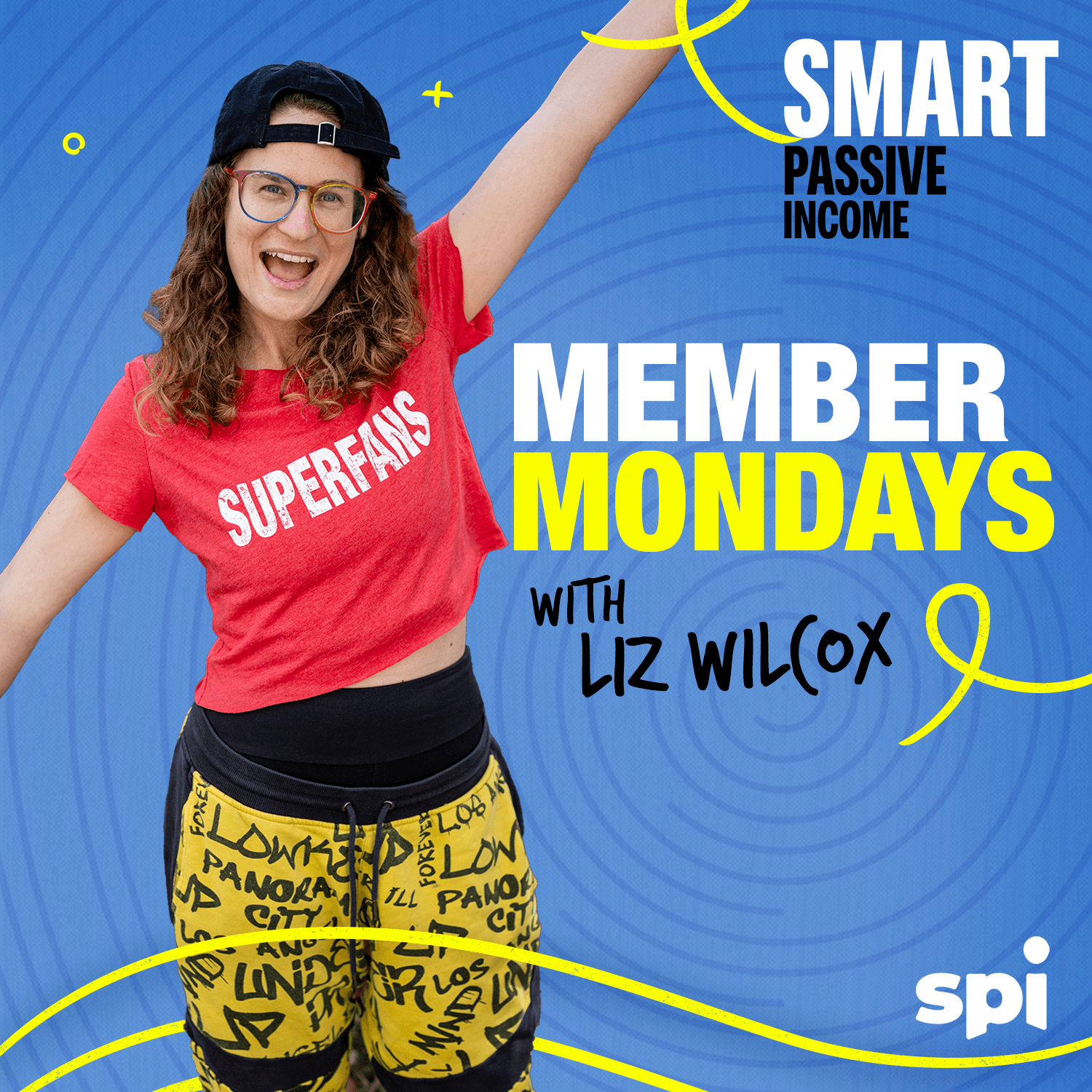


There’s freedom in saying yes to yourself. That’s why the more you say yes to your ideas, the more creative you’ll be.
I love that as the takeaway from today’s Monday Members chat with my guest, Marion Bevington. As you’ll hear, she’s overcoming important obstacles and putting herself out there to build a community around her mission!
In fact, being herself is what helped her attract nearly 200,000 young followers on TikTok in just four months!
But she’ll be the first to say that patience is just as essential if you want to build something that lasts.
Because here’s the thing. It’ll still take longer than you think, even if you go viral!
So get comfortable with frustration. Get comfortable being impatient. And get comfortable being yourself!
Listening in on today’s episode will inspire you to do just that. You’ll hear how Marion has locked in on a mindset that finds as much value in the lows as in the highs. We’ll learn more about her book on IBS, what creating looks like when you can’t see the phone in front of you, and why posting unfiltered attracts true superfans.
Enjoy!
Today’s Guest
Marion Bevington
Marion Bevington — blind writer, yoga therapist, lifelong pattern-spotter. Former software engineer. Trauma-informed practitioner.
After decades working in technology, she became fascinated by a different kind of system — the human one. Her work brings together lived experience, systems thinking, yoga, trauma awareness and a deep curiosity about how people adapt, survive and heal. She writes the way she speaks: honestly, directly, emotionally and usually with a very dry sense of humour.
- Find out more at AfraidToFart.com
You’ll Learn
- How Marion’s IBS journey changed her mindset around creativity
- Building an online brand to regain independence and freedom
- Going viral on TikTok and attracting a young audience
- What creating looks like when you can’t see the phone in front of you
- Why posting your unfiltered self attracts true superfans
- Building patience when everything takes longer than you think it should
- Showing expertise while still allowing yourself to be playful
- Why no one can copy you if you’re being yourself
Resources
- Subscribe to Superfans Secrets—our weekly newsletter on the strategies behind building real relationships with your audience, delivered free, straight to your inbox
- Connect with me on Instagram
MM 004: 200K TikTok Followers in Four Months with Marion Bevington
Liz WIlcox: Hello, hello. I am so glad you are here. What’s up? I’m Liz Wilcox, and this is the Smart Passive Income podcast. And on this episode, we are interviewing another member of the community, of my community, of your community, of the SPI community at large. And today I wanna introduce you to Marion. Wow, what a ball of energy.
You are in for a treat today. Marion is actually a blind creator, and her handle, her website, is AfraidToFart.com, and she works with people with IBS and how to unravel the shame behind it, find joy, and just find comfortability in themselves.
What I want you to take away from this episode is there is freedom in saying yes to yourself. The more you can say yes to your ideas, the more creative you’re going to be. That’s what I got out of this. I’d love to hear what you got out of it as well. And honestly, I hope in hearing all of what she has to say, you also see whatever obstacles you have, you can overcome them if you are not afraid or if you are willing, rather, if you are willing to sit in the impatience, sit in the frustration.
I think it’ll take you very far. It’s taken Marion very far, and can’t wait for you to hear what she’s got to say.
All right. Well, let’s, let’s get into it then now that the audio is working just fine. So Ms. Marian, you are in a restaurant right now. We’re very happy we’re able to make this call and make it work with all the time zones and all the obstacles, right? So I’d love for you to introduce yourself, introduce your amazing, amazing platform, and talk about what you think is successful in your creator business right now.
Marion Bevington: Wow. Okay, so the business is all around a book I’ve written, and the book is called Afraid to Fart: And the Fine Art of Following Through, and it’s about my healing journey and IBS. I was diagnosed with IBS in, oh, 20 years ago, but I’ve not had any symptoms for about 10 years, and how I cleared it was by understanding what the symptoms were actually telling me.
And three years ago, while I’d started the book, I’d done a thesis for a master practitioner in a specific health modality, and it was through studying that that I pr- began to appreciate like the metaphysical aspect of symptoms and how they are the language of the body on many levels. Then three years ago, I lost my vision almost completely.
I’d had a vision issue for about 15 years, and it was slowly getting worse. It’s an inflammatory process. You can probably see it in my face. And as the situation got worse, I had double vision for many years, and that was difficult to negotiate. But then three years ago, I lost most of the vision in both eyes, and that was after a particularly stressful situation.
And it’s, again, connected to all this understanding what the symptoms are actually about. I’ve managed in the last 10 months or so to actually regain probably about 5% of the useful vision that I’d lost. So I’ve really improved my symptoms with that as well. So the whole book, Afraid to Fart,
when I studied and found out or understood what my body was actually trying to do, and then realized, actually, this is something everybody should know about, we should really begin to appreciate what our body is doing when we are having symptoms.
And don’t assume that your body’s broken, and don’t assume that your body’s betraying you, which was what I went through. And also not to be alone, ’cause I couldn’t find anyone who had my symptoms. And it was the early days of Google, and it couldn’t find it on Google. And I was like, “I’m the only person who has this disgusting thing happening to me.”
And it’s not true. It’s a really quite a common symptom pattern that I have. So then I decided, right, I’m gonna write the book, and it took me until I went blind to actually have the space to become more creative and have the ability to put all the ideas that I knew were important into the one place, with the book.
And then I published in January, and I went on social media just before.
And I went on social media, on TikTok. I’d never done TikTok before. And after the blindness, I’d stopped all tech use. So my friends all supported me. They said, “Come on, come on, let’s get you back.” ‘Cause I, I love social media. I love tech. I always have. And then TikTok just blew up. Within two months, I had five million likes- I had over, I had nearly 200,000 followers, and so it just suddenly took a life of its own, and that gave me the confidence to get really creative.
So not only had I completed the book, but I’ve also done a series of workbooks, and the workbooks are all around the subtle bodies and the aura, the eight layers of our subtle body. So there’s a whole series of workbooks. And I love tech. I used to program computers. Now I say I deprogram people, and I start with me.
And the ability to use tech was always one of the things I was ex- I excelled at, and all my friends relied on me, and I had no idea how absolutely rubbish my friends are at tech. Because now I need them, they’re like, “Well, we don’t know. You used to do it for us.” So I’m really struggling to find the support that I need to achieve what I know I’m capable of, and it’s, that’s been a real barrier to progress for me this year.
So the, I’ve got a, I’ve got a website that’s almost developed. Again, I would have done that myself. And I’ve got a community on that website that I’m building we called the Fearless Fartes Famalam. And it’s about be fearless in your life because everybody’s unique, and the more we recognize we are unique, the more we can just be ourselves.
Liz WIlcox: Yeah. So I gotta interrupt you, ’cause there’s so much to unpack here, and I wanted to have you on the show, and I’m so excited, you know, we were able to make the tech work. Because there’s, there’s a lot of us listening that are afraid to post, let alone fart. You know, we’re, we’re, we’re afraid. And including me, I, I feel like I’m in this messy middle of trying to not follow in Pat’s footsteps, but take a n- a notch from him, right?
If that’s the right saying. So you are legally blind. You’ve been able to kind of get some of your sight back, but like you said, you’re really good with the tech. Except now, not really, because we can’t see straight. We can, we can barely see, right. So what, despite all these obstacles, ’cause we put obstacles…
You said it. We put obstacles in our own head, and then we also have these physical obstacles. And you might have already hinted at it maybe a little bit with the community. What made you say, “You know what? I know that I have these obstacles, but I’m gonna get on TikTok. I’m gonna get back on the internet. I’m gonna get back in technology. I need this.” What was it?
Marion Bevington: It’s the freedom and the independence that I’d lost with my vision. It seemed like a … I feel upset saying it. It feels like, because that loss was so great, that anything that I can do to try to bring back a little bit more independence, a little bit more freedom. The loss of the freedom and the loss of independence, not having an, a, a, a, a, we t-
The lady who just brought my food is actually a business partner, and we used to run retreats and events. 2020, we just lost it all. And so this was my way of trying to rebuild my financial freedom and build my personal independence back again. And also, the thing that really I’ve realized is I had no idea just how creative I am, and just how much fun I feel, and joy I feel when I’m occupied with what really is fulfilling and creative for me.
Liz WIlcox: This is so fun. Yeah. Talk to us about, like, what does creating look like when you literally can’t see the phone in front of you? Like, what equipment are you using? Are there any sort of accessibility features that you use or outside sources like a friend, a business partner? What does the… Well, let’s just start really granular.
What does, I wanna make a post, I need to record it, possibly edit it, and post it. What do- what does that process look like? I’m so curious.
Marion Bevington: Personally, I’ve got balls of steel, I’ve been told, and I just post now. I, since day one on TikTok, I never retake, never edit. I mean, now I do a bit more editing, but for the first six months I would… I knew where the record button was. I’ve got the apps that speak to you, so it, I could find the record button.
I’d switch off the speaking, press record, and I’d just go for it. And at the beginning I had it stuck on, I think it was on three minutes or a minute, and I didn’t even know what I was doing, so it would just cut me off. I thought, right, posted it. I posted it. And that was one of the ways that I really got a big audience, I think, because I didn’t care.
I didn’t know how to go in, i- into the app even to find the comments. So I was just posting and it was my friends that were telling me, “Have you seen your numbers?” I’m like, “No, I’m just posting.” Post twice a day. I was in, I was with friends editing my book in Cyprus, so I had free time to do it. So I’d just post two or three times a day, just get one.
And I knew that people were, were keen to connect, so I knew I was talking to somebody every time. So it just, it’s like having a FaceTime conversation with me when you watch my videos. Often I get told that by people, like, “It’s just like we were having a call with you.” ‘Cause that’s how I feel when I’m speaking to people on the other side of the phone.
It’s like I’m speaking to somebody who wants to hear me.
Liz WIlcox: Yeah, let’s talk about that just a little bit more because that is something that really attracted me to Smart Passive Income and why I bought it was just the conversations, the community, the camaraderie, and I wanted to amplify that, and it sounds like you’re similar. What is that feeling like? ‘Cause a lot of us listening, we want that, too.
We want impact words. We want our super fans. And what is that feeling like when you realize your friends say, “Hey, take a look at this.” You start to have those conversations. You start to realize you’re making an impact. What does that feel like?
Marion Bevington: Really exciting. I, I just turn into a little, I turn into a screaming teenager myself. Who- I’ve got teenage fans who come on lives with me, and they’re all like, “Oh my God. Oh my God, it’s Afraid to Fart.” And I wanna go, “Oh my God. Oh my God, it’s my fans.” So it’s like we have this, my inner teenager’s active, very active, always has been, and I think that really helps me to just connect with, especially the younger audience.
And then with women my own age, I’ve got life experience that you can … When, as you get older, you hear, don’t you? People, when they kinda know what they’re talking about, we’re all making it up as we go along, but some of us have got a little bit more experience to base it on, and I think that comes through.
I’ve always loved teaching.
And I think it’s allowing myself to really just be transparent, is the word, isn’t it, really? To just, if I mess up, I go, “Oh, God. Look, I just messed up.” I’ve got a bit of a potty mouth, so actually I think sometimes I think that puts people off, and then other times I think actually, you know, people like it ’cause I’m not, um-
Liz WIlcox: It’s who you are. Yeah.
Marion Bevington: I mean, I will try and be extra potty mouth if I know it annoys somebody I’m not vibing with, which is a bit naughty, isn’t it?
But there we go. I’m transparent, I admit.
Liz WIlcox: Very, very much herself. I love that. So let’s talk a little bit more about the, that audience, ’cause I know you’ve built a large one. Talk to us about how many, and is it just, you mentioned young people, or is it a mix? Like, who is watching these videos?
Marion Bevington: Everybody. It’s crazy. It’s like it really does go across the board. The most enthusiastic were sort of 15 to 30-year-olds. At the beginning, they were the ones that … from TikTok that I really vibed with initially. But that’s not m- the ab- I had an Instagram profile and a Facebook profile for years, so they were sort of, uh, all historical audiences, if you like, which were generally middle-aged women and a few middle-aged men.
So we- 40 to 60 was the group that I was working with in ages. And so I didn’t … When the, when the, all this youth fandom showed up on TikTok, I was really surprised, because I just assumed I’d continue to speak to the same level of audience. But it was a different me, ’cause it was the first time I’d started to go live after going blind.
So it’s a different me speaking from a different place, and then a different platform. So now I recognize, you know, it, it could never have been the same. But you ca- you know, you only … We, we just expect what we’ve had before, don’t we? We don’t really expect new things, do we? But that real, that … The audience is great, because I know most of the people don’t s- they don’t comment, ’cause they’re where I was when I couldn’t find my IBS symptoms on Google.
They’re scared, and they don’t want anyone to know. And there’s shame and embarrassment and all the stuff that is what my work is all about. It comes up. And every so often, people will say, “Oh, I’ve been watching your videos all year, and I’ve just realized I’ve been able to fart in the office and not feel I was gonna die,” or so I get these tiny little comments coming through, and it really warms my heart. Because I know if I can shift someone’s state of shame out of that old habit of freezing when you feel your stomach starting to rumble, that is gonna do nothing but help improve the state of somebody’s being, their energy, their body, their physiology.
Any clenching tight, any, any holding that we do, it’s holding down life. You know, I say people, “You never died from farting, but you could possibly die from holding them in.”
Liz WIlcox: Yeah, that’s, you know, that’s true.
Marion Bevington: Just, it’s just a tiny little window into patterning generally in life. So even though it’s kind of, you know, The Fart Queen or the fart thing is the thing that I’ve got because of the book, what I also know is that’s not the
The picture is, it’s to do with shame. It’s to do with understanding what symptoms are about. They’re just a tiny doorway into that big general human need for more support.
Liz WIlcox: Yeah, more, um, coming back to yourself, I think. I love this. We talk a lot about at SPI hooks, and what’s the hook of the video, this and that. But I think what Marian is talking about is, is such a wider lens of the hook, right? The, the hook is the f- farting, right? It’s, it’s a little taboo, it’s a little funny.
You know, some people love it, some people hate it, but it, it draws everyone in. But really, it’s about the IBS and what is the root cause of that? What is this shame? What is this tension you’re holding in that’s making it worse and worse instead of alleviating the symptoms? So I, I love that so much, and it’s such a good reminder for folks to kind of take a bigger, wider picture of what they’re trying to do and what can connect all of us.
Something that we love here at SPI is community. That was why I was so attracted to the business in the first place, and why we started these kinds of episodes to feature our people, and what are we doing? How are we doing it? And I– you mentioned something earlier about you have a lot of barriers to progress, but one of the reasons I wanted you on the show was because it seemed like even if, like yes, but I’m still gonna do it.
So I love this so much. Can you talk about… And, and you mentioned, you know, it was a way of connecting, but more of that mindset shift that went from, “Oh my gosh, I can’t see,” to, “You know what? I’m gonna reclaim my freedom, reclaim my creativity. I’m just gonna hit that record button wherever that reader told me to click and I’m just gonna go for it.”
What i- what is the mindset, and also maybe where is the– how has it even improved as you’ve grown the platform?
Marion Bevington: At the beginning, the level of frustration I experienced is enormous because one of the things I say is everything takes 52 times longer. It took me… I realized it took me a year to achieve something that would’ve taken me about a week before. And so I was, “Okay, so there’s a, there’s a metric. I’ve got a metric. It takes 52 times longer to do things.” And that, just that idea was it’s about me helping myself to deal with the impatience because it comes up, and when it’s up, it’s strong. And when you’re in it and it’s strong, doesn’t matter how clever your mind is, doesn’t matter how much knowledge and wisdom we’ve got, when you’re in a state, you’re in a state.
And it’s recognizing and respecting the fact that you’re in it, that I can actually start to loosen it a little bit. Just I’m just, I’m frustrated. Some of the conversations, I used ChatGPT a lot at the beginning. I didn’t understand properly how to use the dictate function, and the transcription glitches are enormous.
I’ve got a bit of a Liverpool accent, and so it’s quite a, a- it’s got… there’s a bit of dialect in there. So when I get really passionate, it wasn’t transcribing what I was saying, and I couldn’t work out how to get the transcriptions more accurate.
And in the morning when I’d listen back or look back at the dictated messages and actually listen to me shouting at ChatGPT and having the biggest arguments, but that was really cathartic because ChatGPT or, or Claude or p- you know, all the other ones, they’re not emotionally involved.
And so you have a complete rant, and they go, “Oh, yes. Well, I did make a little mistake. Let’s just try and do it again.” And it’s not a person, so y- I, I, I can ask it to do it again.
So that was really healing for me to be able to be angry, because that was something I was never allowed as a child. Now, one of the things about IBS metaphysics, it’s indigestible family anger. 90% of the time, indigestible family anger is at the root cause of the series of symptoms that we call IBS. And so that anger was something I was not allowed to express as a child, and as an adult, I’m a people pleaser.
You don’t do angry. You hold it in. You swallow, you get sweet. And it would really take a lot to push me to anger. A lot. And that’s one of the reasons why inflammatory processes survive so well in my body, because I don’t express that heat, that fire, that anger and rage and those other emotions. But
Liz WIlcox: Yeah. Well, I was gonna say, what a fun use of AI that we haven’t yet discussed on this podcast, using it to release those emotions that sometimes we might not feel comfortable releasing to humans. That’s, that’s very funny. That’s very funny, but also I can see it, and I love it for everyone who needs that message today.
You mentioned, and I, I love this because I’m constantly telling people, “This is going to take longer than you think. This is go- you know, get comfortable with being frustrated, get comfortable with being impatient.” But you said 52 times. I love that you have a metric now, ’cause that also kind of helps the brain say like, “Okay, I can be frustrated, but I, at least I know the formula.”
So let’s talk about some of those accomplished things. What have you accomplished since you wrote the book? You said it was, it came out in January of 2026. Is that accurate?
Marion Bevington: Yes. Yes, it went on Amazon in January. Jan- I think we got it on for New Year’s Day.
Liz WIlcox: Amazing. I love that. And when did you start going live or posting on TikTok?
Marion Bevington: In the September prior to that.
Liz WIlcox: Amazing.
Marion Bevington: Four months on TikTok just before. But the book had already been almost completed at the beginning of the TikTok journey. Took four months to get all through the Amazon stuff. So I knew it was ready, and I knew it was coming, so that was why it was so easy to make the videos.
Liz WIlcox: Amazing. Yeah, so what have we accomplished since launching the TikTok platform, launching the book? Like, what has happened since? Like, give us some numbers, some exciting stuff. What have you been able to accomplish? Because I feel like it’s a lot, especially if it takes you 52 times longer than the rest of us.
Marion Bevington: Absolutely. So I’ve … The other things I’ve accomplished, so I’ve got … I mean, I’ve got all these workbooks, and they’re, they’re ready for blind people because they’re all workbooks that are … Well, they just, they look like a text message. They need formatting and laying out, that’s the, that’s one of the jobs that I’ve got that I need a lot of support with.
The website has been developed. I’m on the third set of developers because, again, people not understanding what I’m doing, and I really know what I want. It’s very specific, and I’ve found a few programmers who are helping me.
It’s got all accessibility features on it, so I decided if I’m blind, I’m gonna make sure that other blind people will have ease of access to anything that I produce, so I put that as one of my key indicators on wo- on the work that I’m doing, that it has to be accessible.
Because I’ve found life so difficult in this inaccessible world, I’m not gonna provide more inaccess- So the website’s looking great. The understanding of what I’m gonna do for the community is great, and I loved your thing about the, um, Costco thing, ’cause that was the idea I had as well. I didn’t put it quite so eloquently as you, but it was literally just give people a pass to just come and go as they want, and let’s just be here and have the community and, uh, you know, y- a few stores set out for people to use.
I love going live and having interactive live sessions as well. Using social media platforms is a nightmare ’cause it’s full of trolls. You spend half the live streams actually trying to get rid of the trolls. But again, it’s been a… It’s like school. Every day is a school day. I’ve really learned about where my strengths are, and I’ve learned that if there’s trolls around, I need to not focus on them, because all the other people who wanna listen to me, they wanna listen to me talk to them, not talk about trolls.
So just different things about managing my own mood when I’m feeling overwhelmed, or staying present with the people who are actually wanting to communicate with me. That’s something I think that I’m really beginning to appreciate about myself, that I’m very good at that. And the community idea, everybody that I’ve spoken to about it is like, “Wow, this is such a great idea.”
People tell me it’s underpriced, but I’m like, I d- I don’t… I’m not here to get anybody to give me a lot of money. I’m here to help as many as possible as easily as possible.
Liz WIlcox: I love that.
Marion Bevington: That’s where the numbers come from. I’m not interested in putting zeros on your bill.
Liz WIlcox: Right. That reminds me, I was, I’ve been reading Good to Great, I think it’s by a guy named Jim Collins, and he, I just got to the part where he talks about Hewlett-Packard, which were, like, software manufacturers, and Packard, I forget his first name. He died a multi-billionaire in the ’90s, and his obituary just said, it said rancher, et cetera, on it, as far as who he was.
And he lived in the same house that he built in the ’50s with his wife, and he never moved on, and he was quoted as saying so- I’m gonna butcher it, but he was quoted as saying something like, “We focus on the people, we focus on the product. The profits take care of themselves. We’re not gonna focus on that.”
So also, Marian mentioned, like, my Costco story. If you don’t know, I have something called the Annual Pass in my personal brand, and I stole it from Costco. You know, you make money… Costco makes money from the membership fee and they pretty much give away their products at cost. That’s why it’s called Costco.
And I said, “Well, I don’t have a lot of costs. I could just have this yearly membership fee and you can get all my products, all my training, all my content for that one low price you can get in the store, so to speak.” And so that has worked really well for me and it, it’s very similar to what she was talking about of if I just focus on the people, focus on that community, things are gonna go well.
Let’s talk about the size of your TikTok, ’cause it, it’s, it’s remarkable to me. I want you to brag on it a little bit. How many people are following you now?
Marion Bevington: Well, at the moment I think I’ve got 200 and, nearly 200,000. Like 180,000, 190,000 followers. I got most of them in the first three or four months. I talk about things that are off script mainstream, so TikTok have canceled and barred and c- I actually got thrown off the creator rewards because I talk about health in a different way.
And, uh, yeah, I’m very open about my own health journey, which was, I mean, part of the eye condition is vaccine damage. So I’m very open about that, but social media, uh, uh, no. So within the first four months before they’d kind of caught me at my shenanigans, they didn’t really interfere, and it just grew and grew and grew, and I was getting, like, 30, 40,000 followers every week or two.
And then suddenly it stopped, and then the numbers started to fall, and I ne- and that was when my videos started to get less and less air time. But I just stuck at it, and I thought, “Right, don’t talk about the things that they block. If they block it and you know they block it, just talk about something else.”
There’s plenty to share. I don’t need to get focused on the things that are not helping
Liz WIlcox: I love that perspective, ’cause yeah, you wanna help people, so you don’t want to actually be blocked because you wanna build that community. You wanna help people. And yes, when it comes to health and as even specifically IBS, there’s plenty to talk about. So I really love that perspective instead of, oh my gosh, the sky is falling, or you could be angry or whatever.
You’ve really taken that and you said, “Okay, well these are the topics people are watching. These are the topics the platform wants me to talk about. Let’s stay on task here.” I, I really, really appreciate that perspective for sure. So let’s talk about the future. What are your hope… You know, you’re getting the website up.
You wanna build a community.
Marion Bevington: The book’s gonna be bigger than the Bible. That’s my intent
Liz WIlcox: Yeah, why not? Why n- I, my mantra is always, “Why not me?” So I love this so much. So how are you planning on growing, growing your following and growing the awareness around the book?
Marion Bevington: So it’s mainly about me standing up and speaking out about it, and I’m happy to stand on stages, and I’m happy to go on videos, and I’m happy to show up anywhere and just talk about what I love.
Oh, I did a stand-up, a five-minute stand-up comedy mic thing on Monday. I got four laughs. I counted them.
Liz WIlcox: Well, congratulations.
Marion Bevington: But also it’s about engagement. I love to engage an audience.
I’m not here to talk at the audience.
So I just love having fun, and I’ve always been silly and sincere. I’m not serious at all. But I do silly very well, and I do sincere very well. And it’s just about me really just allowing myself to be that playful me because that’s where the engagements come from, and I know that’s what was so attractive about the TikTok account is that I’m just me, and I’m just silly and but I do know what I’m talking about, but I don’t take life too seriously, and I try not to take myself too seriously. And when it’s sad, it’s sad, and when it’s great, it’s great, and it’s being the juice of whatever the thing is that is happening for you right now. The juice of sadness has got its value, as much as the joy.
And it’s really … There’s a, there’s a yoga word called rasta, and it means juicy. And it is that. It’s the essence. Everything has it. A mosquito bite has its essence. A smelly fart has its essence, and then joy has its essence. So it’s that. Can we just be with the essence? ‘Cause that is where you’ve … There’s awe, and there’s just this like being in love with life can come from that.
Liz WIlcox: Awesome. Well, I’m so excited for you to grow, and of course, we’ve talked offline or off air, and, you know, I’m happy to help any way I can grow your email list and help you sell the book. I bought a copy. Super easy to buy. Like you said, very accessible website. It was easy-peasy. But I’d love for you to tell us if we are inspired by you, if we wanna follow your journey, and also if we are afraid to fart, uh, how can we follow you?
How can we get the book? Yeah.
Marion Bevington: Afraid To Fart. It’s- there’s nobody else using that phrase, so at #AfraidToFart, and you’ll find me on any social media platform. And then the website is called AfraidToFart.com. Even with that, every time I say the website name, I go www.afraidtofart.com.
Liz WIlcox: That’s fun.
Marion Bevington: So that’s where the website is, and the social media I use the hashtag all the time.
See, that little bit of technology sort of works quite well, doesn’t it, when you don’t have to, you don’t have to overindulge, you don’t have to overwhelm. Just that one little catchphrase, and that’s really, really… It’s been a ma- it’s been magic, ’cause I’m not even getting people who are trying to copy me really.
I mean, I get people using bits of video and my voice and things, but you c- you, you can’t replicate me. I’m not-
Liz WIlcox: That is for sure, and that is one of the, the things that I am learning to love about you and ’cause I get, find myself very similar, and that’s, that is something we talked about in the last episode where we interviewed a community member was there is nowadays this monetary incentive to be yourself. You can truly be yourself and create an income online and build a following, and I can’t wait to help you take those 190,000 people, get them on an email list, and sell this book ’cause it’s gonna be really fun.
Marion Bevington: Liz, I’ve already got about 700 emails, but we haven’t got that bit of the business working. They came in the first three months, because that was what I was doing on TikTok, “Send your email, send your email, send your…” And I had an email capture page on the website, and I captured… I mean, we’ve got, I think we had 600 that had reconfirmed, and 800 in the, in total.
So even that went really, really well. But then I’ve got, now I’ve got a database of email addresses that are like, “Oh, I want to do something with that.” Gonna take me 52 times longer. I need to do something.
Liz WIlcox: Well, I’m here to help, so maybe we can turn that into maybe only 26 times longer. Maybe we can rally the troops. If you’d love to help Marion create a, a slicker process and you’re good with email and tech and all of that, you can find her at AfraidToFart.com. Thank you so much, Marion.
Marion Bevington: Thank you so much, and I really, really appreciate it. And I’ve, I have been binge-watching you and Pat, I’ve got to say. It’s quite… I love it.
Liz WIlcox: Oh, well thank you. We love that. Thank you so much.