Which community platform is right for you, Mighty Networks or Circle.so? We've got all the details to help you make the right decision.
The post Review: Mighty Networks vs. Circle (in 2023) appeared first on Smart Passive Income.
]]>In this blog post, we’re going to compare two membership platforms: Mighty Networks and Circle. One has been around for years. The other launched more recently.
Both are amazing platforms, but as you’ll see, there are some key differences, and they have different strengths and benefits. Which one could be right for you?
Disclosure: This post contains our unbiased review and recommendations to help you decide between Mighty Networks and Circle.so for your membership community platform. However, Circle.so is the platform SPI uses for its membership community, SPI Pro, and this post contains affiliate links for Circle.so. Read our full affiliate disclaimer here.
Mighty Networks Review: An All-In-One Tool
I've interviewed the founders of both platforms on my podcast, but let's start with Mighty Networks first.
The platform has been around for a few years. Here's some background on how this platform came about.
How Did Mighty Networks Start?

Mighty Networks was founded by Gina Bianchini, who was cofounder of Ning.com, an online social media network platform for people and organizations to create custom social networks. Gina left Ning in 2010 and started Mighty Networks.
She and her team wanted to build something that was mobile-fast and creator-led.
Pat interviewed Gina in session 405 of the SPI Podcast, where she talks about her vision with Mighty Networks: “… to create something that allowed you to bring your people together in one place, do more with them, run online courses, have virtual workshops or even organize in-person events because of some of the features we have related to people near me.”
“What's powerful about a Mighty Network,” says Gina, is that “you're not just bringing your community and courses together in the same place. You are in fact creating and taking advantage of the same underlying dynamics that have built some of the most successful companies in the history of companies [Facebook, Twitter, etc.] The difference is that you as a creator can take advantage of the same underlying dynamics that built those platforms by having your own network effect that is creator-sized, that is for your people that built your business.”
Gina Bianchini, founder, Mighty Networks
Gina wanted to create a place for “brands and businesses to come together via online courses, paid memberships, events, content, and community—all under your brand, instantly available natively on every platform.” Mighty Networks serves the growing world of “creators with a purpose” in a category they term the “passion economy.”
Mighty Networks is one of the oldest and most established platforms to host membership communities, and it’s filled with tons of features.
Recently, it has started marketing itself as a “website builder” rather than just a community platform. This is an interesting move, because it offers online businesses a way to build their entire infrastructure on one platform.
What are the Features of Mighty Networks?
The platform has a ton of functionality you’d want as a creator, including:
- Website builder
- Online courses
- Memberships
- Subscriptions
- Community
Mighty Networks has the ability to produce articles, online courses, and organized events. The company wants each creator to be in control of their own Mighty Network and to be able to bring their content, courses, and community together in one place.
Mighty Networks discovered through customer feedback that their customers didn’t want to have to go to other platforms to create online courses, so they built a way for creators to create and sell online courses right on the Mighty Networks platform. Today, over 65 percent of their paying customers (premium plan), take advantage of the ability to host their online courses on Mighty Networks.
How Much Does Mighty Networks Cost?
The platform offers two main plans to choose from, based on your needs.
Mighty Networks Community Plan ($33/month paid annually):
- Native Livestreaming & Video
- Chat & Messaging
- Events & Zoom Integration
- Paid Memberships
Mighty Networks Business Plan ($99/month paid annually):
- Online Course and Cohort Course Creation
- 2,000 + Zapier integrations
- Premium analytics
- Featured Pages & Events
You can see the full list of plans and features here. There’s also a Mighty Pro plan (price not provided on the website), which includes white label capabilities and your own iOS & Android apps.
Why You Might Consider Using Mighty Networks
We've identified three key reasons why Mighty Networks might be your platform of choice for your membership community.
It allows you to build your entire online business infrastructure on one platform
As mentioned above, Mighty Networks was originally created as a community platform, but has since transitioned into positioning itself as a “website builder”—which allows people to start with their website and build everything out from there. This allows people to have their community, course sales, and content creation all in one place, rather than having to figure out different platforms for each.
It has been around for a while and has developed a ton of features
Since Mighty Networks is several years old, it has more capabilities than other membership platforms. For now, the built-in events functionality seems a lot better than Circle and other platforms, and their member profiles are more robust. In addition, it has a tool for payments so you don’t have to integrate an outside platform when selling courses or your membership community.
Having everything in one place helps to encourage audience engagement
If your fans have to log in to several different platforms to engage with you and your other fans, then engagement might suffer. If they’ve just finished a course and then have to go to Facebook to connect with others who took the course, it may be too much work.
Gina believes that entrepreneurs want everything in one place: “They’re saying, ‘You know what? I'm sick of having a static website. The fact that I can have my website and my community and my courses and my payments and my marketing pages all in one place is what I want because I want to move from having something that's static to dynamic.’”
It’s also outside of the noise and distraction of Facebook—it’s a dedicated space so you have people coming to the community intentionally, not just when they’re scrolling through Facebook. So you won’t have to work as hard to keep your community members' attention.
Why Mighty Networks Might Not Be Right for You
Mighty Networks isn't for everyone. Here are the main reasons it may not be the best fit for your needs.
You might not need so many features
Some established creators don’t need this many features. If you already have your courses housed somewhere else, you don’t need the “courses” feature. If you’re a more established entrepreneur and creator, you may not want to move your payments, courses, and website all over to Mighty Networks.
It’s not very intuitive
While it’s very feature rich, Mighty Networks isn't as intuitive as other platforms, like Circle. Some users have found it hard to navigate. Sometimes you have to click through one or two levels before you find the conversation. Also, the platform isn’t “white label” unless you pay for the Pro membership, which isn’t priced on its website.
Bottom Line: This platform could be perfect for you if you need an all-in-one platform to build your business infrastructure, but it seems less intuitive and harder to navigate than Circle.
Circle.so Review: A Tool That Turns a Passive Audience into Passionate Superfans
Circle is a much newer platform than Mighty Networks, but it's powerfully intuitive, and that's why here at SPI we chose it for our membership platform. We host both SPI Pro, and our SPI All Access Pass on Circle.
How Did Circle Start?

Circle was started by three colleagues who left Teachable around the same time. Sid Yadav was Teachable’s first designer and worked there for five years. He teamed up with Andrew Guttormsen, the former VP of growth at Teachable, and Rudy Santino, the former head of design.
According to the Circle.so website, Circle promotes itself as the “modern community platform for creators” that “brings together your discussions, memberships, and content” and enables you to “integrate a thriving community wherever your audience is, all under your own brand.”
The biggest difference between Circle and Mighty Networks is that Circle isn’t trying to do everything. Its main focus is on membership communities, and then providing seamless integration with other platforms you may be using.
As Circle cofounder Sid Yadav says, “We’re not trying to do all of it. Our approach is a little more modular: we’re trying to nail the community piece, and specifically the engagement piece. Our approach is to integrate with everyone else, so we have a partnership with Teachable, with Memberstack, with Memberspace, Memberfull.”
Circle also doesn’t currently have its own payment option, but it does integrate well with payment platforms like Stripe.
The other big difference between Circle and Mighty Networks is that Circle offers a white-label community experience, where you can choose your own brand colors, add a custom domain, etc.
As we wrote in this blog post about the launch of SPI Pro, we've been all-in on Circle since it launched last winter.
Matt, our co-CEO, had a vision for SPI Pro, and then went looking for a platform that could do everything we wanted. Circle seemed like the perfect fit. Matt and Pat have since become advisors for the company.
What Features Does Circle Have?
Circle includes a 14-day free trial here, but here is a list of the features included on the platform.
- Online courses
- Live video streaming
- Custom domain
- Private spaces (similar to Slack channels)
- Bulk import/export
- Zapier Integration
- Embed Widgets
- In-app notifications
- Member profiles and directory
- Basic moderation
- Direct messaging
- Group messaging
- Weekly digest email
- iOS app
- Updated price structure
Complete white labeling (for the Professional and Enterprise plans)
To see a full list of Circle's features, go here.
How Much Does Circle Cost?
Circle offers three main plans.
Circle.so Basic Plan ($39/month paid annually):
- Engaging discussions
- Rich member profiles
- Unlimited events
- Group chats
- Private messaging
- Moderation
- iOS & Android
- Easily accept payments
- Custom domain
Circle.so Professional Plan ($89/month paid annually):
Everything in Basic, plus:
- Courses
- Live stream video experiences
- Fully White Labeled
- Advanced analytics
- Custom CSS
Circle.so Enterprise Plan ($360/month paid annually):
Everything in Professional, plus:
- Dedicated CSM (Annual Plan Only)
- API Access
- Customizable profile fields
- Priority Email Support
- Custom Single Sign-on
- Concierge onboarding (Annual Plan Only)
Why You Might Want to Consider Circle.so
There are three key reasons to consider Circle for your membership community.
Seamless integration with your existing tech stack
If you already have a website or online courses, and if you’re already using multiple tech platforms, Circle integrates very nicely with your existing tech stack.
It’s very customizable, so you can build your community space from the ground up
When you create spaces, you can customize who has access to each of those, change whether they’re displayed in “post,” “list,” or “card” view, control whether members can create new topics, change the way the topics are ordered, and pin topics to the top or sidebar.
You can also have a blend of a free community on Circle that has private spaces that someone would need to pay to have access to, or a completely free platform on Circle. Every part of the platform is modular so that you can do with it whatever you want.
Circle also lets you choose your colors, add your logo, and use your own custom subdomain so that the experience on the platform feels native to your brand and your products.
It’s intuitive, and combines the best of platforms like Slack and Facebook
Circle feels a bit like Slack with “spaces” you can customize similar to Slack Channels. As an admin, you can choose who is in what space, and it’s easy to make spaces public or private.
It’s not just one long newsfeed, so conversations are easier to join and respond to, without having to be on the platform constantly or having to click through several layers to find the conversation.
Circle has a clean, simple interface that will be very familiar for people who have been a part of a Facebook or Slack group. It’s also more user-friendly than Mighty Networks.
Why Circle.so Might Not Be Right for You
While Circle is a great option, there are a couple of reasons why it may not be the best fit for you.
It doesn’t have as many features as Mighty Networks
One important thing to consider is that Circle does not include a tool to collect payments for your membership community, so you will need to integrate another platform like Stripe in order to process user payments on your own.
It also doesn’t have group messaging (although the Circle team working on including that in the future), or a mobile app (also coming soon).
Circle is new on the scene, and it will take time to develop these features. And some features may ultimately not be a part of Circle’s vision. Instead of adding features like a payment tool, the platform may focus more on community and integration instead.
You’ll need other platforms to build out your business infrastructure
If you’re a new entrepreneur and don’t already have a website, courses, or a payment platform, you’ll need to set those up separately from Circle. Depending on where you want to go with your business, that may not be a bad thing. But just keep in mind that Circle is laser focused on building a membership community platform that will be more user friendly, and keep your fans engaged.
Bottom Line: Circle might be perfect for you if you need a community platform that is flexible and customizable, and you don’t need an all-in-one tool. It’s still new and developing its tools, but the team at Circle is incorporating feedback from its users.
Why We Chose Circle.so for SPI Pro
So far, Circle has been an amazing home for SPI Pro. We didn’t need an all-in-one tool like Mighty Networks, and we liked the fact that we could build our community space exactly how we wanted it, and didn’t have to try to shoe-horn it into an existing template.
We have found that our community members are highly engaged—a recent monthly challenge event generated over 500 comments! That said, we are noticing that some of the spaces aren't being used very much, and so it’s easy to delete them when necessary, or add new spaces based on the needs and interests of our community.
Seeing the spaces (similar to Slack channels) on the left side of the page keeps topics and conversations easy to access which leads to more engagement.
The Circle team has been amazing in responding to our feedback and requests, and we’re excited to see how this new tool can evolve within the next year.
If you’re starting your own membership community, be sure to do your research and find the best fit for your business. If you think Circle might be the right solution for your business, you can get a free 14-day trial to put it through its paces [affiliate link].
The post Review: Mighty Networks vs. Circle (in 2023) appeared first on Smart Passive Income.
]]>If you're ready to quit Facebook (or any other platform) as your community's home, here's what you need to keep in mind.
The post How to Quit Facebook Groups as Your Community’s Home (9 Tips) appeared first on Smart Passive Income.
]]>Want to move your community off of Facebook Groups, whether it’s to a Circle community, Discord, or another platform?
These are the 9 important steps we followed during our own migration off of Facebook Groups. They’ll help you maximize the number of people who convert to your community's new home, and ensure that everybody is happy—yourself included.
The 9 Keys to Successfully Moving Your Community Away from Facebook
Pro tip: These steps apply whether you're trying to leave Facebook or any other platform as your community's home.
1. Give your community time.
Give them time to know that this will be happening. Give it a couple months, or at least a few weeks notice, if possible. Anything less, people won’t have time to process the change, and a lot of them will be upset. This helps the rest of the steps go smoothly.
2. Nail the benefits of the migration.
Know why you’re doing this, and communicate it. You have to understand and share the benefits. You almost have to sell the migration process with your community. Nobody likes change, so make sure they know why it’ll be good for them.
3. Address the pain points.
Don’t hide from the downsides. Tell your people that you know that this move will be a big pain. (Yes, they will have to create a new login and password.) Be upfront about these pains—and make sure to contrast them with the benefits from the previous step.
4. Rally your superfans.
There are likely people in your community who are super active, who would follow you anywhere. Find those people (you probably know them already), and give them an early heads-up. They’ll feel even more special, and they’ll want to help you sell the change to the rest of the community.
5. Bring your superfans into the new space first.
Your most dedicated members will probably be okay with things not being fully fleshed out yet. In fact, they’ll appreciate that you’re building and testing the new space with their help and with them in mind. And once the regulars are ready to join, there will be activity happening in the new space already.
6. Set a firm date.
Pick a day that you’ll make the change, and stick to it. If you don’t, you run the risk of people not feeling urgency about the migration. A lot of people will wait right until the last minute to move over, so give them a clear deadline.
7. Have an overlap period.
Set aside some time when you’re helping people get set up in the new space while the old community space is still open. This will give the stragglers a little extra time (up to the firm date in step 6) to make the move. Give it at least two weeks, up to a month.
8. Give clear instructions.
Make it super clear how to make the shift to the new community platform. Show pictures, share a video if it’s helpful. And be prepared to share those instructions many times.
9. Make onboarding easy.
Onboarding your members into the new space is super crucial. give people clear steps to take once they’re there. They should always have an answer to the question, “What do I do next?” Nail the onboarding process, and your members will have a great experience in their new, unfamiliar environs.
A final word of wisdom: You will lose some people in the process of moving your community off of Facebook Groups. The steps above are designed to minimize the number of people who don't make the leap with you. And once people hear how awesome the new community experience is, hopefully they'll want to return!
For more detail, watch Pat’s 8-minute video on the Community Experience by SPI YouTube channel.
Our Chosen Facebook Groups Alternative: Circle.so
If you’re wondering how we know so much about migrating your community away from Facebook, it’s because we successfully moved all of our Facebook groups over to Circle.so [affiliate link]. We love Circle for its customizability and intuitive design, and it’s also been the platform of choice for our highly engaged community of entrepreneurs, SPI Pro, since its inception.
Want to Become an SPI Pro Member? Apply Before Prices Go Up!
Speaking of SPI Pro, you have just a couple of weeks to take advantage of our original pricing ($49/month or $490/year), before it doubles. This community will still be well worth it even at twice the price, but head over to SPIPro.com and apply before they go up on May 16.
The post How to Quit Facebook Groups as Your Community’s Home (9 Tips) appeared first on Smart Passive Income.
]]>In our March 23 CX Day event, Circle's Andy Guttormsen and Alexis Teichmiller shared 12 ideas to make your community a place of belonging.
The post How to Make Your Community More Valuable (12 Ideas from CX Day) appeared first on Smart Passive Income.
]]>How can you create a community where members feel like they truly belong? A place where they can find their people and get the resources and guidance to create real transformation?
In the second session of March 23’s CX Day, Circle‘s Andy Guttormsen and Alexis Teichmiller took us through dozens of real-life examples of successful communities, to provide inspiration for creating our own.
They also shared 12 practical ideas you can use to make your community more valuable and create that sense of belonging—and we’re going to run through them today.
12 Ideas to Create a Sense of Belonging in Your Community
As you’ll notice, most of these ideas are about creating a sense of belonging for your community members, because that’s key to a great community.
There are 12 ideas here—that’s a lot!—but the point is not to overwhelm you with options. If even just one or two spark something, that’s great. Run with it! (We don't even use all 12 of these ideas in our community, SPI Pro.)
The most important thing is to keep in mind the folks you want to serve and how these ideas might be applicable to them.
- Monthly introduction calls. Invite all new members to a monthly call to introduce themselves and their goals, and what they’re looking for from the community.
- Group coaching calls. Help multiple people at once with a group Q&A session where you help people identify their problems and suggest solutions.
- Weekly or monthly “hot seats.” Similar to the group coaching calls, one person talks about a problem they’re trying to solve, and the rest of the group helps them with it. Rotate who’s in the hot seat each time.
- Continued education. Host a book club, watch the same movie, or listen to the same podcast episode. Then create a shared space where people can connect over what they've learned.
- Expert guest interviews. Lend your platform to someone else. Bring in someone who has the heart of a teacher, and run a video- or text-based interview. Bonus points: get the community to vote on specific guest speakers they’d be excited about, then book them.
- Weekly or monthly office hours. This gives your community dedicated time to ask questions and dive deeper into your content and expertise.
- Accountability groups. Host a weekly or monthly check-in with your community to identify what they need accountability for and then challenge them to pick an accountability partner.
- Panel discussions. Bring two or three people from your community together and host a panel discussion that's relevant to that month’s content or topic.
- Live workshops or trainings. Run training workshops focused on teaching your community. Invite participants to engage with the live chat during the workshop!
- Challenges. Run a monthly challenge, and at the end of each month host a live video announcing the challenge winner and talking about their experience.
- Community champion program. Invite three to five members from your community to be community champions. Ask them to commit to posting a new question in the group weekly to inspire community engagement.
- Show and tell. Invite a member to join you live in showcasing their business, personal growth, or new idea.
If you want to dive into these 12 ideas in more depth, check out the replay of Andy and Alexis’s session from CX Day.
And these 12 tips are just the tip of the iceberg of what Andy and Alexis covered in this session. Here's what else they talked about:
1️⃣ They covered the most common ways to structure your community—so your community home is designed for connection and your members are encouraged to build relationships and engage.
2️⃣ They even built a brand new community from scratch, in real-time, to show how quick it is to get up and running.
3️⃣ And they walked through 20 real examples of different communities, to show the breadth of what's possible.
Bonus Insight: The 2 Big Myths That Can Hold Back Your Community-Building Efforts
Oh, and they also debunked two of the biggest myths that can prevent you from starting a community or membership experience for your business.
Myth 1: I need to have a large following to create a community or membership experience for my business.
Reality: It can be a major advantage to start with a smaller, tight-knit community before growing larger. You can give people more attention, and have a tight feedback loop as they get acclimated. It’s easier to nail down who you are and who you serve when you’re smaller.
In fact, the great majority of the most successful, beloved communities on Circle have fewer than 100 members!
Myth 2: I need to offer a lot of stuff for my community to be really valuable to my members.
Reality: It’s much better to overdeliver on one or two big promises you make to your members. Remember, people aren't joining your community to get “stuff” from you—they want the transformation that stuff can provide.
For more on these myths, and the 12 practical ideas you can use to create a more valuable community for your members, check out Andy and Alexis's CX Day session at SPI’s Community Experience YouTube channel.
And ICYMI, check out last week's post, where I covered Pat and Matt's CX Day session on the differences between audience building and community building.
The post How to Make Your Community More Valuable (12 Ideas from CX Day) appeared first on Smart Passive Income.
]]>Relationship development is crucial for online community managers. Here are the five main types of member you'll encounter in your online community, and how to best engage with each of them.
The post The 5 Types of Online Community Members appeared first on Smart Passive Income.
]]>Nurturing an online community takes patience and dedication. But if you spend too much time focused on launching new programs for your members rather than engaging with your members, you may find your community is less than thriving.
Relationship development is one of the best ways to spend your time in your community. The thing is, individual members engage in online communities in a variety of ways, and may therefore prefer a certain type of relationship. It helps to know each of the member types you'll find in your online community, so you can best serve all of your members and ensure a thriving community.
In this post, I’ll talk about how to identify and work with these five online community member types:
- The Lurker
- The Social Butterfly
- The Critic
- The Troublemaker
- The Tech Challenged
Note: These types are not mutually exclusive, and each member is likely to fall into several categories. The point is not to wedge each of your members into one group, but to get an idea of common behaviors and how best to interact with those behaviors. Really interesting communities have a variety of personalities and viewpoints. It's your job to celebrate these differences and provide several ways for your members to engage with each other.
#1: The Lurker
You may mistake a lurker for an inactive member, because on the surface they don’t seem to be participating. Some people prefer to observe the public interactions and participate through one-on-one interactions like direct messages, or in smaller private groups. This is different from inactive members who do not visit your community regularly.
There is often only one way to differentiate between a lurker and an inactive member, and that’s to reach out directly. Lurkers will likely respond if you ask them questions, so check in and see if they need anything. Inactive members are unlikely to respond, but your message may inspire them to come back or communicate why they aren’t around.
TL;DR: Some people are perfectly happy observing conversations, but the only way to know for sure is to ask them. Check in with your lurkers on occasion, and make sure they know how to reach out to you should they ever need to.
#2: The Social Butterfly
Social butterflies need no introduction—they love being a part of things. They respond to the majority of posts, they are comfortable reaching out to everyone, and they are seemingly always around. These are great members to have, as they can help keep your online community lively. It can be tempting to rely on them to keep your community going, but don’t lean on them too much. If they start to feel like an unpaid intern or like they’re being pressured to post a lot, you run the risk of losing them as an active member altogether.
TL;DR: Prioritize a relationship with your most active members. Appreciate the time they dedicate to your community, ask them for feedback on your ideas, and engage in the content they create to show them that you see them.
#3: The Critic
Every typo, every change will be dissected and evaluated by the critic. They will notice even the slightest inconsistencies in the information you communicate. It is easy to generalize the critic into a know-it-all or annoyance, but most online community members who do this are friends, not foes. Taking the time to communicate errors and missteps means they are invested in your community.
Other community members will either love or hate a critic’s behavior, and will watch how you interact with their public feedback. A good rule of thumb is to show gratitude when the critic points out a mistake: “Oh, nice catch. Fixed! Thank you!” and move on. Feedback from a critic about policies or administrative decisions should be heard, acknowledged, and even considered. But it should not necessarily dictate what you do.
Dealing with the Critic: A Common Scenario
Here is a common example I’ve experienced in several online communities: merging topics. On many occasions, community members or an administrative team may want to create a new topic space. Before you know, it there are several topic spaces with much less engagement than anticipated.
As a result, the admin team opts to consolidate spaces. This is likely met with a range of reactions, and it is likely that regardless of the critic’s personal opinion they will point out the original decision to create the spaces and challenge the admin team's decision-making abilities. Probably publicly.
These situations can feel … frustrating. Annoying, even. After all, you’ve likely already invested some time in problem solving to get to the decision. But the critic is only saying what others are likely feeling, and their feedback warrants a conversation beyond an announcement post. Why? Because your community members should be a part of the steering committee. They are the ones invested enough to care what happens. Have an open conversation about the proposed change, with the caveat that you can stick to your decisions if that still makes the most sense.
TL;DR: Give the critic the space to be heard, and be transparent about your decision making, but don’t let their opinions dictate every choice you make.
#4: The Troublemaker
Loki has entered the chat
Every community will experience disagreements now and then, but true troublemakers take chaos to an entirely different level. These members repeatedly test boundaries to see what they can get away with. Whether they have ulterior motives (like soliciting and spamming), are true trolls, or just lack basic online etiquette and awareness, you initially deal with them all in a similar manner.
You should have community guidelines and a moderation policy in place to help you redirect their behavior. Be clear and consistent with your moderation, and give them the opportunity to participate within your community's parameters. If they continue to stir the pot or dance the line, then continue with your moderation policy until they’ve earned removal entirely.
TL;DR: Make your guidelines and moderation policy clear, and be consistent with their enforcement. This will let your troublemakers know that you will not tolerate those behaviors, and make the rest of the community feel safe.
#5: The Tech Challenged
Most of us interested in digital communities are pretty tech savvy. We know how to get around and problem solve, especially on a community platform we use every day in our business. But this is not the case for all our members. Some do not find learning a new platform as intuitive as the rest of us do.
As a result, the tech-challenged member may look like a lurker, when in reality they are just unsure how to use the platform. Without intervention, they may give up entirely and miss out on the community you’ve built. When reaching out to potential lurkers, you may find they just don't know where to start or how to engage.
TL;DR: Pay attention to the questions and issues your members have, and let them guide the creation of tutorials and help documents. Revisit your existing support documentation regularly to ensure relevance. And check in with tech-challenged members after big changes to ensure they feel comfortable with how to proceed.
Effective Community Management Requires Versatility
Running a community takes constant work, and it helps to have an idea of what type of members you have so you can best serve them. Most of your members will behave like more than one of these mentioned types, so don’t be too quick to categorize them. Instead, continually ask for feedback and give your community a few ways to communicate with you. A lurker may not respond to a public post asking for feedback, but if that post mentions the option to email you privately they may take you up on that. Be kind with your responses, both public and private, to ensure they feel comfortable reaching out to you in the future.
One of the best ways to serve your greater community is to model kind interactions, even during tense situations. This will undoubtedly help to protect the sense of safety and community you’ve spent so much time creating for all your member types.
The post The 5 Types of Online Community Members appeared first on Smart Passive Income.
]]>How do you know if your membership community is succeeding? Here's how to get started tracking the right metrics for your community.
The post The Most Important Metrics for Your Membership Community appeared first on Smart Passive Income.
]]>Is your membership community doing well? How do you know? The not so simple answer is “metrics.” The not so simple part is because there are an infinite number of data points that you can analyze. Sound overwhelming? Fret not. In my previous post I shared five tips to avoid ruining your membership community, and today I’ll reveal the most important metric every community owner needs to know and measure to ensure the success of their community.
Community professionals understand this world well. A big part of our role is to know which metrics are critical to the health of our communities and which ones are irrelevant. Yelp, for instance, will care a lot about user generated content (UGC) in the form of reviews, while a brand like Peloton will be more focused on membership retention and churn (percentage of cancellations).
Those are obviously big companies with lots of resources. But what about small business owners running their own communities? With so many potential metrics to collect and track, busy business owners may hesitate to start tracking any metrics because it is hard to know which ones really matter.
Getting Started with Metrics: Picking the Right Platform
For those of us who run communities on a smaller scale than Yelp and Peloton, there is still hope. Some platforms will provide metric data for you. And some platforms, generally social media giants, will give you quite limited access. This is one reason why we choose not to invest in social media-based communities.
At Team SPI, we use Circle (affiliate link) for our communities, which provides easy access to several key metrics, making it easy to get a snapshot of engagement and activity. For a business owner with little to no staff, the metrics provided are a great start.
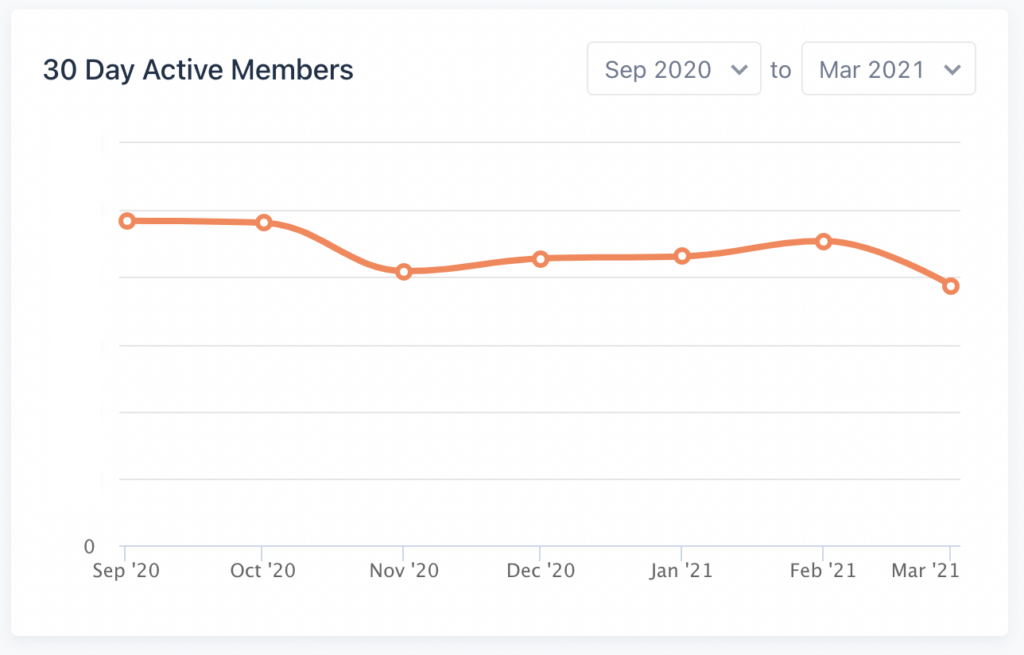
In SPI Pro we pay attention to our active vs. inactive members because we want to make sure everyone is getting the most value from their paid membership. There will always be ups and downs, which is why that dip in November or March isn’t too alarming, but if we start to notice a downward trend that is not recovering month over month, we know we need to spend time talking to our inactive members to see what we can do to re-engage them.
The One Metric to Rule Them All
Active vs. inactive members is one of the key metrics we track to gauge the health of our community. With so many differences between community types and goals, what is the most important metric for every community owner?
Simply put, return on investment (ROI). If you have a strong understanding of what makes your community worth the time and effort, then you can determine its general health.
So what would make your community worth the time and effort?
If you own an online plant shop and launch a community for plant lovers, would you rather see a quieter community but increased sales, or would you be happy with a busy and supportive community with strong brand recognition?
If driving sales is the primary purpose of your community, your ROI will be directly related to your monthly sales numbers and not monthly user engagement. However, if your community purpose is for plant lovers to connect, you should be focused on engagement metrics like daily active users and membership growth.
Finding Your Community’s Purpose
What if you’re having trouble figuring out the purpose of your community?
Here’s a hint: Healthy communities are about connection. People want to connect with each other and join communities about things or beliefs they are interested in. So your community should provide value that fosters connection in a way that makes sense for your brand.
Ask yourself, What is the purpose of my business? Now ask, How can I provide value to the people who use my business?
We already know the purpose of our business at SPI Media is to help people create sustainable income. SPI already provides a ton of educational content, courses, and workshops, and as a result has a large group of customers. So it made a lot of sense to create a community tailored to the customers and followers who have succeeded in launching their own income streams and now want to network with and learn from other entrepreneurs who are trying to take their businesses to the next level.
A Note about the “Investment” Part of ROI
Be clear on the minimum investment required to maintain the community you envision. For example, one of the fastest ways to ruin your community is to neglect engaging with your members through thoughtful content.
And by the way, investing in community means much more than investing money—most notably the investment of time. Whether it’s your own time or that of a community manager, someone’s time is needed to create content, manage the strategy, and do the day-to-day operations. There is plenty that can be automated, but every community still needs regular human attention to thrive.
A Workshop for Membership Community Owners
Do you need help getting clarity on the purpose of your community?
Try our free two-hour mini-workshop, Making of a Membership Community, that goes into detail on how we conceptualized our private SPI Pro community of entrepreneurs. We explore how our first attempt at a community didn’t work (because we needed more clarity on our purpose), how technology is catching up to what we need to run a robust community, our strategy to launch SPI Pro, and the future of memberships.
The truth is, if you know what the purpose of your community is, and the effort you put into the community helps you achieve this purpose, then you have a positive ROI and your community is working.
This doesn’t mean you should ignore all the other metrics. Looking at data trends will help you understand when a slump in activity is a problem or just an expected lull. Spend some time learning about the metrics your community or social platform already provides and start with those.
As someone who has tracked metrics for several different types of communities, I’m here to help. Stay tuned for future posts about how to get started tracking and analyzing common metrics. Until then, assess the ROI of your community and when in doubt, ask your community members what they want to see happening in your community.
The post The Most Important Metrics for Your Membership Community appeared first on Smart Passive Income.
]]>What does it take to start a membership community? For SPI Pro, it was over a year in the making.
The post The Story of SPI Pro: How We Built Our Membership Community appeared first on Smart Passive Income.
]]>We launched SPI Pro in July, but our team had been dreaming about it for over a year. Recently, I talked with SPI's co-CEOs, Matt and Pat, about the story of SPI Pro, and why and how we started this membership community. If you’re thinking of starting your own membership community, hopefully this will give you inspiration and a way forward.
Step 1: Recognize the Problem
At the end of 2018, Matt and Pat were concerned.
It was right before they merge their two companies (Matt and his team at Winning Edits, a creative agency, merged with Smart Passive Income ), and as they discussed the future of the company, they recognized a problem.
Online course sales had been the main revenue for SPI for a few years by then.
“We were having conversations about the future of online courses,” says Matt.“We had been tracking the financial performance on SPI course sales for at least a year at that point. So I was thinking about the business model in the future and in the context of the industry and I realized, Okay, we're struggling with certain promotions.”
SPI was doing a lot of the same things we had been doing for years, creating courses, and then promoting them. Course promotions and sales were happening a few times a quarter and were labor-intensive and time-consuming.
“Some of our tactics were still working, but it was too risky to just be dependent on one primary revenue stream,” says Matt.
Instead, he wanted to create a business model with more stability and predictability. “I felt strongly we needed to grow and diversify across some new offerings, and add some new dimensionality into the business model,” he says.
Recurring Revenue? Tell Me More
In all of its twelve years of existence, SPI had never had a recurring revenue component. “Inherently in any business where you're just doing sales all the time, there’s a more volatile top line,” says Matt.
The other problem with course sales is that creating and promoting them takes a lot of the team’s time and energy. “We didn’t want course revenue to be the main thing forever. I'm not suggesting that I was worried that course revenue was going to decline to zero or that there was going to be some kind of bubble that bursts in terms of the market popping and people just all of a sudden not buying courses. I don't think that's true, especially not this year when everyone's more than ever going online for education. But it’s an inherent, existential threat to this business—or would be any business—if you're just relying on one primary source of revenue.”
Matt asked Pat if he was open minded to trying to diversify some things. Pat said he would love recurring revenue as a broader concept.
Okay, cool.
Step 2: Develop the Idea
“So what Pat and I were talking about at that point was more like, ‘Oh, what if, what if it was more like a digital conference or a digital gathering,' with that frame of mind,” Matt says.
“Entrepreneurship is a very lonely path,” says Pat, “especially when you're just starting out and you feel like there's nobody else in the world who can understand you, and it's why people show up at conferences. It's why people are in Facebook groups.”
In-Person Inspiration—How FlynnCon Showed the Way
Pat's theory was confirmed at FlynnCon, SPI’s first in-person conference, which happened in July 2019.
“There was a certain magic at FlynnCon that we wanted to try to replicate in a certain way digitally, online.” Pat says. “Time and time again, I hear feedback about FlynnCon, and it was the moments in between the main sessions. It was those talks in the hallways. It was the connections. It was just the mastermind groups that were created in those moments that really provided the true value there.”
Around this time, Matt drew the vision for what, at the time, he and Pat were calling SPI Plus (which would later become SPI Pro).
Having a place where people find each other and get support from each other, and from Pat and the SPI team, was the vision that started to emerge.
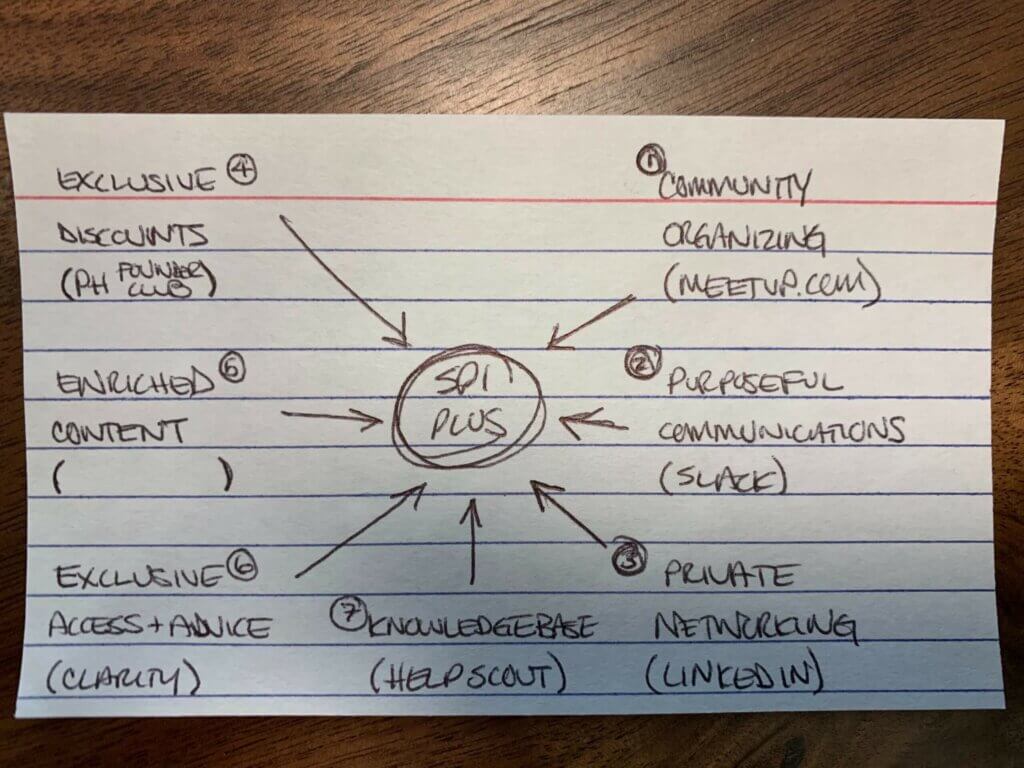
Matt's original notecard vision for what SPI Plus (later SPI Pro) could become.
“So it was at the time called SPI Plus in my mind. So you see SPI Plus in the center of the card, not SPI Pro. And it was this six-dimensional, a composite idea of community as represented in the digital sense by Meetup.com.”
Components of the Community Idea
Matt’s idea had six components. The program needed to have:
- Community
- Purposeful communications (similar to Slack)
- The ability to have private networking (similar to LinkedIn)
- A robust knowledge base (similar to HelpScout)
- Exclusive access and advice (Clarity)
- Enriched content created specifically for the needs of the community
- Exclusive discounts
Step 3: Pivot When Necessary
The conversations continued—between Matt and Pat, and eventually the rest of the SPI Team—around the idea of SPI Pro.
During our annual team retreat in Columbus, Ohio in the fall of 2019, SPI Pro was pegged as one of the “big new things” we would launch in 2020.

“Our idea was to be on stage, like at an Apple event when they roll out their big, new thing. We wanted to get some hoopla and fanfare and try to do some, you know, new member enrollments right from the conference,” says Matt.
But then COVID happened.
We had to cancel FlynnCon.
Our dreams of rolling it out with a lot of hoopla on stage at FlynnCon were dead.
From Disappointment to Opportunity and Urgency
“We were like, okay, we're not launching from stage anymore. How are we going to launch this instead?” says Matt.
Besides having to pivot our launch plans for SPI Pro when FlynnCon was canceled, we felt even more of an urgency to get SPI Pro up and running.
People were in quarantine. Everyone was working from home, isolated. We knew that a membership community would be one way people could connect online since no one could go to in-person meetups or conferences.
The sad reality of having to cancel FlynnCon came with a silver lining: It gave the SPI Team more time to focus on getting SPI Pro ready to go.
Step 4: Pick a Platform
During this whole time, Matt was evaluating what kind of platform would support our vision for the membership community.
Where would we host it? His original idea for the community was inspired by various tech platforms (Slack, Meetup, LinkedIn), but was there something out there that combined all of those things into one platform?
“I was evaluating different platforms like Mighty Networks and Podia. I was walking through the software, getting a feel for, Is this going to support the vision and the concept that I have?” Matt says.
He was also in contact with Ankur Nagpal, the founder and CEO of Teachable. Teachable has housed the SPI courses from day one, and since we knew much of the SPI community consists of people who have taken SPI courses, Matt was keeping Ankur up to date on his thinking around SPI Pro, getting his inputs about various platforms, and even wondering if Teachable would eventually be creating something that we could use.
Circling Down to the Best Option
But then Ankur was like, ‘“Holy s**t, you should talk to the Circle guys—they are some former top brass Teachable employees who would just love to do this thing.”
The three founders of Circle.so, Sid Yadav, Andrew Guttormsen, and Rudy Santino, had all worked at Teachable and left to create their own platform specifically for creators to develop their own membership communities.
“So we talked to them, and we were very impressed at their functional prototype at that point,” says Matt. “We set up a meeting in February. I went to New York, and when I was there in person, they had certainly advanced on their prototype. I saw more. And basically I made the decision there that this was what we were going to do. I called Pat a couple of times to keep him in the loop. And I told him, ‘Yeah, this is it. We’ve got to say yes to this, we've got to do this.’”
Check out our in-depth interview with Circle founder Sid Yadav
Pat was totally on board. Circle’s vision is for creators to architect a membership community the way that they want it to be, versus being forced into a one-size-fits-all way of thinking about community.
“We'd been doing a lot of research on these platforms, and Circle seemed to be the best fit for us in the way that we wanted this and the experience we want people to have within the community in SPI Pro,” says Pat. “We definitely have fallen in love with the Circle platform. It takes all the best things about Facebook groups and combines them with the best things about Slack.”
Step 5: Build the Product
So we had the idea. We had the platform. Now we just had to build SPI Pro.
In March of this year, Matt laid out his vision to the whole team at SPI and started delegating projects and tasks. It was all hands on deck.
Putting Together All the Pieces
The whole team dove into the implementation phase, including developing and implementing plans for:
- The SPI Pro membership application
- Billing set-up
- Onboarding plans for new members
- Rules and policy documentation
- A schedule of events and meetups
- Creating content, including eight ebooks
- Deals and discounts
- Integration with our other platforms
We also had to figure out what features would provide value but not be overwhelming for members. After several iterations of what we wanted to include in the membership community, we settled on a set of features, events, and content that we felt would offer our community real value and give them what they needed.
“Our ideas for what to include were rooted in an ethos of connection more than content and connection even before engagement,” says Matt. “I give my friend Jay Clouse credit for that connection-before-engagement concept. Jay is a great guy. He's one of the consultants we've brought on to advise on some of the finer points as we develop SPI Pro, which is we want our members to establish their own connections, to discover people, to find their own buddy programs to develop little mastermind groups that might even live, and they can actually have their conversations in private channels within SPI Pro.”
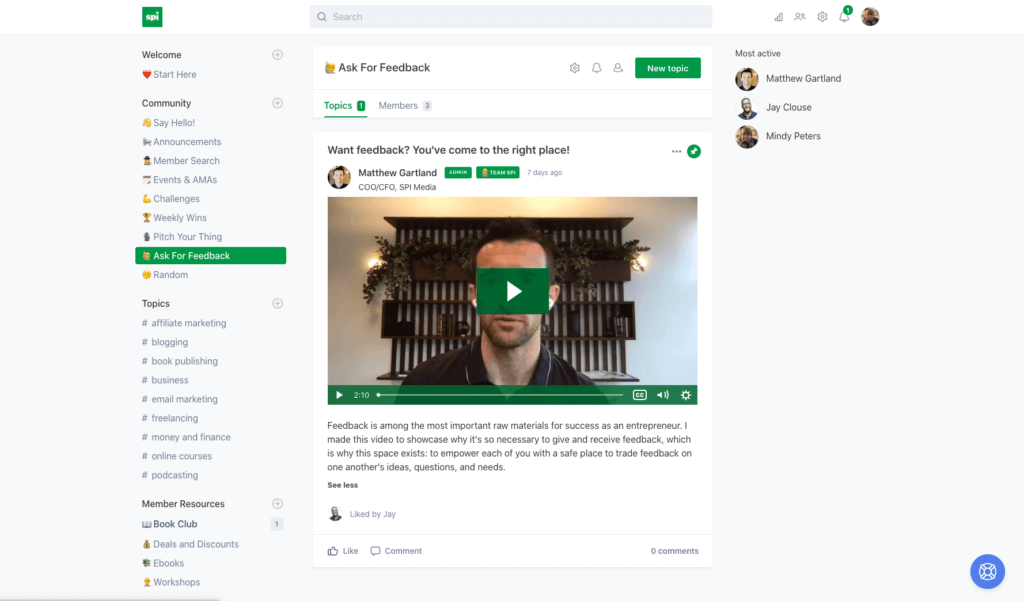
SPI Pro Features
The features we landed on include:
- Learning channels for discussions around skill development topics such as podcasting, affiliate marketing, and email marketing
- Discovery channels for member networking, collaborations, and more
- Monthly challenges that encourage, support, and reward member growth
- Pitch opportunities where members can get exposure for their new thing
- Private channels for focused discussions among member cohorts
- Private 1:1 messaging between community members
- Matchmaking with a mastermind group or accountability partner
- A monthly book club discussion
- Free workshops and “ask an expert” events
- Free content such as ebooks
- New members community hangouts
- Regular ask me anything (AMA) events hosted by Pat and SPI team members
- Professional networking community hangouts organized around themes
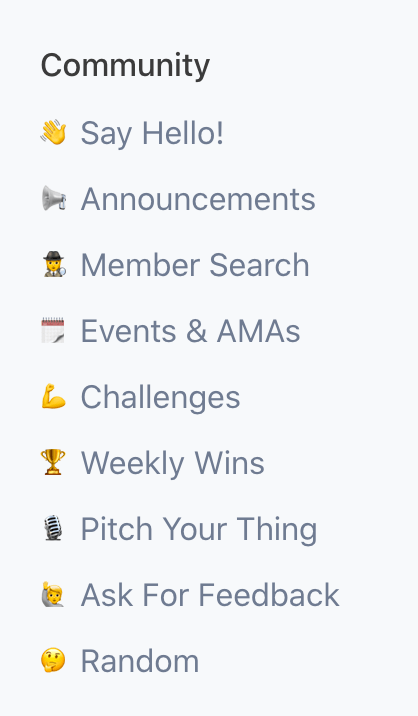
“We consolidated pretty dramatically the first version of our information architecture for the community,” says Matt. “We ended up with a sharper focus, less overwhelm, more intentional messaging, especially for new members when you come in. You have to think about the experience that a person has, not just what is typical in a lot of other membership site platforms, which is just, ‘Let's dump everything in there and just have them pay monthly to get access to everything.’ That's not the most helpful thing.”
The features and value within SPI Pro is what keeps members coming back. We had to think about what’s the motivation to consider logging into SPI Pro every day.
Step 6: Launch the Community & Celebrate!
Finally, in July we were ready to welcome people into the community.
We couldn’t launch SPI Pro at FlynnCon as The Next Big Thing. But we still promoted it on the SPI Podcast, in the Smart Digest newsletter, and through an email campaign and social media.
The launch has been a huge success. We have over 500 members (exceeding our goal), with new people applying to join each day.
Members are networking, learning, creating mastermind groups, connecting one-on-one, asking questions, getting feedback on ideas, and much more.
It’s already a thriving community, and we couldn’t be more excited.
Recently, we hired a community manager, Jillian Benbow, and have plans to go bigger next year in terms of marketing and try to get some extra firepower behind it.
“It takes community,” says Pat. “It takes commitment. It takes accountability and getting involved with a group of people who speak, and talk, and think just like you. There's nothing better than that. We can be all of our weird entrepreneurial selves in SPI Pro, when oftentimes we can't have conversations with our immediate family about these things because they just don't understand.”
“That's what we're building here. I just haven't been so excited about a project in so long. I mean, I get excited about every project, but nothing to this level.”
The post The Story of SPI Pro: How We Built Our Membership Community appeared first on Smart Passive Income.
]]>SPI talks with Sid Yadav, co-founder of a new, innovative platform for building custom online membership communities
The post How Creators Can Build a Thriving Online Community with Circle.so appeared first on Smart Passive Income.
]]>When SPI launched its membership community, SPI Pro, in July on the brand new Circle platform, we were excited to integrate our world with this exciting new platform because it was made specifically for creators who want to build their own online communities.
After researching other platforms to host SPI Pro, it was a no-brainer when we realized what Circle could give us. Not only are the three co-founders former employees of Teachable (the platform we use to host all of the SPI courses), but their vision matched exactly with what we were looking for: A cohesive, private, VIP community experience for our members. The ability to customize our own white label space and not have to fit our vision into a premade template. A way to connect to other platforms seamlessly. Most of all, a way for mid-tier-and-up entrepreneurs to seamlessly share insights, learn, and collaborate.
Our vision for a membership community coalesced almost perfectly with what Circle provided, and it’s no surprise that the SPI Pro launch has been a huge success so far. As Senior Writer for SPI, I had the opportunity to sit down and talk with one of Circle’s founders, Sid Yadav, who worked closely with Pat and our COO/CFO, Matt Gartland, to make Circle work for SPI’s audience.
Can you tell me how Circle came about?
Sid: I have a background as a designer and engineer—I was Teachable’s first designer, and I worked there for five years. I left when the company was at about $125 million in annual revenue.
Through that experience, I got immersed in the world of building products for creators. It’s really fun to build products for creators. And what I love the most is you’re basically helping people who are like Pat’s audience, and if you look into their needs, it’s a lot about wanting to start a passive income business, to make their vocation their full-time job. And [helping that type of audience] just really appeals to me.
So, with that mindset, after I left Teachable last April, I teamed up with other folks at Teachable—the [former] VP of growth at Teachable, and the [former] head of design.
We started digging into this space and having conversations with creators, but also more specifically, course creators; a bunch were podcasters, people very much like Pat Flynn or folks who might consider themselves to be Pat’s audience. And in that process, we were pretty open-ended about what opportunities there were. But we knew that we had a certain skill set, which is we can build quality products, and we want to help; we want to serve.
How did you zero in on the idea of building Circle as a platform for communities?
Sid: Two months into that process, we started honing in on the potential around [membership] communities. And what we realized is, taking Pat as an example: Pat has courses on Teachable, he uses ConvertKit for his mailing list, he has this massive audience. And from what I know, he’s had some Facebook groups that are widely open and available. And there are a lot of people like him.
And the needs then start to evolve a bit, where it becomes about not just having a presence on Facebook and Slack, but having a central hub for their members. And a version of this might be where it’s like a paid community, or it ties into a membership access level.
Another version of this might be if someone has their courses on Teachable, the comments section is very limiting. So if you’re running a course cohort with fifty or a hundred students, they need some place to interact with each other and with you and for you to share announcements and updates and so on. And there’s just a lack of a good, solid product for that.
When we entered this process, we started to see people co-opting Facebook groups and Slack for this use case. But it turned out to be very messy because you can imagine what happens when you add a ton of people to Slack or Facebook groups. It’s not cohesive, and it’s not very organized.
We realized our first value-add would be to bring a bit of purpose and cohesion and organization around a community builder. So our MVP [minimum viable product], our first version of the product, was built with that person in mind. And we had other users who were very much like Pat: Tiago Forte, David Perell. These are some known names in the online courses landscape. A bunch of bloggers and podcasters early on, too.
So, we had our first paid user in January. And we have since evolved into something a little broader, which is a community product that not just works for the creators and their specific use case—a creator supplementing their course—but it’s open-ended with our paradigms around spaces. You can think of them as like Slack channels.
Can you give examples of how your customers are using these “spaces” in Circle—what it looks like in practice?
Sid: So we’ve seen someone starting a paid community where they charge twenty members $800 a month essentially to exchange quantified data. People pay for that, and they love using Circle for that member-to-member communication and for the community. Another way it’s being used is as an open-ended community, for example in the case of Teachable. Teachable as a product had a Facebook group of 45,000 of their followers. And they’ve since moved to a customer community that’s centered on Circle.
To get into some of the value props and the differential between Facebook, Slack, and Circle: First, for a lot of these folks, it’s about white labeling and owning their brand. For example, Pat launches SPI Pro, and there’s a feeling of exclusivity when it’s on Circle versus it just being something on Slack or a Facebook group. So that’s definitely top-of-mind.
Another value prop associated with that is it’s very hard to integrate Facebook groups and Slack into other products because they’re fundamentally closed products. But you can have a community on Circle, and you can embed that onto your own website. Or you can use that as a comment section inside of the Teachable courses. We have a full API. We have Zapier integrations. We can tie it into a bunch of other products and groups. A customer can set it up just the way SPI has, where someone makes a purchase on Stripe, is added to Circle, when they unsubscribe or they move from Circle, and they’re given access to certain spaces based on the tiers they’re on.
The idea of having both free, publicly open spaces and paid spaces is possible too, which is not possible with a Facebook group, which can only be public or private, or Slack, which is entirely private. So that’s basically the initial traction we’re seeing around the use cases and why we’re seeing folks move their communities over to Circle so far.

You mentioned Teachable migrating its 45,000-plus Facebook community to Circle. What does that process look like, and how do you assuage the concerns of someone who’s excited about Circle but worried about making the transition?
Sid: The process is very iterative. The way Teachable did it was to start small. They started with a 500-person, very exclusive cohort. They added some of their most active members from the Facebook group just to see what it was like. They started to conceptualize spaces and experiences: What are the features of the community that we’d like to offer? What things are now possible with Circle that weren’t before?
Things like product updates being posted in Circle for them became relevant, or a weekly Q&A session. Spaces dedicated to product feedback as opposed to customers exchanging feedback on their own courses. So that takes some time to figure out. And then once they felt comfortable, they went through a series of steps of adding just more and more members, into the thousands.
The other thing that happened is they consolidated their 45,000-member Facebook group, which was open to all, to something that was just open to their paid members. So the community then becomes exclusive. And by virtue of that, the hope is that it becomes a lot more tight-knit. Even at that scale, it feels like, okay, these are all paying Teachable customers. They aren’t just random people lurking in this community and trying to promote their own products. And that becomes a better experience for their members.
Did Teachable shut down their Facebook group entirely?
Sid: They did. We also find that there are other folks who don’t end up doing that, and what we ended up realizing is maybe there are two different value props. So with Facebook groups, it’s more about being discovered, being out there, being open; and with Circle, it’s more about exclusivity. And I’d imagine that’s the path that, let’s say, someone like Pat has gone down. There are pros and cons to both.
I imagine with a migration like that there would organically be some dropoff in community size. But maybe a benefit is that you end up with a more tight-knit, more committed group. Is that what you saw in Teachable’s case and what you’ve seen in other migrations?
Sid: Absolutely. It’s just cleaner discussions, more relevant discussions, better organized. Maybe a smaller amount in total, but you’re also ruling out a lot of the noise. So it’s not a bad thing to have fewer discussions if the kind of discussions you’re seeing are higher quality. And then on top of all of this, there’s kind of like the macro movement of just people moving away from Facebook. And what creators ended up realizing there is if that’s happening on a macro level, the balance between what they could get by being on Circle versus being on Facebook, starts to tip a little bit. And that’s something that Teachable realized.
Are you seeing some creators holding onto their Facebook, Slack, or other communities and using a hybrid system?
Sid: Actually, it’s about half and half. And it’s so contextual, based on where they’re coming from and what their needs are.
If someone has had a Slack community running for three years, if their members are engaged enough, maybe Circle is not the best thing to switch to. But where it could help is in getting some of the longer-form, asynchronous, better-organized discussions that are more welcoming to new members.
What a lot of Slack members find is, when your community scales up, first off, a lot of people just can’t afford to pay for the paid product, which means they’re losing—you know, they only get to keep their last 10,000 messages. So they’re losing that archive. And it makes it feel overwhelming and unwelcoming to new users because what you have is a bunch of one-on-one conversations in these channels that add up. So when I join as the thousandth member, I’m like, well, what’s happening here?
Whereas with forums and the community paradigm, like we have in Circle, it’s a little different because things are based around the concept of topics and spaces. So a new member knows where to go to start, where to go to ask a question, and the context there is, “We welcome new topics and questions.” You’re not just butting into someone’s discussion.
Or if people have a Slack community already, what they may find is it’s not a direct replacement, but it could be a supplement. So they keep their Slack for more informal chat use cases, and the Circle community is a lot more serious and longer form. That’s where they’re posting announcements and updates and more of the “content-y” side of the conversations, as opposed to the “chit-chatty” side.
You also touched on how for a new user, especially coming into a large community, Circle eases them in and gives them some structure.
Sid: Oh yeah, for sure. It starts with the overall structure of what a Circle community is. To give you one example, Slack has the concept of channels, but channels can add up. There can be hundreds. With Circle, things are organized in groups of spaces, and the groups of spaces can have different permission levels.
You can have free spaces, and paid or premium spaces. You can have interest groups. We have this mode you can turn on within the product, where if you want your members to create their own channels or spaces, you turn this mode on and all of a sudden, your space, your group home page turns into a directory of spaces, which people can browse and find the things that interest them and then join them.
And if you imagine this experience in Slack, it’s an alphabetical, top-down list of hundreds of channels, which become a nightmare to navigate around for new users. But in our case, it’s all neatly sort of bundled together in an interest-group section. So that’s one example.
And the other thing is, when you’re having a conversation in Circle, you’re not just shouting into the ether; you’re starting a topic. So things are based around the concept of topics and discussions as opposed to just random back-and-forth.
So is the discussion framework like Quora in that respect?
Sid: More towards Quora than, I’d say, Facebook right now. But you also, as a community creator, have the power to choose one or the other. This is one of the other key elements of Circle, which is, you can customize what a space looks like. So if you want it to look more like Facebook, you can do that. If you want it to look more like a forum, with its titles, you can do that. If you want it to look like a blog with “cards” of stuff, you can do that. And similarly, on the actual post level, you can enforce titles for stuff if you think that’s important, or you can make it more like Facebook, where it’s just, “Write out anything you want and post it.”
Interesting. Can you have a mixture of those different structures?
Sid: Absolutely. And we do this in our own community. For example, we have a space where we post our product updates, and we find that a linear list isn’t the best form for that. And then we have a “showcase” space where members post screenshots and videos of their communities. So they’re showing off to others. And in that mode, the better format is something more like Facebook, where you can just scroll through and see a real nice view of screenshots and videos in one view, as opposed to having to click into each one.
You went into beta in January, but you’ve already got some key clients. What has surprised you about how they’re putting Circle to use and shining a light on other possibilities for the platform?
Sid: We never expected a customer like Teachable to emerge. That’s not who we were building for in the early days. But they did a ton of vetting. It’s not like we got any preference having worked at Teachable. They spoke to everyone, they got all the demos, they evaluated us, alongside everyone.
And what they found was, our structure and our way of approaching community, was pretty open and welcoming to them as a customer. So one thing that was surprising was, if we manage to actually nail the fundamental paradigms around how we’re thinking about community, it’s not just a product for specific course creators to add a community to their course; it’s actually a very open-ended product.
So to that effect, we never imagined that there’d be that community I mentioned before—that $800 paid, quantified self, tight-knit group of people, exchanging data. And they were able to get that up and running with just Stripe. We never imagined those kinds of use cases. And we’re seeing a lot more of that, of the premium, paid, exclusive type stuff. And one thing we’re realizing is, it’s not about the amount of users—of DAUs [daily active users] and MAUs [monthly active users]. You can have a very profitable, functioning community with twenty people.
So we don’t actually measure ourselves on that, although our numbers look pretty good. It’s more about the quality of the experience that the member has.

If someone is thinking about starting their own membership community on Circle, are there characteristics of their audience or their business that predict success? Another way of asking this is, who is not a good fit for Circle?
Sid: The first persona that comes to mind that’s probably not a fit is someone, let’s say, with a hobbyist interest group.
They’re not a brand themselves. They’re not trying to build an audience. They’re just trying to get together with like ten folks to talk about X. So in that case, I actually think for them, Facebook groups are a perfectly good option. Like Telegram groups, WhatsApp groups, all of that, that stuff may lend itself better for what they’re trying to do, because it’s not things like white labeling, embedding, all the integrations we have, like having multiple spaces and multiple types of conversations—they’re just not that important. So that’s who comes to mind at first.
And then, maybe you can extend that to extremely large Facebook groups. You may find that there are a million people in one Facebook group dedicated to some kind of interest, maybe movies or politics or whatever. We’re probably not the best suited for that. So it’s, again, the lack of a brand and a presence there.
An example [of a good fit] that comes to mind is Makerpad. They had a Slack community and charged, I think, a one-time $900 fee, before they switched to Circle. And what they found is that Circle just gives them more organization layers, better integrated with the product. They’ve actually embedded Circle into their website, in multiple ways.
And it lended itself much better to their key value prop. So they are now starting to think around the features of the community, which are not the features of Circle. It’s about, okay, “If I’m charging $900 a year or whatever it is for a customer, what are the value props that my community is giving to them?”
The thing that people don’t tend to instantly latch onto is this: The factor that decides whether or not your community is successful is more about you defining the features for your persona, which are very nuanced, than it is about the tool. The tool can help. We like to make a lot of those use cases possible with our spaces and free and paid and video and all of that stuff. But ultimately it’s going to be, if you’re charging for a community, is a member getting that value from it? And that’s just so contextual.
I wanted to zoom out a little and get your thoughts on how you see Circle evolving.
Sid: In the one-year horizon, it’s a lot about just making everything feel like it’s not just good but the best. And we’ve talked about this with Pat and Matt a lot. So, things like the product feeling like it’s completely real-time, having live video within the product, having group messaging, so people can form their own tight-knit group within the SPI Pro community. We have basic versions of all this stuff. So we’re very heads-down on improving the product and nailing it so that it feels differentiated and special, as opposed to more of a commodity. And a lot of these things come down to specifics. They’re like a thousand micro-decisions and micro-improvements versus one large thing. Maybe live radio, group chat.
And then there are aspects like, let’s say, the SPI Pro community networking with each other and finding like-minded entrepreneurs. Obviously one aspect of that is a community manager enabling those types of connections, but products like Circle can and should help. So things like members defining or admins defining custom profile fields, almost like a LinkedIn profile. That’s important, so members can express themselves, and they can be more granular and looking through others that may be of interest to them. Because if you’re in a community with a thousand-plus people, you probably want to reach out to folks that are interesting to you specifically, and you can’t just do that by looking at their name and one-line bio.
So these are all the areas in the next year which we’ll focus on. And then there’s other obvious ones, like, we’re launching an iOS app this month. We’re working on an Android app. Soon we’ll work on a desktop app. We want to be across all the platforms.
Over time, where I’d like Circle to be is, it needs to be very easy for someone to start their own community, and our product needs to be friendlier to a broader persona of users. So not just someone who’s established a course and an audience already, but someone who’s more in the long tail or just starting out. And I think we have work to do before we become a viable solution for them, but it’s definitely where we’re evolving to.
And we’d like Circle to be the central hub for members. That’s, again, a nuanced thing because, you call it a community, but in a lot of cases, on the internet right now, communities elsewhere—you go to a website first and there’s a “community” tab, or somewhere else to go to. And we would like to question that and see if we can make Circle almost like the default experience for a lot of folks.
I wanted to ask you about your relationship with Pat and Matt, who are both advisors to the company—how that came about and what that’s meant for Circle.
Sid: Yeah. We’ve known Pat since our affiliation with him at Teachable. I’ve always respected the fact that, in Teachable’s early days, Pat was extremely instrumental to everything that went down at the company from $1 million in ARR to $10 million-plus.
So we’ve known Pat for a while, and with Circle, my sense is SPI was very much in the evaluation phase of the tool of choice for their membership. And near the end, we just happened to be in the right place at the right time.
We connected with Pat and Matt, who both showed a great level of interest. I think there was a three-day period where Matt literally flew down to New York. We spent a whole day whiteboarding everything from the SPI Pro community and Circle at large and how we’re thinking about the product and roadmap and all of that stuff.
And it’s been a very mutual, co-evolving experience where we’re learning from them and they’re learning from us, and the ways in which they’re using Circle are things that we’re observing and we want to improve at the same time.
When we launch new features, they’re mostly the first people we go to to say, Hey, what do you think about this? Or would you like something like this? To get feedback. With both of them, we have a quarterly call where we go in depth on both the SPI side and the Circle side.
So it’s just been great overall because we want to be the best product, and these guys are very in tune with the product and the audience to help us get to that. And there’s a distribution aspect of what Pat enabled for Teachable, where his audience has a set of needs that products like ours and Teachable can cater to.
In terms of the membership community space as a whole, it seems fair to say that there’s a lot of growth in store. How do you see the industry evolving?
Sid: I think that’s accurate. And one of the recent things that’s happened in this space, as you know, with COVID, is there’s been the added emergence of a need for virtual communities over in-person communities. So we’ve seen a lot of folks transition or start to supplement their in-person thing with a virtual community. And so it’s been interesting on that level, on a meta level. Who knows what’s going to happen after COVID, but that’s just given it that extra push.
And then a couple of other macro trends that we are a part of. So there’s one, the sort of passion economy, creator trend, of creators owning their audience and making a living by doing something they love to do and monetizing their passion. So there’s just no way I can see that going in the opposite direction. Given where we’re at from a meta perspective, in the world at large, unemployment having skyrocketed.
Then there’s the no-code emergence of tools getting easier to use and enabling a lot more use cases for someone who doesn’t know how to code. So I don’t have to know how to code to stitch together Stripe with Circle using Zapier. And our version of that, as I was saying before, would be to have an ecosystem and almost like a marketplace for plugins, a marketplace for experts. So previously, if you wanted a very custom experience with your community, you would have had to build it yourself, and that’s just cost prohibitive. You have to hire engineers, and do we really expect thousands of people invest in all the specifics around engagement? How notifications work, and all of that stuff?
Our answer to that is, well, we can do that for you, and we can make it extensible enough so that even for someone who’s not technical but is willing and wants to build something that feels special, that doesn’t feel cookie-cutter like every other Facebook group, we become a viable solution for them. And it’s not just us, as I said—it’s all these tools emerging in this landscape . . . that are making it possible for someone to do a lot more without having to invest their time and effort and money into what they want to achieve.
The post How Creators Can Build a Thriving Online Community with Circle.so appeared first on Smart Passive Income.
]]>