This post is a revised look at what I use for planning my editorial content: the content pyramid. Here are both the types of content and how often I use them.
The post The Content Pyramid: Healthy Portions of Posts for Your Blog appeared first on Smart Passive Income.
]]>This post was previously published back in 2011. I thought it would make sense to republish with new and timely content examples, considering the Content Pyramid is still relevant today. I hope you find it useful for your blog!
Most of you are probably familiar with the food pyramid, right?
If not, it's a graphical representation (in the shape of a pyramid) of the suggested serving sizes of different food groups, which together illustrate a healthy and balanced diet. It was adopted by the USDA (United State Department of Agriculture) in 1992 to give Americans an easy and memorable way to understand nutrition.
Here, I want to show you something called a content pyramid.
The content pyramid below is a graphical representation of the “serving sizes” of different types of blog posts that I've written on this blog, which together illustrate what I believe to be my own healthy blogging diet—a diet that has proven to quickly build some authority in the blogosphere.
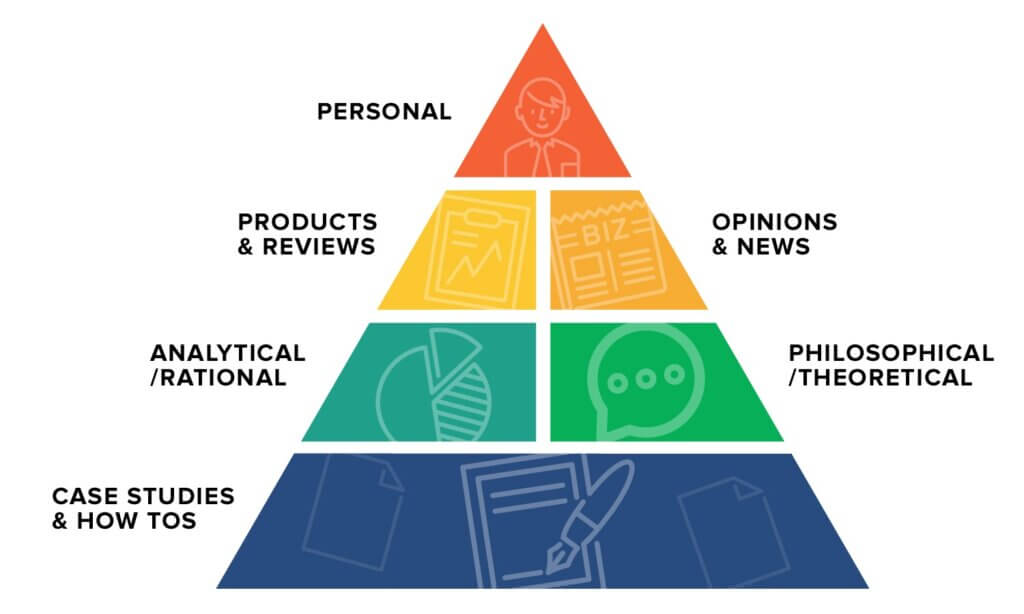
In an older post, I had outlined a strategy I use to diversify the content that I publish on this blog. I went into detail about several different types of posts and how they each catered to a specific type of person and how they like to digest information, but I failed to illustrate exactly how often each of those posts were published.
Hence, this pyramid.
Now, in pure SPI fashion, let's break it down from the bottom, up.
Bottom Tier: Case Studies & How Tos

Case studies and how-to articles are what made this blog. There is no doubt about it.
Using real life examples from real life businesses that I own (the Niche Site Duel, The Smart Podcast Player, GreenExamAcademy, FoodTruckr, etc.), these posts accelerate my authority and prove not only that my methods work (or in some cases, don't work), but also that I don't just talk the talk, but I walk the walk too.
When I think of other successful bloggers who have made an impact on my life, they each utilize the case study and how-to post quite often and quite beautifully.
For example, Bryan Harris put together a compelling and powerful case study on how to launch a product with a tiny email list.
Brian Dean from Backlinko wrote about an SEO strategy case study that boosted his organic search engine traffic by an amazing 963 percent.
And no, your name doesn't need to be a variation of Brian (with an I or Y) to make this work!
These types of posts really do become the foundation of a blog (a.k.a. pillar articles) and without them you're making it that much harder to stand out from the crowd and become a leader in your niche.
If you're lacking in this part of the pyramid, all you need to do is take action and create your own case studies.
They don't just happen on their own.
Second Tier: Left Brain & Right Brain

The second level of the pyramid is for posts that appeal to the two types of people that are reading our blogs: the left-brainers and the right-brainers.
Left-brainers are those who are into analytical thought and logic (i.e., Science and Math).
Right-brainers are those who are into design and theory (i.e., Creative Arts and Music).
Where the center line that divides the two settles depends on your audience, but I try to make sure I cater to both types of people.
Left Brain Examples:
- My Income Reports, which are some of the most visited pages on SPI
- 6,795,850,072 Reasons Why You Can Make a Successful Living Online
- How SPI Made Me More Income Than 3 Bestsellers and 2 Movie Deals
Right Brain Examples:
- Why You Need “Moments of Activation” Injected Into Your Brand
- Top 10 Things To Consider When Designing your Blog
- How to Command Any Conversation, Meeting, or Interaction You Have with Michael Port
This second tier of posts, combined with the foundation, become the core of the articles that I publish. As you can see, they take up most of the space.
That said, without the remaining top portions of the pyramid, I wouldn't have the brand that I have today.
Third Tier: A Voice and Recommendations

Opinions and News
Even though the previous two tiers take up the majority of the pyramid, I feel it's important to also include a decent mix of opinionated and news-type blog posts as well.
Not only do these types of posts keep people up to date, but it also enhances a blog owner's authority as he or she is the one who publishes the information for everyone else to read (and then share).
For example, I've written about Google's algorithm change and its effect on many websites, including my own. Even though I know I wasn't the first one to share this information, because I posted about it immediately after it occurred, it showed my knowledge and up-to-date-ness on the subject.
Opinion articles, which could be combined with the news posts, are important too because it begins to give a blog and its owner some personality–a voice. It's important to have a voice and take certain positions in whatever niche you're in, because it helps you stand out as a leader.
No one pays attention to the person who just sits in the back of the class and never raises his hand.
Lastly, even though these types of post are important and could become generous traffic generating tools for your blog, I want to reiterate the fact that it only takes up a small portion of my pyramid.
Why?
Because these posts are not timeless. Typically, within a week or two (or even a day or two in some cases) these posts won't be very useful anymore. You'll want to make sure a majority of your focus is in the foundation of your blog pyramid—pieces of information that are more likely to withstand the fall of time.
Products and Reviews
Many bloggers, including myself, monetize their websites.
It's okay to monetize your site, but the methods you choose and how often you try to do so can dramatically effect your potential income.
More is not always better, and this is why this segment also takes up a small portion of the content on my site as well, and really the line should be moved over even more because I don't even write product and review posts at all. I do, however, sprinkle product recommendations within my posts, typically in stuff that I write in Tier 1 and Tier 2 of the pyramid.
No matter what though (and this is huge for me), I will only recommend products that:
- I've used myself.
- That have helped me succeed or achieve something.
- I feel would be beneficial to my readers.
These three rules keep me grounded and help me not promote things that could potentially damage my brand or just simply make me seem like I'm in it for the money (trust me, the opportunities are there). If I can offer a product that I've used and will help others, I feel more comfortable because it's a win-win for everyone: my readers get a product that works and have someone to go to for help if needed (me), and of course I get a commission too.
People are still emailing me regularly about how much they love Teachable, for example, and it's awesome. [Full Disclosure: As an affiliate, I receive compensation if you purchase through this link.]
ConvertKit is another product I need to mention. Toward the end of 2015, I made a big decision to move my list of subscribers (135,000-plus at the time) to ConvertKit, a decision I've been really happy with. So much so I chronicled at length and created a ConvertKit demo video (see below). [Full Disclosure: I'm a compensated advisor and an affiliate for ConvertKit.]
Top Tier: Personal

I believe it's important for every business that deals directly with their readers, subscribers, or customers to put in a little personal touch here and there.
Not too much (which is why this is at the top of the pyramid), but just enough to really connect with people, to help them understand that you're more than just a blogger or some random person behind a website.
Personal Examples:
- SPI 225: Meet the Flynn Family (the ones who really run the show), with April, Keoni, and Kailani
- SPI 407: How to Raise a Kid Entrepreneur
- Chapter 4 of the Mindset for Entrepreneur's guide is all about an important conversation my wife April and I had about my work-life balance.
I don't know about you, but I connect with people, not websites.
Still, there are a lot of people out there who are paranoid about posting even their name and a picture on their site, let alone a little bit of information about who they are and what they do. The problem is, when I come across these totally faceless blogs, I wonder to myself, “Why? What are they hiding?”
As a result, I can't really believe their content and there's just no connection. I hardly ever come back for more.
I don't know, maybe it's just me, but I like to know who is speaking to me.
Your Pyramid
The content pyramid above is the Smart Passive Income content pyramid. Yours may look different based on your niche and/or personality, but this is what is working for me.
I'm hoping that at least you can see the importance of timeless posts and how they really became the fuel for the growth of this blog, with all of the other parts intertwined to become the Smart Passive Income brand as a whole.
So what's your content pyramid like right now? What kind of posts are you writing the most, and do you need to make any kind of shift in what you post in the future?
Happy Monday everyone! Cheers!
The post The Content Pyramid: Healthy Portions of Posts for Your Blog appeared first on Smart Passive Income.
]]>One of the biggest lessons I've learned while building multiple successful blogs and businesses is this: you cannot go it alone. Each and every milestone I've had was the result of people I've built a relationship with. In this post, you'll learn a system for connecting to other bloggers and entrepreneurs online that will help take your blog and business to the next level. Check it out...
The post How to Grow Your Blog Audience By Building Relationships with Other Bloggers: The Ultimate Guide appeared first on Smart Passive Income.
]]>When I think back to all of the most noteworthy moments of my online business career—from my first digital product sale back in 2008, to my first feature article on a top-blogger's website in 2009, to my first speaking gig in 2011, to the launch of my best-selling book [This link leads to Amazon. As an affiliate, I receive a commission when you purchase through this link.] on Amazon—beyond the hard work and the patience I had to have, they all have one major thing in common:
For every milestone, I can pinpoint one or more people who played a critical role in the outcome. Without those people, those events may never have happened.
In other words, I would not be where I am today if it weren't for those people I had built a relationship with.
You must be actively building real relationships with other bloggers and entrepreneurs—online and off.
In my opinion, there is no better way to grow your blog and business and create real life-changing opportunities for yourself.
If I could go back in time and give my younger self some advice, it would be this:
“Pat, dude. First, lose the bowl cut. Second, and more importantly, the best way to get ahead in life is to get to know and build relationships with as many people as you can. When you get a job in the architecture world, it's not going to be because of your resume, it's going to be because of someone you know. When you lose your job in the architecture world, it's going to hurt, but other people will be there to guide you. Search for those people, find the ones you trust who inspire you, and let them guide you. It's all going to work out, but one thing's for sure: you cannot do it alone.”
Now it's my turn to introduce someone who is a master at relationship building, and definitely a person you should know about: John Corcoran of Smart Business Revolution. You'll see just how systematic, but real and valuable his approach is.
John has introduced me to so many amazing people, many of whom have been featured here on the blog and SPI podcast before. He has a gift for knowing who should know who.
In The Tipping Point, Malcolm Gladwell states, “The success of any kind of social epidemic is heavily dependent on the involvement of people with a particular and rare set of social gifts.” Gladwell discusses three types of people who become those “Agents of Change” in the tipping points of epidemics. They are:
- Connectors
- Mavens; and
- Salesmen
John is a connector. I met him in person earlier this year and I already felt like I knew him. I'm 100% positive you'll find major value in his guest post below about how to go about approaching other bloggers and entrepreneurs and how to build a true and mutually beneficial relationship that will take you and your blog or business to the next level.
Take it away, John!
Jeff Rose is not your typical personal finance blogger. In fact, one of the most valuable lessons he learned about blogging came in Baghdad.
As an Army Staff Sergeant for the Illinois Army National Guard, he led a division of nine other men into battle in the early years of the War in Iraq.
That’s right folks: he can explain the details of annuities to you, and he can operate an M-4 rifle. Better pay attention, right?
The experience taught him many lessons: the importance of working hand-in-hand with teammates, building relationships with your team, and helping one another. “Early on during training, it was embarrassing. We couldn’t function as a team,” says Rose. Over time, Rose and the other members of his platoon got to know each other better and their relationships gelled. “Everything started to click and then by the end of our tour in Iraq, we were a machine.”
It was a lesson that Rose applied years later when he had returned to the private sector. When Rose started his own financial planning firm, he knew he needed something unique to stand out.
“I had just left my big firm, so I was looking for unique ways to market myself,” says Rose. “I was reading a financial planning trade magazine, and they had an article that said if you want to stand out from the crowd of other financial advisors, you need to start a blog. I didn’t even know what a blog was, but I was determined to figure it out.”
But Rose soon found blogging wasn’t as easy as it seemed. “There was some growth early on, but not much,” he says. “If I got 100 people to my blog, I was blown away.”
He quickly learned it takes more than writing regularly to grow your blog.
That’s when Rose started connecting with other personal finance bloggers. Rose found a mentor—another financial advisor at his former firm who had been blogging for a number of years. “He gave me guidance. He showed me how it was done.”
Shortly after that, Rose joined a private forum with other bloggers who provided critical advice and support. Much like Pat’s experience with the Internet Business Master Community early in his blogging career, this little community of other personal finance bloggers became a crucial source of support, guidance and friendship.
The group also helped Rose with putting together a major post that put him on the radar screen of many fellow personal finance bloggers.
“One of the very first posts that did really well for me was ‘107 things that make good financial cents,'” says Rose. “I had at least 60 bloggers who contributed. That was the post that put me on the map.”
Jeff Rose’s story is a common one, because his experience demonstrates the importance of teamwork. Like an army platoon going in to battle, you need a team. You cannot go it alone.
In this post, I’m going to explain why one of the most important things you can do as a blogger—especially early in your blogging career—is to start building relationships with other bloggers and online entrepreneurs. This is a theme Pat has written or spoken about frequently, as he’s credited the value of relationships with other bloggers, key mentors and mastermind groups with much of his success.
However, if you’re just getting started, you might be unsure of where to begin or how to go about connecting with other bloggers—particularly bloggers who are more advanced and successful than you are.
To help you develop those key relationships you need to be successful as a blogger, I’m going to share my own 7-step system you can use to build relationships with other bloggers and online entrepreneurs that can lead to real growth for your audience.
Why You Need to Forge Relationships With Other Bloggers
First, I have a confession to make. For years, I went about blogging the wrong way.
I spent day after day laboring over new posts for my blog. I didn’t get to know other bloggers. I didn’t attend conferences or meetups or try to connect with other bloggers or online entrepreneurs.
Then, one day, I took a hard look at my results. I realized I hardly knew anyone who was doing what I was doing. I had few friends who were on the same journey. More importantly, my growth was stagnant.
That’s when I realized I had to break out from behind my WordPress walls. I had successfully built networks in different industries throughout my career—from politics to Hollywood to Silicon Valley—and I needed to do it with blogging as well.
Corbett Barr agrees. When he started blogging back in 2009, he struggled to gain traction. “I was in the trenches, just trying to write content that would break through.” He found he needed to branch out beyond his existing circle of friends at the time. “You realize for the type of thing you’re writing in your circles there are only going to be a few people who care about it.”
That’s when he discovered how important it was to connect with other bloggers. “I didn’t have a breakthrough until I focused on relationships,” says Barr.
Today, as the co-founder of Fizzle, Barr shows other bloggers and online business owners how to use a casual, friendly approach to grow relationships first, which can later blossom into business opportunities. [Full Disclosure: As an affiliate, I receive compensation if you purchase through this link.]
“Just make friends with people then talk about what each other is working on. Start first with casual encounters by attending a meetup or some event, then become friends, then start sharing, then move on to affiliate relationships,” he says.
How to Systemize Your Relationship Building
I'm going to share with you my 7-step process for growing your blog by building relationships with other bloggers and online entrepreneurs.
This is a plan I wish I had five years ago. As soon as Pat figures out how to get his hands on a real-life Flux Capacitor, then I’m going back in time and handing this plan to a younger me five years ago.
First, I'll go over the seven steps. Then, I’ll dive into how you can apply them to growing your blog and your business.
Here are the seven steps:
- Develop a Mindset of Helping Others First
- Create a Roadmap to Your Future
- Before Reaching Out, Lay the Foundation Using Social Media
- Learn How to Email Busy Bloggers and Get a Response Every Time
- Get Offline and Start Attending Conferences and Events
- Create a System for Following Up
- Measure ROI and Optimize Your System
OK, now let’s take a look at how to apply these steps.
1. Develop a Mindset of Helping Others First
One of the biggest barriers for new bloggers who are trying to build their platform is not that they don’t have any connections to begin with, or that their blog readership is small, or that they don’t have anything to offer. The problem is they are thinking too much of themselves, rather than of others.
That can sound confusing. How can you build your own audience and following if you’re supposed to focus on helping others?
In fact, as Pat has demonstrated over the years, you get ahead by helping others, not by helping yourself. Just take a look at his Twitter stream sometime, and you’ll see how much time he spends helping others.
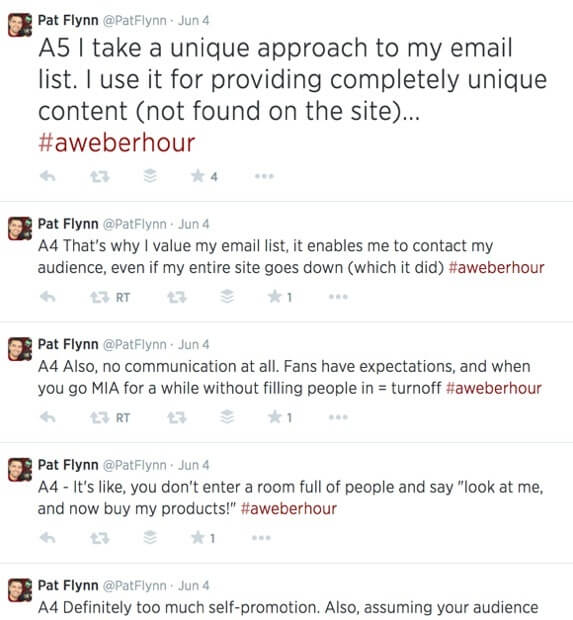
As Zig Ziglar said, “You can have everything in life you want, if you will just help other people get what they want.”
Jeff Rose says it took him a while to realize the importance of helping others first. “I think at the beginning I didn’t quite get it. I was being somewhat selfish,” says Rose. As an example, Rose approached the Art of Manliness blog and pitched himself to be profiled in their “So You Want My Job” series.
“I emailed and said I love the blog and you’ve never done a ‘So You Want My Job’ profile on a financial advisor—and I offered myself,” says Rose, who laughs at the memory. In spite of his approach, Rose landed the profile. “It was very self-serving at the time. If I did it again, I’d do it differently.”&
2. Create a Roadmap to Your Future
You wouldn’t leave the house for a 1,000-mile journey without a map, would you? Of course not. You wouldn’t make it very far.
In business, your relationships make up the roads and highways that guide your journey. You can’t get to your end destination without them.
And yet most people embark on the journey of their career, or try to build a business, without taking time to map out their route. They spend almost no time thinking about how they should build relationships to support their journey—even though those relationships are one of the most critical factors in a person’s success or failure.
As a result, they wander without direction or focus.
So, create your own roadmap. Sit down and create a list of the 50+ bloggers or online entrepreneurs you want to connect with in the next 12 months.
I call this your “Conversations List” because you should think of it as a list of people you want to have an ongoing conversation with over time. You can do this by creating a very simple spreadsheet using Google Drive, like this:
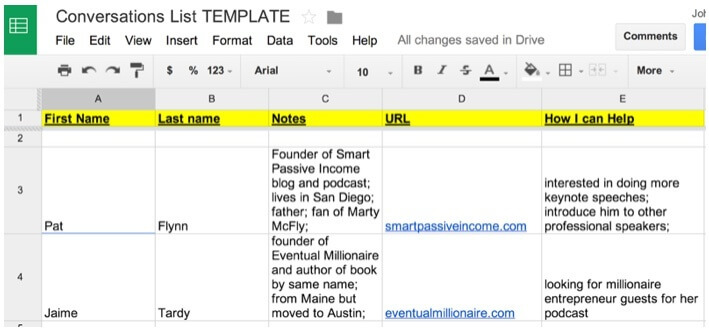
As you can see, you don’t need much information. Just some basic details. I also like to write down how I can be of help to that particular person.
For example, if Pat Flynn was on your list, then you could make a note that he’s interested in doing more keynote speaking. If Jaime Tardy was on your list, maybe you’d note she can always use interesting guests for her Eventual Millionaire podcast or help with promoting her book. [Full Disclosure: As an affiliate, I receive compensation if you purchase through this link.]
Who should be on your list? Don’t just include people who are already successful. “Often people think that networking is all about connecting with people who are bigger or more successful than they are,” says Corbett Barr. “But actually, you should focus often on people who are at about your level. Some of my most meaningful relationships have been with people who were at my same level.”
Barr also says you should try to connect with other bloggers who are go-getters with good work ethics. “Spot people in your peer group that are standouts and become friends with them,” he says.
I suggest a varied approach—include a lot of bloggers who are “at your level,” but also include some bloggers you admire who are further on the journey and who you think you can help out.
You can create a similar list for organizations you are interested in participating in and events you want to attend. I’d suggest a much smaller list of 6-8 organizations and 6-8 events you’d like to involve yourself with over time.
3. Before Reaching Out, Lay the Foundation Using Social Media
Before you dash off an email to a blogger you are hoping will become your new BFF, hold your horses a minute. Slow down. You don’t ask to get married before asking for a first date.
Take some time to lay a little foundation.
Let’s pretend you’re back in high school, and you want to meet a new girl. Do you walk right up to her and introduce yourself? Probably not, right?
Instead, you show up where she hangs out. You find ways to have a few short conversations in the halls or the cafeteria. Then, once she has seen your face around awhile, you are no longer some anonymous person she doesn’t know.
Social media works the same way. You can use it to show your face around and exchange short messages so that when you go in for that direct email, you’re not some anonymous stranger.
The key here is to use the platform where the blogger is most active, not your social media platform of choice. You may prefer Facebook, but if the blogger you want to connect with is most active on Instagram, then that’s where you need to be.
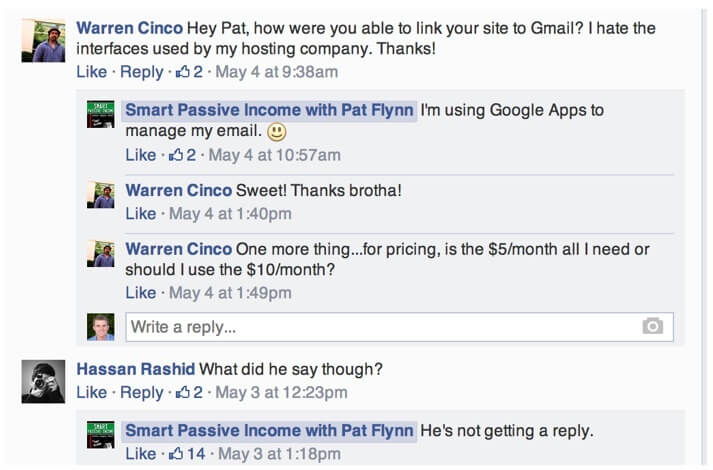
In Pat’s case, he’s pretty active on Facebook:
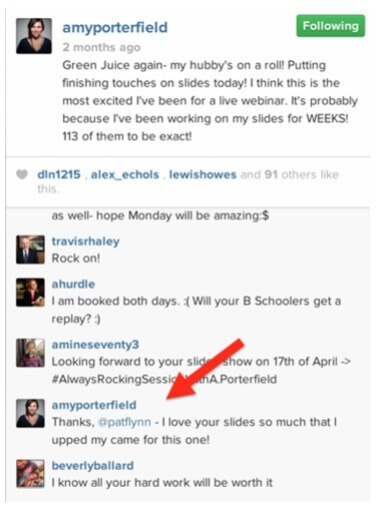
On the other hand, if you wanted to connect with Facebook marketing wizard Amy Porterfield, you’re more likely to make a personal connection with her on her Instagram account:
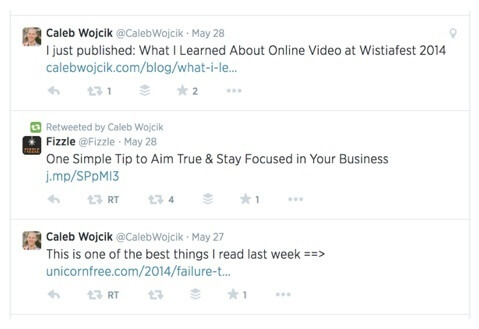
Online video expert “Uncle” Caleb Wojcik is active on Twitter:
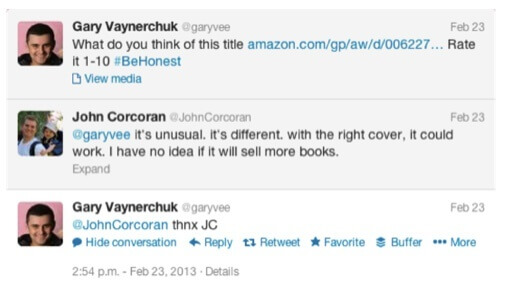
Whatever the platform, look out for opportunities to help, or reply to a request for feedback. Here’s what that might look like:
4. Learn How to Email Busy Bloggers and Get a Response Every Time
Assuming you have already laid the foundation and “warmed up” the relationship using social media, then you’ve already done the heavy lifting. Now you need to contact that person. There are four key principles to connecting with other bloggers who may be as busy or busier than you are.
The four principles are:
- Do Your Research
- Keep it Short
- Focus on THEM
- Have a Clear Call to Action
One of the best books I’ve read on how to email busy bloggers was originally published in 1936, and it’s one of both Pat’s and my favorites. It’s called How to Win Friends and Influence People by Dale Carnegie. [This link leads to Amazon. Full Disclosure: As an affiliate, I receive compensation if you purchase through this link.]
Of course, Carnegie didn’t know he was writing a book that would apply to blogging or email, neither of which would be invented for another 40+ years. But the principles in the book are universally applicable, whether you are connecting with someone in-person, over the phone or via email.
“Of course, you are interested in what you want. You are eternally interested in it,” wrote Carnegie. “But no one else is. The rest of us are just like you: we are interested in what we want.”
Corbett Barr says that when you email someone, you should entice their self-interest by grabbing their attention. “Lead with your best foot forward, whether by name dropping or key facts, such as ‘my podcast gets 50,000 downloads a month, and I’d love to have you on as a guest,'” says Barr.
Another approach is to try to land a big name first, then use that to reel in others. For example, if you were creating an interview series, you might say something like “I’d love to get 15 mins of your time to participate in the interview series, and I’m going to make it really easy for you,” says Barr. “Oh, and by the way, Leo Babauta has confirmed he’s participating as well.”
The blogger you are trying to get involved may want to participate just so they can connect with or be associated with the big name blogger.
One last tip: “Pull out and make bold the thing you’re asking them to do,” says Barr. “Often you have to read five paragraphs to figure out what the ask is.”
5. Get Offline and Start Attending Conferences and Events
Another thing you should absolutely do is get out of your office, crawl out from behind your laptop and start meeting people.
If you live in a small town, this is even more important. Start traveling to conferences like the New Media Expo, World Domination Summit, Financial Bloggers Conference (FinCon) or Social Media Marketing World.
You’ll make great friends and meet partners you can work with as your business grows.
Whatever you do, don’t expect to build as solid relationships with people without meeting them in person. I hung out with Pat at New Media Expo one year and even though I had connected with him online years earlier (and even wrote another SPI guest post years ago), I believe you get to know someone far better once you meet face-to-face.
6. Create a System for Following Up
The next step is to create a system for following up. One of the biggest mistakes I see people make after meeting someone is failing to follow up.
Here’s how it happens: you meet someone at NMX or WDS or a meetup. You have a good conversation and maybe you think, “This is someone I'd like to get to know.”
And then… nothing.
You don't follow up with that person. And they don't follow up with you. It's as if you never met.
Do you realize how crazy a strategy this is, especially if you don't like networking? By not following up, it's like you're dooming yourself to the networking hamster wheel.
If you want to go pro with your blog, you need a system for following up and managing relationships. If you have a system for following up, it helps ensure you spend time deepening your relationship with the people who matter.
Now, you can try to schedule reminders in your calendar manually, but that will get unwieldy quickly. A much better approach is to use a CRM (Customer Relationship Management) program to automate reminders to follow up.
There are literally dozens of CRMs, and more and more of them have been aiming at the small solopreneur market. These include Insightly, Podio, Nimble, and larger options traditionally used by sales people like Salesforce. Products like Infusionsoft [Full Disclosure: As an affiliate, I receive compensation if you purchase through this link.] and Ontraport have CRM features built in.
I use a tool called Contactually which I love because it helps me manage thousands of relationships in minimal time.
Here’s how it works: you sync your email account, your LinkedIn, Facebook, and other social media profiles, and then Contactually creates merged profiles for all of your contacts. You then prioritize people into “buckets” based off how frequently you want to follow up with that person. Contactually will send you reminders to follow up at that interval.
Here’s a quick video to walk you through how it works:
(Here's a direct link to the same video on YouTube)
7. Measure ROI and Optimize Your System
Finally, you need to be able to figure out if all of this is worthwhile. Are these relationships generating more income for your business? Or is your blog just a fun hobby?
To figure that out, practice keeping track of any incoming business or professional referrals for 30 days. This is going to be easiest if you use your blog to sell a service like coaching or web design, but it can also work if you sell digital products as well.
Create a simple Google Drive document that includes the first and last name or the business name of the new client or buyer and the referral source. The referral source could be a person, an organization or a conference where that new client came from.
Here’s what it might look like:
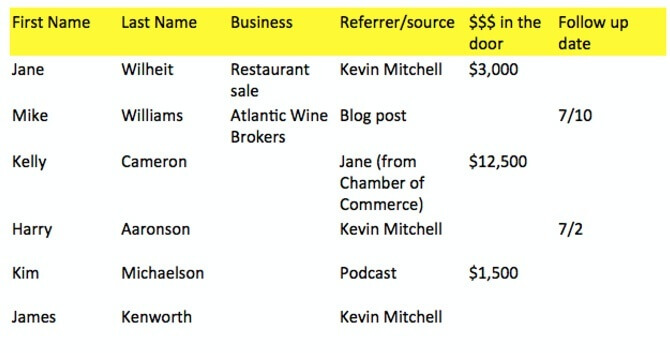
Now here’s the key point. Over time, you will be able to see patterns emerge. Notice in this example:
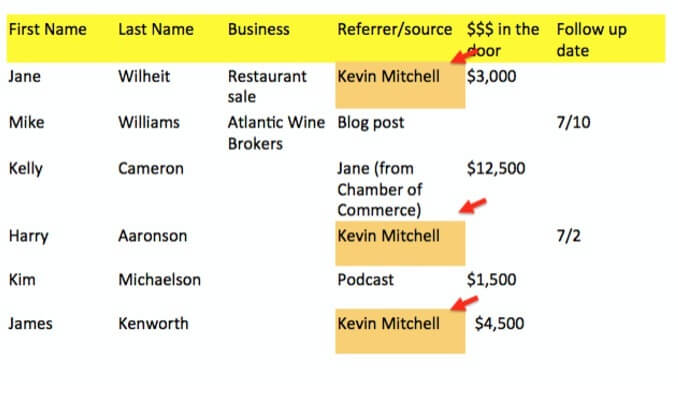
Pay attention to these patterns. Not only will you see which relationships are bearing the most fruit, but you’ll also see which relationships are most useful or which conferences or meetups you attended yielded the best payback.
You can also figure out which organizations you should remain involved with—or better yet, deepen your involvement with. Then you can double-down, or cut out what doesn’t yield results.
Now Go Out and Build Your Network
There are no black hat ninja SEO tricks that will get you a flood of powerful connections and friends overnight.
If you want to break through as a blogger, then you need to focus on building relationships.
But if you are willing to put in the time and effort, your relationships will be be an asset that fuels your business for years to come.
“You've got to find other bloggers you feel you can connect with,” says Rose. “You don’t have to go for the big time bloggers. Find the bloggers who’ve been around 3-5 years who haven’t reached that A+ elite status who you can connect with—find that commonality and give first.”
The post How to Grow Your Blog Audience By Building Relationships with Other Bloggers: The Ultimate Guide appeared first on Smart Passive Income.
]]>