In a new Campaign Income Report, learn how this game-changing tool helped me earn 6-figures: RightMessage, the ultimate tool in audience personalization!
The post Income Report: This Game-Changing Tool Helped Me Earn 6-Figures appeared first on Smart Passive Income.
]]>Welcome to another campaign-based income report here on Smart Passive Income. This month, we're going to examine a promotion I ran at the end of last year for Cyber Monday to promote my online courses.
I've run small promotions during Cyber Monday before, but only for my architectural-related business.
Why not anywhere else? Because I had no other products of my own to sell!
Up until 2017, affiliate marketing had accounted for about 90 percent of my income, with podcast sponsorships, books, speaking, and niche sites making up the rest. Then, I finally created my own courses to better serve my audience, and have seen a significant increase in income ever since.
There were a lot of lessons learned and many things that could have been improved upon during this promotion, but I'm most excited about the results behind a brand-new tool my team and I discovered that makes selling a lot easier, and will forever change how I approach sales and marketing in the future.
I'm going to share all of that here in this post with you, including income generated during the promotion, and by the end, hopefully you'll be better equipped with the knowledge, and tools, for your upcoming promotion, too.
SPI-ber Monday
For Cyber Monday (which my team and I decided to call SPI-ber Monday), I wanted to promote all of my online courses to finish off the year. This promotion would last 48 hours, and all of my online courses would be sold for 30 percent off.
I have three courses available that would be featured in this promotion:
- Smart from Scratch: Designed to help you pick a niche and discover a winning business idea and lead you to your first sale.
- Normal Price: $249
- Sale Price: $147.30
- Power-Up Podcasting: My most popular course built to help anyone not just start a podcast, but launch it effectively with marketing strategies to help you get the most listeners possible, even on day one.
- Normal Price: $799
- Sale Price: $559.30
- 1•2•3 Affiliate Marketing: A step-by-step program to walk you through the best affiliate marketing strategies to make money by recommending products other than your own.
- Normal Price: $699
- Sale Price: $489.30
In addition, we wanted to pre-sell and validate a brand new course—an upcoming advanced podcasting course (for existing podcasters only) called AMP'd-Up Podcasting. It was already outlined in heavy detail, but not yet created.
(AMP'd-Up Podcasting will be available to the public in March 2019.)
As my team and I were discussing how to market all of these courses at the same time during a 48-hour sale period, it quickly became apparent that it could become very confusing (and potentially overwhelming) with all of the different products that were being offered at the same time.
Too many options often means too little action.
That, combined with the fact that everyone else who had a product to sell would be actively engaging their audiences, too. It was going to be a challenge, for sure.
Consolidation and segmentation during this promotion was key.
Teachable, the online course platform that I use and love (also, in full disclosure, I am an advisor and an affiliate for Teachable) puts all of the courses together on a “school page,” but that's more like a library with hardly any room to put any special promotional copy or deals. Furthermore, I have free courses (such as Build Your Own Brand) that I did not want to have shown on the same page.
Although each course has their own separate sales page, I wanted to build a central hub—a single landing page—for all of the courses and the SPI-ber Monday launch.
This hub would include a few key elements:
- A customized video at the top of the page to get people excited about the limited-time offers that were available. I was not course specific (you'll see why in a minute), but I was very clear on when the promotion was over, mentioning the date and time specifically.
- A countdown timer at the bottom of the page, thanks to a tool called Deadline Funnel.
- A mini-sales section for each course with compelling copy and a clearly marked discount off the regular price point.
- Testimonials for each product next to the buy button.
- A buy button for each course that goes directly to check-out (versus the individual, longer-form sales pages)
- A Facebook pixel so we could retarget people who have visited the page.
Pages like this should have no other navigation, buttons, or calls to action other than the products that you are offering. This is the drawback of simply creating a new page in WordPress, which usually still includes all of the navigation and sidebar options.
My team and I love using LeadPages to build pages like this. The builder makes it drag-and-drop easy to create, and although the page is not hosted on Smart Passive Income (it's hosted on LeadPages' server), that actually doesn't matter so much. [Full Disclosure: I am a compensated affiliate and advisor for LeadPages.]
After building the page, LeadPages gives us a link, which becomes exactly where we want to drive all traffic to. We can also include a Facebook pixel on that LeadPage.
Here's a sample section of the page for you, showing just how much copy we used, and how we tailored the call-to-action:
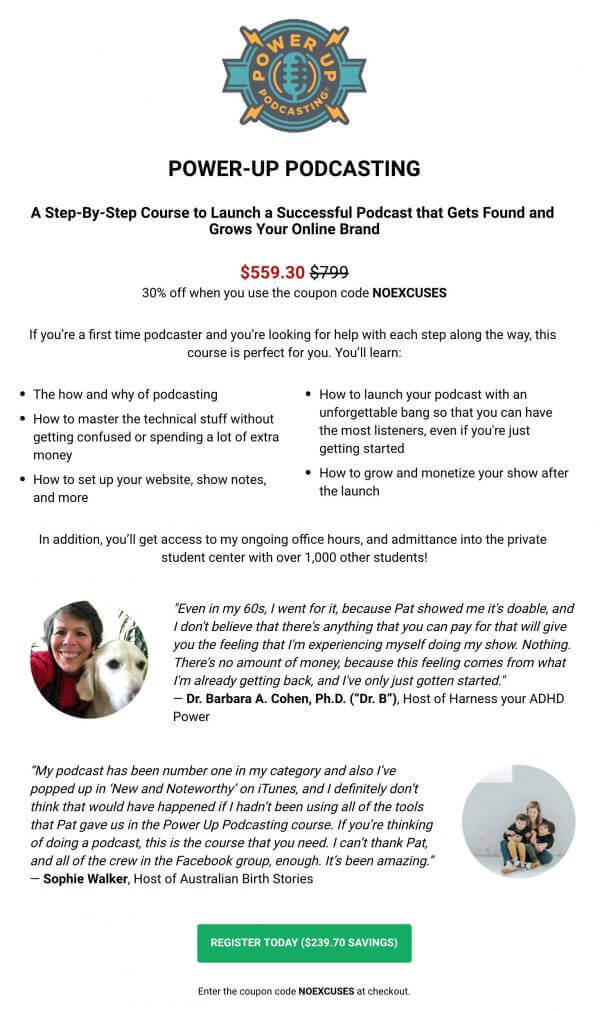
A few important things to note here:
- You'll notice a strikethrough of the normal price, followed by the sale price. You can't get more clear about the savings here. I tested this back when GreenExamAcademy.com first started selling products, and it works like a charm.
- The content section is split into two columns to allow for more bullets in less space. Again, this can be done simply in the LeadPages builder.
- Proof, both in the form of the numbers of students served, and of course, the testimonials from a couple of my students.
- The CTA button color stands out on the page and also includes the savings right on it.
- There's a coupon code.
The idea behind the coupon code, which was mentioned at the top and bottom of each section, was to allow for customers to actually see their savings come through off the regular price, as opposed to automatically applying the sales price during checkout. That experience—the act of entering the coupon code and seeing the savings being applied—would, in theory, convince more people to actually follow through.
This doesn't always work, but for a promotional period that has a clear start and end date, I believe personally that it's more likely to work.
Does it actually make a huge difference?
There are so many variables in every single person's promotional style and products, the best answer is to test it for yourself.
But There's Still That Problem
The central page is setup, all of the buttons go to where they need to go, but we still have a problem:
There are too many products for sale on a single page.
I'm not an Amazon or ecommerce store where browsing for multiple products on a single page is the normal buying behavior. For online marketers, especially if you're building audiences and serving them with quality products, you want to be more direct when possible:
“Have this specific problem? Here's this specific solution.”
Understanding who is in your audience and segmenting them based on the problems they might have and the language they specifically use is a significant advantage. I'd recommend listening to Ryan Levesque, author of Ask, in Session #178 of the Smart Passive Income Podcast for more info about audience segmentation and exactly how to do it.
Over the years, I've been able to use my email service provider, ConvertKit, to not only collect emails, but start to place my subscribers into different buckets depending on where they are on the entrepreneurial journey. An example of how I do using in-email surveys can be found here in this video. [Full Disclosure: I am a compensated affiliate and advisor for ConvertKit.]
But even after segmenting my audience and understanding who needs what on my email list, how can I give access to only what they need, and nothing more?
What about my existing students? It's a poor practice to offer the same course to someone who has already purchased it.
Sending different groups of people to different sales pages makes sense, but that's a huge overhaul of three to four separate pages in a very short period of time, only to then revert back to what they were before the sale.
There's got to be a way to organize this!
(You can probably sense there's a solution coming . . . hehe.)
Enter, RightMessage. My 2019 pick for new conversion tool of the year.
Note: My team and I tested this tool for over six months to make sure this was the best for us and the SPI audience who wants to level up their conversions. As a result, I'm proudly an affiliate for this tool, and have struck a deal with the company to offer you an extended free trial (from 14 days, to 30), which is only available through my link.
To best explain how RightMessage works (before I share how my team and I utilized its superpowers, and the results), let's create a hypothetical, but simple example.
Let's pretend you own a website and business that helps people learn how to paint. While you share a lot of tips to help the first-time artist, you also share a lot of tips and strategies for helping existing artists sell their artwork.
You basically have two groups of people who follow your work:
- Bucket 1: Beginner artists (who have no business selling their artwork yet); and
- Bucket 2: Artists who are ready to sell their artwork online.
Through your email list, you begin to tag and segment your audience based on which bucket they fall into. Furthermore, using RightMessage's built-in tool, RightAsk, you begin to create surveys that show up cleanly on your website that ask which bucket they fall into and categorizes that person (even if they are not on your list).
And with that information, and the power of RightMessage, magic happens . . .
Every time a Bucket 1 (beginner artist) comes back to your homepage, they see messages such as:
- Develop the skills you need to become a successful artist!
- Painting isn't hard, it just takes some time. Let me cut the time in half for you.
- Want to start painting? You're in the right place. Grab your first lesson here.
And on the SAME homepage (not a second homepage that you create), Bucket 2 (pro artists) will see this kind of messaging:
- You make great art. Now it's time to make great money.
- Your artwork could be worth a lot. Let me show you how much.
- The best strategies for monetizing your art and talent.
For each, you could have different images, too:
- Bucket 1 could include images of rough sketches and something not entirely intimidating.
- Bucket 2 could include artwork at an auction, or hanging with a price tag next to it.
When you know your customers and can speak their language, you're more likely to capture their attention, more likely to hold their attention, and more likely to convert them into a customer.
On Smart Passive Income, starting in July 2018, I begun using RightAsk to show a survey at the bottom right-hand corner of my website to begin collecting data, which you might have seen on a previous visit here on the blog. It looks like this:
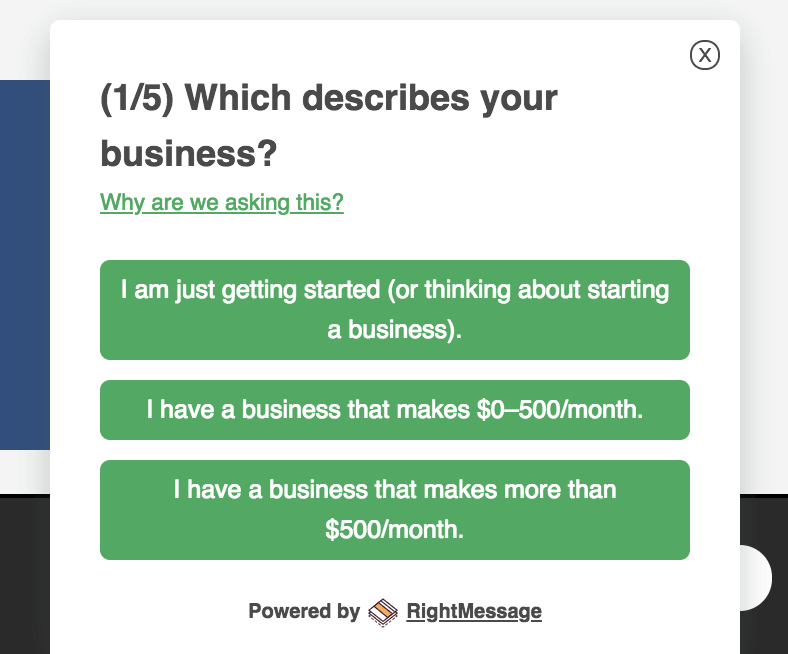
I ask five questions in total, and currently we have an amazing completion rate that helps me better understand my audience. Here's a sample of the data we receive from RightMessage:
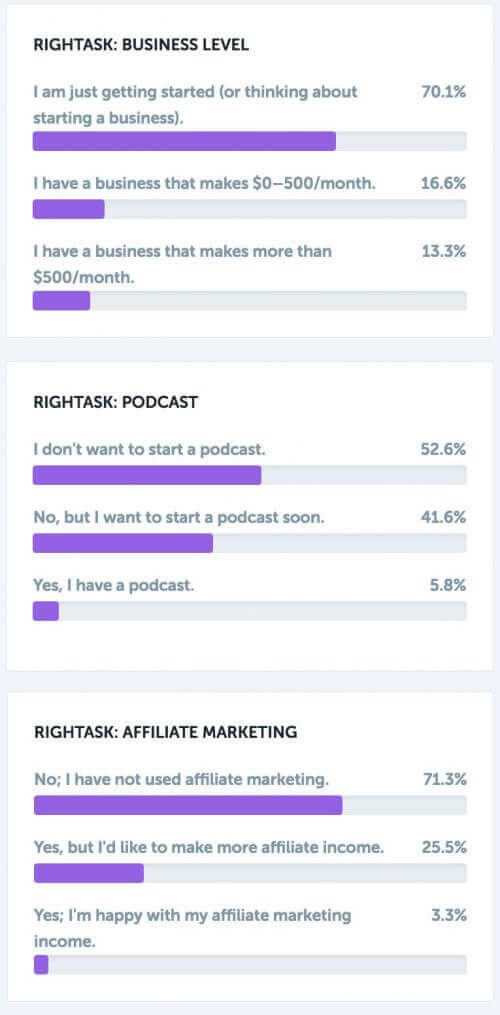
Through RightAsk, over 60,000 questions have been answered!
Not only is SPI collecting real-time survey results from the audience, but that data is held onto that specific person in RightMessage via IP address, and then email address after they subscribe. How huge is that!?
That means that I can have any page on the website show different messages to people depending on what I know about them.
See where I'm going with all this?
Let's show you an easy example using the SPI homepage.
I have three buckets in my audience that I segment for:
- Bucket 1: People who are interested, but have yet to start an online business.
- Bucket 2: People who have started an online business, but only make $0-500/month
- Bucket 3: People who are making more than $500/month
Each bucket has different needs, solutions, and unique language that they use.
Using RightMessage's visual editor (because hardly any coding knowledge is needed to make these personalizations happen), here's what the homepage of SPI looks like when a person is in Bucket 1:
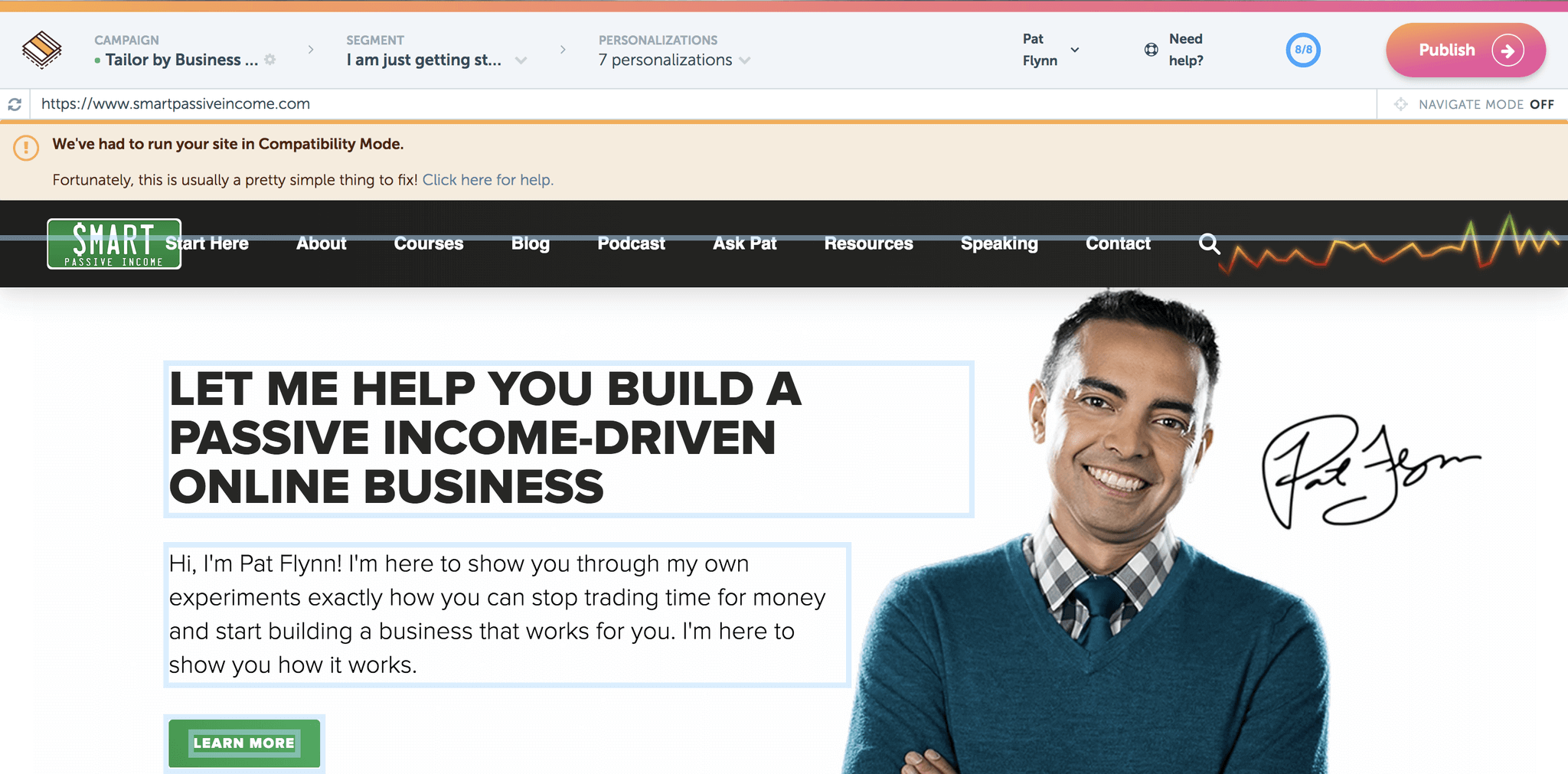
Notice the subtle different in the headline here for Bucket 2:
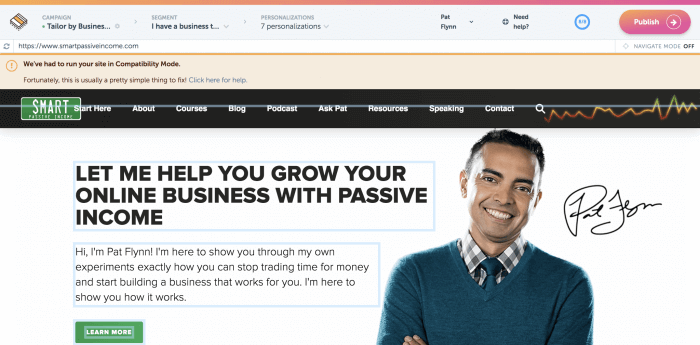
And Bucket 3, the more advanced segment of my audience:
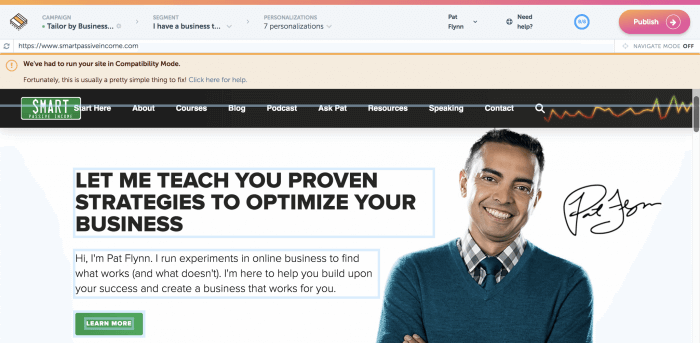
Now that I look at this again, I should probably create more personalized subtext under the headline, which would only take a few seconds.
The copy on your homepage is the easiest thing to personalize first. That's where I would start. Then, you can go even further with it if you'd like, which takes us back to our landing page for SPI-ber on LeadPages, which yes, also integrates with RightMessage.
Yes, you can personalize any custom LeadPages you build, too.
Can you see why I love this thing!?
Making Magic Happen
Using the data collected from RightMessage, AND the integration with my email service provider, ConvertKit (meaning, RightMessage can serve people different messages on my website based on what tags they have in my email service provider), I can have the same sales page promotion only show what courses and messages I want to show.
I'm not going to get too specific with the campaign details here because we did have eight to ten different variations based on what bucket they are in, whether they have a podcast already or not, whether they were a student already or not—those kinds of things—but here's the gist of what we wanted to make sure happened:
Beginners will not see messages for my advanced courses, and their primary course offering would be my beginner course, Smart from Scratch.
Existing students will not see the sections that promote the same courses they are already in.
Existing podcasters will clearly see the promotion for Amp'd Up Podcasting up top.
To the best of our ability, language should be personalized for each particular group.
It's like magic, when in reality, it's just RightMessage.
So How Did the Campaign Perform?
As a result of the campaign (and this was after a lot of data crunching and even chats with the RightMessage team), during the SPI-ber Monday sale, we were able to increase revenue by $104,000 by dynamically tailoring the offers based on customer status tags we had stored in ConvertKit and RightMessage.
We discovered, through A/B testing against a control (which was the standard sales page) that Right Message helped us increase conversions by 2.38x. That means without it, we would have generated only $75,900 on our own.
HOME RUN!
That's a huge increase in income due to personalization. On one hand, I know I've built a ton of trust with my audience and would have likely done very well without the tool, but the numbers are that much higher that, even if the numbers aren't exactly correct here in the reporting, you can't deny that this is helping out, big time! Right Message is a huge discovery and I can't wait to see how it impacts the results of my business moving forward!
And furthermore, I was happy to have several new beta students (over 50!) join my new course, AMP'd Up Podcasting, taking advantage of the pre-sale that happened during the campaign!
And interestingly, the best-selling course as far as quantity was Smart from Scratch, which tailored to the beginners in my audience which, as you saw in the survey data from above, makes up a majority of my audience.
Lessons Learned
Three big lessons learned.
First, although we used RightMessage to personalize offers and better convert several customers, having a pre-sale for a new course in the mix definitely is something I wouldn't do ever again.
A pre-sale for a course is a big deal, and any and all messaging during a pre-sale period for the validation of a course should be about that course, and that course alone. To mix that along with the other courses that were available was a big mistake, and I think it reduced the overall conversion rates on both sides of the equation.
In the future, a pre-sale or beta launch should be treated more like its own event. It's a big deal, and you shouldn't lessen that by having other offers potentially confuse the buy, or overwhelm them.
I made a mistake in the video on the sales page too, referencing AMP'd Up Podcasting, even though for some we had removed that from the page. I'm sure several subscribers in Bucket 1 must have been confused. The video, however, did have a 100 percent play rate, which takes me to my second lesson . . .
Although I had made that mistake with the video, we did experiment with auto-playing the video once a person landed on the page. A couple of years ago, I would have been 100 percent against this. Auto-play = bad.
But, auto-playing videos is more common nowadays, especially on social media. Scroll through your feed on Instagram or Facebook (and even YouTube now), and you'll see videos play automatically.
But what's the one thing all of those social media sites have in common with the videos they auto-play? The sound is off, and usually there are subtitles.
So, that's exactly what we did.
Using Wistia as our video host, we set the videos to auto-play with the sound off, and we included subtitles so even if a person was watching with the sounds off, they could either keep reading, or simply click the video to have the sound come on.
I'll likely continue to use this strategy on custom sales pages moving forward.
And finally, the third and biggest lesson was from RightMessage. The lesson? It's one of the best tools I've found in a while that has had a dramatic effect on my business. Not just in sales here in this particular promotion, but also for generating more email subscribers, and keeping people on my page longer.
By connecting with people based on where they are at, a little bit of on-site personalization can go a very long way.
If you'd like to explore RightMessage, I'm good friends with the founder, Brennan Dunn. I asked him, knowing I was going to share this tool today, if there was a special deal that he could offer the readers here, and he did not disappoint.
If you click through my affiliate link here, or anywhere else on the page, you'll be given access to a 30-day free trial, which is more than double the normal 14-day trial you normally get access to. That's only available here, so I hope you give RightMessage a shot. It's simple to setup, and once you get a feel for it, it can become a powerful weapon in your arsenal of tools to better serve your audience, and ultimately, make more money.
Cheers, and I hope you enjoyed the Income Report this month! Look out for next month's where I'll take you behind the scenes of one of my content platforms, and just how much money is being made there, and how.
The post Income Report: This Game-Changing Tool Helped Me Earn 6-Figures appeared first on Smart Passive Income.
]]>My ultimate online course guide! Here are the three principles and ten practical steps you need for creating amazing, profitable, and life-changing online courses.
The post How to Create and Sell an Online Course: The Ultimate Guide appeared first on Smart Passive Income.
]]>Online courses can help you make more money, save more time, and help more people. In 2017, I hit one million dollars in revenue from online courses alone! And I’ve made lots of money serving as an affiliate for other people's courses too.
Today, I want to share the keys—the three crucial psychological principles, plus the ten practical steps—that will help you do the same.
This post has been crafted to be the ultimate guide (it’s there in the title!) to creating and selling your own online course, so it’s a bit of a long one. But if you’re looking for a one-stop shop on what it takes to create and sell a great online course, stick around, because you’re in for a treat!
Why You Shouldn’t Create Your Own Online Course
Before we get into it, though, we need to talk a little bit about why online courses are great—as well as who they’re not for and why you shouldn’t do them. The truth is, courses really aren’t for all people and all businesses. I think the most important thing is to first realize: what are the problems and the pains and the needs of your audience? And then ask yourself, “Does it make sense for me to build an online course, and to sell it in order to help them through those problems?”
I hesitated for so long to build online courses because I was too afraid to sell to my audience. Here’s the big realization: you can sell and serve at the same time. The other part of this is, I realized that by creating courses for people who just wanted to go deeper with me, I wasn’t taking anything away from that segment of my audience who is more keen to take advantage of my free and lower-cost material.
That realization was huge for me. It pushed me past my fear of selling my online courses to other people, which was a huge relief, and allowed me to create better courses to better help and serve my audience. Now I see that I’m able to serve even more people, especially those who are willing to invest in themselves to achieve their goals. And for each course I create, my newfound confidence shows through in my sales pages, emails, and in the course material itself.
Okay! Now that’s out of the way, let’s cover the three psychological principles behind why people buy online courses. These are the things you have to know about the psychology that motivates people’s purchase decisions, before you try to sell any online course of your own.
The 3 Must-Know Principles of Selling Online Courses
So, you want to learn how to sell online courses? Maybe they're your own courses or you're an affiliate for somebody else's courses. I'm really excited for you, because there's an incredible amount of opportunity with online courses!
Over the years of building and selling my own courses, as well as promoting other people’s courses, I've learned a ton by experimenting with different ways to promote online courses. There are lots of tactics to choose from when it comes to promoting an online course, from emails to funnels to Facebook ads to podcasts, blogging, videos, and more—but the tactics don't matter unless you get three things right. These are the three psychological principles you need to bake into everything you do, or you're not going to be selling anything.
And they are . . .
#1: Sell Outcomes, Not Courses
People don't want to buy online courses. Wait, what? It's true, though. Nobody wakes up and says “You know, I think I'm gonna buy an online course today.” What people really want are the outcomes and the results that an online course can potentially give them. And so, the secret to selling anything, is to convey the results, the outcome, the way someone’s life will be different after taking your course. If those outcomes are not clear, then your work promoting that course is going to be much harder.
For your sales page, don’t focus on the features of the course, but the outcome. For example, with my Power-Up Podcasting course, I promise students they will have a podcast up and running with subscribed listeners on the day they publish their podcast. It’s a very specific and achievable outcome.
#2: Trust and Proof Are Key
Selling an online course is not easy. When it comes to selling online courses, trust and proof are going to be your best friends. Let's take in contrast, for example, something like a software application that does a specific job in a very convenient way. If a potential customer has the problem that software can solve, that customer will be able to easily imagine using that software to get the result they’re looking for right out of the box. But with online courses, which is usually information, you can't really demonstrate that and the results aren't clear and people aren't necessarily going to get results the moment they buy. They have to actually take action to see the results.
Now, when you're selling an online course, you need to build trust before selling your course. You can do it over a long period of time, through content marketing, for example. You can also do it in a shorter period of time, perhaps through ads or webinars. Whichever option you choose, the proof is really important. You need to demonstrate real-life evidence that this course actually works, and the best way to do that is typically by sharing testimonials and success stories of previous students who’ve taken the course.
A special note for establishing trust with affiliate courses: The most important thing to do is to convince your audience that the person creating the course is the right person to teach them that material, and that your audience can trust them. There are a few ways I like to do that it. Most of the time, I promote courses that I've used myself, so I can talk about my own experience and what I loved about it. I’ve also interviewed the founders or creators of courses on my podcast, which is a great relationship-building tool. And again, proof and testimonials from other people too, specifically those in your audience, is valuable here.
#3: It’s Not About the Information
When it comes to most online courses out there, the information in those courses can be already found elsewhere on the internet. So why would people ever buy these courses? I learned this important lesson back in 2008 when I sold my first online product, which was an ebook study guide to help people pass the LEED exam, a specific exam in the architecture space. That e-book was comprised of 95 percent of the same material that could be found for free on my blog. In fact, right before I sold that product, I remember being scared to death thinking that every person who bought it would ask for a refund and complain about that very fact. Not one did. Not one person out of tens of thousands ever complained about it.
So does this mean people are just too lazy to complain and ask for a refund? Not at all. Trust me: if people are unhappy with their purchase, they're going to be quick to ask you for a refund. A big reason people buy online courses is because they’re convenient. You're saving people time by having all that information they need, and only the information they need, collected and compressed in one place for them to take action and get results.
Also, people often want their hand held, and they want accountability through the process, whether it's through things like weekly office hours, or just structurally through the framework of the course. When a purchase is made and dollars are spent, it's that person saying, “Yes, I want to do this. I've put skin in the game, and I'm going to make it happen.” And it’s your responsibility, as a course creator or as the person who's promoting another person's course, to make sure that they achieve that result.
The 10 Steps to Build an Amazing Online Course
Now that we’ve covered the psychology, let’s get into the nuts and bolts of creating your course! Here are the ten steps you need to follow to create an online course from scratch that people will love.
Step #1: Define the Transformation
In the beginning, you might not know exactly what to do. The best thing you can do is start to have conversations with your audience, to understand exactly what they’re going through and where they could use your help. This will help you understand what you can potentially create a course about.
The key here is to know and define the transformation that your customers are going to experience when they take your course. What will your course help them achieve? Once you know that, you’ll have your selling point. You can draw a clear picture in the mind of the customer of, “Wow, if I get this, then I get that.”
For example, here’s the transformation I promise people when they take my 1·2·3 Affiliate Marketing course. I promise they will earn their first dollars through affiliate marketing, which is generating an income and a commission by selling and recommending other people’s products rather than products of your own. The people who take the course will see a direct impact in their earnings and income as a result of promoting specific products in specific ways. If you do the work, you follow directions, you’re going to earn your first dollars through affiliate marketing. If it does not do that, the course will have failed.
Whatever the course, it doesn’t matter how great the information is; if it doesn’t provide that transformation, then what is the point and why would people buy it? If you’re having a hard time defining the transformation for yourself, well then, there’s a problem, because guess what? Your customers are having a hard time understanding it too. I think of Ramit Sethi’s courses, such as Earn Your First Thousand Dollars, or Land Your Dream Job. Those are very clear promises about what will happen if you follow the course correctly—and they’re baked right into the name.
Step #2: Brainstorm the Content
We started at a higher level, identifying our audience’s pains and problems and figuring out the transformation we want to help them achieve. Now we have to figure out the steps they need to take to get to that transformation. Once you’ve defined the transformation your course will provide, you can start to define the pieces that lead to that transformation. What stories do you need to tell? What facts and case studies do you need to share? What exercises does the student need to do to get on the path toward that transformation?
To do that—to reverse-engineer that transformation and figure out exactly what needs to happen for them to achieve that transformation—we first have to do some brainstorming.
You may have some ideas in your head about what should go into your course, but unless you do this brainstorming stage the right way, you’re either going to miss a lot of things, or you’re going to go out of order. The way I would recommend doing this is with my favorite tool in the world: Post-it notes. Post-it notes are my favorite tool for brainstorming, because they’re great for getting what’s in your brain out onto paper, and they’re small (so you can only include one idea per note).
Our brains do a great job of coming up with new ideas, but a terrible job at organizing and prioritizing them. Writing down those ideas on Post-it notes lets you bring them out into the world, where you can see them and start to organize them. Just remember, in this step, you’re basically “throwing up” the contents of your brain onto these notes—you’re not organizing yet!
Cool things happen when you are in that kind of creative mindset—you can just let your creative brain get into the flow. I like to structure my brainstorming according to what I call the “triple 10” exercise. In this exercise, you spend ten minutes brainstorming as much as you can, then you rest for ten minutes. Then after that rest period, you come back to where you were, and brainstorm for another ten minutes.
I’ve found that the final ten minutes in that total thirty minutes is often when the best ideas come out. Why’s this? What happens during that break? Yes, you are resting, but your brain is also absorbing and processing everything it’s just done. When you come back from that break, your brain has just processed it in a way that you couldn’t have if you hadn’t taken the break.
So Step 2 is to brainstorm, using Post-it notes, by letting anything in your brain come out then posting those ideas onto your table or wall. Just let it happen.
Step #3: Organize Your Thoughts
Now, you need to take all those Post-it notes and put them into some kind of order. The key in this next step is to organize the notes into different clusters or hierarchies related to your core topic.
Eventually, you might find that these clusters essentially become modules in your course, and each of these Post-it notes will become your lessons. That’s the magic of this process. This process also makes it easy to find the right order of all the pieces. You can ask, “Would it make sense to put this before that, in the eyes of my customer?” That’s the beauty of Post-it notes again: you can simply move them around on the desk or whiteboard to reorder things.
As you go through this process, you’re going to have a few Post-it notes that will make you say, “Why did I even write that?” Just throw them out. You’re also going to find where there might be some holes, some things missing. In that case, just create more Post-it notes to cover those missing topics and add them to the appropriate clusters.
Step #4: Make the Outline
Now you’ve gone through the brainstorming and organization phases, you can create an outline for your course. The work is mostly done; you just need to review the re-ordered Post-it notes and “extract” the details of how you’ve organized them to create your outline.
The key here is what you do with that outline. And what’s that? You’re go to share it with others to get their feedback. Perhaps you have superfans, people in your audience who would benefit and feel great with you trusting them with this, and could provide some amazing feedback. Maybe it’s people in your mastermind group, or other colleagues or friends who might be looking for the kind of transformation you’re offering with your course. Whoever it is, share your outline with them and say something like, “Hey guys, here’s the tentative outline for this course that’s going to help you [transformation]. Look over it, and let me know what you think. Does it make sense? What else would you include? What would you remove?”
Now, you’re going to get feedback, and some of it you might not want to hear. Your team might suggest cutting things you really like. That’s a hard thing to do. This is what in the book writing space is called “killing your darlings.” And you have to be willing to do the same thing with your courses. You’re going to have to kill the lessons that aren’t necessary in order for that transformation to happen.
So it’s super important to ask your reviewers, “What lessons in here are not necessary to achieve this goal?” That allows you to make sure you only have what you need in your course. Doing the sometimes painful work of identifying and cutting unnecessary material helps in several ways. It’ll save you valuable production time, and it’ll help the course participants by reducing the amount of unnecessary fluff they have to wade through in the course.
Step #5: Pre-Sell the Course
You have an outline, and you’ve collected feedback to validate the concept and the outline. Now, you’re going to pre-sell this bad boy to a limited number of people in your audience, if you have one already. If you don’t, it’s going to be a little bit harder, but you can still do things like run ads for webinars to promote your course.
I talk about validation a lot in my book Will It Fly? (link leads to Amazon). [Full disclosure: I receive affiliate revenue if you purchase through the Amazon link.] If you want an in-depth treatment of validation, check out the book. But today I’m going to keep it higher-level, so you know the steps. If you have an audience already, you can simply let them know, “Hey, I’m coming out with this course. I haven’t made it yet, but I want to share a little bit about the course and how it might be helpful for you.”
Then you can go on to pre-sell it, explaining, “I haven’t made this yet, but I’m going to give access to twenty people who are willing to work with me as I build this course, so I can make sure it meets your needs exactly. I’m also going to give you some extra time with me to help you through this content. If we get twenty people, I’m going to create it. If not, don’t worry. I’ll refund your money.”
Pre-selling in this way lets you validate what you’re trying to do with your course. If people are willing to buy at this early stage, this information helps solidify that you are going in the right direction. It allows your audience and your potential customers to vote with their dollars that it’s something they want, and something you need to do.
What do you need to do to pre-sell? A number of people I’ve interviewed on the podcast have simply pre-sold their courses by saying, “Hey, if this is something you want, shoot this much money over to my PayPal, and I’ll put you in a Facebook group to communicate next steps.” That’s one way to do it. You don’t even need a landing page or anything like that.
Step #6: Communicate
Step 6 builds on what we just talked about in the pre-selling step. The last thing you want to do when you sell anything is to have a person buy it and then not know what happens next. No matter what, always make sure you have a great onboarding process. You want to make sure your customers know you didn’t just take their money and leave.
So, once you pre-sell the course, you have to make sure that you keep your customers up-to-date. Communication is crucial. For instance, if you’ve promised entry to a Facebook group to communicate with people as you are building the course, then set that up.
With 1·2·3 Affiliate Marketing, because I have a team and a lot of resources in place, we created a landing page with a video that explained the transformation, what people are going to get, the fact that it was a beta launch, that it was going to be pre-sold, and that there was nothing to get access to yet. We had a button on there that connected to a shopping cart through Teachable, where the course was hosted. Once they got access to the course, they saw one lesson in there, a welcome video thanking them for being in the course and telling them what would happen next.
Follow through, stay in touch, and most importantly, be honest. Simple, but crucial.
Step #7: Build the Course
Finally, we’re on to product creation! You’ve validated the course through pre-selling. Hopefully you still have your Post-it notes, because they’re going to be your guides for the next step here. This stage—production—is a difficult one, because it takes the most work.
My first recommendation is to plan ahead in terms of how and when you’re going to create your course content. Whether you decide to use video, audio, text, or a combination to create the content for your course, you need to plan what needs to be created, and when. Then, make sure to really honor that time.
Even if it’s just one lesson per day because you’re strapped for time, really honor that time you’re blocking out to create those course videos and lessons.
The best tip I can offer you related to the production of these lessons is to take things one lesson at a time, and plan out how many you’re going to record or create in a given time period. Depending on the length of your course, the amount of time to produce all the course material could range significantly. We recorded the videos for 1·2·3 Affiliate Marketing over the course of two days that we blocked out just for creating the course. It was great to batch-process it that way, because I’d wake up each day and know exactly what that day would be about.
Now, let’s talk production. Quality-wise, video is generally the form of media for most of your course material. But if video is out of your budget, you can create audio versions of the lessons, or simply written ones. In terms of other things that can go into your lessons, you may want to add worksheets to certain lessons to help reinforce the material. Another thing I like to do in all of my courses is have a list of action items at the end of each video the participant should complete before moving on to the next one.
Next, you should also consider what needs to go into the creation of the beta version of your course—the one you share with the early adopters, the ones you pre-sold the course to—compared to the final version that most people will be experiencing. Thankfully, you can get away with a “lighter” version of your course for the beta, which you can then enhance later on to create the final version.
There are a few ways you can get away with going “lighter” in the beta, particularly when it comes to video. If you’re going to create videos, you don’t need the highest production values in the beta. When I create final versions of videos for my courses, I do them in my video studio with a high-end camera. But for the beta versions, I typically record in my home office, just using a basic DSLR camera. You can even use a video camera from your phone, as long as the audio quality is good. You could also use a portable recorder such as a Zoom H4n or a Zoom H6 to record audio separately could benefit you. You could also run a wired mic to your phone using a Rode smartLav or something like that.
In the beta, I also don’t include a lot of elements in the videos other than just me talking and what’s on my Screenflow on the computer. In the final version, though, I might add things to the videos like layovers (text that pops up when you say certain things) and B-roll (camera footage that demonstrates things you’re talking about). But these things take time and effort to create, so it doesn’t make sense to create them until you have all the inputs and feedback you need to make them perfect. So, in the beta, as long as the videos and the lessons do what they need to do to help a person achieve that transformation, then you’ll be okay.
Finally, although Step 7 is all about content creation for your course, you also want to make sure during this whole time that you’re keeping your pre-paid students updated. You can share tidbits and little hints of the course content. You can even give them a little “homework” to help them prepare for the first lesson. I actually did that for 1·2·3 Affiliate Marketing, and a lot of the students appreciated being able to get a head start on the course.
Step #8: Collect Feedback
Once the course is up and running, you want to have a way to collect feedback from your students to improve the course. Email and surveys are two good ways to do this you wanted to do that, but honestly, the best feedback has come from one-on-one conversations and group conversations, like those that take place during group office hours.
It’s important to collect both positive and constructive feedback. This lets you identify what’s working well, what’s not so great and needs to be fixed, and what could be added to make things even better. Something I’ve gotten better with over time, thanks to student feedback. is not including too much information in my courses. I got a lot of great feedback from my students saying, “You know what? I didn’t feel like I needed this to help me get there.”
Your students are the perfect ones to provide this feedback, because they are your target audience, so listen to them more than anybody. They are the ones who need you to make this great, but your audience out there who wants this course, you’re going to get that greatness coming from the voices of your current students. Collect that feedback.
In addition, some of the best feedback I’ve gotten is simply from direct messages on Facebook. Sometimes I’ll just direct message somebody and say, “Hey, I saw that comment you made on Facebook earlier, and I just want to make sure you’re good. What else could I do to improve your experience with this course?” A lot of great feedback can come from a simple action like that.
Finally, as you’re collecting feedback, be sure to ask for testimonials too, because those are going to come in handy in the next step. The best way to collect testimonials, in my experience, is to just approach someone individually and say, “Hey, if you enjoyed this, and you’ve gotten some great results from it, I would love it so much if you’d take a few moments to leave me a testimonial.”
The more testimonials you can get, the better. The more diverse those groups of people who are leaving testimonials, the better, because they’re going to be able to help relate to more people. And people are not likely to give you testimonials out of the blue. Some may, but most people will only give you testimonials if you ask, and it is 100 percent okay to do that.
Step #9: Refine the Course
This one might seem obvious, but once you’ve collected all that great feedback, the next step is to refine the course. Redo the videos that need to be redone. Add worksheets where they’d be helpful. Remove anything that need to be removed. Add text, animations, and B-roll to your videos to spice them up. Refine the course and make it great so that when you go public with it, it’s going to rock.
This step also that includes refining the sales page. You’ve already gone through one round of sales, and you’ve likely helped some of your early students achieve those transformations. Hopefully you’ve also collected some great testimonials by now, and you can use them to adjust the messaging on the sales page. You can even include a new section with some of the best testimonials. Remember what we talked about in the first part of this post? When it comes to selling an online course, trust and proof are key, and testimonials are a great way to demonstrate that proof and cement that trust.
Step #10: Be Confident
The tenth and final step is a small one, but a very important one. It’s a tiny phrase you’ll take with you moving forward, and it’s a big, big deal. What’s that phrase? It’s this: be confident. Through this whole process, you’ve created a lot. You’ve brainstormed and organized and outlined. You’ve done a ton of research. You’ve collected feedback. You’ve created a huge amount of content. You’ve done a lot of work to make sure that this course is something that can truly help people, that it’s a great solution for the problem you’re trying to help them solve, and that it can help them achieve the transformation you’ve identified.
That transformation you promised them is now your responsibility, and you need to have the confidence that you can deliver that transformation for them. If you had a cure for a disease, wouldn’t you want to make sure that you get it in front of as many people who have that disease as possible? Obviously, you haven’t created a cure for a disease, but you’ve still come up with a way to solve a specific problem through your course. So you should approach it in the same way, in terms of your certainty that it can help, your drive to make sure that as many people as possible can find it, and your confidence in the messaging you use to sell it.
And guess what? Some people are not going to be a good fit, or be ready for your course. And that’s great. When you can confidently say, “This is what my course will do for you,” you make it easier to weed out those who won’t benefit from it. You won’t be wasting anyone’s time, or upset anyone when they realize they’re getting something different from what they initially thought.
But when you mess around with the messaging, and try to please everybody, the result is that nobody will understand if the course for them. They either won’t buy because they’re confused, or they’ll buy and say, “This is not what I signed up for.” You have to make it crystal clear for them, and that requires confidence in what you have to offer.
So go out there, and be confident. Make some sales, and then serve. Remember, you can sell and serve at the same time!
Now, go forth and create some amazing courses!
The post How to Create and Sell an Online Course: The Ultimate Guide appeared first on Smart Passive Income.
]]>One of my 2017 goals was to create and launch powerful online courses. Learn what went well, what could be improved, and what my plans are for 2018.
The post The Year of Online Courses (The Results. The Good. The Not so Good.) appeared first on Smart Passive Income.
]]>Last year, when I was setting goals for 2017, I knew that a primary strategy for my business was going to be creating and launching effective and in-depth online courses for the SPI audience. One of the motivating factors for this was to significantly transform the way I generate income.
You see, for the past eight or so years of running Smart Passive Income, I’ve generated the majority of my income from affiliate marketing. I wanted to change that in 2017. I needed to add some nuance and diversity into my income portfolio. I needed to add different, and significant, pockets of value.
Now, I still think affiliate marketing is a fantastic way to generate income, and every business owner who has an audience online should participate in affiliate marketing. I mean, it’s exactly why I created my latest online course, an affiliate marketing course, at 123AffiliateMarketing.com.
But there should be a balance. I knew I couldn’t rely on affiliate marketing alone. If you build your business entirely from recommending the products or services of others, you’re putting your business at risk. At any moment, the relationships you have with those product owners and services owners can go away. I’ve had that happen before. It wasn’t fun.
By creating my own products (online courses in particular), I can better serve my audience because I have full control over the product; I can better craft the product for my target audience. It’s a better experience with the Smart Passive Income brand as a whole. It allows me to keep the SPI community within my ecosystem, and continue to foster that relationships by sharing new products I think they can benefit from.
So, that’s when it hit me. After all of these thought experiments in my 2017 goal planning, I decided that I was going to break through my fear and just create it.
I was going to create online courses.
Giving my audience opportunity
Here’s the thing: Change is hard.
Even though I knew I needed to diversify and create my own products, it took time to let that thought settle in. I was making “enough” money after all, through affiliate marketing. Why would I need to change?!
That’s a rhetorical question. 
Adding to my hesitation to create online courses (or any product) was the fear that I’d be doing it for the wrong reasons, and that’s how my audience would see it too. I didn’t want to just make something in order to make more money. That’s never the way to go, and that’s not who I am.
I heard from a number of smart people who told me I was actually letting my audience down by not creating online courses. One person, in particular, told me that they’d heard me talk about an online course I took once that had had a deep impact on me and my business. And so, by not creating online courses for my audience, I wasn’t paying it forward. I wasn’t giving my audience the same opportunity to discover that deep impact for themselves.
So, in October 2016, I beta launched my first online course, Smart From Scratch. We had over 200 students in the beta launch, and I was able to get feedback and adjust the course for the public launch in March, 2017.
From there, I created more courses, including Power-Up Podcasting, Build Your Own Brand, and 1·2·3 Affiliate Marketing.
Here’s a brief timeline:
- October 2016: Beta launch of Smart From Scratch
- March 2017: Public launch of Smart From Scratch
- March 2017: Beta Launch of Power-Up Podcasting
I beta tested this in front of a live audience at Chalene Johnson's Marketing Impact Academy. If you want to take a deeper dive, I spoke about it at length with Chalene on the SPI Podcast, Session 274. - June 2017: Public Launch of Power-Up Podcasting
- September 2017: Public Launch #2 of Power-Up Podcasting
- October 2017: Public Launch of Build Your Own Brand
- November 2017: Cyber-Week Relaunch of Smart From Scratch (I relaunched Smart From Scratch with a discounted price starting on Cyber Monday for the week.)
- November 2017: Pre-sales of 1·2·3 Affiliate Marketing.
January 2018 and beyond
On January 2, 2018, 1·2·3 Affiliate Marketing will go live for the limited beta group of students who took advantage of a small presale that I ran on Cyber Monday in November. We’ll walk through the course together, and the students will provide feedback along the way like previous beta releases.
That’s four online courses created and announced in 2017. When I initially told my team and a few other people this plan, they thought I was maybe biting off more than I could chew. And they’re right; four courses in a year is kind of bonkers.
Not only is it just a ton of effort to put out four in-depth courses, there’s also the risk that you’d be overloading your email list. A number of people expressed that concern when I told them I was going to create four courses. I knew I had the team in place to make it happen. And I told them, as I am telling you now, that I had planned for this scenario.
For a few years, I’ve been collecting specific data from my audience, and separating my list into specific interests, and what levels they are at in their business. So, for example, I knew going into it that specific people on my list wouldn’t see my emails about Power-Up Podcasting because they had been tagged as not interested in podcasts. Those who already had a business or something up and running would never see the promotions for Smart From Scratch, for instance—or at least that was the idea.
Did it all happen the way I wanted it to? Well, keep reading this post because I'm going to outline what went well, what could have been improved, and what I plan to do moving forward.
The results. The good. The not so good.
My plan was to launch four online courses in 2017. Did it all go according to plan? How well did it succeed? To start, I just want to say that overall it went extremely well.
Our goal for the year was to generate about $400,000 in sales from online courses, which would be a solid increase in my diversification of earnings related to what it was the previous year with affiliate marketing. Again, my goal was to add more balance to where my income was coming from.
Did we meet our goal of $400,000?
Well, there are still sales coming in for some of these courses because I'm testing certain things and some of them are ongoing. But the number we’re at, as I am writing this is . . .
. . . Over $900,000 in course sales for 2017!
This blows my mind! But it also shows you that my audience has been hungry for this. There was a need, and I was able to meet that need. In addition to the value created for the students of the courses, we’ve created quality assets and information that will generate income for SPI and my businesses for years to come.
That’s a good feeling.
(Looking ahead, there will be more courses created, but I don’t plan on creating four courses in 2018. Phew!)
The good
In the Year of Online Courses, here are some of the things that went well.
Crash course in . . . course building
Obviously the strategizing, building, and launching of the courses was a big win. The team and I are also enjoying a good rhythm as we provide updates and upgrades to the courses. Caleb, my videographer from DIY Video Guy, and I are also in a good rhythm, efficiently and strategically setting recording dates for any video assets that are needed for the courses. We had a crash course, so to speak, in launching courses. And I think we’ve done an amazing job, from creating all of the assets to building the course curriculum to setting up the landing pages. We did it efficiently and with quality in mind.
For example, Power-Up Podcasting was sold on stage to 165 people out of 700 in the room. That’s a high percentage for basically pitching an online course to a crowd. I was incredibly thankful for that opportunity (thank you, Chalene!).
From the time that was announced, my team and I had about two weeks to put the course together before the new students arrived. When we were building Smart From Scratch, the first online course, we learned a lot about what it takes to do it right. We applied what we learned to create Power-Up Podcasting and it became a much more efficient process, from creating outlines to filming videos to getting the course into Teachable (Teachable has been an incredible partner in our success; thanks, Teachable!). [Full Disclosure: I’m a compensated advisor and an affiliate for Teachable.]
In the end, we were able to create what I feel is the best podcasting course out there that walks people through the entire podcasting process, step by step. Not only that, it helps them market their podcast too! The results I’m seeing from students is amazing. I’m so proud!
Promoting through email
Another thing that went well are the email promotions for each of these courses. As I mentioned before, I’ve spent a lot of time and energy segmenting my email list, doing my best to share the content people actually want to see—based on interests and where they’re at in their entrepreneurial journey. Having those assurances in place was comforting, knowing that I’d be sending out emails throughout the year promoting and selling the courses.
Plus, the more positive results and testimonials I heard from students of the courses, I felt validated and more comfortable in promoting the course through email. It made me want to get the course into even more hands, help even more people launch a podcast or business.
Nitty gritty numbers
More good things! The numbers. I'm very proud of the fact that for those who have taken action in my courses, many of them have seen great results. From what I understand about the online course completion rates industry wide, the completion rates for my courses are trending a little bit higher.
One of the worries that people have in creating online courses these days is the lack of people who actually complete the courses. When we launched Smart From Scratch, our first course of 2017, we learned that students needed a little bit more hand holding through the process. So we adjusted, and helped them through it by sending out an email when they completed a lesson that shared tips and frequently asked questions.
In doing this, we’re providing the solutions they need before they even ask, which makes the process for them (and us) much more efficient
An amazing community
It warms my heart to see how helpful and supportive the community of students has been for each other as they work their way through the courses.
For Power-Up Podcasting and Smart From Scratch, we created private Facebook groups for the students to share and engage with each other. I pop in here and there to provide updates, answer any questions, and have my office hours. Each time I do, I’m always so happy to see how much of the time I am not even needed—the students are answering each other’s questions, inspiring each other, getting value from each other. It’s awesome!
Office hours
Even though the students have been amazingly self-sufficient at times, the regular office hours I hold have been of great help. What I love about that is it helps control the emails and questions that are coming in. It allows questions to come in, but on my time, and the students seem to like having direct access to me to answer more specific questions.
When I was taking courses back in the day, having that little bit of attention from the course creator to get a question answered here or there was very integral in pushing me over those hurdles. Thankfully, that’s been true for my students too.
Typically I'll have anywhere between six and eight sets of office hours per course launch. And a number of students have said that they’re getting more value from the office hours alone than the courses they’ve taken from other course creators—where, in a lot of cases, there aren’t any office hours. I think people love knowing that I'm there for them and they could see me and talk to me. And this won’t change as I continue to create courses for my students.
Testimonials
Collecting testimonials has been a joyful and successful process. Whenever I ask for them, students have been more than happy to share their thoughts about the courses. I think one of the things I know I can improve on, is simply asking for more. But I definitely have plenty in hand for the courses that I currently offer, which is a great way to help convince those who maybe are on the fence about signing up.
The not so good
In the Year of Online Courses, what could we have done better?
Facebook ads
Mid-year, I started trying out Facebook Ads to promote the courses. I utilized a separate team to help set those up. So far, it’s just been so-so.
To be honest, I don't know much about Facebook Ads, and by utilizing a different team, you never know exactly what to expect. I'm not sure if I should spend more time learning about Facebook Ads before hiring a team or what. I just don’t know yet. What I do know is that I’m learning as I go, and the next time we do this, it will be better—and so on and so forth!
The bonus: We’re seeing a profit. We've spent probably around $30,000 on Facebook Ads and have seen 3-4x profit as a result of just those ads alone. As my Facebook Ads team tells me, because the promotions are only open for a short period of time, it's difficult to hone in on the most effective copy and specific offer to the right audiences in that short period of time.
Ideally you want these things to be ongoing and continually tweaked to decrease the number of dollars you're paying per lead and potentially increase the number of conversions. Going forward, we’ll continue to explore Facebook Ads, and I’ll learn more about Facebook Ads so I can share that knowledge with you later!
Different ways to promote
For 2018, I’d like to explore different ways to promote my courses. I think there was a lack of attention in promotion, aside from email (and the small amount in Facebook Ads). I think that limited the number of sales.
One area that could be improved is to utilize the content that I’m already producing (podcast, blog, video) to cross-promote the courses; to create a better cross-pollination among all of the content I’m creating. It’s a good lesson for any content creators out there. If you are creating value on other platforms, make sure those platforms are connecting in some way, promoting each other in some way.
There was one instance where it did work well though. I had a Smart Passive Income Podcast episode where I interviewed three students from Power-Up Podcasting. They talked about their experience as new podcasters and about their experience with the course. After that episode came out, I saw a significant bump in sales that week. I also received a bunch of messages from people who told me specifically that the episode inspired them to sign up for Power-Up Podcasting.
Next time, I plan to try more of that type of promotion.
Course pricing
Pricing is another thing that's hard to figure out. I feel like I did an okay job pricing the courses, but there’s always room for tinkering and testing.
At $197 for a beginner course, it’s not an insignificant amount, so it feels like an investment, especially for beginners. It’s also high enough to potentially weed out the people who are just looking for a magic button.
For some of the higher premium courses, like $697 for Power-Up Podcasting, it seems like that’s a solid price point, as I’ve heard from a number of students who have taken the course, have seen great results, and have told me that I could probably charge double. For now, I'm quite happy with the $697 number, especially as it compares to some of the other courses and offerings that are available in that space right now.
For 1·2·3 Affiliate Marketing, we went with $497 for the limited Cyber Week run. Although that course has not yet been distributed to those who purchased the presale, I know that people who take action will likely get that money back in a relatively short period of time if they implement what I’ll be teaching within the course.
The thing that I know I could improve on is helping people understand why those are the price points before they buy. This involves price juxtaposition and really being confident in sharing those price points on the sales page. If I want to adjust the price, I need to have clear reasons, and explain those reasons well. For Smart From Scratch, I did actually increase the price point from $197 to $247, due to feedback from the students who thought we were underselling the course, and because I wanted to offer a higher perceived value of everything that was offered.
Too much customization
At the beginning of the year, we attempted to customize the sales page on Teachable a little bit too much. That really didn’t work out in our favor. We tried to make the sales page look like what you’d find on SmartPassiveIncome.com, with the same stylings and fonts. Through that process, we ended up breaking a number of things that were really important.
For example, one of the things in Teachable that people loved is the fact that it tracks your progress. Every time you complete a lesson, it shows that you've increased in progress. But, because of our sales page tinkerings, that function was broken for the first three launches, including the beta launch.
So we decided to scrap everything and revert back to the standard Teachable code base, and take advantage of their built-in customization options. It’s a bit more limited but it's working out much better. I think we got a little bit too ambitious and wasted a lot of time on things that actually didn't really matter in the beginning. Maybe down the road, more customization can be done, but to start it’s best to stick with the foundational elements.
And, if you’re ever going to create a course, there’s no better platform than Teachable. It works perfectly, their team is amazing, and, if you have multiple courses, you just need one login for all of them! I love being an advisor for Teachable.
If you’d like to create your own online course, go to SmartPassiveIncome.com/teachable.
[Full Disclosure: I’m a compensated advisor and an affiliate for Teachable.]
Online courses in 2018
In 2018, one of my goals is to work on the funnels, and better integrate course content with other content I’m creating, especially the videos I’m creating more of on YouTube. Video is a big part of the SPI strategy moving forward, so please be sure to subscribe to my YouTube channel at YouTube.com/smartpassiveincome.
I love the community aspect of the courses, and will continue to emphasize that. There have been so many amazing students who’ve completed a course, and have stuck around in the community as alumni to help, encourage, and inspire the students that came after. It’s so cool to see! I didn’t expect that, and I am so grateful for it. So, I want to continue to focus on that and encourage that. One way I’ve done that is by sharing custom-made pins created for that specific course with the students.
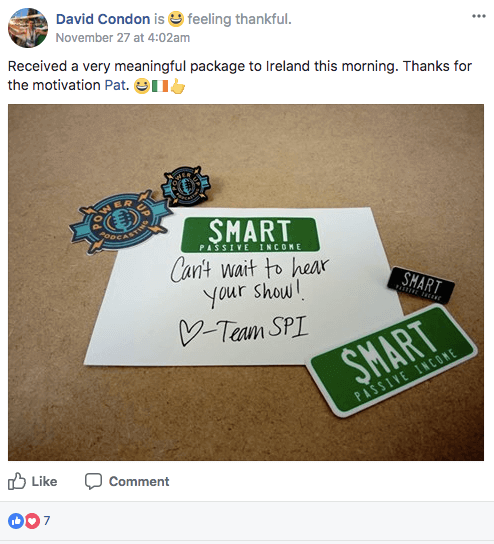
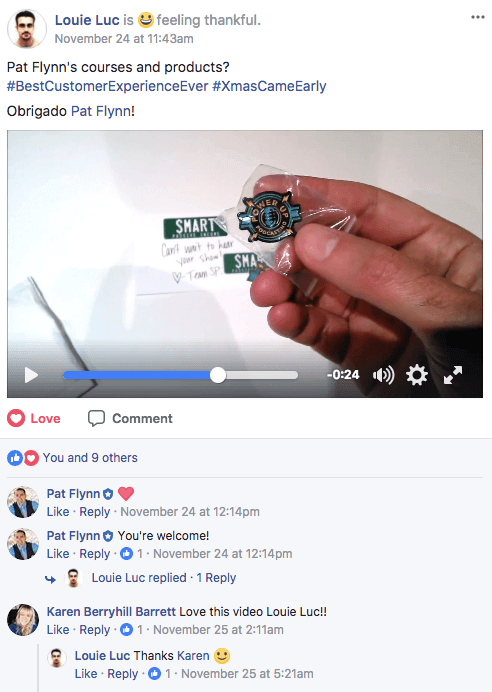
A little token of appreciation, but those types of gestures can go a long way toward keeping student morale up, encouraging, and inspiring them to finish the course.
Then, finally, one thing that we tested last year was a live workshop. I actually had fifteen people pay extra to come to San Diego for some in-person podcast training for two days in my hometown. It was a remarkable experience!
And, guess what? We’ll be launching a new Power-Up Podcasting live workshop in May 2018!
Power-Up Podcasting Workshop
Yes, that’s right . . . in May 2018, I am holding my second ever live workshop. Here are a few ways you can benefit from signing up:
- Get immediate feedback on your podcast topic from me and your classmates. Many students at the first workshop made significant changes to their ideas or their audiences based on class discussion.
- Watch me record a sample podcast and ask lots of questions as I record and edit.
- Meet with a graphic designer to create your podcast logo.
- Build a support network with your classmates. This has been so valuable for the first group of students! They continue to support each other with launches and feedback after the event, through the workshop's private Facebook group.
[Editor's Note: We no longer offer the in-person workshop. Instead, we offer a multi-week accelerator in the All-Access Pass community.]
The year of online courses — final thoughts
So, for your reference, here are the four online courses we created this year:
I'm excited about where things are headed, into 2018 and beyond. I'm going to try and get a little bit more advanced in how my courses are pushed out there, with funnels and webinars and exciting things like that.
As always, I’ll keep you updated on what's working and what's not—sharing the tools and strategies along the way that I figure out because this is all new for me too. A lot of you who are reading this probably have had courses for much longer than me. I'm learning a lot as I go. Thank you so much for an amazing year. I'm looking forward to serving you again next year!
Learn how to create your own online courses with our how-to guide

Online Courses
Monetization
How to Create an Online Course: The SPI Essential Guide
Learn how online courses work, how to create them, and how to sell them. This guide is packed with creation and marketing advice to start you out right.
The post The Year of Online Courses (The Results. The Good. The Not so Good.) appeared first on Smart Passive Income.
]]>