
 Pat Flynn
After being all excited and getting over the fact that I could actually say “I, Pat Flynn, own my own business” (I can’t wait for my 10-year reunion), I soon realized that this is really serious stuff. There’s much more to it than just filing papers with the Secretary of State and having a really cool stamp thingy that has my company name on it.
Last week, I met with a CPA to help me with the finances of my business. I learned so much in that hour, but the most important thing I learned was that in order for a business to function properly, AND in order to maintain the protection of my personal assets (which is the main point of starting my LLC), I must separate my business finances from my personal finances.
Before I go on, I’d like to mention once again that…
Everything you read on The Smart Passive Income Blog, including this post, is just reflection on my personal experiences with making money online and owning a business. I am not a lawyer or financial advisor, and I’m simply just trying to make your job a little easier through my own experiences. I cannot guarantee anything and will not be held liable for any of the information I post on this website. Please remember that everything I write and comment about is my own formed personal opinion about the subject matter. You should always form your own conclusions and perform your own actions based on those conclusions.
Ok, back to “business.”
The Bad Financial Model for Running a Small Business
Here is a chart of what’s been happening since I started making money online, before I started my company (yay for charts!):
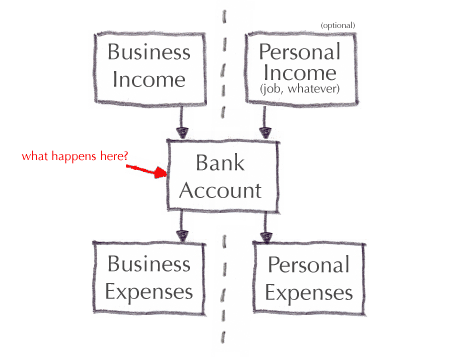
It may seem that this is the easiest way to do things—I mean, you just pull out money from the giant bank account that you and your business add to, but this is not good. An article I found on about.com by Darrell Zahorsky outlines 5 reasons why you should never mix personal and business banking:
- The Business Deduction Rule: The law says only businesses can deduct business expenses. Let me say that again: Only businesses can deduct business expenses. If you have a business that runs out of your personal bank account, you’re going to have a very hard time convincing the government that you are indeed running a business. To them, it might just look like a hobby.
- Tax Time Woes: When you file taxes for yourself and for your business, all of the transactions for each must be separated. If you don’t have separate accounts, going though each transaction is going to suck big time.
- The Audit Trail: Note that it’s not a requirement to have a separate bank account for you and your business. The only thing that is required is that “all records be accurate, complete, permanent and show a clear record of income and deductions.” If you’re audited, your separate business statement and record provides a “clear audit trail” and will make your life much much easier.
- Missed Deductions: With a giant bank account with both business and personal transactions, it’s going to be very easy to miss deductions that you can write off. Messiness equals wasted time and money.
- Lack of Professionalism: If you were doing business with someone and they paid you with a personal check, you’d think they were a little unprofessional, or not even a real company—right?
The Good Financial Model for Running a Small Business
Below is a chart of what my business and personal finances should look like:
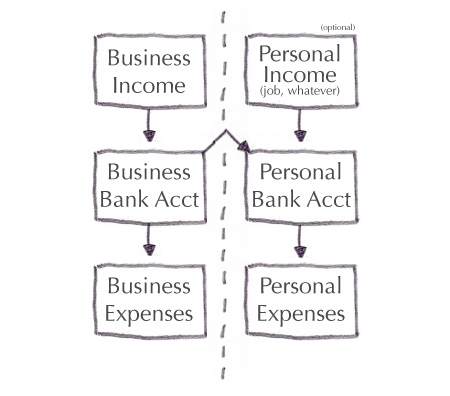
As you can see, the business is kind of like another person. It makes it’s own money, has it’s own bank account and it’s own expenses too. The only interaction between the two sides is when you get paid from your business. This can be hard to understand, but it’s like you’re working for your business (i.e., you’re an employee and you get paid). Money that goes to you gets recorded as a transaction and this again is really important to keep track of for both you and your business’s financial health.
There’s still a lot for me to learn, but I just wanted to break this down for you because I now understand the importance of separating business and personal finances—and it is all accomplished by first opening a business bank account…
My Experience Getting a Business Bank Account
As you know, I filed for my Limited Liability Company (LLC) with LegalZoom.com. One thing I got in return was a federal tax ID number from the IRS (also known as an EIN, or employer identification number). Remember how I said your business is kind of like another person? Well, your EIN is pretty much the social security number of your business. Keep this in mind.
Anyways, I chose to get my business banking account for Flynndustries, LLC at Bank of America. You can get one at pretty much any bank, but I do personal banking with them, and I’m really used to their online banking system.
Just so you know, there are going to be fees involved wherever you go, but the costs are far less than the benefits to your business. At B of A, their fees for the account are waived if you use their check card (which is attached to the business checking account) at least once each month. If not, you get a $7.00 hit each month you don’t use it. I recur a $15.00 fee for one of my services which help me automate my business, so this will not be a problem.
Sole Proprietor or LLC?
At the bank, the first thing I was asked was if I was doing business as a sole proprietor, as an LLC, or a corporation. Of course, I said LLC, but you don’t need to be an LLC to get your own business banking account.
Sole Proprietor
You can be an individual person, or a sole proprietor who just wants your own separate business banking account for your business. That being said, you’ll need to provide two things:
- YOUR social security number, and . . .
- A DBA
Regarding the first item, please know that although you’ll have a separate bank account for your business as a sole proprietor, you’re not really protecting your own personal assets since your the one on the account, instead of a separate business entity, like an LLC or corporation. If your business were to be sued for whatever reason, both your business and personal assets would be in jeopardy. Again, this is why I started an LLC.
Now, what’s a DBA? You need a DBA, as a sole proprietor, in order to open a business bank account. Without it, it’s a no-go. DBA stands for “doing business as” and it’s a formal way to legally operate a business under a different name than your own. So, if your name was John Smith and you sell cucumbers, after you file a DBA you could legally do business as “Cool Cucumbers.” LegalZoom can also help you file a DBA for you for about $100. [Full Disclosure: As an affiliate, I receive compensation if you purchase through this link.]
LLC
As an LLC, I had to provide the following in order to get a bank account with B of A. They kept copies of each:
- The LLC’s EIN (aka. Federal Tax ID): The IRS provides you with a form with the EIN on it. They need to see this.
- The “Articles of Organization:” This is a form that comes from the Secretary of the State that is signed and stamped and basically proves that you are indeed an LLC. It has a really long number in the upper right hand corner which they need.
- The Operating Agreement (if you have one): This is basically a formal statement about your company and it’s members.
It was a fairly simple process, and they just asked a few questions about what my business was about.
They set me up with an online ID so I could easily access my account online. I was also given a temporary checkbook which has the correct routing number and account number. This is important because I can immediately begin to connect my PayPal account and other forms of business income to it.
Lastly, in order to open the account, I needed to deposit at least $25.00. I deposited $100 for good luck.
And that was that. I’ll be getting a check card in the mail in a few days, and I was actually approved for a business credit card as well, which will help my company begin to form a credit history, which is important if I ever want to take out any loans or lines of credit in the future.
In Conclusion
I apologize for the length of this post, but I believe it has some good information for you, even if you don’t plan on starting your own business anytime soon.
The most important thing to realize here, beyond the fact that you should separate business and personal finances, is that you should perform good business habits right from the start. Like a golf swing, if you start out with bad habits, it’s very hard to start over and get to where you really want to be.

 Dave Heistein
 R.J. Weiss