
 Pat Flynn
In my previous post, I presented my First Law of Business and Success, which again was the following: “Any business in a state of uniform motion tends to remain in that state of motion unless an external force is applied to it.”
Basically, whatever state your business is in, it’s going to stay that way unless something happens. If you don’t have a business, or if business isn’t going well, nothing good will happen unless you do something about it and take action. If business is going well, your job is to make sure no negative external forces come by and change things for you.
If you didn’t make the connection already, I’m using Newton’s Three Laws of Motion, but relating them to businesses (which include blogs, relationships, your job, whatever). A better title for this 3-part series may be: The Physics of Business. A nice book title if you ask me (dibs).
Newton’s second law of motion defines the relationship between Force (F), Mass (m), and Acceleration (a). It states that “The acceleration produced by a particular force acting on a body is directly proportional to the magnitude of the force and inversely proportional to the mass of the body.” I don’t want to get into a physics lesson, but you may recognize this equation below:

I want to highlight acceleration in this post, so let’s rearrange the equation really quick:
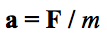
This brings me to my Second Law of Business and Success:
Law #2: The acceleration of your success is directly proportional to the amount of force you apply, but inversely proportional to the number of markets you try to reach.
In other words, the more effort and energy you put into something, the faster you’ll see results. Conversely, if you use that same amount of energy but spread it out amongst multiple markets, the slower you’ll see results. This is why they say your niches and keywords should be more narrow, than general (i.e. “Making Money from Home”, instead of just “Money”).
Let’s talk more about markets and why it’s better to reach one specific kind of market, instead of generalizing and trying to reach more people. To use an example from a recent interview I listened to from the Internet Business Mastery Academy’s “Grill the Gurus”, Perry Belcher describes why there are so many dang shoe stores at the mall. (Perry Belcher is an Internet Marketing MASTER. He makes over $30 million a year.)
Anyways, have you noticed that? Shoe stores are everywhere! Well, they are making bank too. Here’s why:
If you notice, most of the shoe stores are highly specialized to cater to a certain market. Athletic shoes (Footlocker), walking shoes (The Walking Company), running shoes (Road Runner Sports), trendy alternative shoes (Journey’s), skateboarding (Airwalk or Vans), and even shoes that apparently help you lose weight (Shape Ups). There’s even a company that sells driving shoes. Yes…driving shoes.
Anyways, Perry’s point is this. These companies specialize in certain kinds of shoes because they know that people are more likely to buy from them for that kind of shoe. If you were shopping for running shoes and there was a General Shoe Store and a Road Runner Sports store right next to each other, which one would you always go to first? Road runner, of course—because they are the running shoe expert, and will most likely have a larger selection for you.
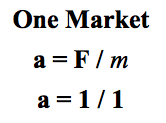
Anyways, to get back to Law #2, if you try and reach more than one market with your business, you’re not going to see great results. Looking at the equation, a = F / m, you can easily see what I mean. If we say your force is “1”, and your market is “1”, than you’re applying 100% of your effort into that one market. Here’s it is in equation form:
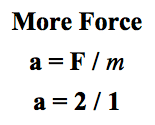
Obviously, you can increase the acceleration by adding more force:
Now, let’s take a look at what happens to the acceleration of your business when you try and reach too many markets at once:
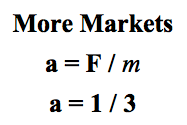
More markets means less acceleration. Just think about that. If you’re going to try and reach more markets, you’ll have to put in more effort in order to obtain the same results as you would with just one market and the original amount of force:
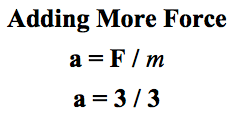
As you can see in this last example, “a” equals 1, just like in the first example where we were just trying to reach one market. The best thing you can do for your business is to stick with a smaller, more specialized market, but put as much force into that market as possible. This will get you the best results, and make things happen faster. Remember the shoe stores.
The Exception
What? There’s an exception? Well—sorta. The above examples are specific for small businesses, just like you and me. When we start to talk about large businesses, the same rules apply, and the numbers appear much bigger. Larger businesses have the resources to reach and take over more markets, so you might see an equation like the one below for a company like Zappos.com, which is a billion dollar online retailer that sells not only all kinds of shoes, but also apparel and bags too, for all kinds of people. Please note that these numbers are just an example and don’t represent any true amount of effort or number of markets Zappos.com may try to reach or have reached:
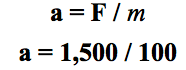
So I think you get my point. Larger companies have the resources to reach more markets, but still have to apply more effort to get to them. More advertising dollars, more manpower, more force. For us small businesses and bloggers, this isn’t possible, so we must stick with one market, long tail keywords, and concentrate on our Force within that market to succeed.
To Conclude
I apologize if this seems confusing. It may seem like way too much effort to try and say something as simple as: just focus on one market and you’ll do better. I think (and I hope) you appreciate looking at online business and marketing from all different angles. Maybe you’re not a math person and this is hard to grasp, but I think I’ve presented it in a way that makes sense. In an effort to stand out and try and be different from the typical Internet Marketer, I hope I’m succeeding in your eyes.
Lastly, writing this post has made me realize that I may be trying to focus my energy (F) into too many things at one time (m). I have my LEED website, which is Passive and automatic and as such doesn’t require much attention. But in trying to find a new profitable project, I have iPhone applications, affiliate marketing, I was looking for a book deal, eHow, and more. I have to step back for a second, take my own advice and know that I will see better results if I apply my effort into one thing and just focus on that. Come to think of it, when I created my 6 figure website, that was the only thing I was focusing on at that time.
Good things are going to happen. Law #3 is coming up next.

 John Corcoran
 Chris Ducker