
 Pat Flynn
I’m sure you’ve heard these before:
“30-Day Money Back Guarantee!”
“If for any reason you’re not completely satisfied with your product, send it back to for a full refund!”
“Guaranteed or Your Money Back!”
“If you don’t lose 100 lbs. in 5 minutes, we’ll refund your money 100%!”
Ok, maybe that last one is a bit exaggerated, but you get my point. Guarantees are everywhere, but they aren’t just for show—they are implemented as a psychological tool of marketing warfare.
The Customer “Psyche”
Before a purchase, customers usually don’t say to themselves, “Oh look, a guarantee! I think I’ll buy this item now.” That’s not the goal of the guarantee. It’s primary objective is to provide a level of comfort and safety for the customer regarding his or her investment. Instead, they may say to themselves, “Well, if this doesn’t work, I can always get my money back.” Of course most of the time, this is all processed subconsciously and decisions are made in nanoseconds.
After a purchase, customers will either be satisfied with their item, or not. An unsatisfied customer, however, will not always ask for their money back, and that’s where the advantage is for any business offering a guarantee. Just think, how many times have you bought something that you probably could have (and should have) returned.
Right now, I’m thinking of a pair of bongos I once purchased on Ebay, which arrived with a big gash on one the drum heads. I wanted to return them, and I probably should have, but I was too lazy and it was just too much of a hassle. Not cool.
What a Guarantee Does for a Business
If you’re selling something, anything, there is always a risk that your product, no matter how good it is, may not do what it’s supposed to do. It may not satisfy customers even if it did do what it was supposed to do. That’s just the way the world works. Having a guarantee will open up the chance that you may have to issue a refund to an unsatisfied customer—which we never want to do, obviously.
That being said, there have been millions of marketing research dollars spent figuring out that businesses who offer a guarantee will almost always earn more money because the guarantee lures more paying customers. The number of refunds you issue will increase, but you’ll almost always net more than you would without the guarantee.
The Lose-Win Guarantee
Tim Ferriss, one of my heroes and author of the best selling book, The 4-Hour Work Week, has a small passage about guarantees. He explains a kind of guarantee that is better than the normal “30-day, money back guarantee”, which uses the same philosophy, but takes it to a whole new level. This guarantee is called the “Lose-Win Guarantee”, and I’m interested to hear what you think about it.
Here are some examples of a lose-win guarantee:
- You sell an item for $25.00. If it doesn’t satisfy, the customer can send it back, and he or she will get a $50.00 check in return—twice the amount they paid for it.
- You sell a product and offer a bonus stapler with it. If the customer isn’t pleased, he or she can send your product back for a full refund, but keep the stapler as a gift. (Does this sound like any infomercials you’ve seen?)
- You sell a weekly newsletter that provides information about the best housing deals in the San Antonio area. For each week that you don’t provide the information as promised, you’ll send the subscriber a $25 dollar check.
So you see, it’s called a lose-win guarantee because if the customer isn’t satisfied, he or she still gets something in return. Even if they lose, they win. The flip-side is, even though you, as a business, may lose a little bit of money, you will win more customers.
The Dangers of The Lose-Win Guarantee
I can definitely see how this kind of guarantee will further comfort a customer and help them feel better about making a purchase.
Most people are honest, but as we all know, the world isn’t made up entirely of honest people. So, who is to stop someone from purchasing your $25.00 product with the intention of sending it back right away for a $50.00 check. This is why I “half-way” agree with Tim Ferriss’ assessment of the lose-win guarantee.
I use the same guarantee, but I protect myself with a little safety net.
How I Use the Lose-Win Guarantee
On my blog at intheleed.com, I offer two different guarantees for my ebook, which you can read below:
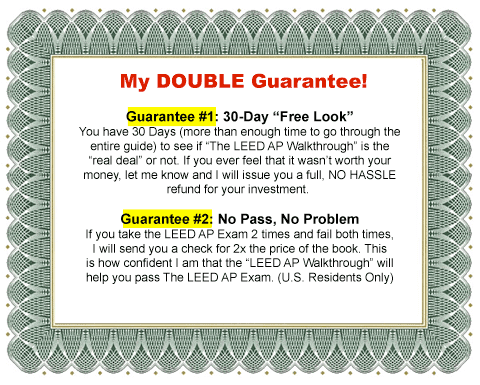
Here are my stats on each of these guarantees:
Both guarantees have been up for about 3 months. Within those three months, I’ve sold 1,407 books.
- Guarantee #1: I’ve issued a total of 5 refunds for this guarantee. Three of those were for customers who wanted to see if it would help for a similar exam, and two were for legitimate unsatisfied customers. Out of 1,407, I think this is pretty good. I can’t really give you a number of how many satisfied customers bought my book because of the guarantee, because that’s impossible—but I think I’m safe to say that having this guarantee boosts my earnings.
- Guarantee #2: Here, you can see what my “safety net” is. If the customer does not pass after taking the exam twice, I will send a check to the customer for twice the amount of the ebook. This way, the customer cannot simply buy my guide and then get double the money for it right away. In fact, the last thing the customer would want to do is ask for guarantee #2, because that would mean they’ve failed twice. I have only been asked to satisfy this guarantee once, and I made sure I got documentation from that person to confirm that the test was taken and failed twice. I actually felt really bad, and wanted to give him that money, because for him—my product did not do what it was supposed to.
So, What Do You Think?
Am I doing something that is indeed boosting my sales, or is it just wasted text—or maybe you think it’s hurting my sales? What do you think?
All of this is part of a larger realm of marketing (especially online) that has a lot to do with how your potential customers will think and act based on what you do. It’s REALLY interesting stuff, so if any of you can point to some articles or resources, or if you have any book recommendations about the subject, please share!
Thanks for taking the time to read this post…I knew you would. 😉