
The purpose of this 3 or 4 post series is to save you time and money. I’ll take you though the steps you can use to determine if your new idea or product that you want to create will be worth your time and effort.
Which guy would you rather be?
Jim, who spends a year creating a membership website for a certain niche that he believes would love his product;
Or Jeff, who spends a month testing his niche market, only to find out his idea for a product would have totally bombed.
I choose Jeff. Why?
Because when doing any kind of business, there’s a HUGE difference between what you believe, and what you know. And here’s the ugly truth – what you believe means nothing. Your gut feeling can only take you so far. Jim’s beliefs may or may not turn out to be profitable for him. Jeff knows his idea is not going to work, so he’ll move on to the next until he finds one that does.
So how do you know for sure if your idea will be successful or not, before you begin investing a significant amount of time creating your product?
Step 1: Make Sure a Market Exists
The first thing you have to do is make sure a market for your product exists. That means there are people who are interested in what you have to say, and on top of that, willing to pay for the kind of information you have to offer. If you end up finding out that a market does not exist, you’ve already saved yourself a lot of time.
“But Pat! My idea is totally revolutionary, and nothing like it has ever been done before!!!”
Here’s my two-part response to that:
1) Is that what you know, or just what you believe? And,
2) Are you sure you want to create the first kind of something? As Seth Godin says in Free Prize Inside, “version 1.0″ of most things end up failing. Think about Napster, Friendster, and even the Segway. Innovate and be remarkable in a proven niche, and you’ll be more predictably successful.
Moving on. Here are the key indicators you should look at to determine if your ideas have a market or not:
Google Advertisements
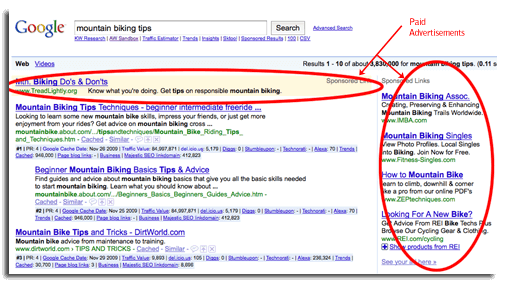
Type in keywords related to your idea into Google Search. If you see paid advertisements on the results page (see below), then that’s a good sign there is a market for that particular niche. Read each one carefully to see exactly what they are about.
Competition
If there are other websites doing something similar to what you had in mind, then a market for your product idea obviously exists. You may have even noticed some of your potential future competitors in the paid ads that showed up in your Google Keyword Search. Don’t Worry! This is a good thing. We can later use information from the websites and products of our competitors to our advantage, but we’ll save that for a later blog post. Just remember – competition is good, both for you and for the consumer.
Amazon
Do a quick search at Amazon.com for any books or other items related to your product idea. If you end up with results in your search, again – don’t worry. Like I mentioned before, this just confirms that there is a market for your product.
Check out the top books and read the reviews. The more reviews there are, the better, because this confirms that people are actually paying money for this kind of information. After reading through the negative reviews, is there anything you should make sure you include in your product so that you don’t get the same responses from your future customers?
Forums
Here’s a cool trick.
For whatever niche you’re looking into, type into Google Search: “Forum:Niche“, where Niche is the name of your particular niche, or a related keyword. For the example below, we’re going to use “mountain biking tips”.
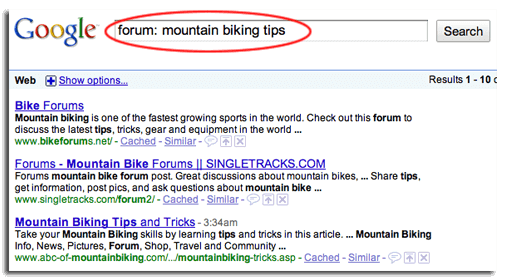
You’ll end up with a list of all of the most popular online forums related to that niche. Click on the first few and browse around a little. Here are a few questions to ask yourself as you do this:
- Is there a lot of conversation going on? How many posts or threads exist within the forum?
- When was the latest post? This will help you determine how active people are in the forum.
- What are people talking about? Are there any sections within the forum related to your idea or product?
- Ninja Tip: Do a search within the forum itself for certain keywords that relate to your idea and see what you come up with. You may need to register for the forum in order to perform a search, depending on the admin’s settings.
- Is there anything you may want to add to your product or idea that you see in the forum? Please make note for future reference.
Quantcast
Here’s a cooler trick.
In the search field at Quantcast.com, type in the url of one of the forums that you visited. Here’s our result for bikeforums.net:
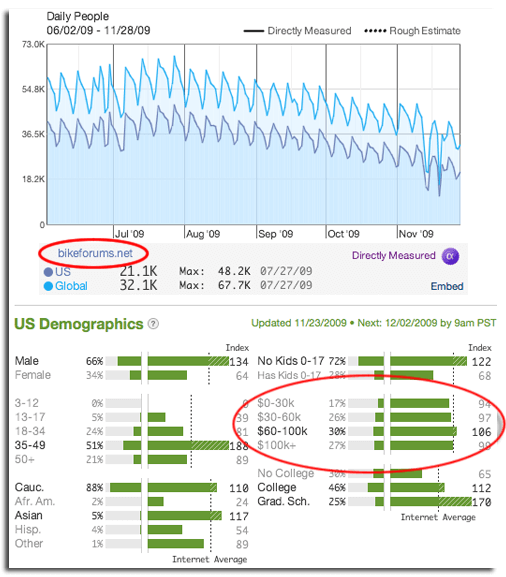
You now have an exact profile of the kinds of people who are interested in your niche. In less than 10 seconds, we know their:
- Gender
- Age
- Ethnicity
- Number of Children
- Income Level; and
- Education Level
Take note of the income level that comes up from your search. If most are in the $0-3ok range, you might want to think about a different market. In the mountain biking market, it’s no surprise that most are in the $60-100k range – some of those bikes are really expensive! We know these people have money to spend.
On the left hand side of your Quantcast results page, click on “Geographic” to see exactly where they are located (this feature is not available for some sites):
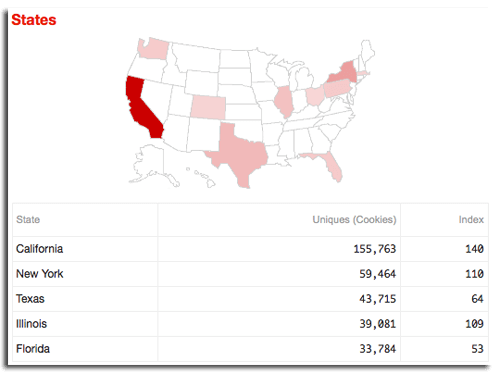
Would you benefit from geo-targeting your product? Are there specific things you have to learn about a certain region in order to make your product successful?
Next, on the right hand side of Quantcast, you can see what other sites these people have been to as well:
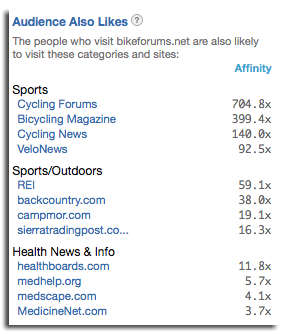
Not only does this information help us confirm that there is a number of people who may be interested in our product, but it will help us in the future when we start advertising and writing copy.
Online Commercial Intention
Lastly, I’d like to cover something called Online Commercial Intention, or OCI. According to Market Samurai, “OCI is an indicator of the chances that someone searching for a keyword is looking to buy as opposed to browsing for information.”
Market Samurai, a paid tool, is an excellent keyword research device which actually spits out the OCI as one of the results for each keyword that you analyze. You can, however, enter keywords one-by-one into the tool at the Microsoft AdCenter Labs here.
Enter your niche keywords (try as many as you’d like), and you’ll get an idea of how many people are “just looking”, vs. how many people are “looking to buy”. I wouldn’t base my decision to move ahead with a niche or not based on this tool alone, but it is a somewhat reliable indicator for commercial intent which may play a role in the later steps in this series.
Coming up…
Of course, there’s a lot more than just knowing there’s a market out there for your product. In the next post, we’ll discover how we can get closer to knowing exactly how your target audience will react to your idea or product.
Cheers!

Like what you read?
If so, please join over 25,000 people who receive exclusive weekly online business and blogging tips, and get a FREE COPY of my eBook, eBooks the Smart Way! Just enter your name and email below:

Check this out!
"Corbett Barr just launched his new blogging product! Here's my Special SPI Bonus just for SPI fans."


Enter your name and email below to get Free Instant Access to the most comprehensive guide available on how to Publish, Market, and automate your own killer eBook.


{ 41 comments (Click Here to Leave a Comment Below) }
Hey Pat, great post. I was going to criticize you for ripping pages straight from Tim Ferriss’ book but you really took this to the next level with the specific details on Quantcast, OCI, and the like. You’ve really got a grasp on this passive income thing!
BTW, I love all your posts Pat. Even if you quoted Ferriss word-for-word, I would read every line.
Cheers!
Reed
Thanks Reed! I do follow Ferriss’ advice as much as possible, but I like to fill in the gaps whenever I can for people. Plus, his ideas aren’t new, he just has a best selling book about this kind of stuff
Thanks for your comment dude! Keep up the good work on your blog!
Excellent info Pat. I didn’t know anything about Quancast until now. That alone was worth the price of admission (but since the info is free, I guess I could have found a better expression…but I digress).
Curious though, how do you feel about trusting your “gut” instincts? I’m sure you’ve felt it before, something most if not all successful entrepreneurs learn to trust that can lead them into successful markets, partnerships, etc. That’s not to say they don’t follow market trends, but what if there isn’t enough information available about a particular market (for various reasons) to make a “safe” bet?
Thanks for the quality content!
Hey Ron,
The “Gut Feeling” is very important, and it really gets us far in life and in business. I’ve felt it before, and I feel it everyday as I write new blog posts and use new tactics, but I try as much as possible to use data and statistics to prove that my gut instinct is indeed the right move, if that makes sense.
As far as not having enough information to make a “safe bet”, a gut feeling will help, but the beauty of it all is that since we’re doing business online, it’s very low-risk and inexpensive to take those chances.
Cheers Ron!
Amazing post!
This is exactly what I needed for my business.
Glad you liked it!
I had never know that we have to do so much of research before starting our niche. I was thinking of starting a market place for proxy exchange and also registered the domain. Now I thinks i have to apply all this steps before going a forward.
Thanks for tips waiting for part 2.
This one was a great help to me. Ok bye need to do all these research about proxy exchange.
Azad Shaikh
http://www.internetgeeks.org
Thanks Azad. You don’t NEED to go through all of this research, but it’s definitely recommended. The more you know about your market, the better off you can be. There’s no way you can learn too much.
Part 2 is coming soon!
Yup, I want to be Jeff too. I don’t care if my idea file is littered with ones that aren’t viable, I want to move through them quickly to get to the ones that ARE.
Definitely Jackie! Keep up the great work on http://www.moneycrush.com! I see your subscriber numbers are growing! Woohoo!
Thanks, I appreciate the encouragement
I had read about Seth’s “innovating theory”, but this is a great real-world scenario on how to apply the concept, thank you for that. I appreciate the perspective on how to learn what your competitors are doing poorly, and then build on their failures to make a stronger product. Your competition is not useless! They are showing you what not to do — learn from them.
Will, I couldn’t of said it better myself. And we can look at our competitors and have an edge in various ways, such as the features, the prices, or even the customer service (i.e. Zappos.com).
Great tips and something as simple as a few google searches with keywords is the best way to judge keywords and competition. I have done this slightly for a potential e-commerce store I may set up for my dad’s business next year.
Nice Craig! Let me know what kind of store you’re trying to setup, and I’d be happy to help as much as I can. Cheers!
Great post, Pat!
…..your one “How-to” article gave me the idea to begin “creating a BUZZ” prior to release my eBook…..and, all along, I’ve had an inkling that the eBook would do well in the niche I chose (err….a “believe”)…..but, I’ve been using my “eBook status updates” to serve as a bit of a “guage” to see how interested people could probably be purchasing it….
so, not only did these progress updates help to generate a “Buzz”, but it’s been great to see comments like “we can’t wait until this is released so we can purchase it!”….
HERE’s a great comment that was posted today…
http://www.infobarrel.com/Documenting_the_Progress_of_My_Info_Barrel_eBook_-_Part_12
“Looking forward to buying this! WHEN do you think it’ll be available? I’m somewhat new to writing and while I think I’m a decent writer I don’t know how to get the best results. I’m excited to get some tips!”
Howie, again, you’re ahead of me! Finding ways to interact with your potential customers is the next step, which I’ll expand upon in the next post. Great stuff Howie!
Gosh so much research goes into this…I would definitely rather be Jeff, but the ‘Paul’ in me wins every time.
I am going to try my hardest to follow this series of posts, but I may get off course. Damn ADD get me every time.
Ms. Freeman, you don’t HAVE to go through this, but of course, the more research you do, the more you’ll discover about your market and the better off you and your ideas will be. Keep up the good work! I’ll do my best to keep providing helpful info for you and everyone else
Great post! I love numbers and would hate to lose precious money and time by not looking into the demographics of a product or service.
Running a blog like a business seems like a never ending task. I never feel like there’s enough time in the day to get done what I feel like I need to.
Thanks for the great post…
Hey Dr. Jason, thanks for your comment!
A blog is indeed a lot of work. The upkeep and networking alone will take up most of your time. This is why I like to think of blogging as a hobby, because then it doesn’t feel like work anymore. Cheers!
Hep Pat, thanks a lot for the Quantcast info; that will be a very interesting tool to play around with seeing as though I’d never heard of it before. Hope you had a great Thanksgiving!
I had a wonderful Thanksgiving, thanks Brian! I hope you had a great one too!
I love playing around with Quantcast. I find myself learning a lot about the random websites I visit each day
Wow, already so much feedback. I for one am over the moon with this blog. I have just stared doing this, yay, shortcut
Im also working on the blog stuff from the course, another wow, I now a structure to work with and can now start finding forums that fit me.
Cheers Pat
Have a good one!
Hey thanks Tammy! I’m glad you’re liking the course! Do you find that it’s helpful for you?
Have a good one!
All I can say is “Wow!” I’ve read a lot of informative posts on this blog, but this one really brings it. Thanks again, Pat.
Hey Pat,
I wrote a similar eHow article (not quite same) and will be testing affiliate products this way.
Good article. I’d love to hear if you’re working on any other projects and how those are coming along.
Great info in a concise article.
Q: do you look for anything more than a Yes/No from this initial check?
Another very informative post Pat.
Gives me a lot to think about as always. Your “how to” stuff is really awesome, especially when you break it down like this and add so much detail.
I appreciate it!
Pat,
This is really great!
It is so nice of you to let this valuable info out in the open. A lot of online marketers become frustrated because of doing what Jim did.
It is really crucial to learn the market well before marketing a product. I can relate it to the law of supply and demand – Choosing a niche with the right amount of demand and low supply.
Hey Pat, another quick trick is to search for the keyword + “membership sites”.
If there is continuity, chances that there is a really good market.
Franck
Hi Pat,
Pat, Firstly thanks so much for this site – the material is absolutely excellent, and I think that lots of “internet marketing gurus” are charging money for this type of advice.
This post is indeed a great addition to the Ferriss material as someone pointed out. However, I think that there are two issues with this type of logic:
- There is the possibility that it will force you away from your passion or from the subjects that you know best if they don’t appear to rank well on the criteria stated above. This can be an important point, because often the subject that is your passion is the one that you can develop content on the quickest. In addition, I could be wrong but unless working absolutely full time on a site it will probably take a year anyway to get traction, and it is much easier to sustain your interest in a topic that you are passionate about.
- It doesn’t allow for the so-called “long tail” benefit of selling on the internet – i.e. there are so many viewers that niches can be sustained and generate a good business, even if there aren’t many adwords for the topic As an actual example, a search for “leed” and “leed exam” only shows a couple of adwords slots, and “green exam” shows no adwords, but this has proven to be a valuable “seam to mine”.
Many people have a unique perspective on some aspect of “life advice” that they can package, and it often may fall outside the obvious categories that are currently on the web. I speak from my own experience with my Texas Holdem Investing site. I know that this proposal is pretty unique but it is built on alot of information that is already out there. However, there are no adwords for “poker investing”. Yet I have been able to slowly build up my site traffic (albeit on a part time basis) and have been invited to make guest posts on two major investing blogs. I would be interested in feedback on my comments and any experience from other readers.
Keep up the good work.
John (aka The Masked Financier)
Information is one thing, a tangible product made of plastic, steel, wiring, and is functional is quite another. Anybody can market information, but what about a product you pick up, hammer with, make flour with, etc.?
adcentercoupons are very hard to come by. Do you know where we can get some discounts?
actually, i watched this movie twice because i sort of laughed a lot on the ugly truth movie :-’
Wow, now that is 1 detailed post. Honestly Pat, for a guy that doesn’t have a million years of marketing stuff on the internet, you open my eyes every post I read. I hope to meet you sometime!!! I hope you can interview me sometime on how I make my online $$$. Thanks again for your excellent posts and only wish you could do more podcasts!!! Take care man!
Bryan
Hey Pat, great advice as usually, I just wanted to say thanks for the link to Quantcast, I haven’t used it before and it looks like a really great tool!
I love this info on Quantcast. It is a great place to get information on demographic information!
Hey Pat just wanted to say thanks…love your material and the way you present yourself. Good intentions make a great life.
Cheers,
Dale
Hi,
Thanks for the post. I’m currently testing some product ideas of my own and I’ve wrote about some of the failures I’ve had in a recent blog post. It seems like there is a lack of info out there where you can actually see successes and failures, so I thought I would share.
Hey Pat,
I just got to read this amazing post from a link in one of your emails called: How to test your product before it’s even made. Just another benefit of subscribing to your list. The great thing about this article is that it is still applicable today. The benefits of using quantcast are awesome when it comes to identifying specific target market demographics.
Thanks for giving so much value:)
Terrick