You're in! Here's how to access the event. Thank you for signing up! We look forward to having you attend. Add the event to your calendar At the Superfans System […]
The post Fast Track Event Confirmation appeared first on Smart Passive Income.
]]>
You're in! Here's how to access the event.
Thank you for signing up! We look forward to having you attend.

Add the event to your calendar
At the Superfans System Fast Track Q&A, Pat Flynn, Matt Gartland, and Caleb Wojcik will answer all your questions about the program and what you can expect.
Event details
Wednesday, January 7th at 1:30 PM PT / 4:30 PM ET
Add event to calendar
Apple • Google • Office 365 • Outlook Outlook.com • Yahoo

Tell us about your business
Take the quick two-minute survey to help us learn about the challenges in your business.
The post Fast Track Event Confirmation appeared first on Smart Passive Income.
]]>You're in! Here's what comes next Thank you for joining the 30-Day Video Challenge! The challenge kicks off on Monday, January 12. Here's what to do in the mean time. Check […]
The post 30-Day Video Challenge Confirmation appeared first on Smart Passive Income.
]]>
You're in! Here's what comes next
Thank you for joining the 30-Day Video Challenge! The challenge kicks off on Monday, January 12. Here's what to do in the mean time.
Check your email for the “prep work”
We've sent you an email with all the challenge prep work so that you're ready to start publishing on day 1 of the challenge.
Your confirmation email will walk you through choosing your series, crafting your hook, and getting ready to hit the ground running on day one. Don’t overthink it — just pick something simple and commit.
Get your copy of the 30-Day Video Challenge: Series Planner from the confirmation email.
Check out Short-Form Formula
If you're looking for more short-form video advice beyond the prep work we've emailed you, our Short-Form Formula course is just what you need. Pat Flynn teaches you how to master short-form video to build your audience, strengthen connections, and fuel long-term growth.


Follow Pat Flynn on Instagram
Make sure you don't miss an update about the challenge! Pat will be posting regularly to keep you inspired and share more tips.
The post 30-Day Video Challenge Confirmation appeared first on Smart Passive Income.
]]>Powerful tools of the trade for online entrepreneurs We only recommend online platforms that we use to manage and grow our own business. There’s no hype or fluff here — […]
The post Resources v2 appeared first on Smart Passive Income.
]]>Powerful tools of the trade for online entrepreneurs
We only recommend online platforms that we use to manage and grow our own business. There’s no hype or fluff here — just the stuff we’ve found essential to our success.
Over the years, we’ve worked hard testing dozens of online platforms to find the ones that can be real game-changers for your online business. Here are the critical few we believe in so much that we use them ourselves.
This page is broken up into a series of guides. Choose the guide that matches where you are right now to get our best recommendations for you.

The right resources for where you're at right now
For beginning entrepreneurs
I'm brand new to this — keep it simple.
Resources, apps, and services for the brand-new entrepreneur. If we were getting started today, these are the tools we would use.

For advanced entrepreneurs
I have employees and contractors to manage.
These are the tools that we use to run the SPI business, manage payroll and taxes, and keep track of complicated processes.

For podcasters and YouTubers
I need gear and software recommendations.
Our favorite equipment and software for video and podcasting production, from budget picks to fancy gear worth the cost.
Special deals for you from our sponsors
This is an affiliate link
Sponsored Recommendation
Ecamm
Create studio-quality video from your Mac. No complicated setup required.
Ecamm is the Mac-native video tool for creators who want professional results without headaches. Whether you're streaming, recording, teaching, or presenting, you get studio-quality features that actually make sense. Join thousands of creators, including Pat Flynn, who trust Ecamm to help them look sharp, sound clear, and show up with confidence.
Get 15% off your first payment with code SPI15.
This is an affiliate link
Sponsored Recommendation
HighLevel
All-in-one sales and marketing automation platform
HighLevel is the leading all-in-one sales and marketing automation platform built for agencies, entrepreneurs, and small business owners. From funnels and CRM to automation, payments, and reputation management, HighLevel brings every essential growth tool under one roof — so you can simplify your tech stack and focus on scaling your business.
Start your free 30-day trial today.
This is an affiliate link
Sponsored Recommendation
Poppy
Create viral content & ads with Poppy AI.
Poppy AI is the only AI tool that lets you work visually with multiple inputs at once. Drag in YouTube videos, competitor content, PDFs, voice notes, and images – then watch as Poppy helps you create viral scripts, ad copy, and social media posts that actually convert.
This is an affiliate link
Sponsored Recommendation
Relay
Your cash flow could be clearer with Relay
Relay is small business banking that puts you in complete control of your cash flow. It’s an all-in-one money management platform with multiple checking accounts, team spend controls, no account fees, and more—so you can see what you’re earning, spending and saving.
Don’t waste another day—or dollar—with traditional institutions that nickel and dime small businesses like yours, sign up for Relay today!
Get $50 when you sign up and fund a Relay account
This is an affiliate link
Sponsored Recommendation
Riverside
Record, edit, and repurpose all in one place.
Riverside is a recording and editing platform built for creators, podcasters, and entrepreneurs. You can capture remote interviews in up to 4K video and crystal-clear audio, then edit and repurpose everything in your browser. It’s trusted by thousands of creators who want to publish faster and skip the tool-juggling.
As an SPI listener, you’ll get 30 days of our Pro Plan for free. That means full access to everything you need to create faster and free up hours in your week.
Use code SMART at checkout to access all Pro features.

This is an affiliate link
Sponsored Recommendation
ScoreApp
Create a high-converting quiz that grows your list…and your income!
ScoreApp helps you create quizzes or assessments that your audience actually get excited to take! It gives them instant, personalized feedback, and gives you the data you need to qualify leads and follow up automatically. Set it up once, and let it work for you 24/7, turning visitors into loyal customers while you focus on what you do best.
SPI listeners get 50% off for three months.

This is an affiliate link
Sponsored Recommendation
Shopify
Shopify is a commerce platform that helps you sell online and in person.
Entrepreneurs, retailers, and global brands use Shopify to make sales, run stores, and grow their businesses.
With Shopify, you can:
- Create and customize your website
- Sell in multiple places, including web, mobile, social media, online marketplaces, brick-and-mortar locations, and pop-up shops
- Manage products, inventory, payments, and shipping
Start your business journey with a free trial.
This is a sponsored link
Sponsored Recommendation
Tailor Brands
Form your LLC from $0 + state fees with Tailor Brands
Tailor Brands brings everything into one place — form your LLC, build your brand, manage your finances, and stay compliant. We guide you every step of the way, so you focus on what matters most and launch your business, worry-free.
This is an sponsored link
Sponsored Recommendation
Taplio
Build your LinkedIn brand like a pro in no time.
Taplio is your LinkedIn coach tool, built for people who take the platform seriously. It helps you stay consistent with all the tools to grow your personal brand on LinkedIn. Taplio shows you what wins so you can post with confidence and grow faster. Start your free trial and see your personal brand grow!
This is an sponsored link
Sponsored Recommendation
Vubli
The fastest way to post short form videos everywhere.
Vubli is the fastest way for creators to schedule & post short form videos across YouTube Shorts, Instagram Reels, TikTok, Facebook Reels, LinkedIn, and X.
Upload your video and thumbnail once, then Vubli auto-generates platform-ready titles, descriptions and tags so you can post everywhere in a few clicks. On average, creators save around 27 minutes per post.
Get 50% off your first 3 months with code PAT.
Easy-to-use resources for beginners
When you're first getting started, it's important to keep things as simple as possible. This will minimize the amount of time you spend working on technical issues, freeing up your time to actually serve your customers. It will also help you keep your costs low. Here is our list of what you need to get started.
Choose a tool for talking to your audience
One of our core beliefs at SPI is that you need to “own your audience,” which means that you need the ability to contact them outside of social media platforms. In other words, you need to be able to email them. SPI began in 2008, and we have seen time and time again that social media platforms love to make changes to their algorithm — and often it upends the current monetization strategy for that platform.
We have two different tools that we recommend. Both of these platforms make it easy to email your audience and to create an online storefront for selling products. Kit leans more heavily into the longer-form content space (podcasting, video creation, blogging), whereas Stan is more focused on helping social media influencers create a storefront that they control.
Kit
Kit is the only email marketing platform we use, and will ever use. Kit is our #1 recommended email marketing platform because it has been built with care to the exact needs of creators building online businesses. Their user experience is very user-friendly. And segmenting our subscribers into focused groups so that we can deliver content specific to their needs has never been easier. We’re all in on Kit.
This is an affiliate link
Stan Store
Stan Store is the fastest, easiest way for entrepreneurs to launch their online businesses. It’s an all-in-one storefront where you can sell digital products, manage income, track analytics, and more — all in just a few clicks. Set up your Stan Store in 5 minutes and start monetizing your knowledge and passions today!
Get started today with a 30 day free trial of Stan Store.
This is an affiliate link
Decide if you want to build a website
After you set up either Kit or Stan Store, do you need to create a separate website? Strictly speaking, the answer is no — both Kit and Stan Store allow you to create landing pages. In the spirit of keeping it simple, this can be enough. But if you need something more, especially if you need to build an informational resource, then you will want a website.
For a Website, you need to purchase hosting, a domain, and then you need to choose a theme, which is the design of the website. There are many website platforms these days, such as Squarespace, Wix, and Webflow. We are big fans of the WordPress platform, because it will grow with your business over time.
Flywheel
Offering thoughtfully built tools to manage your clients and websites while growing your business. Flywheel handles all of the technical bits and bobs of running a website built on WordPress — including nightly backups, blazing-fast speed, 24/7 support, and a free SSL certificate.
This is an affiliate link
Rockbase
The Rockbase theme truly makes it easy to quickly create a WordPress website, using beautifully designed blocks that are easy to assemble. That's why we used it to build this website. Created by talented creators for talented creators—just like you.
This is an affiliate link
Form an LLC
When you build a business, it is important to separate your personal finances from your business finances. Part of how you do that is by establishing a business entity; typically in the United States, most small businesses begin with a Limited Liability Company (or LLC). You should consult an attorney in your area to find out what is best for your individual circumstances. If you want to manage the filing yourself, either of these services can walk you through the process.

Doola
Doola, formerly Startpack.io, helps global online entrepreneurs form US LLCs, supporting customers through the incorporation process so they can confidently collect payments, build credibility, stay legal, and make more money.
This is an affiliate link
ZenBusiness
ZenBusiness provides the essential tools and guides entrepreneurs and small business owners need to create a successful business. Officially filing an LLC is a great first step… but that's only the first step. ZenBusiness provides the ongoing education, support, and tools to quickly and easily set up and run a business on their platform.
This is an affiliate link

If you are starting a community
If the business you are planning involves creating an online community, then we highly recommend the Circle platform. It's the one we use to run our community, and it supports including online courses and events as benefits for your members.
Circle
The modern community platform for creators — and the easiest way to set up a premium community experience. That's why we use it for our communities.
Circle is powerful enough to support some of the largest and most successful online communities — while being easy to use for community builders who are just starting.
This is an affiliate link
What we use as an established business
We often get asked about the tools we use to run the SPI business. Before we recommend those tools, it's important that we stress that SPI has been around for 15+ years, and so we require a set of tools and services that are far more complicated than a beginner needs. With that caveat, here's what we use to run SPI.

Managing employee benefits
Bonusly
Bonusly made it easy for us to create an employee recognition program. We use Bonusly in two ways: to give our employees annual rewards based on longevity with the company; and as a peer recognition program, with points that employees. Employees can choose how to redeem their Bonusly points from a catalog that includes retail gift cards or cash to a PayPal account.
Guideline
We are so grateful that Guideline exists because without it we may never have rolled out a 401(k) plan to our team. It integrates beautifully with Gusto, which we use for payroll. And it keeps us compliant, which provides blissful peace of mind. Follow this link for three months off of your employer fees.
This is an affiliate link
Gusto
Gusto makes running our SPI business a breeze. It starts with payroll, which is critical to get right for a growing business. We also use Gusto for PTO tracking, culture surveys, capturing important documents such as the employee handbook, and more. Oh, and their concierge team is dynamite.
This is an affiliate link

Tools for collaboration

Dropbox
Dropbox is our cloud-based document storage system of choice that easily syncs with all of our team's computers and provides simple access controls to third-party contributors, such as contractors for audio and video editing.
This is an affiliate link
Monday.com
Monday.com is our new go-to work management platform. It's drag-and-drop simple. There are oodles of pre-made templates for a variety of use cases and it's highly collaborative and visual by design. We use it for darn near everything we do.
This is an affiliate link
SavvyCal
SavvyCal makes scheduling easy by allowing your recipient to compare their calendar with yours to find availability. You can connect multiple calendars and offer different meeting types. Our link gets you your first paid month free after your 7-day trial.
This is an affiliate link

Slack
Slack is our beloved digital HQ for all things SPI. We organize all of our communications in Slack using various channels tailored to unique projects, departments, and hierarchies. It's made email almost a thing of the past, which is glorious for our productivity.
This is an affiliate link
Marketing platforms
Kit
Kit is the only email marketing platform we use, and will ever use. Kit is our #1 recommended email marketing platform because it has been built with care to the exact needs of creators building online businesses. Their user experience is very user-friendly. And segmenting our subscribers into focused groups so that we can deliver content specific to their needs has never been easier. We’re all in on Kit.
This is an affiliate link
Poppy AI
Poppy AI is a fantastic time saver for us in the process of creating email copy for nurture sequences. We feed in a bunch of historical content (past emails, lead magnet PDFs, YouTube videos), and then Pat records an audio file with his focus for the email, and Poppy converts it into a written email using AI.
We use Poppy as a jumping off point — from there we edit and revise to make sure the email is a true SPI email. It's a great time saver that we recommend.
This is an affiliate link from a current SPI sponsor

RightMessage
RightMessage gives us the ability to dynamically display content and user experiences on our website tailored to individual audience types. One of our favorite tools is the toaster widget, which has helped us boost website event registration. With A/B testing, pop-up questions and forms, and dynamic page editing, RightMessage gives you a huge bang for your buck.
This is an affiliate link
Rewardful
It can be hard (and expensive) to grow a SaaS business — that's why Rewardful offers a simple way for companies to set up affiliate and referral programs with Stripe. Just connect your account and let us track referrals, discounts, and commissions for you!
This is an affiliate link
Stan Store
Stan Store is the fastest, easiest way for entrepreneurs to launch their online businesses. It’s an all-in-one storefront where you can sell digital products, manage income, track analytics, and more — all in just a few clicks. Set up your Stan Store in 5 minutes and start monetizing your knowledge and passions today!
Get started today with a 30 day free trial of Stan Store.
This is an affiliate link
Tools for your website
Iubenda
Iubenda ensures that your website is compliant with the latest privacy laws. They have a variety of services, including policy and term generators, cookie management, and consent solutions. Of the solutions available, we've found this one easiest to use.
This is an affiliate link
Rockbase
The Rockbase theme truly makes it easy to quickly create a WordPress website, using beautifully designed blocks that are easy to assemble. That's why we used it to build this website. Created by talented creators for talented creators—just like you.
This is an affiliate link
Podcast and video gear and software
Podcast and video production requires both gear and software. We've rounded up our top recommendations for both.

The gear we recommend
We've put together gear lists on Amazon to make it easy for you to get started with your podcast or YouTube channel. The lists below are Amazon affiliate links, and if you purchase through those links, SPI will receive a commission from Amazon, at no additional cost to you.
The Basic Podcasting Kit
Consisting of only three items: a simple, high-quality USB microphone, pop filter, and a basic microphone stand, this kit will get you started as inexpensively as possible without sacrificing quality.
We have two microphones recommended here; the AudioTechnica microphone is easier to get in the USA and Samson microphone is easier to source outside the USA.
These are Amazon links
The Advanced Podcasting Kit
This kit is for serious audiophiles or podcasters ready to upgrade their setup. If you haven't podcasted yet, please consider starting with the basic kit to make sure that you'll stick with podcasting before splashing out on this more expensive gear.
We have two high-end microphones recommended here, but you only need one.
This is an Amazon link
The YouTube Add-on Kit
We often get asked which camera we'd recommend for a high-quality YouTube setup. This camera is our top pick.
Combine this kit with either of the podcasting kits to handle your audio recording.
This is an Amazon link
SwitchPod
This minimal, versatile, handheld tripod was specifically designed by Pat Flynn and Caleb Wojcik with video creators in mind. It's quick to set up and comfortable to hold.
This is an affiliate link

Podcasting software
Descript
Descript offers simple and powerful collaborative tools to edit your audio and video just like a text document! Remove the tedious work that often stands between an idea and its expression and focus on developing your craft instead of getting side-tracked with platform fatigue.
This is an affiliate link
Fusebox
The official podcast player used by SPI! Fusebox provides your website visitors with a superior listening experience. From its powerful podcast hosting and analytics to the industry's most elegant and responsive web players, Fusebox is a must-have tool for starting a podcast.
Get three months free when you join using our affiliate link. After creating your account, email [email protected] with the subject line “Three month credit for SPI readers” to receive your free three months.
This is an affiliate link
Riverside
Riverside is a recording and editing platform built for creators, podcasters, and entrepreneurs. You can capture remote interviews in up to 4K video and crystal-clear audio, then edit and repurpose everything in your browser. It’s trusted by thousands of creators who want to publish faster and skip the tool-juggling.
As an SPI listener, you’ll get 30 days of our Pro Plan for free. That means full access to everything you need to create faster and free up hours in your week.
Use code SMART at checkout to access all Pro features.
This is an affiliate link from a current SPI sponsor

Video software
Ecamm
Ecamm is a livestreaming platform for Mac that allows you to manage multiple inputs, bring in pre-recorded segments or slides, and add effects to your live broadcast. It will help you greatly increase the quality of your live video.
This is an affiliate link
Frame.io
Frame.io is a key component of Pat's workflow for producing, reviewing, and collaborating on videos. The user experience is off the hook. And upload times are blazing fast. And it's all highly secure too. If you're a video pro like Pat, definitely check out Frame.io.
This is an affiliate link
SwitchPod
This minimal, versatile, handheld tripod was specifically designed by Pat Flynn and Caleb Wojcik with video creators in mind. It's quick to set up and comfortable to hold.
This is an affiliate link
Vubli
Vubli is the fastest way for creators to schedule & post short form videos across YouTube Shorts, Instagram Reels, TikTok, Facebook Reels, LinkedIn, and X. Pat and our team use it for posting.
Get 50% off your first 3 months with code PAT.
This is an affiliate link
Wistia
Wistia hosts all of our core website and marketing videos. We've been using it for years and have no intention of switching to a different option. We believe in Wistia and are all in on them.
This is an affiliate link
The post Resources v2 appeared first on Smart Passive Income.
]]>Start your entrepreneurial journey here Our Start tier gives you the tools and support to begin building at your own pace. Here’s what you get when you join the Start […]
The post Start appeared first on Smart Passive Income.
]]>Start your entrepreneurial journey here
Our Start tier gives you the tools and support to begin building at your own pace.
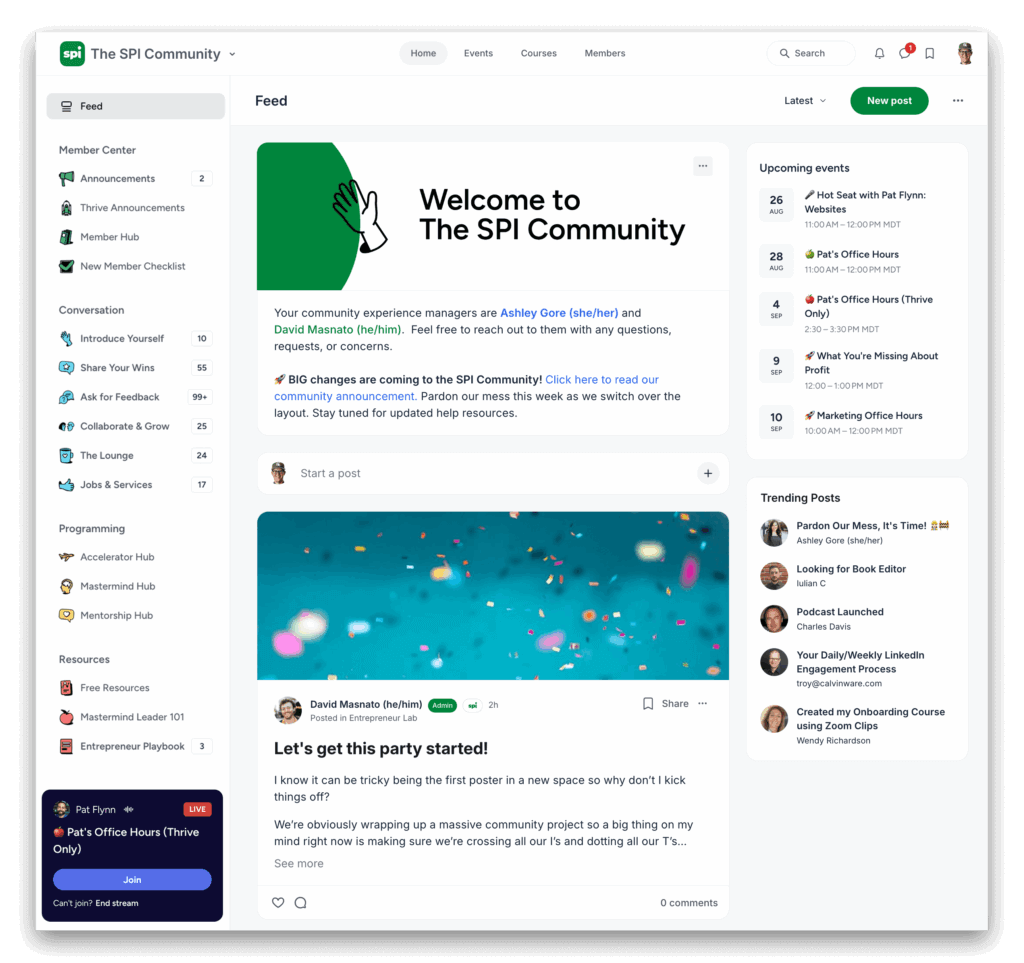
Here’s what you get when you join the Start tier
Take a closer look at the programs, resources, and support that make SPI more than just another course or forum. It’s a complete system designed to help you grow your business on your terms.
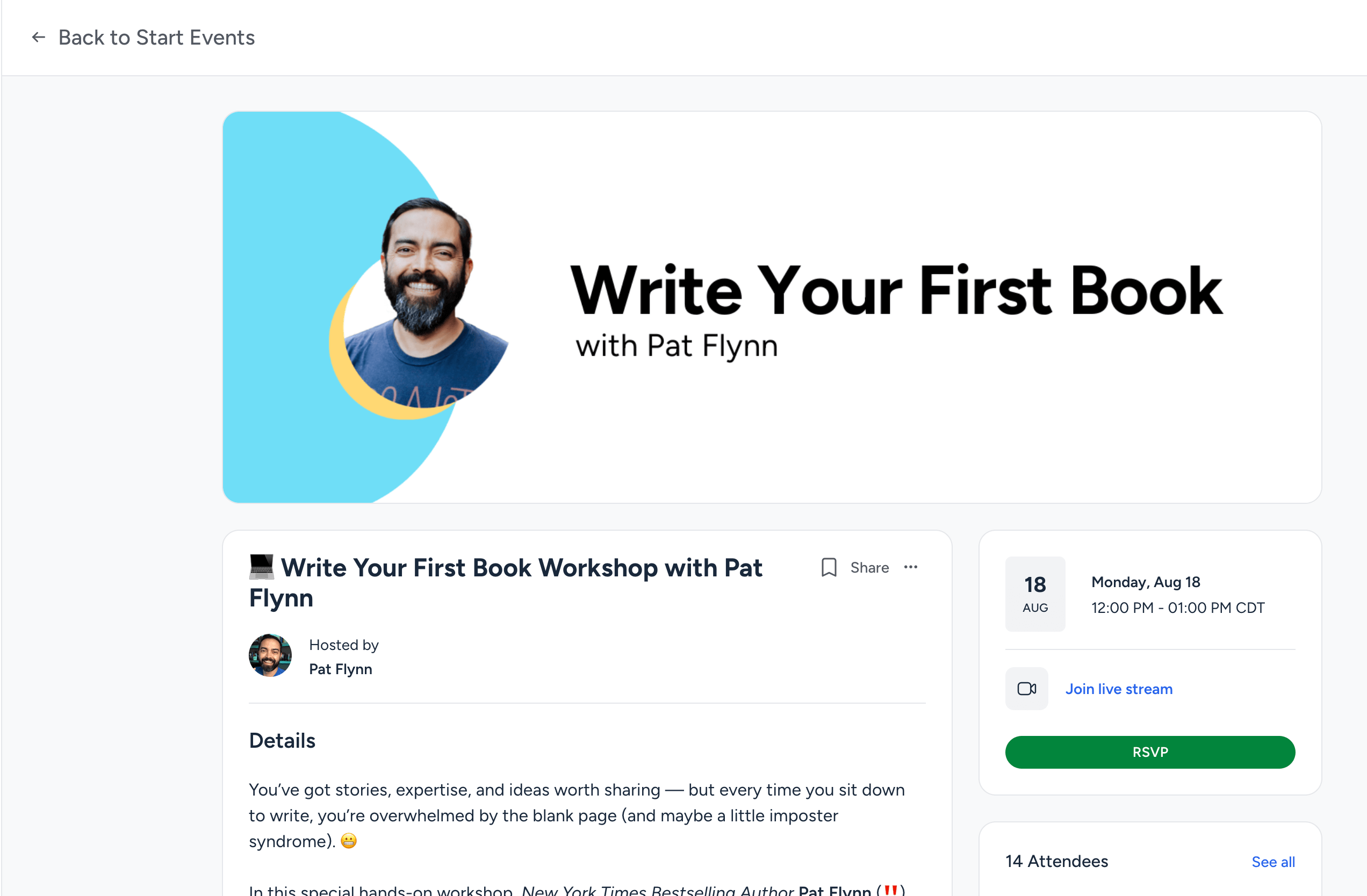
Exclusive Live Workshops
This is where learning meets action. Every month, we host hands-on workshops led by Pat Flynn and other successful creators. These live sessions cover essential business topics like growing an email list, validating your product idea, building your first sales funnel, and beyond. You’ll get real-time feedback, answers to your questions, and the clarity you need to keep moving forward. Can’t make it live? Every event is recorded so that you can catch up anytime.
Live events are available with Start and Accelerate memberships.
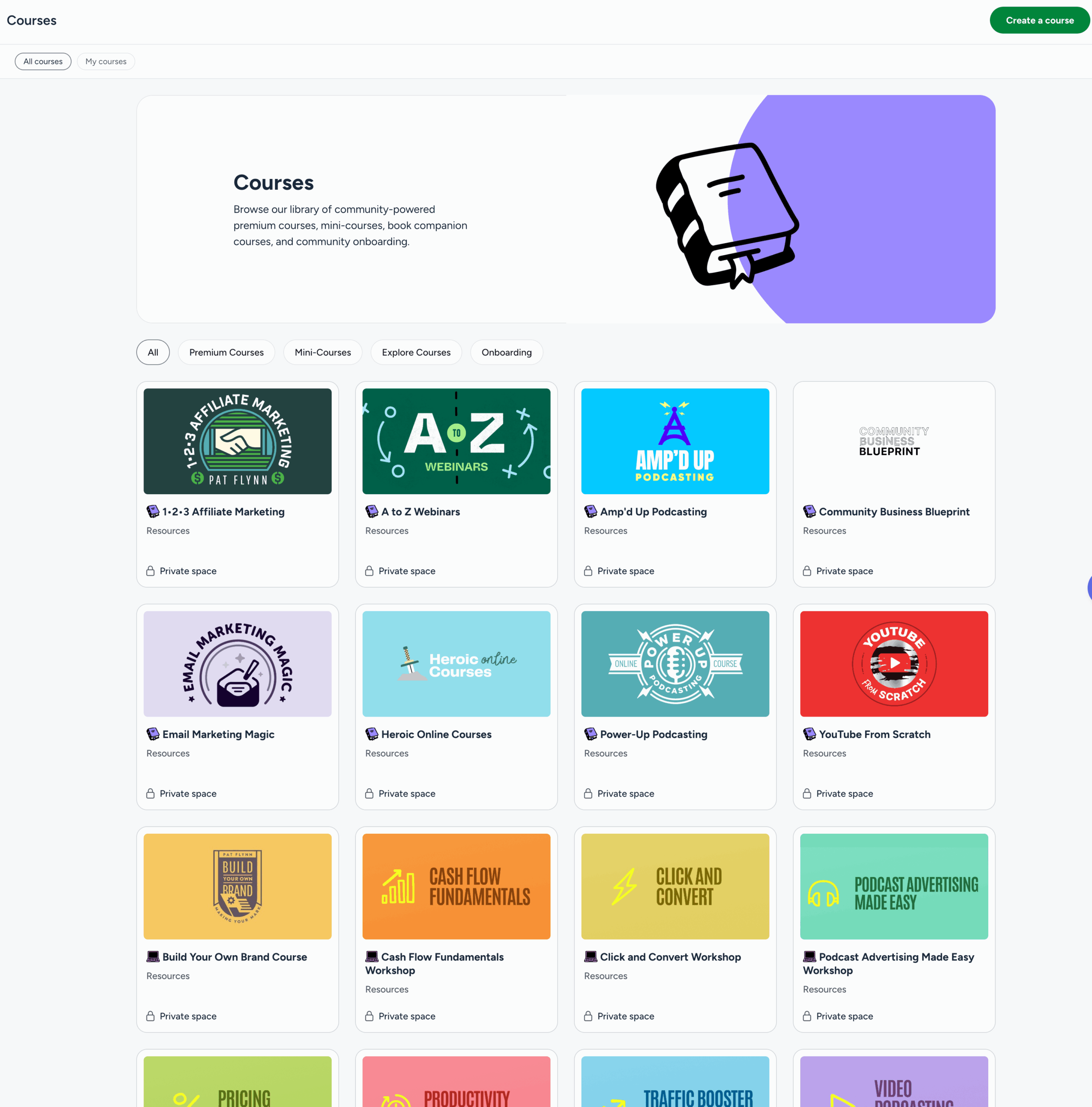
Full Course Library
Our course library includes over 17 full-length and mini courses covering topics that align with your business goals, including podcasting, YouTube, validating your business idea, creating a website, and much more. These step-by-step courses are action-oriented, easy to follow, and designed to help you make real progress. With over 50,000 students served, they’re battle-tested and results-driven, with no fluff — just what works.
Start and Accelerate members get access to the full course library. Explore members get access to a selection of 101-level courses and companion courses to Pat’s books.

Downloadable Cheat Sheets & Templates
Our growing library of ready-to-use templates and step-by-step cheat sheets is here to make building your business easier. We’ve done the research, structured the process, and packaged it up — so whether you’re writing an email sequence, planning a podcast episode, or mapping out your content strategy, you’ve got exactly what you need to get it done.
All members get access to our free resource library.
Is Start right for you?
Start is for those who want to save money and take the DIY approach. You have access to our catalog of courses and replays of past events, as well as our monthly workshop. This tier is designed for people who are ready to:


If the do-it-yourself approach isn't right for you, you might benefit from our Accelerate tier, which offer more support from the community and from Team SPI.
Save 16% with annual billing


Start
Do It Yourself
$49
/ month
Billed quarterly for $147
$41
/ month
Billed annually for $490
You have access to:
- Downloadable cheat sheets and templates
- Public events with Pat Flynn
- Q&A sessions with Team SPI
- Free 101 introductory courses
- Pat Flynn's book companion courses
- Full community forum
- Team SPI (priceless)
- Monthly beginner workshops (live and replays)
- Hot Seats with Pat Flynn
- All premium courses ($5,500+ value)
Frequently asked questions
Which membership is right for me?
 Watch a video from Pat Flynn comparing the memberships.
Start is best for you if your goal is to learn new skills and are committed to working through material at your own pace or you are on a budget.
Accelerate is best for you if you are interested in building new skills and you want the ongoing support of other community members who are working on coursework at the same time as you.
What can I expect after joining?
The best time ever! An exciting onboarding email will be lovingly delivered to your inbox, and you will be able to log in to the community and will be guided through the next steps. We will recommend some activities and actions to help you learn your way around and find the programming you are most interested in. Check out the calendar of events and join an upcoming live session so we can say hello!
But here's the most important expectation: you have to put in the time to get the most out of a community experience. This is not a magic bullet but rather an opportunity to learn and grow with your peers.
Can I talk to Pat Flynn once I join?
Joining our community will not grant you unlimited access to Pat Fynn. Our Accelerate members have the most access to Pat through his office hours twice per month with Pat. Our full-time Community team will be your primary connection with your membership.
I live outside the United States. Can I join?
Yes! We welcome members from all over the globe into our community. Our company and staff are U.S.-based. All live events fall between 8 AM PT/11 AM ET and 2 PM PT/5 PM ET. All events (outside of networking-based events) will be recorded for replay and available for viewing throughout your membership.
Can I switch the membership I am in?
Yes—you may switch between the Start and Accelerate tiers at any time.
Is there an age requirement?
Members must be at least 18 years old to join any of our communities. Participants under 18 years old must have guardian consent to join and will not have access to Direct Messaging as a general safety precaution. If we discover that an enrolled member is a minor and does not have guardian consent, we reserve the right to close their accounts without notice. If you are under 18 and would like to purchase a membership, please email us before purchasing at [email protected] so that SPI can obtain consent from your guardian.
Do you offer discounts?
We do not offer discounts. We've priced our memberships to ensure we are providing outstanding value.
Do you offer team rates?
Please email [email protected] and let us know more about your team size and your goals.
Do you have a refund policy?
We offer a one-time full refund within the first 30 days of your initial membership if you decide it’s not right for you. Please note that refunds are only available once per customer. Rejoining at a later time does not make you eligible for another refund. It’s your responsibility to make use of your membership; extensions to the refund period will not be granted.
Are there any types of businesses that you do not allow?
All business topics must adhere to our community guidelines. Businesses that read as predatory, ableist, racist, misogynist, homophobic, conspiratorial, overly sexualized, or harmful in any way will not be accepted into our community. We do not permit multi-level marketing (MLM) representatives or any business model that involves recruiting downlines.
Does your community offer business coaching?
We do not offer business coaching. We provide strategic programming to help you and bring experts in for high-level guidance, ultimately our communities are designed for peer connections.
Can I offer coaching in your community?
No. We do not allow any selling or pitching of services or affiliate programs in our community. You absolutely should not join if this is your motivation. You will be removed without a refund.
I have a product or service I want to share with your community. Can I do that?
We have a strict no-selling policy in our community and will remove anyone found soliciting customers per our Community Guidelines.
What are your community guidelines?
Go here to read our complete Community Guidelines and Moderation Policies.
Is your community inclusive of marginalized people?
We strive to keep our community welcoming and inclusive of marginalized people as a part of our company and CX (community experience) team values. This will always be a work in progress, and we rely on member feedback to ensure we are maintaining a safe space and providing a positive experience.
I want to create a community like yours. Can you help?
We recommend enrolling in our Community Business Blueprint course. This course will teach you how to curate a new online community or modify an existing one that aligns with your business strategy.
Meet the people behind the scenes
The SPI Team is dedicated to helping you become a stronger entrepreneur through educational programming, supportive guidance, and meaningful community experiences. We believe entrepreneurship is the best path to personal fulfillment, financial independence, and control over your future. We’re here to help guide you on your journey with community-powered education, feedback, and accountability.

Hello, my name is Pat Flynn
I started Smart Passive Income in 2008 to share my journey of building a popular blog for an architecture industry exam. Ethical advice on monetizing a blog was hard to come by, and I wanted to share the lessons I learned.
I became “the crash-test dummy of online business,” running experiments and sharing the results, whether they were positive or negative. I started publishing monthly income reports detailing revenue and expenses, promoting a mission of radical transparency in an industry overrun with get-rich-quick schemes. These reports helped aspiring entrepreneurs understand the realistic effort, time, and investment required to get started.
After over 15 years of supporting creators and entrepreneurs, it’s clear that this journey is best traveled together. My team and I, along with the SPI Community, are here to help you get to where you’re going. I can’t wait to hear your success story and celebrate the day you say, “Pat, it was the SPI Community that changed everything for me.” Here’s to you and the road ahead, together.
18+
Companies advised
(including Kit, Circle, Maven, and Karat)
80MM
Podcast downloads
from four podcasts
1.45MM
YouTube subscribers
from two channels
$5.5MM
Course sales
Companies advised include

Meet the community team
These are the people in your corner from day one. They lead events, facilitate accelerators and mastermind groups, help you troubleshoot, and guide you toward your next step. They’re on the ground floor with you, making sure you never have to figure things out alone.

Ashley Gore
Ashley holds a Master’s degree in Curriculum and Instruction and has over 10 years of experience facilitating impactful, inclusive learning experiences. As an entrepreneur herself, with two businesses under her belt, she understands the rollercoaster journey of entrepreneurship.

David Masnato
David brings a resume of community management, graphic design, UX, and marketing to power the SPI Community both behind the scenes and center stage. His experience in cultivating inclusive and supportive online spaces means our masterminds are safe and empowering places for entrepreneurs at any stage.

Megan Dohm
To help students get results, Megan draws on years of experience working behind the scenes at scrappy online businesses. She also brings her background as a freelance journalist to hosting guest experts on weekly calls, asking thoughtful questions, and ensuring every student walks away with clear, actionable next steps.
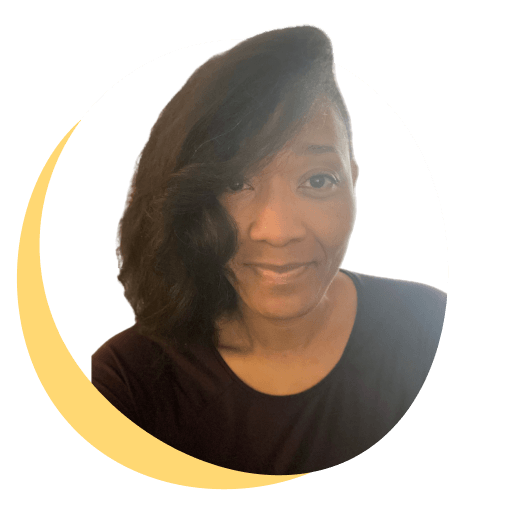
Tanya Monuma
Tanya brings a diverse background in wellness and culture to her work at SPI. She is the host of the Rising InnerShift podcast, where she guides conversations on personal growth, wellness, and designing a life of purpose. In addition to facilitating women’s retreats in the pine-covered Laurentians, Tanya is an Airbnb Superhost who weaves hospitality and heart into everything she does.
Join the SPI Community and experience what it's like to…
Build with people who know your journey
Join a trusted group of over 1,000 entrepreneurs who are collaborating on ideas, tackling challenges, and sharing the journey of building something meaningful — with support every step of the way.
Learn with resources designed for action
Access SPI’s full library of courses, workshops, tools, and templates — all created to help you develop essential skills and make real progress in your business.

Find the level of support that fits your stage
The community’s tiered membership structure lets you choose the guidance, access, and structure that match where you are and where you’re headed next.

Follow through with accountability
Stay focused and consistent with cohort-based learning, peer accountability, and a supportive environment that helps you follow through and make steady progress on what matters most.

Connect through shared goals and values
Build real relationships through large and small group interactions with people who share your goals, support your growth, and consistently show up for their businesses.
Get feedback that helps you move forward
Bring your questions, ideas, and roadblocks to the table and get thoughtful input from peers, the SPI Team, and live sessions with Pat Flynn and other successful creators.
Ready to find join your people and level up?
Like you, we're online entrepreneurs who crave connection, direction, and support from people like us.
The post Start appeared first on Smart Passive Income.
]]>Boost your entrepreneurial journey with Accelerate Ready to stop building in isolation? The Accelerate tier is an ideal fit if you’re looking for accountability, consistent progress, and the kind of […]
The post Accelerate appeared first on Smart Passive Income.
]]>Boost your entrepreneurial journey with Accelerate
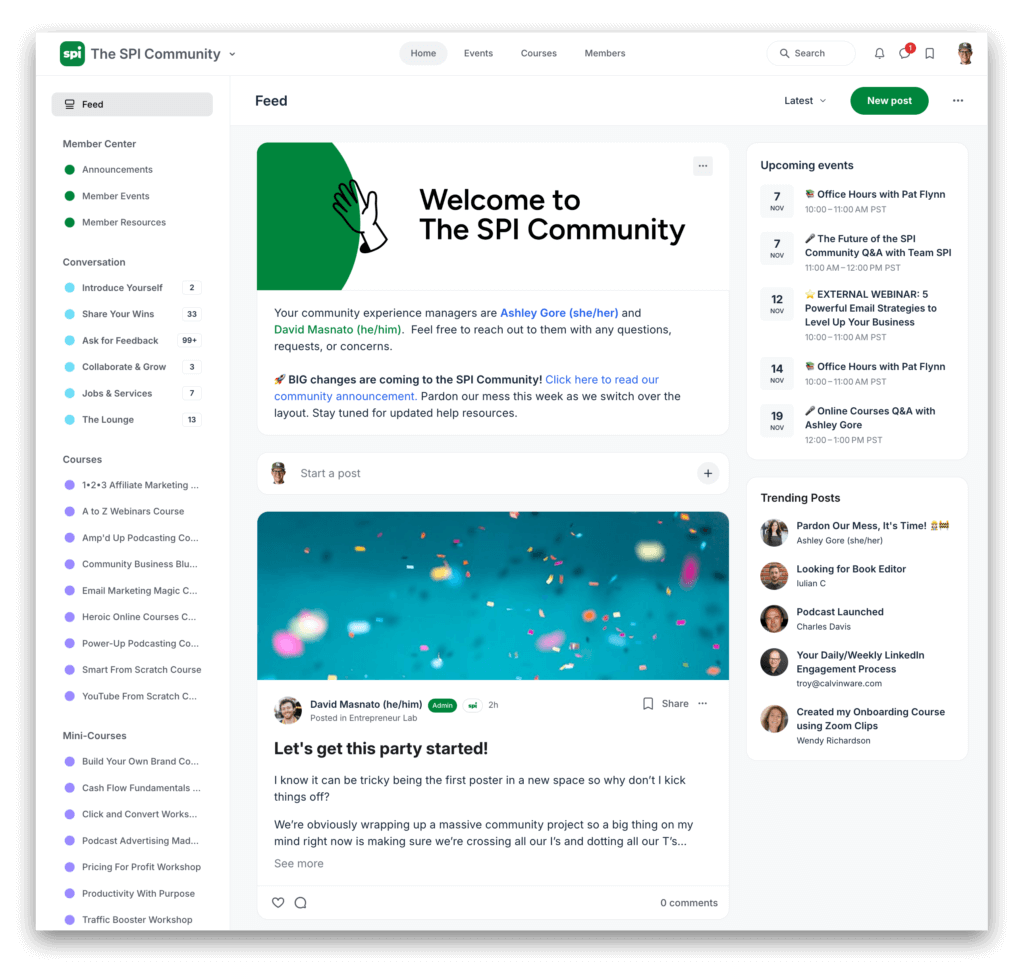
Ready to stop building in isolation? The Accelerate tier is an ideal fit if you’re looking for accountability, consistent progress, and the kind of hands-on collaboration that helps you actually follow through.
Here’s what you get when you join Accelerate
Take a closer look at the programs, resources, and support that make SPI more than just another course or forum. It’s a complete system designed to help you grow your business on your terms.
Live programming, real momentum
Our programming gives you the chance to show up, get feedback, and make real progress. It’s not just about learning; it’s about doing.
Exclusive Live Workshops
This is where learning meets action. Every month, we host hands-on workshops led by Pat Flynn and other successful creators. These live sessions cover essential business topics like growing an email list, validating your product idea, building your first sales funnel, and beyond. You’ll get real-time feedback, answers to your questions, and the clarity you need to keep moving forward. Can’t make it live? Every event is recorded so that you can catch up anytime.
Live events are available with Start and Accelerate memberships.

Course Accelerators
Accelerators turn “someday” into done. These structured, facilitator-led programs bring small groups together to complete a course on a set schedule. We run them about once a month, each one focused on a different course from our library. With weekly live check-ins, bite-sized assignments, and built-in accountability from your cohort and Team SPI, accelerators are designed to fit your busy schedule and keep you moving steadily toward the finish line.
Accelerators are available with Accelerate memberships.
Member-Led Masterminds
You don’t have to figure it all out alone. SPI Masterminds connect you with a small, member-led group of entrepreneurs who share your goals and your challenges. These groups are where real growth happens: through honest feedback, built-in accountability, and regular check-ins that help you stay focused and on track. Many members say their mastermind is the most valuable part of their SPI experience — and we’d love to help you find yours.
Masterminds are available with Accelerate memberships.
On-demand resources that do the heavy lifting
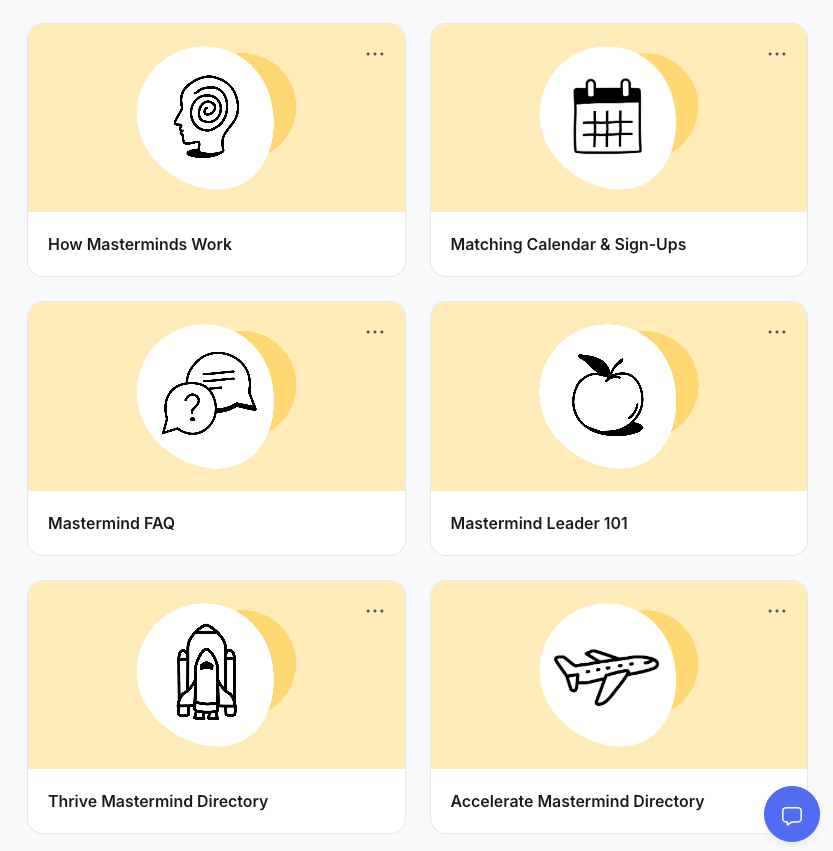
We’ve taken the guesswork out of building your business with ready-to-use courses, templates, and tools — so you can stop spinning your wheels and start making progress.
Downloadable Cheat Sheets & Templates
Our growing library of ready-to-use templates and step-by-step cheat sheets is here to make building your business easier. We’ve done the research, structured the process, and packaged it up — so whether you’re writing an email sequence, planning a podcast episode, or mapping out your content strategy, you’ve got exactly what you need to get it done.
All members get access to our free resource library.
Full Course Library
Our course library includes over 17 full-length and mini courses covering topics that align with your business goals, including podcasting, YouTube, validating your business idea, creating a website, and much more. These step-by-step courses are action-oriented, easy to follow, and designed to help you make real progress. With over 50,000 students served, they’re battle-tested and results-driven, with no fluff — just what works.
Start and Accelerate members get access to the full course library. Explore members get access to a selection of 101-level courses and companion courses to Pat’s books.
Access to Team SPI and Pat Flynn
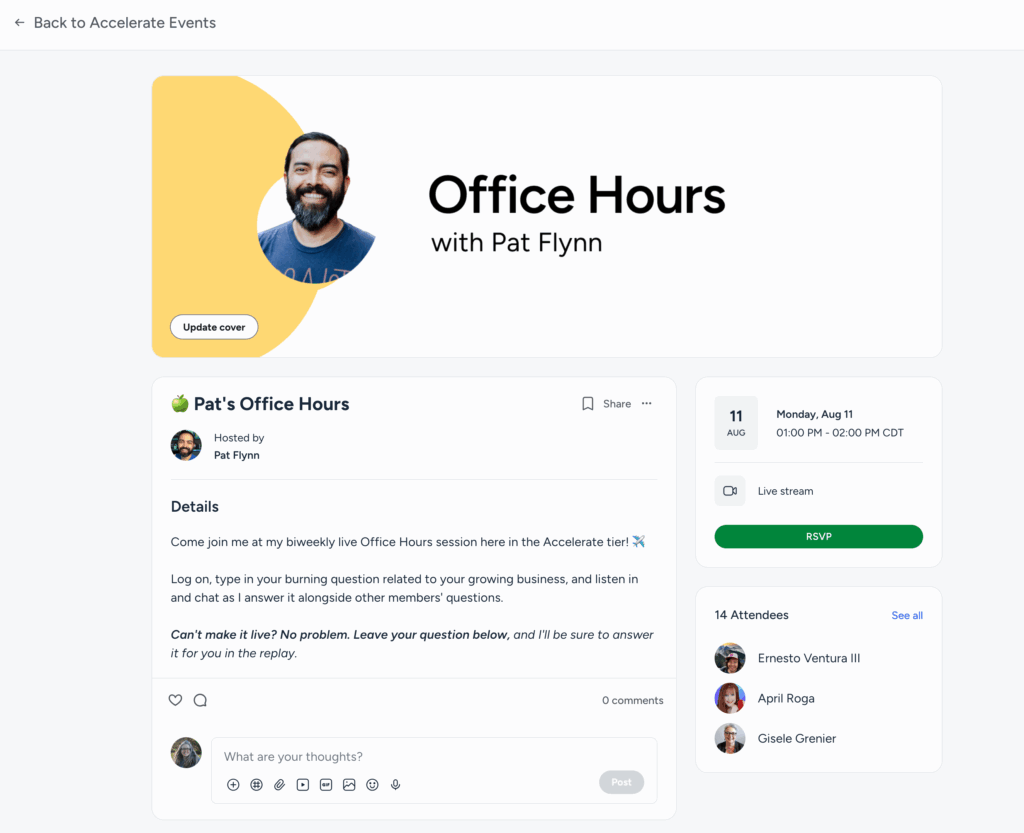
Inside the SPI Community, you’re never on your own. Whether it’s through a live event, a DM, or a comment thread, Team SPI is here to support you. We show up, answer questions, and help you get the most out of your membership. You’ll also have opportunities to connect with Pat Flynn through live office hour sessions, where you can ask questions, get direct feedback, and work through challenges in real time.
Team SPI support is available to all members. Office hours with Pat Flynn are exclusive to Accelerate memberships (two one-hour sessions per month).
Is Accelerate right for you?
Start is for those who want accountability with their learning. You have access to our catalog of courses and and live monthly events, and you add access to course accelerators and mastermind matching. This tier is designed for people who are ready to:
If you're looking for a more do-it-yourself approach, you might benefit from our Start Tier.
Save 16% with annual billing

Accelerate
Do It Together
$99
/ month
Billed quarterly for $297
$83
/ month
Billed annually for $990
You have access to:
- Downloadable cheat sheets and templates
- Public events with Pat Flynn
- Q&A sessions with Team SPI
- Free 101 introductory courses
- Pat Flynn's book companion courses
- Full community forum
- Team SPI (priceless)
- Monthly beginner workshops (live and replays)
- Hot Seats with Pat Flynn
- All premium courses ($5,500+ value)
- Cohort course accelerators ($499 value each)
- Member-led masterminds
- Networking events
- Pat Flynn's office hours twice per month ($1,000 value)
Frequently asked questions
Which membership is right for me?
Watch a video from Pat Flynn comparing the memberships.
Start is best for you if your goal is to learn new skills and are committed to working through material at your own pace or you are on a budget.
Accelerate is best for you if you are interested in building new skills and you want the ongoing support of other community members who are working on coursework at the same time as you.
What can I expect after joining?
The best time ever! An exciting onboarding email will be lovingly delivered to your inbox, and you will be able to log in to the community and will be guided through the next steps. We will recommend some activities and actions to help you learn your way around and find the programming you are most interested in. Check out the calendar of events and join an upcoming live session so we can say hello!
But here's the most important expectation: you have to put in the time to get the most out of a community experience. This is not a magic bullet but rather an opportunity to learn and grow with your peers.
Can I talk to Pat Flynn once I join?
Joining our community will not grant you unlimited access to Pat Fynn. Our Accelerate members have the most access to Pat through his office hours twice per month with Pat. Our full-time Community team will be your primary connection with your membership.
I live outside the United States. Can I join?
Yes! We welcome members from all over the globe into our community. Our company and staff are U.S.-based. All live events fall between 8 AM PT/11 AM ET and 2 PM PT/5 PM ET. All events (outside of networking-based events) will be recorded for replay and available for viewing throughout your membership.
Can I switch the membership I am in?
Yes—you may switch between the Start and Accelerate tiers at any time.
Is there an age requirement?
Members must be at least 18 years old to join any of our communities. Participants under 18 years old must have guardian consent to join and will not have access to Direct Messaging as a general safety precaution. If we discover that an enrolled member is a minor and does not have guardian consent, we reserve the right to close their accounts without notice. If you are under 18 and would like to purchase a membership, please email us before purchasing at [email protected] so that SPI can obtain consent from your guardian.
Do you offer discounts?
We do not offer discounts. We've priced our memberships to ensure we are providing outstanding value.
Do you offer team rates?
Please email [email protected] and let us know more about your team size and your goals.
Do you have a refund policy?
We offer a one-time full refund within the first 30 days of your initial membership if you decide it’s not right for you. Please note that refunds are only available once per customer. Rejoining at a later time does not make you eligible for another refund. It’s your responsibility to make use of your membership; extensions to the refund period will not be granted.
Are there any types of businesses that you do not allow?
All business topics must adhere to our community guidelines. Businesses that read as predatory, ableist, racist, misogynist, homophobic, conspiratorial, overly sexualized, or harmful in any way will not be accepted into our community. We do not permit multi-level marketing (MLM) representatives or any business model that involves recruiting downlines.
Does your community offer business coaching?
We do not offer business coaching. We provide strategic programming to help you and bring experts in for high-level guidance, ultimately our communities are designed for peer connections.
Can I offer coaching in your community?
No. We do not allow any selling or pitching of services or affiliate programs in our community. You absolutely should not join if this is your motivation. You will be removed without a refund.
I have a product or service I want to share with your community. Can I do that?
We have a strict no-selling policy in our community and will remove anyone found soliciting customers per our Community Guidelines.
What are your community guidelines?
Go here to read our complete Community Guidelines and Moderation Policies.
Is your community inclusive of marginalized people?
We strive to keep our community welcoming and inclusive of marginalized people as a part of our company and CX (community experience) team values. This will always be a work in progress, and we rely on member feedback to ensure we are maintaining a safe space and providing a positive experience.
I want to create a community like yours. Can you help?
We recommend enrolling in our Community Business Blueprint course. This course will teach you how to curate a new online community or modify an existing one that aligns with your business strategy.
Meet the people behind the scenes
The SPI Team is dedicated to helping you become a stronger entrepreneur through educational programming, supportive guidance, and meaningful community experiences. We believe entrepreneurship is the best path to personal fulfillment, financial independence, and control over your future. We’re here to help guide you on your journey with community-powered education, feedback, and accountability.
Hello, my name is Pat Flynn
I started Smart Passive Income in 2008 to share my journey of building a popular blog for an architecture industry exam. Ethical advice on monetizing a blog was hard to come by, and I wanted to share the lessons I learned.
I became “the crash-test dummy of online business,” running experiments and sharing the results, whether they were positive or negative. I started publishing monthly income reports detailing revenue and expenses, promoting a mission of radical transparency in an industry overrun with get-rich-quick schemes. These reports helped aspiring entrepreneurs understand the realistic effort, time, and investment required to get started.
After over 15 years of supporting creators and entrepreneurs, it’s clear that this journey is best traveled together. My team and I, along with the SPI Community, are here to help you get to where you’re going. I can’t wait to hear your success story and celebrate the day you say, “Pat, it was the SPI Community that changed everything for me.” Here’s to you and the road ahead, together.
18+
Companies advised
(including Kit, Circle, Maven, and Karat)
80MM
Podcast downloads
from four podcasts
1.45MM
YouTube subscribers
from two channels
$5.5MM
Course sales
Companies advised include
Meet the community team
These are the people in your corner from day one. They lead events, facilitate accelerators and mastermind groups, help you troubleshoot, and guide you toward your next step. They’re on the ground floor with you, making sure you never have to figure things out alone.
Ashley Gore
Ashley holds a Master’s degree in Curriculum and Instruction and has over 10 years of experience facilitating impactful, inclusive learning experiences. As an entrepreneur herself, with two businesses under her belt, she understands the rollercoaster journey of entrepreneurship.
David Masnato
David brings a resume of community management, graphic design, UX, and marketing to power the SPI Community both behind the scenes and center stage. His experience in cultivating inclusive and supportive online spaces means our masterminds are safe and empowering places for entrepreneurs at any stage.
Megan Dohm
To help students get results, Megan draws on years of experience working behind the scenes at scrappy online businesses. She also brings her background as a freelance journalist to hosting guest experts on weekly calls, asking thoughtful questions, and ensuring every student walks away with clear, actionable next steps.
Tanya Monuma
Tanya brings a diverse background in wellness and culture to her work at SPI. She is the host of the Rising InnerShift podcast, where she guides conversations on personal growth, wellness, and designing a life of purpose. In addition to facilitating women’s retreats in the pine-covered Laurentians, Tanya is an Airbnb Superhost who weaves hospitality and heart into everything she does.
Join the SPI Community and experience what it's like to…
Build with people who know your journey
Join a trusted group of over 1,000 entrepreneurs who are collaborating on ideas, tackling challenges, and sharing the journey of building something meaningful — with support every step of the way.
Learn with resources designed for action
Access SPI’s full library of courses, workshops, tools, and templates — all created to help you develop essential skills and make real progress in your business.
Find the level of support that fits your stage
The community’s tiered membership structure lets you choose the guidance, access, and structure that match where you are and where you’re headed next.
Follow through with accountability
Stay focused and consistent with cohort-based learning, peer accountability, and a supportive environment that helps you follow through and make steady progress on what matters most.
Connect through shared goals and values
Build real relationships through large and small group interactions with people who share your goals, support your growth, and consistently show up for their businesses.
Get feedback that helps you move forward
Bring your questions, ideas, and roadblocks to the table and get thoughtful input from peers, the SPI Team, and live sessions with Pat Flynn and other successful creators.
Ready to find join your people and level up?
Like you, we're online entrepreneurs who crave connection, direction, and support from people like us.
The post Accelerate appeared first on Smart Passive Income.
]]>Podcasting is changing fast. From video to new discovery tools, finding and growing an audience can happen quicker than ever. But how do you take advantage of this opportunity and […]
The post SPI 883: What’s Working as a Podcaster Right Now appeared first on Smart Passive Income.
]]>Podcasting is changing fast. From video to new discovery tools, finding and growing an audience can happen quicker than ever. But how do you take advantage of this opportunity and stand out among millions of shows?
That's what I'm sharing in today's episode. I'll break down the best strategies for podcasters in 2025 to help you put yourself out there and succeed!
Listen in because, now more than ever, your first podcast clip or episode could go viral! I’ll walk you through my top short-form content tips that can put your show in front of new listeners, even if you’re just starting. You’ll hear about the AI tools that make creating and sharing video clips easier than ever and how to repurpose your highlights for every platform, from TikTok to Facebook. Yes, Facebook!
I also cover timeless tactics such as podcast guesting and building a community around your brand for a comprehensive look at growing your show.
If you have a podcast or have been putting off starting one, this is the session for you. Tune in, and enjoy!
You'll Learn
- Why 2025 is an exciting year for new podcasters
- How short-form video is changing podcast discovery
- Turning episodes into shareable social media clips
- Leveraging video without extra editing complexity
- AI tools that fast-track podcast creation and promotion
- Why podcast guesting is still a top audience building tactic
- Guesting opportunities outside your niche for expert growth
- Leveraging an online community to build superfans
Resources
- Find out more about my favorite AI tool, Poppy AI [affiliate link]
- Start recording high-quality video and audio with Riverside [affiliate link]
- Learn more about easy video and audio editing with Descript [affiliate link]
- Repurpose your content fast with Castmagic
- Clean up your audio with Adobe Enhance Speech
- Monetize your podcast with Supercast
- Find out more about creating online communities with Circle [affiliate link]
- Join the SPI Community to connect with like-minded entrepreneurs
- Subscribe to Unstuck—my weekly newsletter on what's working in business right now, delivered free, straight to your inbox
- Connect with me on X and Instagram
SPI 883: What's Working as a Podcaster Right Now
Pat Flynn: Here is a stat that will blow your mind. There are over 4 million podcasts out there, but only 10% have more than 10 episodes. That means if you can just get past 10 episodes, you're already in the top 10% of all podcasters, and if you hit a hundred episodes, you're in the top 4.8%.
But here's what's really exciting. We're living through what I call right now, the TikTok-ification of podcasting. For the first time ever, your very first piece of podcast content could be seen by a million people. The rules have completely changed. It wasn't always like that, right? With just audio only, the chances of getting your first episode out there, it was very slim.
You had to build over time, and of course, many podcasts have done very well over time. I started this show back in 2010. And that was literally 15 years ago. I could do math in my head, but now the rules have completely changed and podcasters have a huge advantage. The ones who understand what's working right now, they're seeing explosive growth while others are still stuck in 2010 strategies with the grind.
And you're still gonna have to grind a little bit, but we can grind a little bit faster on things. Today I'm going to break down exactly what's working in podcasting in 2025. From the content strategies that are driving massive growth to the technical approaches that are getting podcasts discovered. If you have a podcast or you're thinking about starting one, everything is about to change for you.
But let's start with the elephant in the room with 4 million podcasts out there. I mean, that's a lot of podcasts, is it still even worth starting a new show? Well, here's the thing. High failure rates, we already talked about this. Only 10% get above 10 episodes, which is kind of insane. High failure rates mean less competition.
While listenership continues to grow year over year, hundreds of millions of listeners are out there looking for new shows to tickle their fancy on their drive, on their walk, while working out consistency is really what will give you a huge advantage. And celebrities, of course, are all launching new shows.
Now you might be like, oh, well, that's like, how can I compete with Jax and and Kristen Bell? Well, that means people are gonna come find their podcast, who might not be regular listeners of podcast. Get the Apple Podcast app and get in there and not just download their podcast or another celebrities podcast, but perhaps even find yours. Maybe they have a problem and they're looking for the solution that you have to offer. So is it even worth starting or having a podcast in 2025? Absolutely. So there's still great opportunity, but what fundamentally is different now about growing a podcast versus like a few years ago? Well, there is now a shift from slow grow podcasting to fast grow podcasting. There are new platforms that have come about that showcase snippets and little parts of things that can help you grow even faster. And there's a couple things I wanna talk about this, right? Yes. There's the algorithm and understanding how TikTok works, of course, then repurposing these things into YouTube shorts, repurposing them into Reels on Instagram.
And I'm even experimenting right now with my existing shorts channel for Pokemon repurposing these same exact content on Facebook. Yes, I said the F word Facebook. We're going back to Facebook. I had a couple friends tell me that Facebook has been exploding for them for short form content. Guess what?
I'm also trying out Snapchat. Snapchat is now redesigned itself to look similar to tiktoks with their spotlight feature, and they still have stories. And yes, it's mainly used for private messaging between people, but there are public facing stories and spotlights out there. That are getting hundreds of thousands of views, and I've posted a few videos on there, and one of them does have 300,000 views at this point.
Now you might be asking yourself, okay, pat, this is short form stuff you're talking about. How does that help my long form stuff? Well, there's a couple things to this, right? Of course, people will discover your short form stuff because you're using those algorithms to your advantage. You're getting in front of more people who are doom scrolling at night.
A couple things happen. Number one, some of them may be so intrigued about the little snippets that you share and you can share more than like one a day. You can share a bunch and try to get in front of people in different kinds of ways. Some videos do well, some videos go nowhere. There is a quantity game on these platforms, and there's a lot of tools like Opus Clip, or if you record in something like Riverside, you can actually take snippets from your podcast interview and just put them right into social media from there, which is really neat.
People may be intrigued to go and listen to the full episode of the show based on the little snippet that they heard. Sure. But more likely and obvious to happen is the fact that you're able to get in front of people with at least a part of your podcast that wouldn't have found you otherwise. It's a way to get the long form content in front of people in a format that they are already consuming things, which is short form.
So whether or not they come and listen to your long form show, it is the creation of the long form show that helps you build an audience through the short form content that you can create from it. So does this mean video should be a part of the process now? In most cases, yes. Now there are still audio podcasts that are doing extremely well.
Obviously this one you're listening to right now, and it still has hundreds of thousands of listeners every single month. But if you're going for growth from scratch, you should think about taking advantage of video. Now, you don't have to even publish the long form videos, whether they're solo episodes or interview episodes with a guest.
Maybe you use the long form video recording to simply find little snippets to take from, and you leave the full episode as an audio only. That works too. However, there are people again, who will benefit from putting their podcast up with a good title and thumbnail on YouTube and getting more viewers that way.
So this is the big difference. This was not how we were found before. How we were found before as podcasters we're either getting rankings, I mean, this is like what it was like in 2010. You know, you launch your show, you launch it in a way that is more event like, which you should still do if you're just starting out.
More noise around it. More hype, more excitement, which means more downloads, more subscribes, more reviews and likes, and word of mouth happening all within a short period of time, and that helps you gain rankings. And that is still the case. However, there's a lot more podcasts there. And in 2010, a launch of a podcast would mean you were also on the new and noteworthy list, which meant you got a little bit of extra love from Apple, or back then it was called iTunes and you could get some more viewers and listeners that way.
But now word of mouth is still important. Yes, you should be creating content that's worth talking about. That's obvious. However, it is these algorithms on these short form platforms that can take these obviously shareable moments, package them and put them in front of people. So that's the fundamental difference.
So yes, it is more work. I'm not gonna deny that. However, again, there are tools that can help you. Castmagic is another one. I love the idea of Riverside. Again, I've been actually falling in love with Riverside. I've been a. A longtime Squadcast user, but Squadcast was bought out. And there are other tools that are just kind of seemingly taking the reins of the interviewing space for podcasters in Riverside.
We use Riverside now, and it's, it's absolutely amazing. So shout out to the Riverside team, Smart PassiveIncome.com/riverside, if you wanna check 'em out, that's our affiliate link. So yes, this is content multiplication, right? Starting with one, which is ideally the long form video, whether it's recorded on something like Riverside, or you're just talking to the camera and it's gonna be cringe in the beginning, right?
You gotta be cringe before they binge. But this is what's gonna differentiate people who grow slowly and those who grow more quickly. It is finding the little snippets within those episodes that are worth sharing and then packaging them and then putting them on to social. Now, here's the thing, one thing that has helped me with this is when you are recording these episodes, especially if it's an interview, because it's a lot harder to go back into an interview and kind of, especially if waited a couple days to go and remember exactly what was spoken about and what the hot moments were.
A lot of times when I'm recording podcasts, I go into it and I try to, I sometimes forget this, but if I do remember, it's very useful and I've tried to create little post-it notes in front of me before recording podcasts, so I remember to do this. But what am I talking about? I'm talking about during the episode if there's something insane that that was said or an answer you get back that was kind of mind blowing, that peaks your curiosity as the interviewer. Great. Mark that timestamp in the audio so that you can go back to it later, or at least mark that part of the conversation or capture a few words that were said. So you can go back to the transcript and find it.
Maybe you're using a tool like Descript, which automatically transcribes your stuff and you can go back to that moment, pull that moment out, and then amplify it on social media. Right with the short form content. So yes, it is more work, but you know what? Sometimes it's gonna require some work to get those things out there that do deserve to get out there.
Unfortunately, this is the game we're playing today. Now a lot of people are not doing that. So those who do find a procedure to do this, and again, you could take a hundred snippets from one episode. If this were easy, what would it look like? That's the question. Maybe you pick one or two. One thing that also helps me when I'm conducting an interview and when I do solo episodes is to either script something that you know is gonna be a hot thing that you could include in a little snippet.
Right? So you're sort of. Planning ahead for these little moments. Or if you're in an interview, queue up a question somewhere midway through after the guest has gotten comfortable. And again, don't put them on the spot. Don't trap them. I don't believe in that. That's not fair. You can warn them or let them know ahead of time that you're gonna ask them about something.
If there is indeed something a little bit more controversial that you wanna bring up, sure, that's fine. And that's okay, I think. 'cause then you can get them to say, no, I don't wanna talk about that. And then you don't have to talk about that, but if you can queue up a question or something interesting and have it in the hopper for a certain moment in time during your conversation, you bring it out, you know that's there.
And then you know, you can go back to it later and pull it out. So another thing that I wanna talk about, speaking of technology and a lot of the stuff that we're kind of already rolling on, is what role is AI playing in the podcast growth space right now? Was a few things. Adobe has come out with a tool recently which magically improves your audio.
Lemme see if I can find the exact name for this Adobe Podcast Enhancer. I think it's called Enhanced Speech from Adobe Enhanced Speech. It's a free AI filter and man AI audio enhancement tool. It's awesome. I mean, you can take a really bad audio. Maybe you've recorded an episode and you forgot to turn on your regular mic and you're using your MacBook mic instead, or the sound from your phone and it's just not great.
Well, you can pump it through the Adobe Podcast AI audio recording and editing tool and boom. I mean, you're gonna have it sound pro just like what you're hearing right now, which is really, really cool. I love that you can improve audio quality. That's a great thing that AI is doing. You can create really nice show notes.
You can take your transcript after your podcast, put it in through a chat bot or a ChatGPT or a Claude, or you know, we use Poppy at SPI. Huge shout out to the guys at Poppy. I mean, they've made this tool so amazing. I use it almost every day. You could check it out. Get Poppy.ai. Or SmartPassiveIncome.com/poppy, I should say, so that you can see what the code is for the 25% discount.
Again, smartpassiveincome.com/poppy, P-O-P-P-Y, probably the most taken recommendation from us at SPI in a long time. We're seeing a lot of additional affiliated income come in. Thank you, by the way, for the recommendation of Poppy and some thank you notes from people who said it's changed their lives in the creation space.
And so for podcasters, definitely check out Poppy. You can use it like I do for taking these transcripts from podcasts and creating smart show notes from them. You can train it, of course, you can create different boards. You can have a lot of different structures of things that just are easy to pull out for you inside of, again, poppy using AI to find those moments.
If you're training AI on who your audience is, you can use tools like this to read through a transcript and then best determine what parts of it you should pull out for social media, which is really cool. You can have to do a lot of things like that. So AI is playing a role for sure. It's playing a role in helping with what interview questions should be asked.
It is helping with even solo shows, and I'm just gonna tell you something right now. I'm gonna tell you a little secret that's going on right now. I'm using AI right now. Now, no, this is my voice for real. I don't need the audio enhancer tool from Adobe because I'm using the top equipment that I could get my hands on.
But what am I using it for? I'm using it to help guide where this podcast episode goes. And here is the prompt that I gave Poppy before I recorded this episode. I said, please start with an intriguing opener. I already gave it information about what I wanted to talk about, right? The title of the podcast episode, what's working in podcasting right now.
I fed it, a lot of information that I shared with it myself. I found information from other people on YouTube and other people's resources. Put them into Poppy here as well, and I said, I wanna create an episode to help people understand what is working today with podcasting. Please start with an intriguing opener, and then follow it with sections marked off by questions that for example is like a person asking me in an interview to get answers that I can then guide my audience through for this show. What's nice about AI too is you don't need to be totally grammatically correct, just like I wasn't there and it can still understand. So the big idea being I wanted AI or Poppy to act like the interviewer to help guide me on what to share with you.
So it created an outline for the show that I'm giving you right now. But it didn't tell me what to say. It asked me questions as if it was the interviewer. In addition to a really nice, intriguing opener, it's asking me questions as if it's the interviewer, which then I can just pretend like I'm in an interview right now, which is really neat.
It also found some stats that I started the show with, right? There are over 4 million podcasts, but only 10% have more than 10 episodes. Right? A great way to start. But I see literally on my screen right now it says, let's start with the elephant in the room with 4 million podcasts out there. Is it even worth starting a new show in 2025?
The next question, okay, so there's opportunity, but what's fundamentally different about growing a podcast today versus a few years ago? And then my answer, and then it says, okay, pat, you mentioned short form content. How exactly does that work for podcasters? Isn't that just more work? I just talked about that.
Speaking of technology, what role is AI playing in the podcast growth space right now? I just shared that answer.
So here's the next question that it gave me, and we're gonna continue this quote unquote interview, even though it's a solo show. But this is a experiment for me to wrap my head around providing you content that would be helpful for you in a way that prompts me to come up with these answers versus just a script that I'm reading.
I'm still sharing this information. It's still coming from me, but I mean, guided through these AI tools. As if it is interviewing me, and so I'd recommend trying that. If you are trying for a solo show, which I know can be very hard, that's probably one of the biggest questions I have from our students inside of Power Up podcasting inside of our community, which is how do I structure a solo show?
Right? Interview shows make sense. You find a guest and you ask 'em questions, you get curious, et cetera. But when it's a solo show and you're talking about a topic, how do you differentiate it from just regurgitated information that you've shared elsewhere and bringing personality into it, like kind of what I'm doing right now?
So here's the next prompt or question from our, let's just say from Poppy. Hi Poppy. Not hi poppy. Not that kind of poppy. Anyway, I keep hearing that video is essential. Now, is audio only podcasting dead? No, it is not dead. But like I said, growth happens on YouTube and these other short form platforms.
Growth does not happen in a more accelerated fashion with just audio only. That is, unless you already have a following, that is, unless you are creating content that is so shareable, perhaps controversial, that people have to listen to it because everybody else told 'em they have to listen to it. Right? It, so again, it's not impossible.
But having video, I feel is very important today because of YouTube, 'cause of these short form platforms and better discoverability and the ability to grow quickly. The ability for video to both serve video and audio only audiences. Spotify now supporting video now thankfully with chapters now on Spotify, which is really great and you don't need it to be very, very difficult.
Again, if this were easy, what would it look like? You could use Riverside during your interviews and then just use that video. Right. You don't need to get crazy with the setups. You don't need a set. Ramit Setti is somebody who conducts these remote interviews on Zoom from home, and he's got one of the biggest financial related podcasts on YouTube because he has a really good understanding of how YouTube works, right?
So if you are a member of SP, I definitely take advantage of our course, YouTube from scratch. If you are a podcaster already, there is a video podcasting. Lesson, there is curriculum inside of our podcasting course that you can use as well. And again, you have access to all those courses. If you are a member of SPI, so definitely check that out.
SmartPassiveIncome.com/community. If you wanna see how else we might be able to help you on your journey, wherever you might feel interested in going. So let's talk about discovery. How are successful podcasts getting found in 2025? So we touched on this a little bit already with the short form content platforms, taking snippets and those sorts of things, getting in front of people.
People who might not ev even ever want to listen to a full episode, to still be able to get in front of them with parts of your podcast episode is, is a huge sort of mindset shift, right? Cross platform promotion, sharing these clips on social media. However, there's one strategy that has been always working.
It continues to work very, very well, and that is being a guest on another person's podcast, guest podcasting. So when you are a podcaster, or even if you're not a podcaster guest, podcasting is an amazing way to grow your brand, to build some authority, 'cause it does a few things. Number one, you're able to get in front of audiences that you wouldn't have been able to get in front of otherwise.
Or it would've taken much longer, at least. Number two, you're able to show up in your fullest personality, especially if that's on video. But even with audio, you can hear a person's voice. You, you build a, a lot more trust faster by hearing a person's voice rather than just reading their words. Correct.
And thirdly, you are able to benefit from the endorsement that that host is giving you. For their audience, right? That person has earned the trust with their audience. They already have that trust with their audience. Those, those are their subscribers, their followers, you coming on their, they don't just let anybody on the show.
So if you get on their show, you're already getting a backing from the host who then helps you fast forward that trust with that new audience, right? So it's not even a cold audience anymore. This host is likely giving you some really nice setup, right? They're telling you about why they had you on the show and what you have to look forward to, and all these things that are building, again, trust, which is one of the most important things that you can build.
Not necessarily the number of followers, but the trust that you have with them is gonna be really, really important. So that is another way to get discovered is by getting on another person's show. The other cool thing about being a guest on another podcast, and this is something that's really cool, Dustin Reichman, who is a long time ago guest of the podcast, who has recently come back on to talk about guest podcasting.
He brought up this really good point that the shows that you become a guest on, like, sure it's cool if it's in the same industry, but it's even better if it's not, but it's still related or important. So here is an example. If you are a personal finance kind of person, right? You help people with their finances or budgeting or whatever that that might be, let's just say that's, that's your expertise, great.
You might think that you wanna get on other financial podcast, which yes, makes sense. That's a bullseye. That's your target audience. People who are listening to those shows are obviously people who are curious and are actively wanting to learn more about the things you have to talk about. Great. But guess what?
Everybody's thinking the same thing. So you're gonna be one guest amongst several other guests who are talking about similar things, and you should, you know, still do that. But you gotta show up. You gotta, you gotta bring your A game, you gotta bring your personality so you can stand outta the crowd of everybody else who's there, who's also a guest on the same show.
Of course, the host, who's probably a competitor, if you wanna call him that as well, but the best podcasts to be a guest on are the ones that would still benefit from your information, but that's not what their show is about. So for example, a marriage podcast, newlywed podcast, or a brand new parent podcast.
Right? Why would that be interesting? Well, because if you are helping people with personal finance, you come on the show that normally he doesn't talk about personal finance, and you talk about something that is very relevant to, for example, newlyweds who need to learn how to budget and talk about money openly together, or else that can lead to trouble.
Most people who get divorced get divorced because of money problems, or at least money is a part of it. If you go on a brand new parent podcast, great. Guess what? Parents have to learn how to now make sure their kids have a financially stable future, or their outcome is good too, because kids cost a lot of money.
So how do we budget? How do we, how do we manage that? Great. You come on as the financial person for that show. Probably the only one. And now you become the leading expert for that particular audience. You can use that to your advantage to build a relationship with that host, and you're gonna be more likely to be referenced more because you are the one and only financial person.
You might even be called back, right? So this is where becoming that specialist for a certain group of people can work really well. Maybe you are a financial advisor. Great. You go into an entrepreneurial episode, of Smart Passive Income, and you drop us some knowledge about specifically managing your books and how to do this in a very economical way, but in a smart way.
Maybe there's some tax related tips or tricks that you can offer an entrepreneur because you know entrepreneurs are listening to this podcast. Great. Now you're not competing against every other guest. You are the specialist who's come on to drop some value and potentially be the recommended person whenever anybody thinks of who they might get financial advice from.
You see what I mean? So guest podcasting is really, really great.
What about community building within the world of podcasting? How does that fit into a modern podcast strategy? Great question, poppy. Thank you so much for this. This is like amazing. I love this again. SmartPassiveIncome.com/poppy and you'll get that discount over on that website, P-O-P-P-Y.
So what about community building? Well, of course we at SPI favor community building very, very much. Uh, there is a lot of value in bringing human beings together around essential topic because that's what we human beings are craving these days, especially in this world of. An overload of information, especially in this world of AI-ification of everything and everything being commoditized in terms of info.
It is the connections. It is the synapsis between different brains working together on something and holding each other accountable and lifting each other up and being there when they need each other. When you bring your community together, that does nothing but heighten your brand and build more trust within it, and so highly recommend doing that.
There are a lot of micro communities being built within certain spaces. You might have a niche and a niche and a niche. Great. It might only have 30 people in it, but guess what? Those are 30 people who will become lifelong friends lifelong supporters, lifelong customers potentially of yours. Those are hosted in different places.
I've seen everything from WhatsApp groups of communities to LinkedIn groups, so being hosted on these other platforms. Discord to, of course, like the community we have on Circle. I actually was a guest on Joe of the Practice Circle community recently. He helps people who have therapy practices and those kinds of things.
He helps those people succeed. And I came on as a guest to talk about lean learning. He was kind enough to buy a number of books. And Joe, I know you listened to this podcast. Thank you so much. I appreciate you. And it was a tight little group. We had like 19 people in there. They asked amazing questions and I could tell there was even a lot of conversation where they were talking about each other and some person who didn't show up that day because something had happened and everybody kind of like nodding their head and wishing them well.
And it was like, wow, there's a bond here. There's a bond between these people who have practices, and Joe is the person who brought them together, which just, just oozes of, of what people are craving today. So if you have a podcast or thinking about starting one, you can start with a small group of people who are there talking about those episodes, who are bringing ideas to the table of who you should, uh, have on the show or topics that you can discuss.
These things just add to helping people feel like they belong to something, which is inherently what we all want. Having Q&As with them, allowing them to bring their questions to the show. Maybe even using tools like SpeakPipe or Google Voice to capture audio and take those. Or maybe you run live q and as in a Zoom meeting and you just capture some of that and bring it to the spotlight. On a public episode, you recognize some of the people in your space. It helps people on the outside realize there's other people like them interacting with each other. Where are they? I wanna find them. And then, then you drop that link in there, which is really cool.
So the, the other thing that I'll finish with here when it comes to growth strategies and stuff that's working today, you know, we've talked about the TikTok ification, taking small snippets from your larger episodes, video, of course, putting them onto those social media platforms and sharing that, repurposing it across all those different platforms.
Wonderful guest podcasting. Great. Using AI to help you with the, not only creation of your stuff, but even the repurposing of your content as well, and finding those hot moments. Email lists are still really hot in the world of podcasting. Emailing your list when a new podcast episode comes out, that has been a topic of discussion for years, and more and more people are doing that to make sure that those episodes that are valuable get in front of their people and when you can share a bit more information about them, or even maybe when you share that episode, link out to your email list, you share maybe some fun facts or behind the scenes about that episode, maybe an image or a picture of the person that you've interviewed or that you were a guest on.
This works really well. In addition to that, and in a similar vein, share for shares. Being a guest on another person's podcast at the same time that they are a guest on yours and doing a nice little collab that is planned, that is premeditated, where both audiences share each other's audiences on the same day, if possible, if not at least the same week.
And this coordination goes a very long way for heightening both brands and kind of winning together and coordinating this ahead of time. Obviously this means building a relationship with these people, these other podcasters ahead of time. You might already have these relationships with these other podcasts ahead of time.
Great. Utilize them. Work on this thing together. The classic example I always give is the Entrepreneurial Summer Summit. Now, what is that? Back in 2012, might've been 2013 back when the Internet Business Mastery Podcast was still around. That was the first podcast that I really fell in love with. That actually was a big reason why I am here today.
Shout out to Jeremy and Jason. We coordinated with two other podcasts, so there's four in total internet Business Mastery mine, and two others to do four weeks, one month's worth during a summer. Where we all are a guest on each other's show, and one week it was on internet Business Mastery. The next week, everybody, again, the same four people were on my show, and then we were on the other two shows after that.
My show was the only one to still be around though. Unfortunately, I miss those guys. Rob was one of the other ones, I can't remember his last name, but he was also with us in San Diego. We played disc golf together, man, those were the days, but that worked really well because. We just shared each other's audiences because everybody wanted to see and listen to their favorite person on each of these other shows, and that introduced every other podcast to all the other podcast audiences, and that worked really well.
This is very similar to back in the day, what used to work like a blog carnival. Very few people are doing this kind of thing today. People like Chris Donnelly are doing this very well on LinkedIn, right? He has a little group, a little clique of people who all are working together to share each other's stuff, and they're all growing together.
This needs to happen more, and I think it can happen more on podcasts. Now with monetization, this is, we're all finished today because we hadn't touched this yet. Yes, there are some new tools available to help provide additional content to your podcast listeners for a payment. Something like a super subscription where a person would have to pay to get access to more stuff.
SuperCast is an amazing tool. I'm an advisor to that company that works with a lot of the biggest podcasts, like Andrew Huberman, to charge a little bit extra to listeners to get additional bonus content. Lots of money being made there, and that is a trend that we're seeing today. Community monetization, we just talked about community, but if it is a subscription model for something that's a little bit more high touch or there's some experts that come in, for example, or maybe it's some previous guests who come on to be a little bit more interactive with the audience that you have, great.
You could charge for that and you can start to build some revenue that stacks on each other each month that way. Of course, using podcasts to drive other business revenue continues to be a thing. A lot of people are driving people to newsletters now. I mean, that was always the case, but even more so now to get a quick win or some content upgrades, something in the episode that relates to the topic so that they can get into an email list and begin to be nurtured from there.
Affiliate marketing still plays a role obvious. I've dropped in Poppy a number of times. Again, SmartPassiveIncome.com/poppy. I believe you can save $25 if you go there and use a code, but you'll see the instructions when you land there. See, I just did affiliate marketing and I told you I'm honest about it, but I'm also gonna get paid.
Additionally for people who use this tool and benefit from it, which is pretty much everybody who uses it because it's pretty amazing. So again, using podcasts as lead gen tools as a part of a conversation, not just the start and finish of a conversation. So that is what is working today. Across the board in podcasting for podcasters, and hopefully this was even helpful for you if you didn't have a podcast.
However, this might encourage you to start a podcast as well. Now, there's gonna be some of you who listen to this and go, oh my gosh, now I need to create short form videos. Ask yourself the question again. If this were easy, what would it look like if you just needed to get started with this? Turn the camera on when you record, find one little snippet from that, just one, and put it out there in the world and see what happens.
And do that once for every episode for the next month. Then maybe try to find two snippets. And once you get that system going, once you get your reps in, you're gonna find that the editing process gets cut down by a lot. When I started my shorts channel, I was taking 45 minutes to record a 62nd video with all the editing and the sound effects and all that kind of stuff.
Well, guess what? It only takes me 12 minutes. Now I can finish an entire week's worth of episodes in a little over an hour. But that didn't happen right away. That happened because I just kept going. So get that consistency going. That's really key. That's gonna help you stand out from all the other podcasters that are out there that are hoping for a quick run.
And it is those again, who stick around who win. I've been at this for 17 years, people that is crazy. 15 years I can do math. I say 17 because my business started in 2008. So I've been at business for 17 years. The podcast has been up for 15 years. Although I, that being said, I did buy my mic 17 years ago and kept it, it started collecting dust before I finally had the courage to get up here.
Anyway, I can't do math anymore. Thank you all so much for being here. I appreciate you. Definitely check out Poppy. SmartPassiveIncome.com/poppy and I appreciate you for, uh, being here. And. Keep up the good work. We'll have another what's working episode next week and we'll also have some fun interviews sprinkled in throughout some Fridays here this month as well.
But keep up the good work. Thank you so much and big shout out to all the SPI community members. Appreciate you so much, spend so much fun to see you in Office Hours and all the workshops that we've been doing recently and I look forward to seeing you in some of the next ones. So take care everybody.
Thanks, peace.
The post SPI 883: What’s Working as a Podcaster Right Now appeared first on Smart Passive Income.
]]>Hot Seat with Pat Flynn: Podcasting It’s time to go beyond Office Hours and step into the hot seat. Office Hours are great for quick questions about entrepreneurship, but this special event takes […]
The post Hot Seat with Pat Flynn: Podcasting appeared first on Smart Passive Income.
]]>Hot Seat with Pat Flynn: Podcasting
It’s time to go beyond Office Hours and step into the hot seat.
Office Hours are great for quick questions about entrepreneurship, but this special event takes things even further.
Each hot seat session, we’re zeroing in on one focused topic to help you make meaningful progress.
This month’s focus? Podcasting.
About the event
July 29, 2025 @ 10:00 am – 11:00 am PDT
It’s time to go beyond Office Hours and step into the hot seat.
Office Hours are great for quick questions about entrepreneurship, but this special event takes things even further.
Each hot seat session, we’re zeroing in on one focused topic to help you make meaningful progress.
This month’s focus? Podcasting.
Join Pat Flynn in the hot seat as he delivers actionable feedback to help you move forward the smart way.
Plus when you submit your question, you can now include audio and visuals — giving Pat the context he needs to provide more detailed, personalized guidance..
Consider asking for feedback on things like:
- Podcast artwork
- Video podcast thumbnails
- Podcast trailer
- Episode introductions
- The first 60 seconds of an episode (or a short snippet)
- Show notes page
- Podcast description
- Episode titles
- And more!
 Members who are Level 4 and above will receive priority for hot seat selection.
Who can attend
This event is open to all members of the SPI Community.


Join the community
Interested in attending this event? Unlock it by joining the SPI Community! You'll get access to live events, all our courses, and a supportive community of entrepreneurs.
The post Hot Seat with Pat Flynn: Podcasting appeared first on Smart Passive Income.
]]>In a world of infinite choice, standing out from the crowd is key. While others are chasing algorithms, you can and should build something worth talking about. So, forget the […]
The post SPI 880: The ONE & ONLY Marketing Strategy that Matters appeared first on Smart Passive Income.
]]>In a world of infinite choice, standing out from the crowd is key. While others are chasing algorithms, you can and should build something worth talking about.
So, forget the marketing hacks and focus on the one strategy that always works: word of mouth!
I just had over five thousand people attend my Card Party Pokémon event in Florida. I won't make you guess how much I spent on ads to attract a huge crowd like this because the answer is zero dollars!
Instead, I focused on providing a remarkable and unforgettable experience. While traditional marketing is ineffective, going above and beyond for your audience will always get people talking and sharing your work.
So how do you build word of mouth around your brand? Listen in on today's episode to find out!
I cover how to get people sharing your content, the psychological triggers that drive word of mouth, and the mistakes to avoid. I also explain the easiest way to access and leverage highly targeted audiences with online groups and communities. This last method has been working wonders for my podcasting students, so don't miss out!
Tune in because I want to challenge you to uplevel your marketing over the next four weeks. If you adopt the mindset discussed in this episode, you'll have everything you need to stand out and grow your business!
You'll Learn
- Why word of mouth is the most effective marketing strategy
- How I got over five thousand people to attend my live event
- Why I would never pay for ads to reach new audiences
- Psychological triggers to get people sharing your content
- Mistakes to avoid if you're trying to build word of mouth
- How to access niche audiences through online communities
- The four-week challenge that can uplevel your marketing
Resources
- Subscribe to Unstuck—my weekly newsletter on what's working in business right now, delivered free, straight to your inbox
- Connect with me on X and Instagram
SPI 880: The ONE & ONLY Marketing Strategy that Matters
Pat Flynn: Today, I wanna tell you about the only marketing strategy that matters. Yes, there are a million different things you can do to grow your brand, whether you're just starting out or you've been doing this for a while, you have a new product, you wanna get it out there. Yes, of course you could do ads and things like that to amplify your messaging, to get your product in front of more people.
But there's one thing that's gonna help you win more than anything, and that is word of mouth. And word of mouth is a strategy that we all know. We want word of mouth. It's ideal for it to happen. People like Seth Godin have written about this, talking about the purple cow that you might see on a freeway.
You stop and you talk about it because it's a purple cow. Every other cow is brown or white or black. But you see a purple cow. You talk about it. But we haven't really gone deep into how to do this, and let me tell you a story. Recently, I just came back from Tampa Bay, Florida, and I had held an event there for 5,000 plus attendees.
It's sold out. We also had 800 vendor tables completely sold out. The event was a massive success, and it's our first year after three years being profitable, in fact, which is really great. But here's the kicker. $0 were spent for marketing. $0. It was all done through word of mouth and it was word of mouth through attendees who have come back and have brought more people.
It's word of mouth through people talking about their experiences on social media and sharing it and introducing the event and the product to more people. And it's the creators who we feature at the event who on their own will create videos, share content at Card Party or about card party when they get back or when they're about to go and they bring their fans along with them.
And in this age of paid ads and influencer marketing, how does word of mouth happen? Right? It's not just a nice to have anymore. It is exactly what we want to shoot for. It's the only marketing that truly works. Traditional marketing, I mean, it's not dead. I hate saying things are dead. I just did a video on YouTube saying, SEO is dead.
And obviously it's not dead, but it's on its last breath, that's for sure. And the same with traditional marketing, right? Ads, banner, blindness, ad blockers, skip buttons. I mean, people are actively trying to avoid marketing. I mean, there's ad blockers and you skip those ads on YouTube and you know, there are ads being shown to you when you are searching, when you are on websites that you don't even pay attention to anymore because you've just seen it so much, right?
People are bombarded with 5,000 plus marketing messages every single day. Trusting brands is not as easy as it once used to be. With so much noise out there, so much AI related things. How do we know what's real? The algorithms have changed, right? Paid reach is declining. Organic reach is nearly dead. And the paradox is that the more we market, the less people listen.
And the key word being, the more we, you and I, the ones who have the product, the ones who own the product, this is why word of mouth reigns supreme. It is the trust factor that comes along with it, right? There's research, Nielsen research. 92% of people trust recommendations from people they know. And think about this in your own life, in your own experiences, the things that you purchase, the things that you go and do, and watch and see.
I was recommended K-pop Demon Hunters, and oh my gosh, it was the best thing ever. I probably wouldn't have watched that Netflix show or that Netflix movie if I just randomly came across that, or if there was an ad display, the name didn't do it for me. But. With so many people talking about it. I watched it and it was great, and now here I am talking about it.
Have you seen K-Pop Demon Hunters? It's actually amazing. It's a great story, and the music is to die for. Think about this. When it comes to the movies that you watch, the books that you read, the things to get involved with, it's likely coming from other people. When you buy on Amazon. You always look at the reviews unless you already have experience with that product.
You look at the reviews, you see even other people who are strangers, who you don't even know who they are, and you trust their recommendations more than marketing messages from the company, you're more likely to read the reviews to make a decision versus reading the description of a product in an Amazon product page.
It's pretty crazy when you think about it. Paid ads. They just feel fake. Friend recommendations feel real. And it just is human psychology. Now at this point, with all the noise out there, we look for social proof. We look for others to determine what is valuable. We are a group think type of species, right?
If you go to the mall and everybody's looking up at the sky, I mean, you're going to do it even without even thinking. You want to know what everybody else is doing. The social proof psychology is real. And what's cool about word of mouth, and again, we'll get into the strategies of how to do that and where that comes from, but it's so powerful once you get it to work.
One person, because of word of mouth, maybe tells 10 people who then tells 10 more, right? It can exponentially grow over time, and word of mouth also brings pre-qualified people into your ecosystem, right? Engaged audiences, not people who you've had to interrupt to get their attention, but rather somebody who vouches for you, who speaks highly of what it is that you have is doing the talking for you and is more likely to be listened to than you are.
This is exactly what I talk about in my book, Superfans, the idea that when you have super fans. Who naturally become your marketing messaging team for you. They're bringing in new active members of the community already, not cold members who start at the bottom, where, if you remember the pyramid that I draw in Superfans, the bottom of the pyramid is your casual audience.
People who've just found you right. They skip that. If they're coming in from a recommendation, they come into the active audience segment already and perhaps even already feel like they're a part of the community because they already know somebody who is a part of the community, right? It's amazing.
There's also this idea of longevity with word of mouth, right? Paid ads. When you stop paying for ads or when your budget runs out, you're done. But word of mouth continues indefinitely. So in addition to Card Party, which I told you about earlier. Even my first business was built without paid advertising.
It was built through word of mouth, and word of mouth doesn't only mean people talking in person, it's people sharing online. And this is exactly what happened with Green Exam Academy, right? Green Exam Academy was my first business to help architects pass the LEED exam. And again, I didn't have a budget.
I had just gotten laid off. I wasn't gonna spend money on anything but building a website. And that's exactly what I did. But however, because of what I did, people started talking about it. I started to find my website being shared on official architecture forums, on green exam building websites and all these other things.
It was there. People were spreading the word, and of course people would take the exam and pass thanks to my help, and they would tell their coworkers, they would tell their friends. They would then share it in their little forums that they were a part of that I might not even ever get access to. You're able to get access to more places and more people through word of mouth. With SPI, our community and the millions of dollars that have been earned, have been earned primarily through word of mouth. And yes, we do grow an email list, and that's an important part of our strategy as well. But we've hardly ever paid for advertising. We did it once and we stopped immediately because we were just attracting not great people. And my account got hacked and the agency that we were working with got my account banned for life from Facebook.
Thanks guys. That's great. I'm not gonna mention any names, but I'm still a little bitter about that. But I wouldn't have used the Facebook ads platform anyway after that because word of mouth is driving, community is driving revenue. And with Deep Pocket Monster, same thing. I mean, yes, we're using algorithms and stuff on YouTube, but people find them and they share them.
In fact, people have shared them so often that I'll see in person when I meet people at card shops and events. They'll say, oh, my buddy introduced me to you. Oh my, my friend got me into your channel. Oh, my friend showed me your shorts, my shorts channel, not my shorts that I'm wearing. Right? So let's change gears.
Let's shift into the psychology of sharing. 'cause that's what word of mouth is, right? People sharing stuff with other people. One person can share with 10, and those 10 people can share with 10, and those a hundred people can share with. 10 each, and it just continues to expand and it doesn't take much to get to the point where people can start sharing these things.
Right? So let's start with the social currency principle, and that is by sharing something useful, valuable, interesting, entertainment based, something that'll make a person laugh, something that's worthwhile, people share things that make them look good. When it comes down to it, most people share things online because it makes them look good in front of their audience. That's just how it is. And yes, it makes them feel good. It makes them more authoritative. Sure. But it just increases their status. Right? When you become the person to share it, you become an authority. That's just truth, right? It's just like if you ever come to California and you start talking about In-N-Out Burger, your buddy's gonna go, oh, let me take you to In-N-Out Burger because I need to show you the secret menu and I wanna share this thing that you've never heard before because you're from the Midwest or the East Coast and it's a secret menu at In-N-Out, right?
And it makes them feel good. It gives them status. They know something that others don't. And so they share, right? This insider knowledge, the exclusive parts of it, or even early access breaking news, right? That's what's all over TikTok, especially in the political space, breaking news. They're sharing information, but what does that do for them?
It positions them as somebody of value. Now, there's also the component in terms of social currency of identity expression, right? People share things that reflect who they are. They wanna attract more people like them and or draw a line in the sand and say, this is what I'm about. So this is why people share, right?
Because it enhances their status. They're giving people insider knowledge, which builds authority. And it's an expression of identity. But it's not just the social currency reasons why people share. People share because they're triggered to share. In some way, shape, or form, right? People share things when they are highly aroused, when there's some excitement, when there's a surprise or maybe anger.
Those things drive more sharing than calm emotions. This is why, and it's part of the problem of social media, why most of social media and the things you see in the things that end up on your algorithm, especially on platforms like X are so negative because that anger, that surprise, that riling up causes sharing and it just causes these negative emotions to amplify.
There's the idea of the peak end rule. What is that? Well, people remember and share the most intense moment in how something ended. As soon as something ends, a relationship ends, a movie ends, something ends, and they're in a heightened state of emotion, that's a moment when a person is more likely to share. When something ends.
So again, keep all these things in mind as we start talking about how you're going to utilize these strategies and these principles for your business, for what it is that you create and when even that one alone. Think about it, when an event ends, that is the best time to ask for a share because people are often excited.
There's a heightened level of emotion during that time. They don't want it to end. They're gonna start feeling the blues after going home. This is what we do at Card Party. We see a lot of creators then start creating content right after the event and start sharing it because they wanna continue how they felt right after the show ended.
Of course there's the idea of story worthy moments. This is kind of obvious. It's the one that gets talked about the most. This idea of like, just create something worth sharing. Create something interesting. Most people are creating boring facts based related things when it comes to their content. How is that interesting?
There's so much content already. I wrote a whole book about just how much information there is if you're just sharing the same information as everybody else, why would people share it? They might already have that information or just don't care to share it because again, they're not providing value to other people who probably already have access to that information.
This is where story comes into play. This is where the emotions that come along with that, the way you wrap that information, the way it unfolds, the way it makes people feel. As I often say, if you can move people, you will move people. Or people will move, they will share. They will be very likely to start pushing things around based on the story you tell them.
Versus just the facts. Less of a reason why people share today than before, but still something worth pointing out is this sort of practical utility. In some cases, there are still information and information alone that is share worthy. If there is, for example, recently the Switch 2 came out and there was a lot of information going around about how to make sure that you don't get your data deleted when you transfer from one Switch to another.
Because it's new. There is this information that wasn't available before, so there's still utility there and people share those things. And again, enabling people to share it because it is helpful, because it paints them in a good position is great. And if you can create those things that are worth sharing and useful to people's audiences, then fantastic.
It's a great way to reverse engineer what a person might share, who is in their audience and what would be useful for them. Create that. Find the people who are influencers, authorities in that space, who may share it, and they're gonna be more likely to share it. People are also likely to share it if they look good in it as well.
This is why featuring other people and creating pieces of content that feature other people's content can oftentimes yield higher sharing opportunities or higher word of mouth because they are featured. A strategy that I teach in our podcasting course, Power Up Podcasting, utilizes Facebook groups and LinkedIn groups using this strategy.
So I'm just gonna share it with you now just to show you how powerful word of mouth can be. So the goal is to get your podcast, to get more subscribers, to get listened to, but just going into forums is not gonna work for you if you just go into forums and say, Hey guys, listen to my podcast, even if it is the most valuable podcast in the world, you're still gonna get the cold shoulder, you're gonna still get the band hammer because you're coming into a space and you're kind of just spamming, even if it's great content. So how do you utilize a group and this idea of word of mouth and sharing in a Facebook group, in a forum, in a LinkedIn group?
Well, this is how you do it. You reach out to the admin of that group or the founder of that group, which you can find them on LinkedIn and Facebook without even joining those groups, although I would join those groups and, and become a part of the conversation first. But you can find out who the moderators and the admins are.
Reach out to them, invite them on your podcast. Ask them one question. If you were fly fishing for the, if we're talking about fly fishing groups, I dunno why. I'm just thinking about that. I do really wanna go fly fishing though. It's so much fun. Anyway, if you're a fly fishing podcaster, right? You reach out to a fly fishing group and you say, Hey, I have one question for you on feature your group on my upcoming podcast.
It's just gonna take a minute. And the question is, what's one thing you wish you knew before you started fly fishing that would've saved you a lot of money or time? Boom money question. You get these answers right, and you try to get them to share it with their voice, whether through a Google Voice or a dm, or even a tool like Speak Pipe, where you can send people a link and they'll just kind of record their voice, sort of like a voicemail.
You can take that MP three, put it into this podcast. Imagine a podcast episode. Top community owners share the one thing they wish they knew before they started fly fishing. Now there's 15 tips in there from 15 different groups. What are the chances? That some of those, if not all of those group owners, when you share that their podcast featuring them is live, that they're likely to share it in that group.
The chances are very, very likely because you've made them the hero of the story. You've painted them in a picture of authority. And they wanna look good in front of their audience that they're building. So this strategy, some of my podcasting students are using alone, just this strategy alone, to get tens of thousands of downloads in front of highly targeted audiences through Facebook groups and LinkedIn groups and other forms.
It is fantastic, and this sort of follow up strategy is maybe one of those tips was fantastic. You like the vibe of those group owners, so you follow up and say, Hey, I'd love to have you come on for a full interview. Why not start with that? Because you don't know how they're gonna be on the mic. So you kind of use this as a filtration process.
If a person's bad on the microphone for one minute, it's not gonna be terrible. You can always come back after that and fill in the gaps for them. But anyway. Do you see how we're utilizing groups and utilizing people and psychology here to increase sharing? It's amazing. So another way to think about this is to create word of mouth worthy experiences, like creating these moments, not just having them happen randomly, but creating these moments, designing them.
So let's talk about first the experience design framework. So there's a few things to think about when it comes to your audiences. Whether they're followers, subscribers, customers, whatever, their experiences and something worth sharing about that experience. Right? So number one, surprise and delight. I love surprise and delight.
When a person has an expectation going into something and you blow that expectation out of the water without them even knowing it's coming, that becomes a moment that is very shareworthy. Sometimes I will say, I want to answer this really quick. Sometimes when you design these moments, you need to ask for the share, but you're more able to, you in fact have permission to ask when you offer this kind of value, right?
Hey, by the way, if you wouldn't mind sharing what just happened on social media, I'd love to hopefully get some more customers because your experience obviously has been really great, or something like that, right? So surprise and delight exceed expectations in unexpected ways. It is those small moments of surprise that can pay off big time.
And do it from a genuine perspective as well. Like, like, yes, the benefit of that, it's gonna grow your brand, but start with value in mind and have that growing of your brand, be the byproduct of that. Create specific instances, right? Like if you have certain customers, especially higher level customers or repeat customers, how can you create a specific instance for them that they might want to retell?
How can you create a moment or one easy way to do this would be to kind of find out a little bit about, I'm just making this up on the spot, but imagine you have a, a customer who's been a repeat customer and you know, they're a huge F1 fan or something like that. You're like, okay, cool. Well, F1's gonna be in Vegas.
I got you a ticket as a thank you. Then all of a sudden they're in Vegas. They have this incredible moment with their family or other F1 fanatic friend, and they share that on social media. I mean, number one, you're gonna have this customer for life. That's number one. But number two, they're gonna do a lot of sharing for you, and they might even share it on social media.
And then you can take that even if they don't have a lot of followers, and say, Hey. Just wanted to say thanks to one of our top customers who's enjoying F1 right now? We love our customers, right? That's a memorable moment, right? And you don't have to spend thousands of dollars to create a memorable moment.
Sometimes memorable moments are as simple as just a 10 minute conversation. If a person. Is a fan and wants to have that with you. A lot of shareable moments, we actually build that into Card Party. So I actually plan to stay four or five hours after the event. We throw up a what's called a step and repeat, which has the logo of Card Party and sort of a pattern and a table where I can sign things and my team is there and we make the line go really, really fast so we can take a load of pictures and have just like a brief moment with as many people as possible who were unable to see me during the event.
But a few things happened because of that. Number one, we're able to get a load of pictures and autographs done. People share those on social media immediately. Of course, that just without even trying, sells more tickets to the next year through those social channels. But number two, people see the line.
They know the event is over. They see me, they're still there four hours later if they're kind of walking by, what do they say? They say, oh my gosh, Pat's in this for the right reasons, for the people. He's there staying until the very end, until the last signature is signed, and that speaks highly and it's often very much shared as well.
Right? That's something a person can say, oh yeah, I saw Pat there. He was there for like four hours after and was signing autographs for people until the lights turned off. I've heard people say that before and people notice those things. People notice when you take a little bit of extra time and care.
So design those moments, right? Design those moments. One thing that you can do is if you're not sure where a potential wow moment could be, I think a smart thing you could do is to audit the current experiences that your customers or subscribers or followers have, right? So, where, finding out in this customer journey that you are creating for your people, where are the potential wow moments?
A lot of times we build and it becomes sort of this Frankenstein model of whatever it is that we're creating from email to nurture to, to customer and we don't see the whole picture. We don't zoom out to look at the whole experience 'cause we've just created a bunch of little ones that kind of connect with these different tools and different things.
So if you can zoom out for a second and ask yourself, where are the potential moments within this customer journey to insert a wow moment for these people? Asking yourself at the same time, with this audit for your customer experience, what's preventing people from sharing, what is stopping them from doing?
So? This is why I, I think it was ClickFunnels. I don't use ClickFunnels, but they have something called the Two Comma Club. And this is absolutely genius. And YouTube does the same thing. And I know this as a customer or user, I guess a creator at YouTube who, when I get my plaques, my silver plaques for a hundred thousand subs and more recently I now have two 1 million plaques, my gold plaques from YouTube.
I mean, I share the crap outta those things, right? Those are. Moments that YouTube creates for me to celebrate and to make it easy for me to celebrate, right? But ClickFunnels has this two comma club and they have like a little, when you reach two commas, which is seven figures, right? Because like one comma two comma club, I think there's probably a three comma club as well.
Four would be what? A trillion. I don't think there's a four comma club, but. The Two Comma Club, which is a great name as well, just rolls off the tongue. You become sort of a member of the Two Comma Club and you feel proud of that. You have reached a new level. You then share this little plaque that ClickFunnels has for you with your name on it.
As now a new member of the Two Comma Club. It's like, that's amazing. So making it easier for people to share and celebrate and again, make themselves look good. What does that plaque do for me? It makes me look great when I share it on YouTube. Yes, I'm proud of the fact that I got to a million subscribers, but it also shows others that I've hit a million subscribers and it hopefully, yes, inspires them, but also proves that I know what I'm doing.
So again, a lot of psychology of sharing. So creating those unforgettable experiences, making sharing easier. And again, reward advocates. People who seem to share your stuff more often, who are the people who are spreading your stuff via word of mouth. You're not gonna know everybody, but eventually you'll find out, you'll hear, oh yeah, it was so and so of, of course you could find it through backlinks and just seeing who retweets your stuff, who has a lot of followers. Yes, those are obvious ways to find out who is sharing your stuff. But through word of mouth, you're gonna find that there's gonna be certain people who might not even have a following at all, but just have a lot of influence over a small group of people.
They might be the ones who are catalysts for a lot of your growth. And when you find out who those people are, reward them, thank them, encourage them, help them provide even more value to them because they're going to come back and provide more value to you. So that's really important. So here are some common word of mouth mistakes to avoid.
So again, a lot of this will happen naturally, especially if you have a great product and you create these amazing moments, these heightened emotional experiences for your people. They will share. However, there are some mistakes. One of those mistakes being asking too early. Yes, you will have to ask for some of this.
Again, like I said, some of it will happen naturally. But an ask is okay, and you should build that in as well to your systems. However, asking too early is not gonna be great, right? If somebody purchased my podcasting course and the first lesson was, Hey, thanks for being here. Please share this on social media.
What is there to share? Like you're a part of this thing and haven't done anything yet, versus at the end, like we talked about earlier. At the end of the course when a person finally has their artwork up and their first podcast episodes are live. That's the perfect time for them to start sharing where they got that or how they learned to do this and all those kinds of things, right?
So that's number one. Number two, being forgettable. Creating just adequate but not remarkable experiences, right? The same stuff that everybody else is doing. If you just do the same thing everybody else is doing, you're just gonna blend in. It's not gonna be worth sharing. Why would people share stuff that is literally everywhere you share stuff.
That is unique. That is a purple cow like we talked about with Seth Godin's book earlier. Another mistake, mistake number three, ignoring the advocates, not nurturing your biggest fans. This is something that's really, really important and why the Superfans model is really great, because you should get to know exactly who those superfans are.
There's not going to be a ton of them, but even just one or two can be a game changer. 'cause they can do so much for you. They can not only share your brand with others, whether or not they have a lot of followers or not, they can be an incredible testimonial. They can provide you the right feedback and constructive criticism that you need at the right time.
Your advocates are so important, so do not ignore them. Lean into them. Focusing on features. That is a mistake. That's mistake number four. But features are great, Pat. Yes, they are. But why do those features exist? That's what you wanna dive into, right? Talking about what you do instead of how you make people feel.
So the benefits and what that opens up for people and what that can do for them emotionally and in their life. Not just like, oh, now you're gonna have more money in your bank account, or Now you're gonna be able to catch more fish. Cool. No. How are you gonna make people feel? You're gonna feel proud that you were able to tie on a hook yourself and catch your own fish.
That's survival. You're gonna feel amazing when you take that picture and share it on social media from a fish that you caught on the Snake River. Again, I'm just making this up on the spot, but focus on how you make people feel, not on just what you're doing for them. And number five is just expecting immediate results.
Word of mouth takes time. However, as we've seen with books like James Clear's Atomic Habits. Yeah, after a certain amount of time, that book hit a tipping point, and it's been on the New York Times bestseller list for 283 weeks or something insane because it just hit the right momentum and people started sharing it and it just amplified and amplified more and more people got access to it, and then more people amplified it.
Right? But it didn't happen right away. It did not happen right away. So here is your call to action after listening to this episode and hopefully this inspires you and gets you to start thinking again more along the lines of Superfans. In the book that I wrote and the experiences that people have, this is sort of a fun callback to Superfans.
'Cause I know I've been talking about lean learning quite a bit. By the way, I did go to Barnes and Noble the other day and I found my book. It's still there, and that's amazing. And it still has been on the USA Today list for several weeks now, which is great. Maybe one day it'll get back on the New York Times list.
We'll see. But I'm just very proud of that work and very grateful and thankful for all of you who have supported it. So here is your call to action, your word of mouth challenge here at the end of this podcast episode, episode 880, which is insane. 120 until we hit 1000. So here it is. It's a four week sort of challenge for you with relation to word of mouth.
Week number one, audit your current customer experience. Start there. Check your systems, read the emails, try to gauge where people are in the journey and exactly what their thinking and what their experiences are within that. Week two, identify one moment you can make more remarkable. How can you understand based on your audit, what the expectations are?
And then how might you be able to exceed them? Create something remarkable noteworthy, shareworthy number three, week three, implement the change and then measure the response. And it's gonna take some time. Like I said, you need to be patient, but we want implementation to happen. And then week number four, ask your best customers. This may even in fact be the thing that you can do right now. In addition to the auditing your customer experience, I would actually move this to number one, ask your best customers if you have them or your most active subscribers, et cetera, what they tell others about you. I know that sounds weird, but when you frame it in the word of mouth, not, Hey, just tell me why I'm awesome.
Don't start it like that. Ask your best customers how they talk about your brand to others. 'cause you wanna learn. You wanna understand better how you might be able to bring more people into the ecosystem. They're gonna want to help you do that, your best customers. So in closing, the future belongs to the remarkable I will say.
And in this world of infinite choices, remarkable will always win. Business has always kind of gone this direction ever since 2010 when I started, but business is becoming more personal, not less. People buy because of how they feel. They buy because of memories, not just products. And while others are chasing algorithms, you can build something worth talking about.
And what's funny about that is when you build something worth talking about, the algorithms will follow because these algorithms are continuously being built to help recommend things that we humans want to see. So create something worth talking about. The algorithm will follow. Keep up the good work.
Thank you so much for listening in and hit that subscribe button if you haven't already. We got some great episodes coming in here at the second half of the year as we head into August very soon. And wow, this summer's almost over already. That's insane. At least here in the West coast when school starts, kind of early August.
So wishing you all the best and we'll see you the next one.
The post SPI 880: The ONE & ONLY Marketing Strategy that Matters appeared first on Smart Passive Income.
]]>Accelerators help you finish what you start Accelerators are structured, facilitator-led programs where a small group of members complete a course together on a set schedule (Exclusive to Accelerate tier […]
The post Accelerators appeared first on Smart Passive Income.
]]>Accelerators help you finish what you start
Accelerators are structured, facilitator-led programs where a small group of members complete a course together on a set schedule (Exclusive to Accelerate tier members).
Why join a course accelerator?
Let’s be honest: completing a course alone is tough — distractions win, motivation fades. Accelerators bring people together to stay on track and accountable, so you can keep moving forward. The result? Participants are more than twice as likely to finish as those who go it alone. Structure + support = progress!
As an Accelerate member of the SPI Community, you have the opportunity to sign up for accelerators about once a month. Each one focuses on a different course from our library.
When you sign up, you’ll get access to:
A set schedule for completion
A deadline can make all the difference — accelerators give you a clear schedule so you stay on track, know what to complete each week, and cross the finish line.
Progress you can manage
Accelerators break the course into bite-sized assignments so you can fit learning into a busy schedule and enjoy quick wins along the way.
Meaningful connections
You’ll work through your course alongside like-minded entrepreneurs who offer support, encouragement, and accountability. Maybe you’ll even make a lifelong friend or business partner — it’s happened before!
Weekly live check-ins
This is a chance to connect with your facilitator, get feedback, ask questions, and learn from guest experts, including Pat Flynn! Can’t make it live? No problem: every call is recorded for replay.
2025 accelerator schedule
Click View details to see the accelerator schedule and learn more about the course content.
February 3 – March 31
Smart From Scratch
(newly revised)
March 3 – April 20
YouTube From Scratch
April 28 – June 29
Power-Up Podcasting
June 2 – July 13
Email Marketing Magic
July 14 – August 10
Simple Site Success
Start tier bonus
August 11 – October 5
Heroic Online Courses
September 8 – October 4
Smart Offer Design

Thrive tier only
October 6 – November 30
Community Business Blueprint
November 3 – December 21
YouTube From Scratch
Save 16% with annual billing
Accelerate
Do It Together
$99
/ month
Billed quarterly for $297
$83
/ month
Billed annually for $990
You have access to:
- Downloadable cheat sheets and templates
- Public events with Pat Flynn
- Q&A sessions with Team SPI
- Free 101 introductory courses
- Pat Flynn's book companion courses
- Full community forum
- Team SPI (priceless)
- Monthly beginner workshops (live and replays)
- Hot Seats with Pat Flynn
- All premium courses ($5,500+ value)
- Cohort course accelerators ($499 value each)
- Member-led masterminds
- Networking events
- Pat Flynn's office hours twice per month ($1,000 value)
Meet your facilitators
Our accelerator facilitators are your guides and cheerleaders, keeping you on track, answering your questions, and making sure you always know what’s next. They handle the planning and organization so you can concentrate on what matters most — completing your course with confidence.
Ashley Gore
Ashley holds a Master’s degree in Curriculum and Instruction and has over 10 years of experience facilitating impactful, inclusive learning experiences. As an entrepreneur herself, with two businesses under her belt, she understands the rollercoaster journey of entrepreneurship.
Megan Dohm
To help students get results, Megan draws on years of experience working behind the scenes at scrappy online businesses. She also brings her background as a professionally curious person (a freelance journalist) to hosting guest experts on weekly calls, asking thoughtful questions, and ensuring every student walks away with clear, actionable next steps.
Accelerator catalog
Interested in one of the accelerators, but you don't see it on the calendar? Let us know which one and we'll email you when it is scheduled.
Tell us which accelerators you're interested in
For Creators w/an Audience
Earn Commissions
1•2•3 Affiliate Marketing
Learn to authentically generate more income for your business through affiliate marketing with our three-step system. Ideal for those who already have at least a small online presence.
See the schedule
WEEK 1
Introduction & Step 1: Choosing the Right Product
WEEK 2
Step 2: Passive Promotional Strategies
WEEK 3
Step 3: Active Promotional Strategies
WEEK 4
Catch Up Week & Final Touches
For All Business Levels
Grow an Audience
Sell Your Products
A to Z Webinars
A step-by-step roadmap to help you create and deliver webinars that work. Grow your list. Increase trust. Make more money. Ideal for business owners looking for growth.
See the schedule
WEEK 1
Modules 1 & 2
Basic Webinar Plan + Equipment & Platforms
WEEK 2
Module 3
Customizing Webinar and Reminder Emails
WEEK 3
Module 4
Marketing Your Webinar & Registration Page
WEEK 4
Module 5
Outlining & Preparing Slides
WEEK 5
Catch-up Week
WEEK 6
Module 6
Live Tips & Preparations
WEEK 7
Module 7, Lessons 1–3
Pitching Tips
WEEK 8
Module 7, Lessons 4–5
More Pitching Tips & Bonuses
WEEK 9
Module 8
Analytics, Replays, & Following Up
WEEK 10
Module 9
Repurposing Replays
For Creators w/an Audience
Sell Memberships
Community Business Blueprint
Draft your ultimate community success strategy to best suit your business goals. Co-created with the team at Circle.
See the schedule
WEEK 1
Module 1: What Is Community?
WEEK 2
Module 2: Defining Your Community Purpose
WEEK 3
Module 3: Your Ideal Member
WEEK 4
Module 4: Your Community Framework
WEEK 5
Catch-up Week
WEEK 6
Module 5: Community Programming
WEEK 7
Module 6: Pricing & Revenue
WEEK 8
Module 7: Charting Your Path Forward
For All Business Levels
Grow an Audience
Sell Your Products
Email Marketing Magic
Grow your list, make more money, and automate like magic with this course on establishing an email marketing program. Ideal for anyone new to or frustrated with email marketing.
See the schedule
WEEK 1
Module 1: Setup & Foundation + Module 2, Lesson 1
Focus: Creating Accounts & an Opt-In Form
WEEK 2
Finish Module 2: Optimizing Entry Points
Creating a Lead Magnet & Thank You Page
WEEK 3
Module 3: Grow Your List
Auditing Your List & Brainstorming
WEEK 4
Module 4: What to Send
Types of Email & Copywriting
WEEK 5
Catch-up Week
WEEK 6
Module 5: Optimizing Your Emails
Advanced Email Features
For All Business Levels
Create a Product
Sell Your Products
Heroic Online Courses
Become a course creator the SPI way! Learn to create powerful courses where you transform your audience into heroes. The course covers everything you need to know, including refining your course niche, creating a production plan, and crafting a powerful sales page.
See the schedule
WEEK 1
Module 1: Nail Your Niche
Your Course Topic & Your Hero (Student)
WEEK 2
Module 2: Create an Extraordinary Course Outline
WEEK 3
Module 3: Making Your Sales Page
WEEK 4
Module 4: Build a Production & Launch Plan
WEEK 5
Catch-up Week
WEEK 6
Module 5 & Module 6: Lessons 1 – 3
Creating a Plan & Equipment
WEEK 7
Module 6, Lessons 4 – 8
For All Business Levels
Grow an Audience
Start a Business
Power-Up Podcasting®
Create, launch, and market a podcast that grows your income and impact online. From step-by-step setup to how to get found (even on launch day). Thousands of students have enjoyed this course. Now it's your turn!
See the schedule
WEEK 1
Pre-Launch Step 1: Lessons 1–6
Equipment & Show Basics
Video Podcasting Add-on
Intro to Video Podcasting & Tips for Recording
WEEK 2
Pre-Launch Step 1: Lessons 7–8 & Step 2: Lessons 1–4
Show Details & Content
WEEK 3
Pre-Launch Step 2: Lessons 5–6 & Step 3: Lessons 1–4
Interviews & Recording Set Up
WEEK 4
Pre-Launch Step 3: Lessons 5–8
Recording
WEEK 5
Catch-up Week
WEEK 6
Pre-Launch Step 3: Lessons 9–10 & Step 4: Lessons 1–3
Editing & Exporting
Video Podcasting Add-on
Tips for Editing
WEEK 7
Pre-Launch Step 4: Lessons 4–10
Platform & Launch Set Up
Video Podcasting Add-on
Uploading Your Video Podcast to YouTube
WEEK 8
Launch & Launch Week: Lessons 1–2
Launch Plan & Submitting to Feeds
WEEK 9
Launch Lessons 3–6, After Launch, & Monetization
Stats, Marketing, & Monetizing
For All Business Levels
Grow an Audience
Start a Business
Simple Site Success
Simple Site Success teaches you the essential principles for building a website that actually works for your business, without getting lost in overwhelming technical details.
See the schedule
WEEK 1
Lessons 1 & 2
Defining Your Website's Purpose & Platform
WEEK 2
Lessons 3 & 4
Website Content & Strategy
WEEK 3
Lesson 5
Key Website Components & Enhancements
WEEK 4
Wrapping Up
Putting It All Together

For Beginners
Start a New Business
Create a Product
Smart From Scratch®
Learn how to find a winning business idea and land your first customer. Ideal for those who do not have a business yet or who are exploring starting a new business.
See the schedule
WEEK 1
Stage 1: Spark Your Idea, Lessons 1 & 2
Generating Ideas and Marketing Research
WEEK 2
Stage 1: Spark Your Idea, Lessons 3 & 4
Refining Week 1, Creating Audience Persona
WEEK 3
Stage 2: Test the Waters
Joining & Participating in Niche Communities
WEEK 4
Stage 3: Align Your Platform
Creating Brand Positioning & Single Platform Content
WEEK 5
Catch-up Week
WEEK 6
Stage 4: Reach & Grow
Publish Content & Set Up Connection Strategy
WEEK 7
Stage 5: Trust Building
Content Calendar, Social Proof & Feedback
WEEK 8
Final Tweaks & Feedback
Advanced
Smart Offer Design
Your step-by-step roadmap to finally turning your ideas into a real, authentic offer you can confidently bring to market. You’ll learn how to validate what to sell, define your ideal audience, and design an offer you’re genuinely excited to deliver.
See the schedule
WEEK 1
The Big Idea
Determine if you're ready to build an offer, generate and narrow down ideas, define your audience, and validate your ideas
WEEK 2
Outline Your Offer
Create a checklist for your offer, a customer journey map, assemble the tools you need to create your offer, define your offer, and set your pricing
WEEK 3
Define the Details
Create the elevator pitch for your offer, the sales page, and prepare your launch
WEEK 4
Prep the Launch
Create your launch checklist and timeline
For All Business Levels
Grow an Audience
YouTube From Scratch
Learn how to start a YouTube channel and get your first 1000 subscribers so that you can qualify for YouTube's monetization program. This is a course for beginners who do not yet have a YouTube channel.
See the schedule
WEEK 1
Module 1, Lessons 1–4
Niching Down & Choosing Topics
WEEK 2
Module 1, Lessons 5–9 & Module 2
Titles & Thumbnails, Schedule, Branding, & Channel Page
WEEK 3
Module 3, Lessons 1–3
Planning & Filming Your First Video
WEEK 4
Module 3, Lessons 4–5
Editing & Uploading Your First Video
WEEK 5
Catch-up Week
WEEK 6
Module 4
Analytics
WEEK 7
Module 5
Monetization
Save 16% with annual billing
SPI Community
$99
/ month
$83
/ month
Billed annually for $990
You have access to:
- Downloadable cheat sheets and templates
- Public events with Pat Flynn
- Q&A sessions with Team SPI
- Free 101 introductory courses
- Pat Flynn's book companion courses
- Full community forum
- Team SPI (priceless)
- Monthly beginner workshops (live and replays)
- All premium courses ($5,500+ value)
- Cohort course accelerators ($499 value each)
- Pat Flynn's office hours twice per month ($1,000 value)
The post Accelerators appeared first on Smart Passive Income.
]]>How to access the Explore resources Click the button → Explore lives in the SPI Community, which is hosted on Circle. Click the button to go to the community. By […]
The post Explore Access appeared first on Smart Passive Income.
]]>
How to access the Explore resources
Click the button →
Explore lives in the SPI Community, which is hosted on Circle. Click the button to go to the community. By accessing the course, you agree to abide by our community guidelines.
Access Explore in the SPI Community
Create an account (or sign in with your Circle account)
After signing in, you'll have the option to fill in profile details, which will be visible to other community members. Once you finish this screen, you'll have access to the free resources and public events.
The post Explore Access appeared first on Smart Passive Income.
]]>