This article is from the Unstuck newsletter archives — a 5-minute weekly read about what’s working in the world of entrepreneurship for creators just like you. I hope you enjoy it! If you do, join the 127k+ readers who are getting unstuck (100% free!) every week.
The post How I Made a #3 Top Trending YouTube Video appeared first on Smart Passive Income.
]]>After publishing a video on my Pokémon YouTube channel, Deep Pocket Monster, this happened:
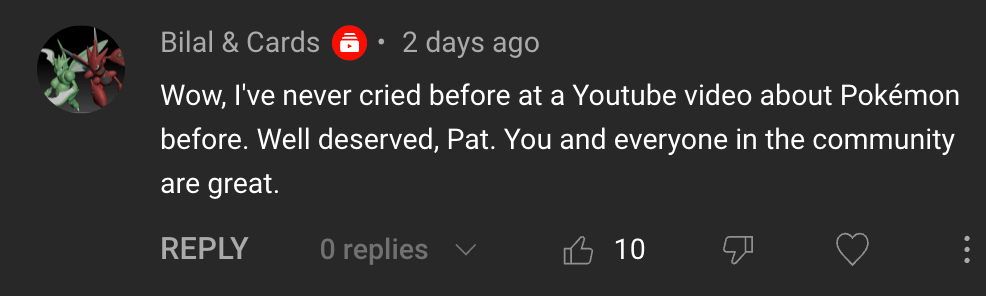
This was one of hundreds of comments, within hours, that mentioned crying or tearing up. Here’s another:

Why is this important?
The truth is, this is not about the tears. The tears are a byproduct of what really matters, and a huge, game-changing lesson that I want to teach you about content creation.
It was certainly game-changing for me. When you do it right, this can happen:
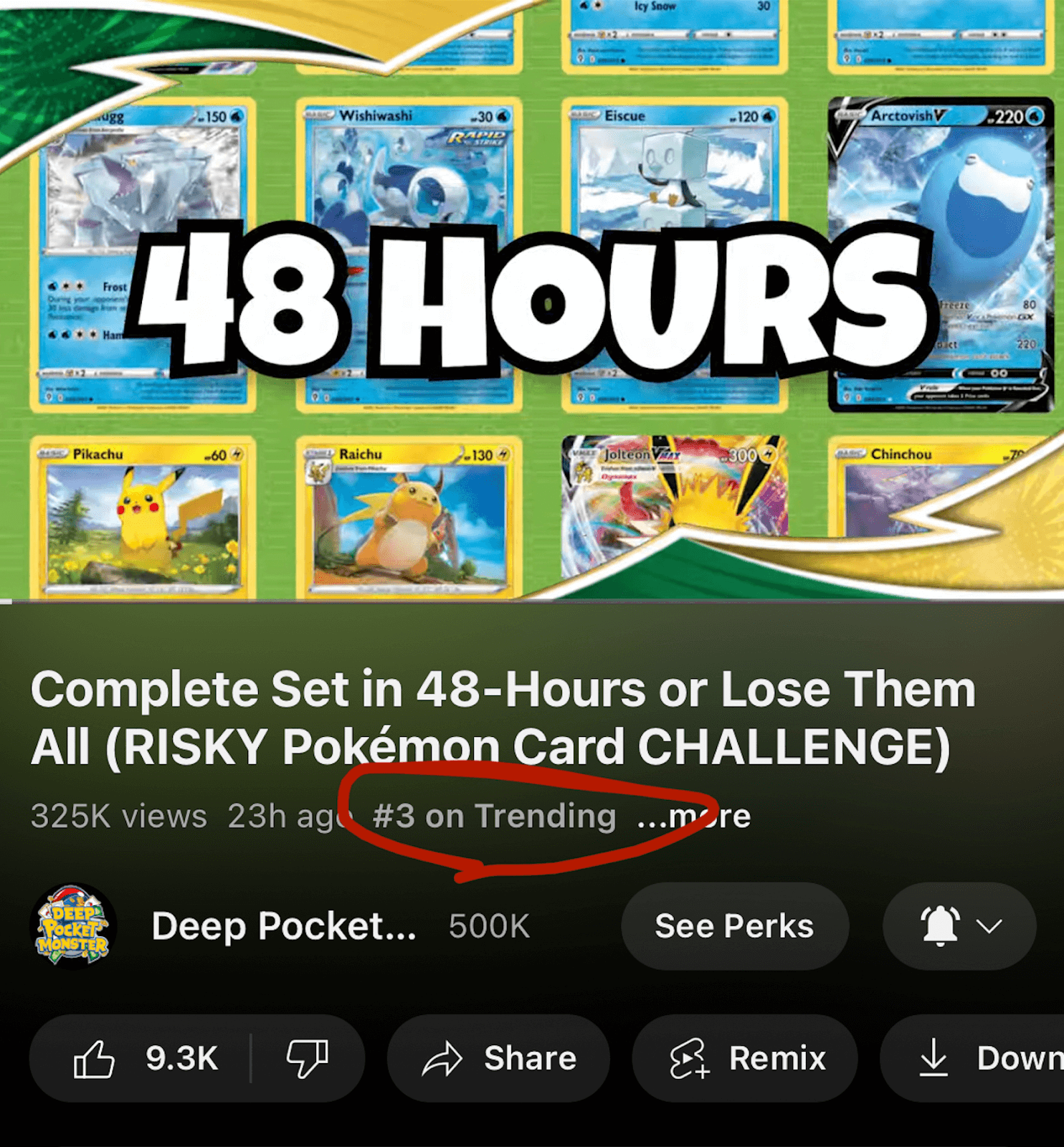
This video has since become the best-performing video I’ve ever published across both of my YouTube channels.
325k views in less than 24 hours and the #3 top trending video in ALL of YouTube.
I’ll tell you why this happened. Let’s get unstuck.
The Story
In early 2020, I caught a series of tweets from my good friend, Ryan Deiss, founder of the Traffic & Conversion Summit. His company is widely known for super tactical and data-driven strategies in the digital marketing space. This series of tweets, however, was new to me.
This is the part that caught my attention the most:
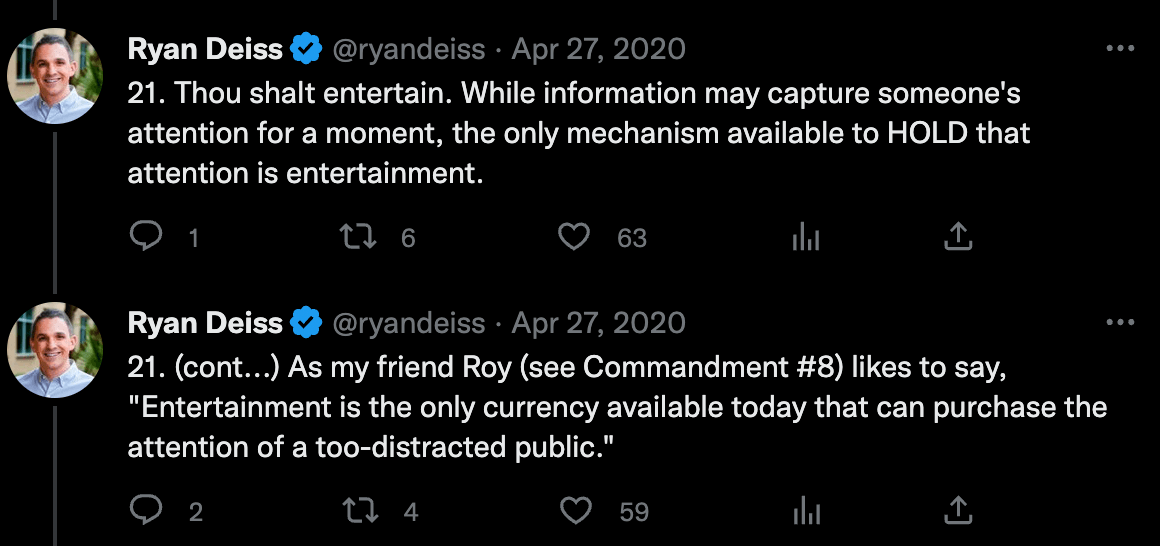
He went on to share a simple strategy to entertain and hold people’s attention: make people laugh, and make people cry. If you can do that, you’ve connected on a human level — more than any surface-level content could ever do.
This spoke to me a lot, so much so that later in 2020, when I decided to start Deep Pocket Monster, entertaining my audience was my #1 goal. Even if I’m educating them, I still aim to entertain in the process.
And it’s working.
In the video I referenced above (here’s a link in case you want to watch it) I take viewers on a rollercoaster ride as I attempt to complete an entire set of Pokémon cards in only 48 hours. This set — which has 237 cards — is a well-known but rather expensive set to complete. To make it even more challenging, I’m in a location I’ve never tried looking for cards in before.
To add to the stakes, if I didn’t complete the set in time, I’d have to give the entire binder of cards that I collected away.
There’s ups, there’s downs, there’s twists and turns, but me and my producer, Dan Patrick Norton, pieced the right story together, one that anyone could follow, even if they know nothing about Pokémon.
We wanted to connect on a human level, so we added comedy and drama into the mix, too…
(Spoiler coming…)
In the end, we painted a picture of defeat, coming oh-so-close to victory. Right when you think it’s over, it turns out a few characters we met along the way had gone out of their way to find what I needed and seal the victory for the team.
It’s a story that anyone can relate to: feeling defeated, only to have someone help you when you’re down — and if you happen to watch it, there’s a chance you might get choked up a little, too.
And now, with over a million views and counting, this video continues to introduce new people to the brand, add more people into the community, and generate more ad revenue, too.
Your Call to Action
In an upcoming piece of content, explore how you can go from surface level to entertainment level.
Don’t be someone you’re not (it’s important to be yourself!) but craft a story that has something at stake — something to potentially lose.
Teach, yes, but showcase the hardships and the comical things that happen along the way.
And finally, study. Study the art of storytelling and entertainment. When you watch a video on YouTube, or a TikTok that captures your attention, ask yourself, “why?”
Get good at it, because as more and more information continues to bloat the internet (and our attention) it’s the creators who find their own special way to entertain who are going to stand out, gain superfans, and survive.
I hope you enjoyed this 5-minute read! To get more like it every week (again, totally free), sign up below!
The post How I Made a #3 Top Trending YouTube Video appeared first on Smart Passive Income.
]]>This article is from the Unstuck newsletter archives — a 5-minute weekly read about what’s working in the world of entrepreneurship for creators just like you. I hope you enjoy it! If you do, join the 127k+ readers who are getting unstuck (100% free!) every week.
The post How to Guarantee Your Audience STICKS To Your Content appeared first on Smart Passive Income.
]]>When I started creating content in 2008, all I had to do was pick a keyword, write about that, and it would rank and generate traffic.
Nowadays, what’s most important is not the information that you publish, but how the audience engages and reacts to it. You must create something worthy of a person’s time and attention. In this article, I’m going to give you a system that I use to help ensure that your audience will stick with your content.
Whether it’s for a blog, podcast, video, book, presentation, or even a sales page, this article will change how you create content forever.
The Story
Let me start with a simple question:
Where’s the best place to keep your money so that it’s safe and still easy to access?
If you’re thinking the answer is a bank, then…
You’re right!
Another question:
Where's the best place to keep your stories so that they’re safe and still easy to access?
The answer is…
A story bank.
Using stories is the secret to creating compelling content. The problem is that we don’t have a purposeful system for capturing and categorizing our stories so that we can summon the right story at the right time.
And by stories, I don’t just mean the life-changing stories that we use in our content (like how my life changed when I got laid off from my architecture job back in 2008), but the little stories — the seemingly irrelevant stories that, when unpacked, actually are interesting, useful, and hold an audience’s attention.
Even if they don’t seem impactful to you, your stories still work because they’re genuinely personal, unique, and also relatable when used in the right context.
Like the time my son asked me to play Minecraft in the car on my iPad when he was 8 years old. Instead of saying no, I asked him, “Why should I say yes?”
Eventually, he came around to saying, “Daddy, if you let me play Minecraft, I can learn more about building and teach you how to be a better architect because I know you used to be one.”
Capturing this moment of my life allowed me to transform this tiny story into a huge lesson for my audience about knowing who you’re speaking to and understanding the language that will resonate with them. I even shared this story on stage during my closing keynote speech at the Youpreneur conference in London a few years ago, and people still recall that story and lesson today.
Another story was about the time I used to work as a waiter at Macaroni Grill, an Italian chain restaurant. There was one person who came in at the same time every single week, a busy businessman, and I quickly learned that he ordered the same thing every time. Eventually, I became the waiter he requested because I knew what he wanted before he even asked.
This story and the lessons I was able to extract from it ended up in my book, Superfans.
All of these examples were just small moments in my life, but after capturing, analyzing, and detailing them, they became two of my favorite stories to tell on stage.
Sometimes, I’ve even used the stories from my story bank while in person at dinners and gatherings, and I gotta tell you, they always seem to leave a lasting impression.
Your Call to Action
Start your story bank and try building it out for one week. If you like it, keep going with it!
Here’s the process, step by step. I like to keep things simple because if I overcomplicate, I underuse.
Step 1: Settle on a tool or app that works for you to capture these moments that happen in your day.
You could use whatever you’re familiar with — Notion, Evernote, or even just the Notes app on your phone (which is what I use). The most important thing is that whatever you use, be sure it’s easy for you to access. It doesn’t take long for a moment to pass by and get lost forever.
Step 2: When something interesting or curious happens, capture that in its own record or page.
You don’t have to capture every second of every day. Simply, if anything interesting or curious happens, add a new record for it. Include anything else that’s on your mind about that moment too. And no editing. Just brain dump so it’s there and you can come back to it later.
Here’s an example of my recent captures on my Notes app:
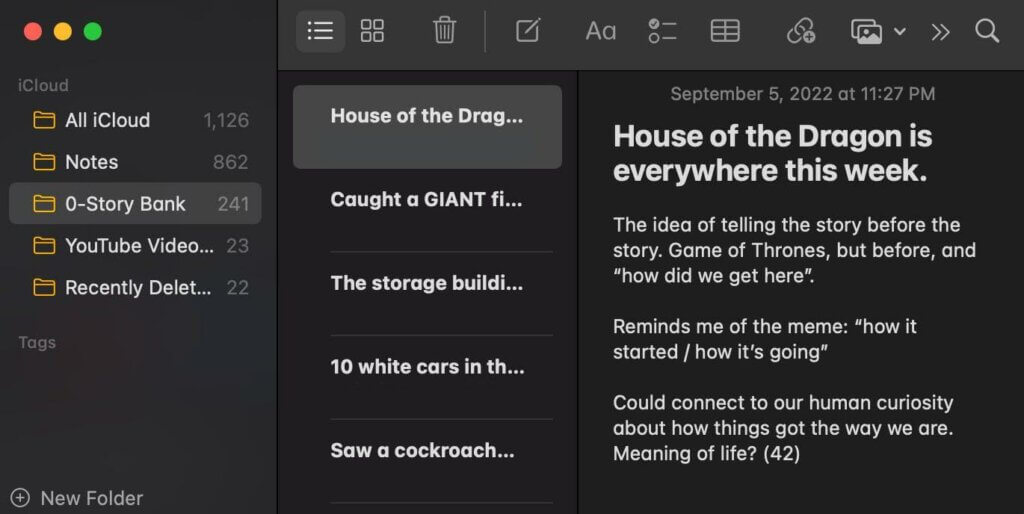
As you can see, it’s messy, it’s random, but it’s there, and that’s what’s important.
In many cases, I’m out and about and capture a moment in my notes app using the voice keyboard. I prefer this over the voice memo app because it captures the thoughts in text (although not perfectly), which is much easier to scan through than audio.
Step 3: At the end of the week, go back through your captures with this question in mind: “How might this story be useful or interesting to my audience?”
Filter each capture with the above question in mind, and if you can’t quickly find any sort of connection that matters, archive it.
Step 4: After filtering, pick one story to go deeper into and finesse into one with a beginning, middle, and end.
This is where the fun begins. Choose one single capture, and expand on it. Create a setup or introduction (a hook) for the story, share the story, and tie it into the larger picture.
For example, there’s a random moment from the other day I captured where I just noticed an entire row of white cars in a parking lot at Target. It was just weird, but thinking about it more deeply, it does have a connection to both the fact that we as humans love to see things in order, and also the purple cow effect (i.e. something you don’t see every day).
Some stories you’ll try to develop, and it just seems forced and goes nowhere. Don’t force or fight it. If it’s just not coming to you, move on to a different capture. Other stories, however, just seem to flow so well, you know this is a story you’re going to structure and continually tell time and time again (and improve each time you do).
Step 5: After drafting a more detailed narrative, tag the story with as many relevant tags as possible.
I have tags for audience growth, branding, podcasting, videos, and a lot more. You can have as many tags as you’d like.If your software doesn’t allow for tagging individual articles, add your tags at the top of each of your stories so you can use the Find feature to locate the stories that have certain keywords attached to them.
The tags should help you recall what you need when you need it. For example, if I’m going to a podcasting conference to speak, or writing an article about podcasting, I hit my podcasting tag, and boom — all the stories that involve a podcast in some way, shape, or form pop up, and then it’s just a menu I can choose from for my content.
Storytelling is a key skill to learn, but it’s hard to tell stories when you’re not actively capturing them. Start your story bank, and give it a shot!
Also, a big shout out to Ramit Sethi who was the first person to introduce me to the power of story banks.
I hope you enjoyed this 5-minute read! To get more like it every week (again, totally free), sign up below!
The post How to Guarantee Your Audience STICKS To Your Content appeared first on Smart Passive Income.
]]>One of the best strategies to build your audience and business could be hiding in plain sight: podcast guesting.
The post How to Be a Guest on a Podcast appeared first on Smart Passive Income.
]]>Podcast guesting is an increasingly popular—and effective—way to gain exposure and grow your business.
Whatever the focus of your brand or business, there are thousands of podcasts out there in your niche with built-in audiences. And if you can serve those audiences by being a guest on those podcasts, you can build your own audience and brand—and have fun doing it!
Take it from Shane Sams, founder of Flipped Lifestyle, a business he runs with his wife, Jocelyn. By making an effort to guest on at least two podcasts a week, their business has blossomed from the connections they’ve made, the audience members they’ve attracted, and the opportunities they’ve found.
Shane details his strategy for how to be a guest on a podcast—and how to use guest podcasting to grow your business—in his talk at SPI’s Audience Driven Summit in October 2021.
In this post, I’ll share Shane’s three keys to help you consistently land yourself as a guest on podcasts in your niche. You'll learn the key steps to finding podcasts that match, how to ask to be on a podcast, and how to make your guest podcast interview a success.
If you're craving even more detail on being a successful podcast guest, be sure to check out Shane’s talk, as well as SPI 547 with Ray Blakney of Podcast Hawk.
Table of Contents
- Step 1: Find Some Podcasts to Be a Guest On
- Meet people
- Make your “80/20 list” of podcast targets
- Explore other places to find podcasts that fit
- Look outside your niche (but not too far)
- Step 2: Get Your Outreach Emails Ready
- Build rapport
- Make the ask
- Suggest some topic ideas
- Show your value
- Offer to promote it
- Ask about the next step
- Say thanks (and offer to return the favor)
- Step 3: Be a Great Podcast Guest
- Be entertaining
- Give the host what they're asking for
- Be on time
- Don’t be a stranger
- Bonus Step: Ask for a Referral
- Unlock the Possibilities of Podcast Guesting
Step 1: Find Some Podcasts to Be a Guest On
There are a lot of podcasts out there to be a guest on—and several ways to find the best ones for you.
Meet people
Internet research is a great way to find podcasters to connect with—and we'll get to that in a second.
But the best way to get on other people's shows is to make a personal connection—in person if possible. Because if you can meet someone in real life, shake their hands, and have a conversation, it's a lot easier to get on their show and start to build a lasting relationship.
Your best bet for that is to check out in-person conferences, especially ones geared toward podcasters, like Podcast Movement and Podfest. And other conferences like Fincon and Social Media Marketing World are places where dozens if not hundreds of podcasters hang out.
Now, things are obviously still tricky with COVID, and traveling isn’t always easy, so keep an eye out for virtual events for podcasters too.
Thankfully, events aren't the only way to find guest podcasting opportunities. Let’s explore a few research strategies you can put to work from the comfort of your home office!
Make your “80/20 list” of podcast targets
The first step is to make a list of all the podcasts you want to be on. These should be divided up in 80/20 fashion: 80 percent should be smaller podcasts that may not have access to the bigger guests but still have a substantial audience.
The other 20 percent should be your dream podcasts, the ones that make you think, I don't know if I could ever get on that podcast… but it sure would be cool.
How do you start filling out your 80/20 list? The first place to go is Apple Podcasts and other podcast directories like Spotify and Google Podcasts. Look at your show’s category, and write down the top 100 podcasts in that category.
Explore other places to find podcasts that fit
Another cool trick to find podcasts to be a guest on: In your podcast app, go to your podcast and scroll down to the section at the bottom that tells you which podcasts other people also listen to. Those shows can be great targets as well.

You can even find Facebook groups where people are looking for podcast guests. And there are tools designed to connect podcasters with potential guests, including Podcast Hawk and PodMatch.
Look outside your niche (but not too far)
When you’re looking for podcasts to guest on, you don’t have to stick to just one category of shows—look at adjacent audiences too. If your business is about email marketing, but it’s also focused on work-life balance and parenting, look in those podcasting categories too.
Just make sure that the podcasts you’re thinking of targeting have audiences that are similar enough—you don't want to just reach out to any old podcast. If your brand is all about outer space, a podcast about pet care might not be the best fit.
We are constantly pursuing opportunities to be on other people's shows. We are building reciprocity by sharing those shows on our social media on our email list. And we are doing everything we can to get those guest appearances. This is a great grassroots strategy.
Shane Sams, Audience Driven 2021
The podcasts you target don’t have to be a perfect match. But they should be in the ballpark.
Do all of the above, and you should have a list of a few hundred podcasts with similar (enough) audiences to start reaching out to!
Step 2: Get Your Outreach Emails Ready
Once you’ve got your list of podcasts to target, you need to start reaching out—and email is the best way to do that.
This is where you’ve got to gin up a little courage and not be shy. If you don't ask, you don't get, so you’re going to have to reach out to tell people who you are, why you want to be on their show, and what you can do for them and their audience.
Your outreach email needs to show them that you’re a worthwhile guest who’s going to bring their audience a ton of value.
Here’s how to write that email.
Build rapport
The first line of your podcast guest outreach email should state a point of connection you may have with the person. Maybe you listen to their podcast, maybe you've retweeted them, maybe you have a mutual friend.
Start your email with that, so you can build rapport right away.
Make the ask
The next line of your email should explain why you’re writing it in the first place. Ask if you can be on their show!
This can be as simple as, “I was wondering, are you looking for podcast guests? I would love to serve your audience.”
Suggest some topic ideas
Then, tell them what you can talk about and the value you’ll bring. Suggest three or four topics—and this is super important—that are aligned with the content they produce. You might have to do a little research here, so listen to one or two of their episodes to see what they're creating.
Show your value
Next, don’t be afraid to brag about yourself a little bit (without making it all about you). Tell them why it’ll be valuable to them to have you on the podcast. If you've already done a few guest podcast appearances, or you have some other media appearances, go ahead and list them.
Offer to promote it
Then, tell them how you can support the success of the podcast episode, and of their podcast in general. Do you have a big Facebook following? A large email list? A great Twitter account? Show that you're willing to help make the episode be as successful as it can be.
Ask about the next step
Next, ask how to book your appearance. Do you need to fill out a form? Is there a booking calendar you can use? Doing this will demonstrate that you’re serious and excited to take the next step.
Say thanks (and offer to return the favor)
Finally, thank them and sign off. And this is key—finish with a PS that says, “I'd love to have you on my show.” If you have one, of course. If their podcast aligns with yours, then you should be happy to introduce them to your audience just like you're asking them to introduce you to theirs.
Step 3: Be a Great Podcast Guest
Nice job! You’ve applied the above advice for how to be a guest on a podcast, and landed an interview on a great show. Now you need to make the most of the opportunity. If you’re wondering how to be a good podcast guest, put these tips By being an awesome guest.
Be on time
It goes without saying, but don't be late to the recording session. Be on time (or a little early), so you can relax into the episode and create something great. Your host will appreciate your punctuality, and the content you create will be all the better for it.
Be entertaining
Have fun with it. Bring some energy to the interview. Don’t rush or feel like you have to prove everything you know in a forty-five-minute interview. But whatever you do, talk about it in a great story. Being an awesome storyteller is one of the best ways to be remembered and get shared.

Give the host what they're asking for
Remember, it's not about you—you’re going on this show to make the host look great. You want the host to love that episode and share it wide and far.
So go in with some humility. Remember that someone is allowing you to go in front of their audience. That's incredible.
Answer their questions. Tell them what they want to know. If the host asks you a question about your biggest failure, don't turn it around into your biggest success. Tell them how you fell on your face. It’s their show, so honor and respect the opportunity they’ve created for you.
I can say without a shadow of a doubt that podcast guesting is the best way we have ever found to grow our audience, expand our reach, and to make connections that make our business grow.
Shane Sams, Audience Driven 2021
Don’t be a stranger
Last but not least, keep in touch! Don't just go on a show and leave and never talk to that person again. Stay in contact with them and build the relationship. And do what you promised, so if you said you’d share the episode on social media and your email list, do it.
Bonus Step: Ask for a Referral
One last tip for you—and granted, this is one that will benefit you at least as much as it will your host.
After your guest appearance, ask them, “Have you been on any great shows yourself lately? One that might be looking for more guests? Or do you have any friends in the podcast world you could connect me with? I'd love to go out and be on some other shows.”
Most people will be happy to connect you with somebody else who could be the host of your next podcast guest appearance.
Unlock the Possibilities of Podcast Guesting
It bears repeating, but the more you focus on making connections and building relationships—whether IRL or online—the better your chances of getting on someone’s show.
If you’re excited about the possibilities of podcasting guesting, be sure to watch Shane’s full talk from Audience Driven over on the Team SPI YouTube channel.
Shane has also graciously offered a full nuts-and-bolts breakdown of his entire strategy for finding shows and booking yourself as a podcast guest. Just visit Flipped Lifestyle and grab those resources for free.
I also mentioned SPI 547 with Ray Blakney, founder of Podcast Hawk, a great paid solution that takes a lot of the work out of getting booked as a guest on podcasts.
Pat’s interview with Ray has a ton of great advice for succeeding with guest podcasting, including customizing and optimizing your email campaign, more prep tips for your guest appearance, pitfalls to be aware of as a podcast guest, tech tips for getting great audio quality, and more.
You can put Podcast Hawk through its paces using our affiliate link at PodcastHawk.com/spi.
The post How to Be a Guest on a Podcast appeared first on Smart Passive Income.
]]>